
Diplomatic talks between India and Pakistan will likely remain stalled due to ongoing disputes over water-sharing and airspace closures, which will increase the risk of future conflict following the two countries' military confrontation earlier this year. On May 10, India and Pakistan agreed to a ceasefire after a series of retaliatory strikes and cross-border clashes triggered by a deadly militant attack on April 22 in India-administered Kashmir, which New Delhi claims was carried out by an alleged Pakistan-backed militant group. Following the ceasefire, India and Pakistan's military leaders held a phone call on May 12 to discuss de-escalation. Later, on May 30, a senior Pakistani military official stated that the two countries were close to reaching an agreement to reduce troop deployments along the border to pre-conflict levels, though no such drawdown has yet been observed.
- On June 24, during a June 24 phone call with Saudi Crown Prince Mohammed bin Salman, Pakistan Prime Minister Shehbaz Sharif reiterated Pakistan's readiness to hold a meaningful dialogue with India on all outstanding issues, including Jammu and Kashmir, water, trade and terrorism.
While the Pakistan-India ceasefire remains in place, renewed conflict remains a risk given the scale of the two countries' recent escalation and the depth of unresolved grievances between them. Pakistan has firmly denied any connection to the April 22 militant attack on India, and has accused New Delhi of making accusations without sufficient evidence. In the days that followed the April 22 attack, both countries implemented a series of measures that severely downgraded bilateral ties. Most notably, India suspended the Indus Waters Treaty, which governs the sharing of the Indus River system that both countries rely on for water supplies. Tensions escalated further on May 7 when India launched airstrikes using missiles and loitering munitions against alleged militant targets in Pakistan's Punjab province and Pakistan-administered Kashmir. These strikes went deeper into Pakistani territory than India's previous cross-border actions in 2016 and 2019, which were largely confined to Kashmir. Pakistan quickly retaliated, claiming it had shot down five Indian jets. Despite public statements from both sides expressing a desire to avoid further escalation, hostilities intensified along the Line of Control. The most serious escalation came on May 10 when India struck three Pakistani airbases, including Nur Khan near Islamabad, which is located close to Pakistan's nuclear command center. In response, Pakistan launched attacks on Indian military facilities, including airbases and a missile storage site. Hours after this escalation, U.S. President Donald Trump announced that India and Pakistan had agreed to a ceasefire, reportedly following U.S. mediation. Even with the ceasefire, the scale of the recent escalation and the persistence of unresolved grievances suggest that the risk of renewed conflict remains high. These unresolved grievances include the decades-long territorial dispute over Jammu and Kashmir, accusations of cross-border terrorism, and trade suspensions. Nationalist pressures, mutual distrust and a lack of sustained diplomatic engagement have repeatedly prevented Islamabad and New Delhi from resolving these thorny issues.
- In the wake of the April 22 terrorist attack on Kashmir, India reduced its diplomatic staff in Islamabad and closed the Attari-Wagah border crossing (which is the only operational land route between India and Pakistan). The Indian government also suspended visa services for Pakistani nationals, and ordered those already in India to leave. In response, Pakistan closed its airspace to Indian carriers, halted all trade with India, including goods routed through third countries, and canceled visas for Indian nationals with the exception of Sikh pilgrims. India then imposed similar restrictions by closing its airspace to all Pakistani flights, both civilian and military. Despite the ceasefire, all of these measures are still in place.
- During a June 17 phone call with Trump, Indian Prime Minister Narendra Modi rejected Trump's claim that the United States helped secure the recent ceasefire with Pakistan. During a meeting with the U.S. president the following day, Pakistan's Field Marshal Asim Munir thanked Trump for his role in easing tensions between India and Pakistan. Trump's cordial dialogue with Pakistani leaders is making India worried that the United States is overlooking Pakistan's record on terrorism and reviving strategic ties with the Pakistani military, which New Delhi sees as a potentially troubling shift that could undermine its own status as a key U.S. partner.
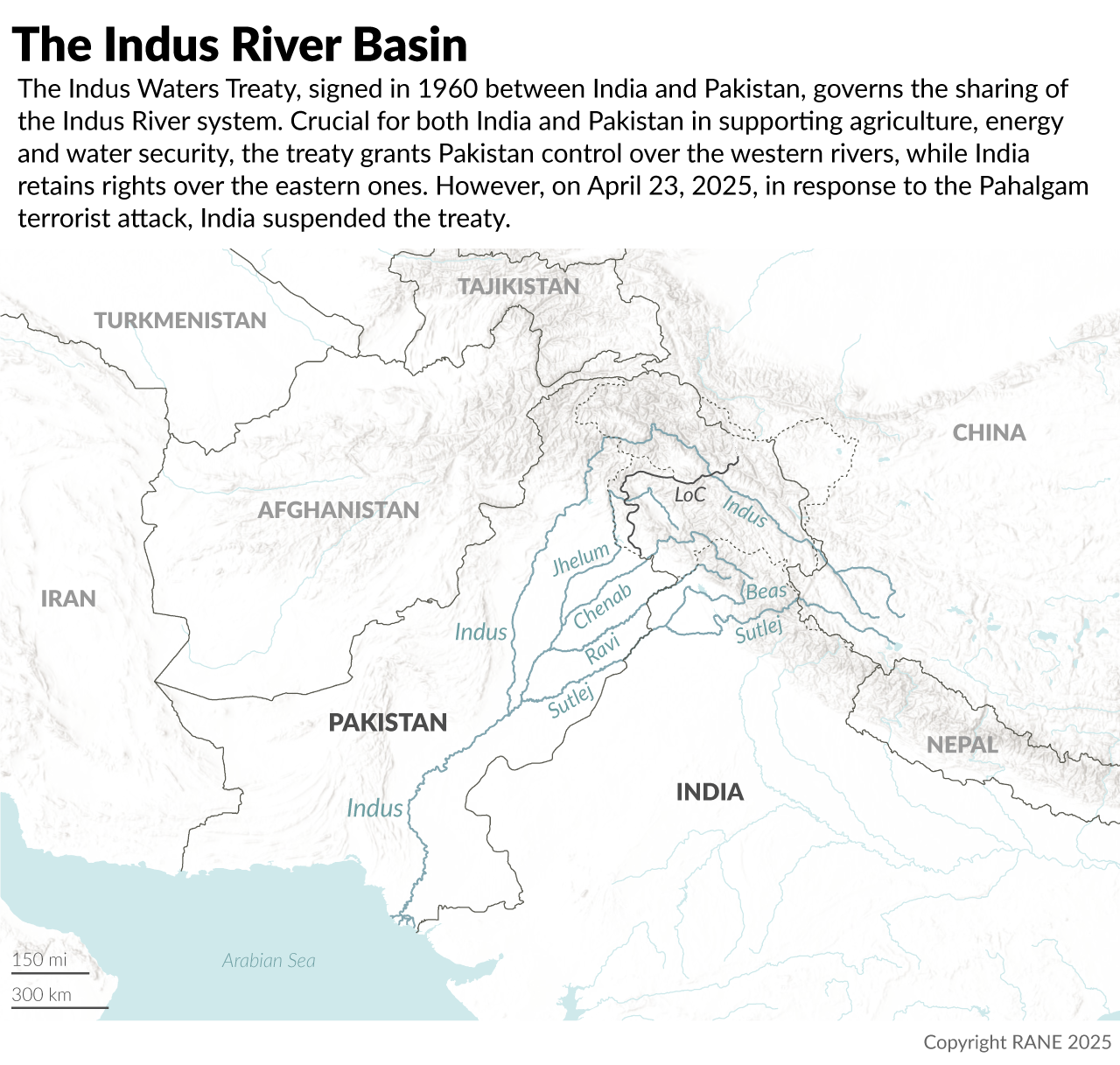
The continued suspension of the Indus Waters Treaty signals that India-Pakistan negotiations are unlikely to meaningfully advance, reinforcing a long-term diplomatic deadlock and raising the risk of future conflict. While the ceasefire has held, key diplomatic setbacks remain unresolved. Most notably, India's suspension of the Indus Waters Treaty, which governs the distribution of the Indus River system between the two, remains in effect and continues to be a source of tension. The suspension of the treaty does not imply an immediate loss of water access for Pakistan, as India lacks the capability to halt river flows without undertaking extensive infrastructure projects, which would require significant time to complete. However, Pakistan's short-term concern is that India may withhold vital hydrological data and flood warnings, thereby heightening Pakistan's susceptibility to flooding. While there has been no indication that India has stopped sharing water data, India has begun reservoir flushing to clear sediment, releasing sediment-filled water downstream that has caused some flooding in Pakistan. Additionally, reports indicate that Modi has directed Indian officials to accelerate the planning and implementation of projects on the Chenab, Jhelum and Indus rivers, three key waterways in the Indus River system primarily allocated for Pakistan's use. Thus, for Pakistan, resolving this issue is a top priority because, as the downstream country in the Indus River system, it is vulnerable to India's position as the upstream country, which gives India control over the timing and volume of water flows, as well as access to critical hydrological data. This is bolstered by the fact that around 80% of Pakistan's farmland and nearly all of its hydropower depend on the Indus and its tributaries, which are also crucial for drinking water and food security. A disruption in these water flows would likely hurt crop production, worsen food shortages and deepen Pakistan's ongoing economic crisis. Pakistani officials will continue efforts to restore the treaty, viewing India's suspension as a national security concern. However, India shows little inclination to resume cooperation — especially as it faces its own mounting water scarcity issues, exacerbated by climate change, population pressures and mismanagement. Against this backdrop, New Delhi sees retaining leverage over the river system as both a strategic and practical imperative. This deadlock makes meaningful negotiations unlikely in the near term. Without a clear mechanism for resolving disputes over the Indus River system, mistrust between the two countries will likely deepen. While Pakistan may temporarily agree to reduced water allocations to ease tensions, Pakistan's own water scarcity challenges, coupled with a lack of meaningful progress on treaty revisions, will likely remain a key driver of future conflict, increasing the risk of further military confrontations, even in the absence of militant provocation.
- On June 21, India's Home Minister Amit Shah declared that New Delhi would never reinstate the Indus Waters Treaty with Islamabad, adding that water flowing to Pakistan would instead be diverted for domestic use. While Shah is known for making provocative statements, Modi has expressed similar views. On May 22, Modi asserted that Pakistan would not receive water from rivers over which India holds rights. In response, Pakistani officials have periodically warned that any attempt to withhold water would constitute an act of war.
Continued airspace and trade suspensions between India and Pakistan further dim the prospects for diplomatic progress, while the more structural disputes increase the risk of more severe conflict. The mutual extension of airspace closures by India and Pakistan, along with the continued suspension of trade, exemplifies the deep-seated mistrust between the two governments. These actions, though limited in immediate practical impact — particularly in the case of trade — signal a refusal to engage even in low-risk confidence-building measures, thereby reducing the likelihood of progress on more substantive diplomatic issues (such as the Indus Waters Treaty). Even if there is progress on these relatively smaller issues, the deeper issues at play will sustain a constant risk of renewed conflict. Given the number of potential triggers and the precedent established by the May clashes, any new escalation risks being more severe than seen in previous years, potentially involving deeper incursions into each nuclear-armed country's territory and targeting military assets, including those located near or within major cities.
- Around 20% of India's international flights, and nearly 30% of those bound for destinations in the West, typically transit Pakistani airspace. In contrast, 99% of Pakistani flights do not rely on Indian airspace. If Pakistan maintains the closure for a full year, reports indicate that Air India could incur additional costs of up to $600 million due to longer flight paths and higher fuel consumption. Pakistan, meanwhile, stands to lose revenue from overflight fees, which can amount to several hundred dollars per flight.
- Between 2018 and 2024, bilateral trade between India and Pakistan declined from $2.41 billion to $1.2 billion. According to data from the Indian trade ministry, India exported approximately $500 million worth of goods to Pakistan from April 2024 to January 2025, primarily pharmaceuticals, chemicals, sugar and auto parts. In contrast, imports from Pakistan during this period totaled only $0.42 million. Pakistan's main exports to India include copper, glassware, organic chemicals, sulfur, fruits and nuts, and certain oilseeds.
