
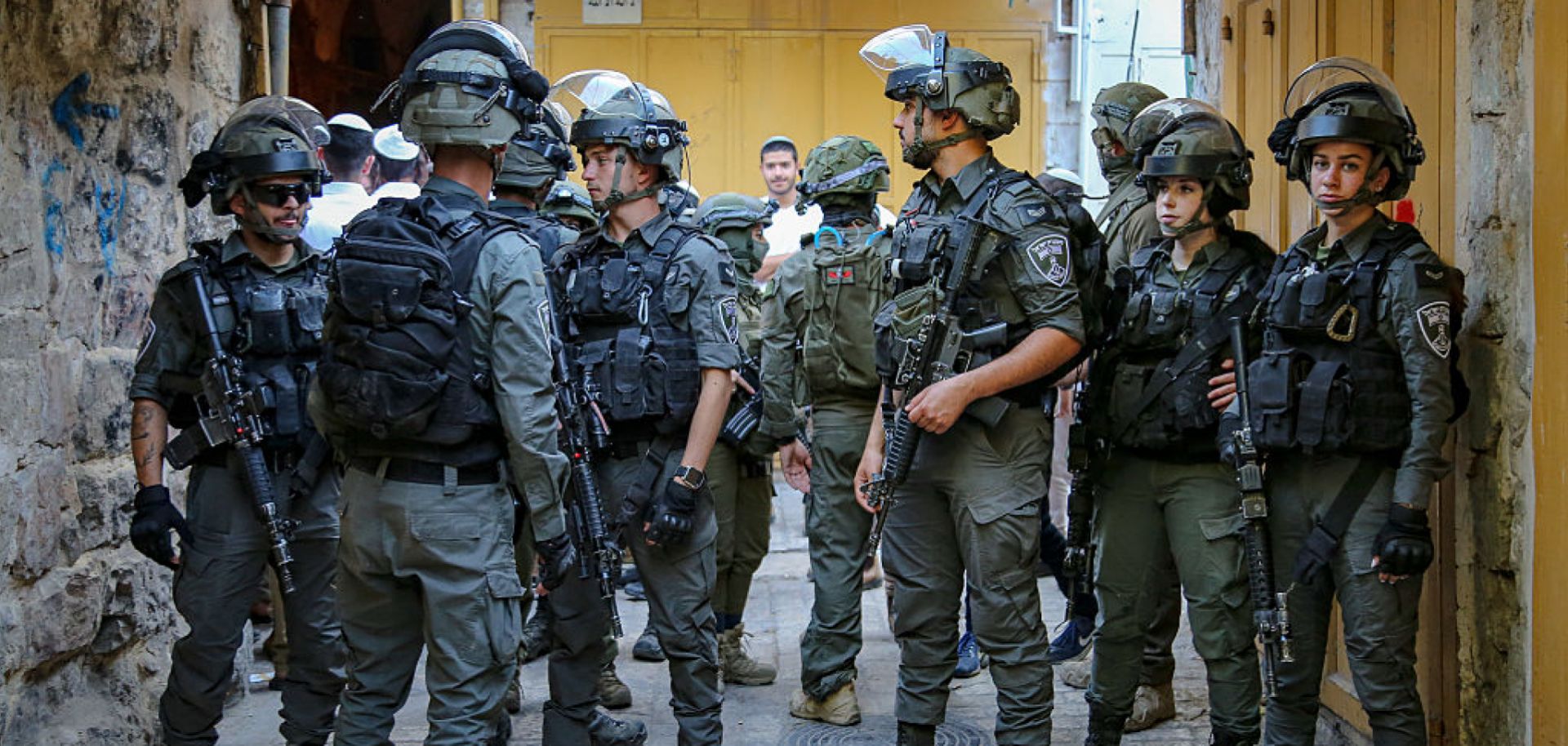
Israel's lockdown in the West Bank will likely reduce the threat of a major terror attack in the near term, but it will also worsen Palestinians' grievances and sustain the risk of a larger uprising in the territory, while potentially fueling tensions within Israel's coalition government. Following Israel's June 13 attacks on Iran, Israel has implemented a lockdown throughout the West Bank. The Israeli army has restricted movement from smaller towns and villages to larger cities — such as Nablus, Qalqiya, and Tulkarem — by closing some city entrances, blocking certain roads, and imposing more checkpoints. The Israel Defense Forces (IDF) has also reportedly displaced Palestinian families in parts of the West Bank, seizing their homes due to their strategic military locations. In addition, the IDF has closed all entrances to Jericho and Bethlehem, and has blocked the King Hussein Bridge connecting the West Bank to Jordan. Furthermore, in East Jerusalem, which adjoins the West Bank, Israeli forces closed the Al-Aqsa mosque (the third-holiest site in Islam) and prevented Muslims from praying there until further notice.
- Palestinian media sources reported that some IDF soldiers positioned at checkpoints in the West Bank shot at Palestinians approaching them on foot, though these reports are unconfirmed.
Israel is trying to prevent militant attacks within and emanating from the West Bank amid the escalating Israel-Iran war. Iran has historically provided funding and weapons to Palestinian militant groups, in particular Hamas in the Gaza Strip, though Tehran has also backed groups in the West Bank. However, Iran's supply lines through Syria, crucial for arming these groups, have been significantly disrupted since the December 2024 collapse of the Bashar al-Assad regime, a key Iranian ally. Nevertheless, Israel remained concerned that its recent strikes against Iran, coupled with fervent anti-Israeli sentiment in the West Bank, would heighten the risk of attacks against Israeli troops and settlers in the Palestinian territory. Israeli leaders also feared that Palestinians in the West Bank could cross into Jerusalem or other neighboring areas to conduct attacks. To detect and thwart these potential attacks, Israel consequently implemented more checkpoints and restrictions within the territory. More broadly, the crackdown aligns with Israel's greater goal of further isolating the West Bank, as demonstrated by Finance Minister Bezalel Smotrich's move on June 10 to cancel the waiver that permits cooperation between Palestinian and Israeli banks. If approved by Israel's security cabinet, this action would effectively sever the Palestinian banking sector from Israel's financial system, as the vast majority of transactions in the West Bank are conducted in Israeli shekels.
- The Israeli military has also called up additional reservists to enforce the new restrictions in the West Bank, as well as to support expanded military operations against Hamas in the Gaza Strip. Many of the additional call-ups will likely come from ultra-Orthodox communities, which have long resisted serving in the IDF. Earlier in June, religious parties in Prime Minister Benjamin Netanyahu's ruling coalition threatened to exit the government in protest of the draft, but they backed down after reaching a compromise with Netanyahu that eases sanctions on ultra-Orthodox Yeshiva students who refuse to serve in the IDF.
- Smotrich called to cancel the Palestinian banking waiver a day after five Western countries, including the United Kingdom, sanctioned him and far-right Israeli National Security Minister Itamar Ben Gvir for allegedly inciting violence against Palestinian communities, especially in the West Bank. The Palestinian banking sector is heavily reliant on cooperation with Israel since the Palestinian Authority does not have a central bank or its own currency. Many economists and international organizations, such as the United Nations, have warned against the cancellation or expiration of this waiver for fear that it would worsen the humanitarian crisis in the West Bank.
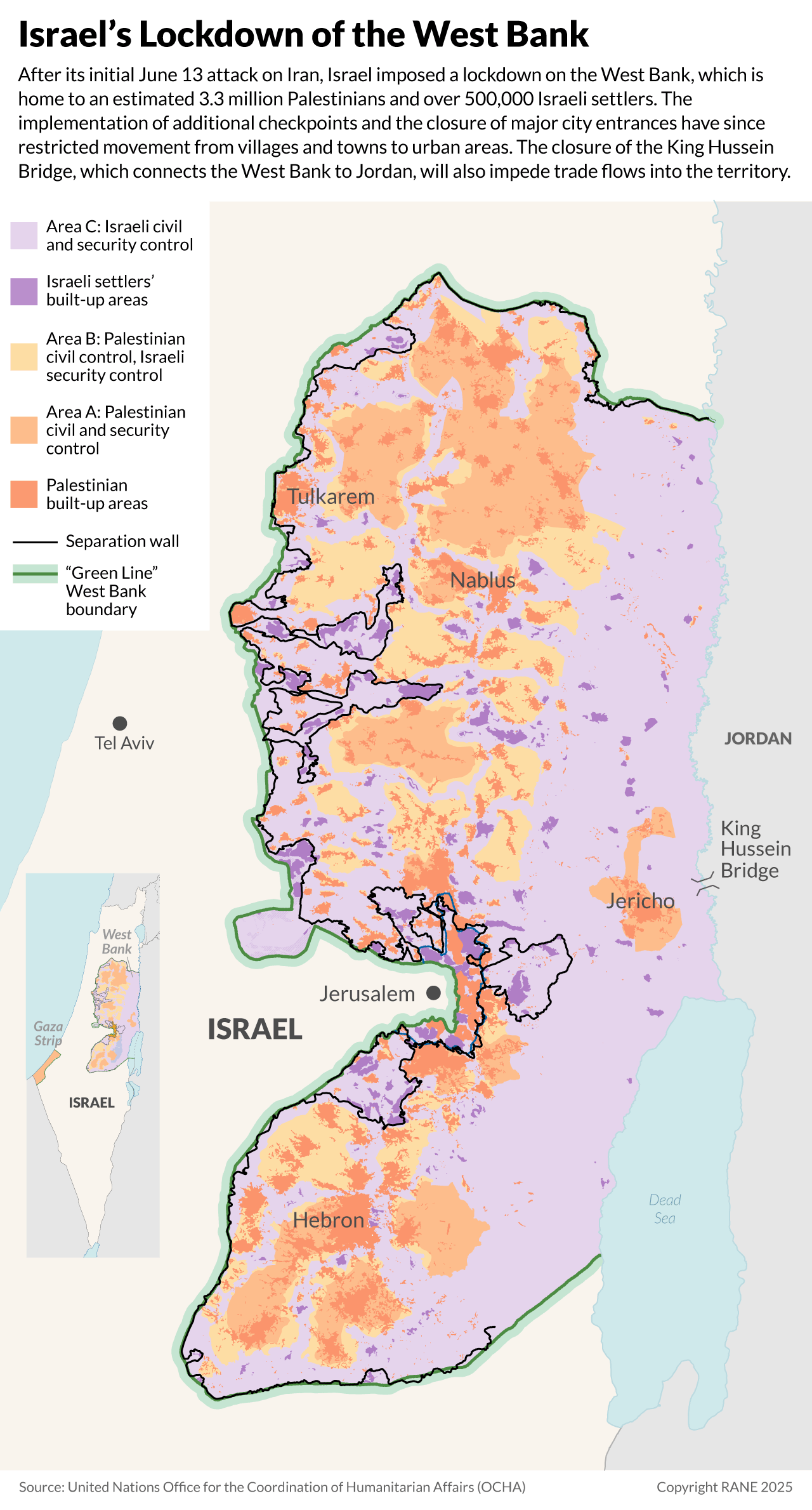
The restrictions will likely decrease economic activity in the West Bank, disrupt trade with Jordan and worsen living conditions in the territory, adding to already simmering Palestinian grievances. The closure of the King Hussein Bridge connecting the West Bank to Jordan will disrupt trade flows into the West Bank and impede Palestinians' access to basic goods from Jordan — a key part of the local economy that reduces Palestinian reliance on Israeli goods. In addition, increased checkpoints and prolonged wait times for crossing them will further impede business operations and obstruct medical care in the West Bank, as reports indicate that some ambulances are being required to transfer patients to different ambulances on the other side of these checkpoints (rather than being allowed to cross the checkpoints to access the nearest hospital). Palestinian media reports also allege that IDF troops are using stun guns, live ammunition and tear gas against Palestinians approaching checkpoints on foot, which will deter them from trying to cross checkpoints due to safety concerns, further limiting movement in the territory. Moreover, Israeli settlers may exploit the IDF's restrictions on Palestinians to expand settlements in the West Bank, potentially leading to violent confrontations. This will only worsen the security situation in the territory, which — combined with the increasingly repressive environment created by Israel's crackdown — will compound existing anti-Israel sentiment and grievances about the poor economic and living conditions in the West Bank.
- According to the United Nations, Jordan exported about $340 billion worth of goods to the Palestinian territories in 2023, comprising around 17% of Palestinian imports.
Israel's expanded military presence in the West Bank will likely reduce the near-term risk of major terrorist attacks, but the threat of smaller, isolated attacks will remain elevated and, over time, keep the possibility of a wider Palestinian uprising on the table. The military restrictions will hamper the movement of Palestinians within the territory, making it more difficult to coordinate a large-scale terrorist attack against Israeli military and settler targets, such as one involving multiple attackers acting in concert. Furthermore, such militancy would have limited external support. For one, it is now much more logistically difficult for Iran to get weapons into the West Bank due to increased Israeli vigilance regarding smuggling efforts through Jordan and disrupted supply lines in Syria. Additionally, Hamas — the Iran-backed Palestinian militant group best positioned to call for a major escalation of violence in solidarity with Tehran — has less influence and fewer operational capabilities in the West Bank than in the Gaza Strip; Hamas's overall militant capabilities have also been severely weakened after over a year and a half of brutal war with Israel. Nevertheless, the drivers of Palestinian militancy in the West Bank remain and will likely be further stoked by Israel's total lockdown. Furthermore, regardless of what happens in the coming weeks, Palestinians' anger at Israeli actions will only reinforce the long-term possibility of a larger uprising in the West Bank, especially if the major movement restrictions are sustained over time. While Israeli forces have so far been able to prevent this scenario, recent data shows a clear uptick in IDF and Israeli settler attacks on Palestinians in the West Bank, which is also happening against the backdrop of expanding Israeli settlements in the territory — all potential triggers for a future intifada.
- Since the collapse of the al Assad regime in Syria, the IDF has reported several thwarted attempts to smuggle weapons into the West Bank, indicating that while many of Iran's supply lines through Syria have been disrupted, some remain intact.
However, troop shortages will make it difficult for Israel to maintain its lockdown in the West Bank, especially as far-right members of Netanyahu's government continue to push back against ultra-Orthodox conscription. With global attention on the Israel-Iran conflict, and secondarily the war in Gaza, Israel will likely be able to conduct more extensive crackdowns in the West Bank with very limited international pushback. This will likely further embolden far-right ministers, including Smotrich, to push for contentious West Bank policies such as settlement expansion and even annexation. While Prime Minister Netanyahu's government has repeatedly approved settlement expansions and will likely continue to do so, he will probably only support annexing the West Bank if it is a political concession needed to keep his coalition, which depends on far-right parties, intact. Indeed, it is this reliance on the coalition partners, including ultra-religious parties, that may ultimately challenge Netanyahu's ability to maintain the military mobilization needed for an extended West Bank lockdown. This is because such a lockdown would likely require drafting more ultra-Orthodox Israelis into the IDF, which is already stretched thin across multiple fronts, including ongoing military operations in the Gaza Strip and recent attacks against Iran. Israel will likely be able to economically sustain increased mobilization, as its annualized GDP growth in the first quarter of 2025 was recently revised from 3.4% to 3.7%, despite the ongoing Gaza conflict. However, the reservist call-ups will fuel pushback from ultra-Orthodox Jews who have long resisted conscription. This thorny issue is unlikely to seriously threaten Netanyahu's government again in the next six months, as the June 12 rejection of the opposition-backed bill to dissolve the Knesset means another such bill cannot be introduced until December. But drafts to meet the IDF's growing manpower needs will still likely heighten tensions between Netanyahu and his religious coalition partners, as many ultra-Orthodox Israelis are expected to evade draft orders, leaving Israel with fewer troops to maintain its lockdown in the West Bank and wage its wars against Iran and Hamas. If the troop shortage becomes particularly acute and fighting in other conflicts persists, Israel may ultimately be forced to relax some of the movement restrictions in the West Bank, which would allow IDF forces to be deployed to more critical areas, while potentially averting ultra-Orthodox conscription that could reignite a push to destabilize Netanyahu's government in late 2025.
- On June 12, far-right Israeli government ministers and coalition members held a conference in Sderot calling for the annexation of the West Bank.
- In late April 2025, the IDF released a statement saying it was "short 10,000 troops, 7,000 of them in combat units." To mitigate the shortage, the IDF has increased the number of reservists and extended callups, but after more than a year and a half of conflict, Israeli forces are struggling with increases in post-traumatic stress disorder cases and a growing (albeit still relatively small) number of secular reservists unwilling to serve.
