
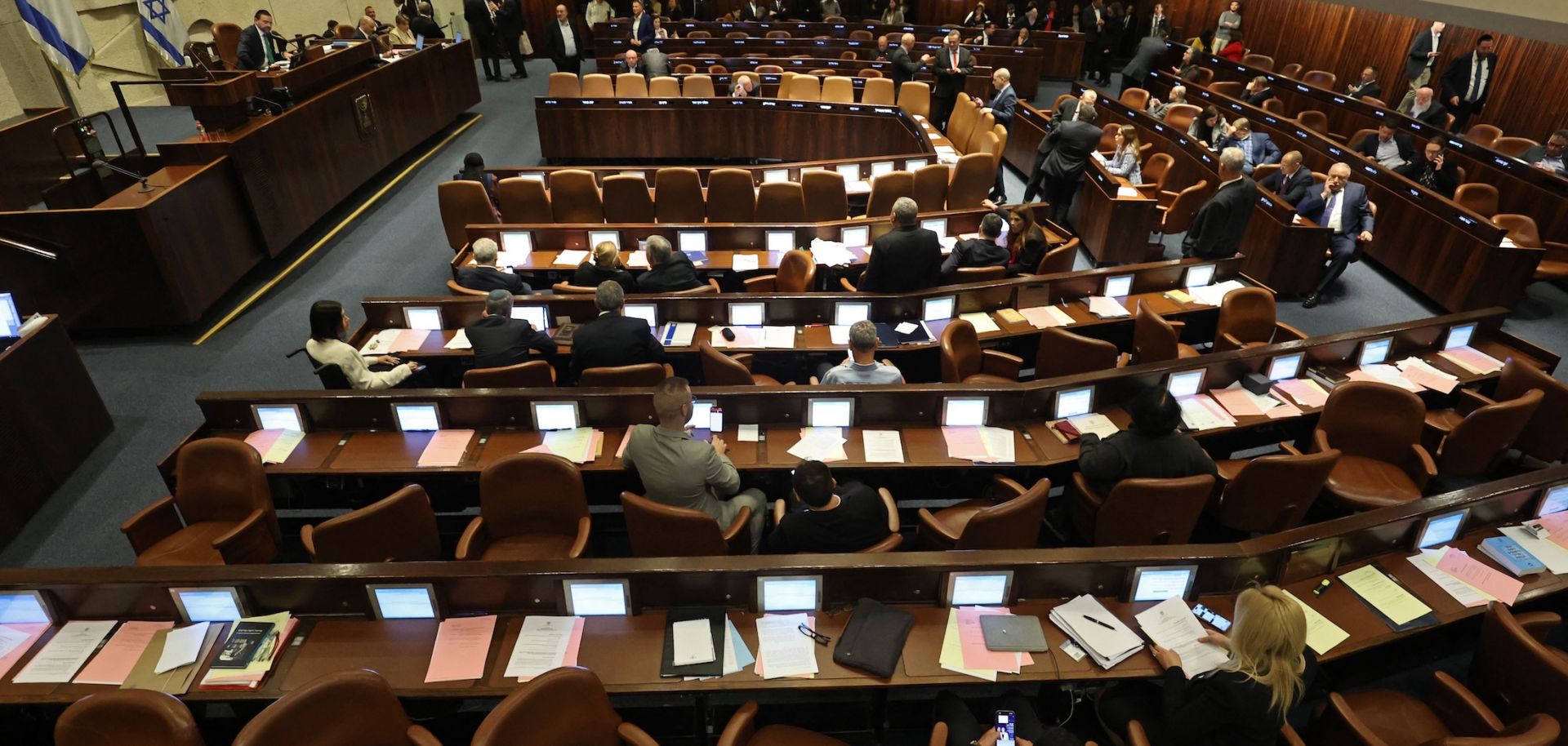
Israel's parliament meets March 20, 2023, in Jerusalem.
A potentially imminent collapse of the Israeli government would pressure the caretaker government to make concessions in Gaza and, if current polling holds, would likely result in a new government willing to take a different approach toward Hamas, Hezbollah and Iran. On June 9, the ultra-Orthodox party Shas announced that it would leave the Israeli coalition government and join the opposition to dissolve the Knesset in a vote currently set for June 11. Shas holds 11 votes in the 67-vote government, giving it the power to deprive the government of a 61-vote majority. A spokesman said the party would remain open to a potential last-minute compromise on the issue of drafting ultra-Orthodox Yeshiva students into military service, but had lost faith in Prime Minister Benjamin Netanyahu's ability to deliver such a compromise after a deadline the party imposed for a compromise passed June 2. Shas' declaration follows a statement from United Torah Judaism, another religious party in the coalition, that it also would leave the government and vote for an early election due to the impasse over the conscription of Yeshiva students. As a result, opposition party leader Benny Gantz stated he was withdrawing his party's legislation from the June 11 Knesset session to clear procedural obstacles for a swift vote that would dissolve Netanyahu's coalition government.
- The controversy over the conscription of ultra-Orthodox has plagued the Israeli right for years, as the religious community demands permanent exemptions despite their growing demographic share of the population. The Israel Defense Forces has steadily been conscripting limited numbers of Yeshiva students since a moratorium on their exemptions expired in July 2023, but wartime emergencies have caused the IDF to accelerate its plan. The IDF says that the military is short 12,000 soldiers, most of them combat troops, due to the extended war in Gaza; it plans to send out 50,000 draft notices to ultra-Orthodox communities starting in July.
Dissolving the Israeli government and scheduling a new election would require overcoming various political and procedural hurdles. UTJ and Shas have limited options for joining a new opposition government, since the opposition would not exempt Yeshiva students from the draft. This means they will find themselves out of power unless they can extract a concession from the government, keeping them reluctant to follow through on their threat to leave. Netanyahu has suggested such a compromise might be possible, though what one would entail and whether it would meet the expectations of the religious parties while also keeping his secular allies (which support Yeshiva conscription) loyal remain unclear. Procedural obstacles to a dissolution also remain, including the legislative requirements that such a dissolution bill must pass three readings in the Knesset before becoming law. During these readings, UTJ or Shas could reconsider its position, either due to a concession from Netanyahu or concerns that a new election could result in a less sympathetic government that would leave Yeshiva students even more exposed to an IDF draft than they would be under the current government. As long as they conclude that a swift dissolution of the government is not in their best interests, the political process to dissolve the government could last all summer, as the Knesset enters recess at the end of July, leaving the legislation to languish. But if the government dissolves, a new election would need to be held within 90 days.
- Israel has a quick process for bringing down governments. Unlike in many countries, parliament, rather than the prime minister or president, brings about such changes. This has resulted in significant political instability, as few Israeli governments serve out their four-year terms before collapsing.
If the Israeli government does dissolve, Netanyahu's government would become a caretaker entity constrained by the political imperatives of the upcoming elections, suggesting it may be more willing to de-escalate the war in Gaza — but also become more belligerent toward Hezbollah and Iran. Wartime elections in Israel's history are rare, with only one municipal election held since the Oct. 7, 2023, Hamas attack. A wartime Netanyahu caretaker government would have incentives to change some of its policies regarding Gaza — and potentially toward Hezbollah and Iran — in an attempt to shift polls that currently suggest the coalition would suffer catastrophic losses were a new election held now. Many Israelis support returning the remaining hostages over continued conflict with Hamas, suggesting that Netanyahu might overrule his far-right coalition allies to become more open to a temporary ceasefire in an attempt to secure hostages and bolster his lagging poll numbers. Meanwhile, Israelis have largely applauded Netanyahu's more hawkish approach to Hezbollah and Iran, with his poll numbers improving after particularly successful operations, like the pager explosions in September 2024 against Hezbollah operatives and Israeli airstrikes in April and October 2024 on Iran. This suggests that the government may carry out provocative actions, like strikes against Iranian proxies and/or Iranian forces outside Iran itself, against these rivals in an attempt to win popularity back home.
- A May 2025 Channel 12 poll found that 69% of Israelis, and 54% of coalition voters, would back the end of the war in Gaza in exchange for the release of remaining hostages, a new high.
- That same month, a poll from the Israeli pollster Lazar found that in new elections, Netanyahu's Likud party might drop from 32 to 23 seats, a major decline that would make it difficult for it to retain leadership.
- Israel remains unlikely to directly attack Iran so long as U.S.-Iranian talks are ongoing, but expanded attacks against Iranian assets elsewhere — like Yemen, Iraq or Lebanon — would be on the table, particularly if they are linked to the anti-Iranian proxy campaigns in those countries rather than against Iranian targets. So far, Israel has refrained from attacking Iranian assets in those countries directly.
Were the opposition to win a new election, the next prime minister would — like Netanyahu — face competing ideologies of coalition party members and the management of the war in Gaza, the legacy of the war with Hezbollah and the challenge of a nuclear Iran. Based on current polling, a new election would likely produce a new coalition government of left-wing, including Arab, parties; centrists; and right-wing factions united in their opposition to Netanyahu's continued rule, but with competing domestic and foreign policy imperatives that would make it fragile. A number of contenders have a shot at becoming prime minister, each of whose unique personalities and policy preferences would help define Israel's regional security strategy, even though all would likely rely on coalition partners that would require compromises and would have political contradictions. A leading contender could be former Prime Minister Naftali Bennett, who is hawkish on Iran, Gaza and the West Bank, but pragmatic with domestic policies towards Arab and left-leaning parties. Avigdor Lieberman of Israel Beitenu is another possible contender, suggesting that the next government could be right-wing-dominated and pursue the reoccupation of the Gaza Strip — something Lieberman has long advocated. Yair Lapid, the centrist head of Yesh Atid, would be more focused on domestic issues and more likely to cut a hostage deal with Hamas rather than single-mindedly aiming to destroy the militant group. He might also be open to a peacekeeping force led by Arab nations to take control of the Gaza Strip, unlike Netanyahu. And opposition and center-right leader Benny Gantz would meanwhile likely bring a more restrained version of Netanyahu's own policies to Gaza and Iran, favoring methodical reescalation over adventurist strikes, but nevertheless holding similar policy views that neither Gaza can be run by Hamas nor can Iran be allowed to develop a nuclear weapon. Because of the ideological contradictions of a future coalition, Israel could also plunge back into a series of elections similar to its recurrent political chaos that took place between 2018-22, which would leave Netanyahu in power as a caretaker prime minister and introduce even more political uncertainty amid what would likely be policymaking paralysis.
