
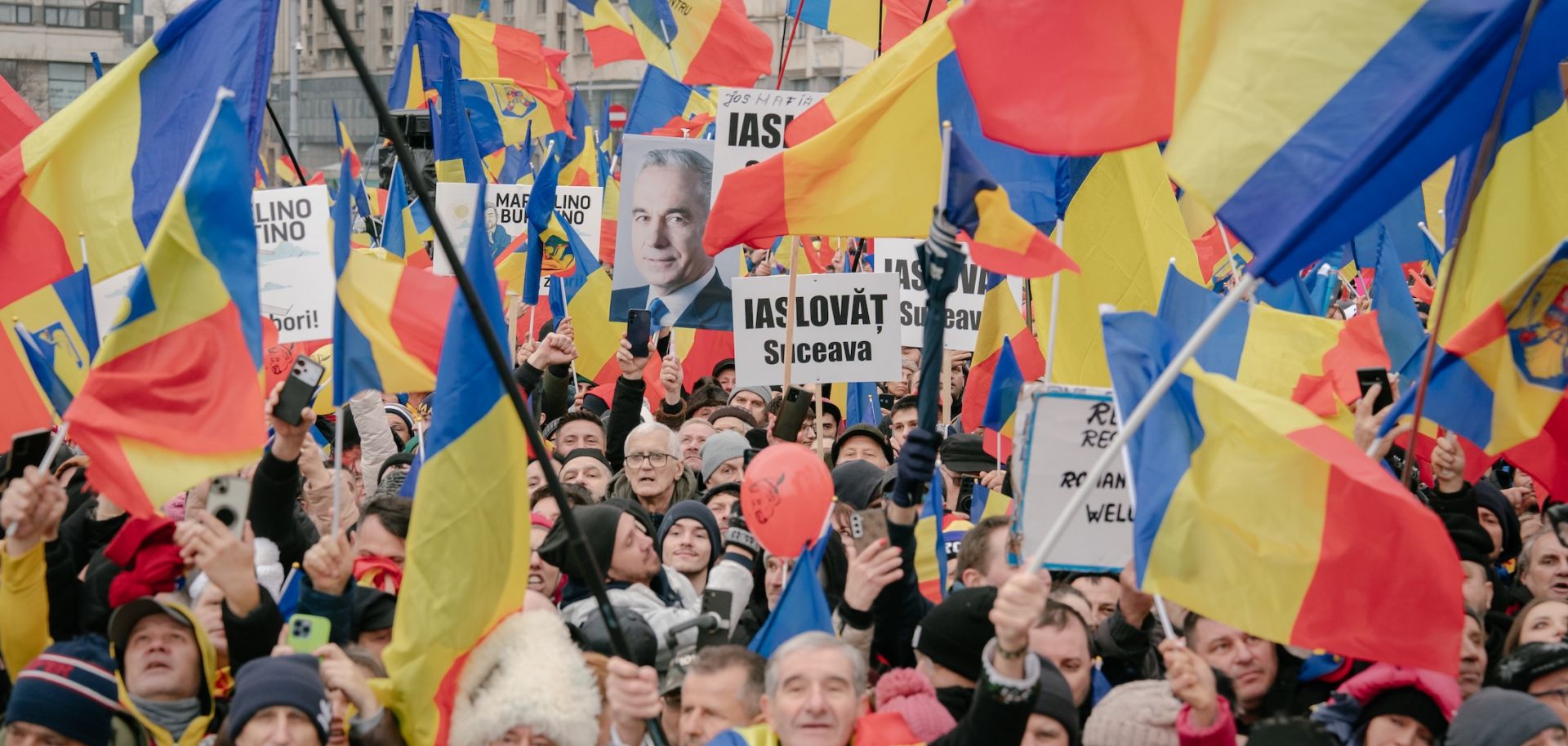
The disqualification of the far-right frontrunner from Romania's upcoming presidential election rerun will deepen anti-establishment sentiment in the country, heightening the risk of violent protests, bolstering alternative far-right candidates and potentially triggering an institutional crisis that would increase government instability and cast doubt on Bucharest's pro-Western alignment. On March 9, Romania's Central Electoral Bureau disqualified far-right, pro-Russian candidate Calin Georgescu from running in the country's presidential election rerun in May. The decision follows a ruling by the Constitutional Court in December that invalidated the results of the first round of the presidential election held on Nov. 24, citing procedural irregularities and evidence of a Russian-backed influence campaign in favor of Georgescu after he unexpectedly won the most votes. Ahead of the new presidential election, which is now set to be rerun on May 4 (first round) and May 18 (second round), Georgescu had been leading the polls, with around 40% support. Romania's electoral authority justified Georgescu's disqualification by citing his alleged breaches of laws against extremism, stating that the ruling was based on the same grounds that led to the election's annulment. Georgescu denounced the move as ''tyranny,'' and hundreds of his supporters gathered in front of the election bureau in Bucharest to protest the ruling, leading to violent clashes with the police. Georgescu has 24 hours to appeal, which he has pledged to do, after which the Constitutional Court will have until March 12 to issue a final ruling.
- On Feb. 26, Romanian prosecutors formally charged Georgescu with multiple offenses, including incitement against the constitutional order, providing false information on campaign financing and establishing a fascist organization.
- Georgescu is also expected to take his case to the European Court of Human Rights. However, on March 6, the court unanimously rejected his prior appeal to overturn the annulment of last year's presidential election, ruling the application ''inadmissible'' and stating that the decision was ''final.''
Georgescu's disqualification will worsen Romania's increasingly polarized political climate, heightening the risk of violent protests and strengthening alternative far-right candidates in the upcoming election rerun. Georgescu's exclusion will exacerbate anti-establishment sentiment in Romania and deepen public distrust in the country's mainstream parties and democratic institutions, alienating a large segment of voters who will likely view the court's decision as politically motivated. The unrest that has already erupted in Bucharest indicates that more localized protests and street violence are likely in the lead-up to the May elections and could escalate further, potentially evolving into a broader movement challenging the government's legitimacy and denouncing the perceived interference of ostensibly independent institutions in democratic processes. More broadly, Georgescu's disqualification will likely bolster Romania's far-right by turning him into a political martyr of sorts, amplifying nationalist and anti-Western narratives and strengthening whichever far-right candidate steps in to replace him. The far-right vote is currently expected to consolidate behind George Simion, the leader of the far-right Alliance for the Union of Romanians. However, Simion lacks Georgescu's broad appeal, meaning the election is now more likely to go to a run-off on May 18 as Simion is unlikely to win outright in the first round on May 4. Mainstream parties will thus likely attempt to unify behind whichever candidate will run against Simion or any other anti-establishment opponent they would face in the likely run-off on May 18, though internal divisions and declining voter confidence create significant uncertainty over the final outcome.
- Simion denounced the March 9 decision as a ''continuation of the coup d'etat'' that began after the Constitutional Court on Dec. 6 annulled the results of the November presidential election. He had previously stated that if Georgescu were disqualified, he would step in as his replacement in the election rerun.
- Romania's two main ruling parties — the center-left Social Democratic Party and the center-right National Liberal Party — have agreed to back the latter's former leader, Crin Antonescu, as their joint candidate for the May election rerun, with current polling placing him at approximately 18%. Independent candidate and Bucharest Mayor Nicusor Dan is polling around 13%, while liberal candidate Elena Lasconi stands at roughly 8%. In the event that one of these candidates advances to the final round against Simion or another far-right contender, many of their supporters would likely consolidate behind the remaining mainstream candidate, increasing their chances of defeating an anti-establishment opponent.
A far-right presidency could significantly affect Romania's pro-Western alignment and lead to an institutional crisis in the country, particularly regarding foreign and defense policy, where the president and prime minister share authority. While Romanian presidents have limited authority over domestic policy, they wield significant influence over defense and foreign policy, meaning a victory by a far-right, anti-establishment candidate in the presidential election could threaten Romania's pro-Western alignment. Drastic actions like withdrawing the country from NATO or the European Union would remain unlikely, as such decisions would require a majority in parliament, which is currently controlled by centrist parties that favor stronger EU cooperation and continued support for Ukraine. Under the Romanian constitution, the government, led by the prime minister, also has the last word in shaping and executing foreign and defense policies. However, conflicting messages from a far-right president could still significantly disrupt policymaking and weaken Romania's influence and credibility in international fora, including the European Council and NATO. Moreover, continued clashes with the government could further bolster popular support for the far-right president by making Romanians all the more frustrated with mainstream parties and the political establishment. This would create an increasingly unstable domestic political environment that could raise the specter of a government collapse — whether through sustained social unrest or defections from smaller parties — and of early elections (which are currently not due until late 2029). This scenario would likely further strengthen far-right parties, raising the possibility of a nationalist, anti-establishment government after new elections. The election of such a government would cast serious doubt on Romania's continued support for Ukraine, including its potential participation in future European peacekeeping missions in and around Ukraine, which may include deployments of European troops on Romanian soil. Indeed, Romania's strategic location in Eastern Europe and the Black Sea region, as well as its long border with Ukraine, have made it a key hub for aid deliveries and a vital transit route for Ukrainian exports to the European Union. Any change in Bucharest's stance on helping Kyiv fend off Russian aggression could thus significantly complicate any future European-led efforts to provide post-conflict security guarantees to Ukraine.
- Romania's president represents the country abroad, including at international forums such as the European Council and NATO summits. He or she also serves as Commander-in-Chief of the Armed Forces and appoints key officials, including prime ministers, judges and intelligence agency heads. However, the president does not have veto powers and lacks legislative authority beyond promulgating laws passed by parliament or, in limited cases, sending laws back for reconsideration. Additionally, major foreign policy decisions — such as treaties, alliances, or military interventions – require government and parliamentary approval, while defense policy implementation, military budgets and troop deployments fall under the government's jurisdiction rather than the president's.
- If a president publicly opposes the government's foreign policy stance — defying the mandate of the parliamentary majority — the prime minister and foreign minister can issue clarifications or override presidential statements. Should the president repeatedly challenge government policy, mainstream parties could consider initiating impeachment proceedings, though this would require broad parliamentary and public support, including a two-thirds majority in parliament, followed by a national referendum, making it a difficult and unlikely option.
- Romania's December 2024 parliamentary elections yielded a new coalition comprising the center-left Social Democratic Party, the center-right National Liberal Party, the Democratic Alliance of Hungarians and national minority representatives. These ruling parties, together with the liberal Save Romania Union (which sits at the opposition but equally opposes the prospect of a far-right presidency), control 216 seats in the 331-seat lower house of parliament, falling just short of the 221-seat threshold needed for a two-thirds majority. This means the governing coalition and its allies lack the necessary votes to pass constitutional amendments or remove the president without securing support from at least five lawmakers from far-right opposition parties.
