
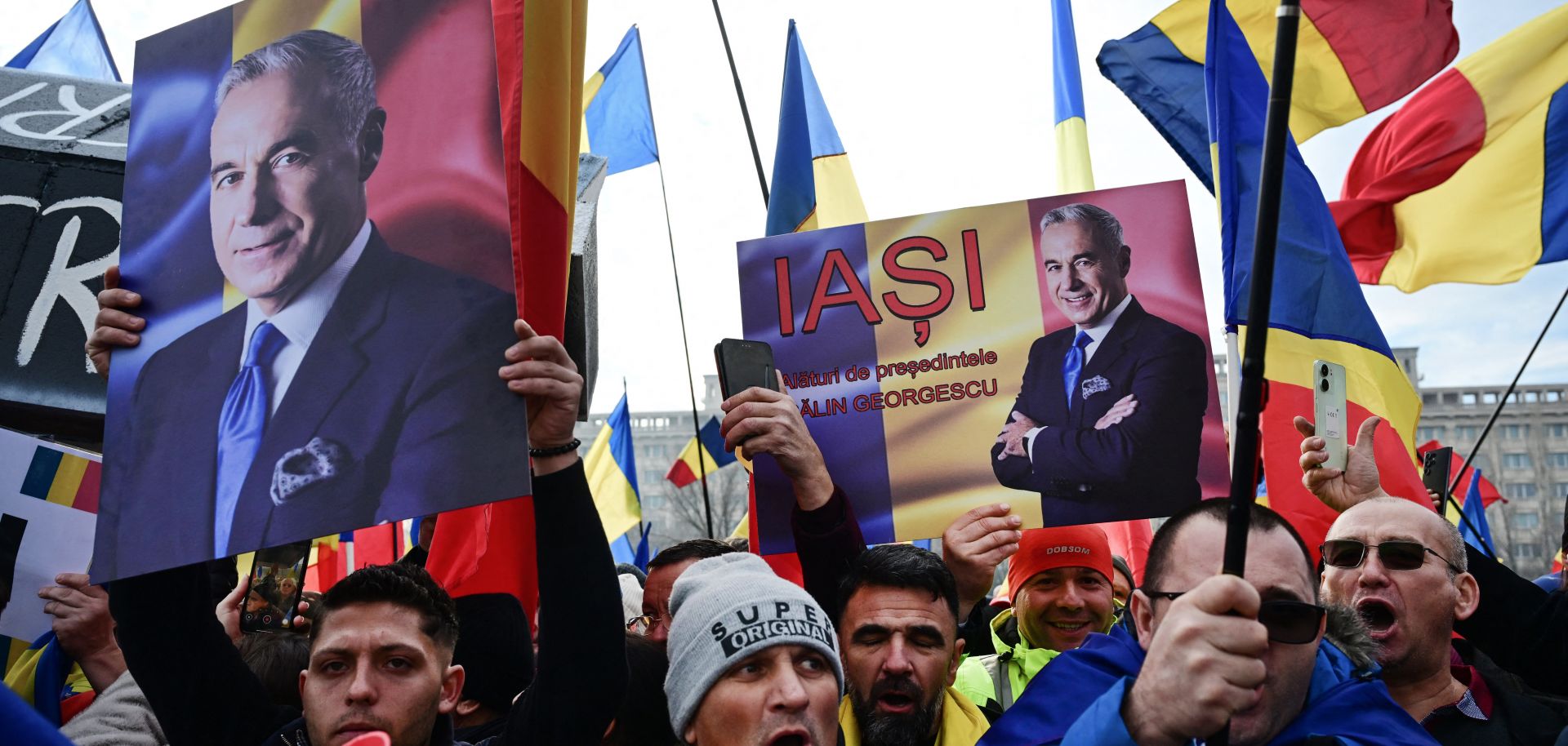
The resignation of Romania's president underscores the country's deepening political crisis, which is raising the risk of a far-right president taking office that would disrupt foreign policy and, less likely, a far-right prime minister that would worsen relations with the European Union and increase the risk of an economic crisis. On Feb. 10, Romanian President Klaus Iohannis announced he was stepping down amid a push from far-right lawmakers to impeach him over his role in annulling the results of the first round of the presidential election in November, in which a far-right candidate unexpectedly won the most votes. Hours later, on Feb. 11, the leader of the right-wing Alliance for the Union of Romanians (AUR), George Simion, announced his party would also file a no-confidence motion against the government of Romanian Prime Minister Marcel Ciolacu next week. Iohannis' resignation became effective on Feb. 12, when he was replaced by the president of the Senate, Ilie Bolojan, who will act as interim president until a new president is elected.
Romania's political crisis began on Nov. 24, after the results of the first round of the presidential election were announced and then quickly annulled following the far-right candidate's surprisingly strong performance. Calin Georgescu, a right-wing nationalist who ran as an independent, unexpectedly secured the most votes (23% of the total) in the Nov. 24 ballot, despite his polling numbers having been much lower during the campaign. The center-right Save Romania Union (USR) party's candidate Elena Lasconi finished in second place and qualified alongside Georgescu for the runoff election, which was scheduled for Dec. 8. However, shortly after the election results were announced, then-President Iohannis accused Georgescu of being supported by Russia while Romania's Constitutional Court ordered a recount. While the court initially confirmed the results, a few days later it reversed its decision and annulled the election. Both Georgescu and Lasconi condemned the move, but Iohannis said the court's decision was legitimate and pledged to remain in office until a new presidential election took place. Large protests subsequently erupted in Bucharest, while AUR members and other far-right lawmakers in the Romanian parliament called for Iohanis' impeachment. The presidential election is now set to be rerun on May 4 (first round) and May 18 (second round). The controversy has since boosted Georgescu's electoral prospects, who is now polling around 40%. However, there is a chance Georgescu will be barred from running in the new election, as Romania's Electoral Commission has yet to decide whether he will be allowed to contest following the accusations of Russian interference. Should this happen, the far-right vote is expected to consolidate around AUR leader Simion, thereby making him a more competitive candidate.
- Notably, the presidential candidates for Romania's mainstream and governing parties, the center-left Social Democratic Party (PSD) and the center-right National Liberal Party (PNL), both failed to qualify for the runoff in the Nov. 24 election. In early January, these parties — along with their junior coalition partner, the small Democratic Alliance of Hungarians in Romania party, or UDMR — agreed to back former interim president Crin Antonescu as their joint presidential candidate in the May election rerun, in a bid to have a single candidate representing the government.
- According to a Sociopol survey conducted between Jan. 27 and Jan. 30, Georgescu would receive 47% of the vote in the first round of the presidential election, followed by Antonescu with 10%. A CURS poll conducted between Jan. 21 and 25 put Georgescu at 37% and Antonescu at 18%.
- In scenarios where Georgescu is not a candidate, polls have Simon securing around 25% of the vote, with only modest gains for Antonescu.
While Prime Minister Ciolacu will likely survive the no-confidence motion, his defeat would open the door to an early general election where the far-right would likely perform strongly and stand a chance of appointing the next prime minister. Romania's three-party coalition government — which includes the PSD, the PNL and the UDMR — only controls 157 of the 331 seats in Romania's Chamber of Deputies and thus depends on small parties representing ethnic minorities to pass legislation. This means that the government will need support from at least nine additional lawmakers to survive the upcoming no-confidence vote. Prime Minister Ciolacu stands a good chance of winning the vote, as lawmakers re-appointed him in late December, which suggests he will again win a majority in the no-confidence motion in late February. Still, the vote will be tight. If Ciolacu loses the motion, Romania's interim president would first seek to appoint a new prime minister who can win the backing of parliament. But should this attempt fail (which would be possible in a scenario where the government coalition has failed to keep Ciolacu in power), Romania would have to hold an early legislative election. Even if Ciolacu survives the no-confidence motion in late February, the far-right opposition would likely trigger similar motions in the future, which will once again put the government on the verge of collapse and increase the risk of an early legislative election. Considering that right-wing parties are polling strongly, they are likely to also perform well in an eventual legislative election. This could make it hard for the country's mainstream, moderate parties to retain the premiership and increase the possibility of Romania appointing a far-right prime minister.
The election of a far-right president would disrupt Romania's pro-EU and pro-Ukraine foreign policies, though the more severe policy disruptions would happen if the country also appoints a far-right prime minister, a scenario that would jeopardize crucial EU funds as well. Romanian presidents have a limited role in domestic policymaking, but they represent the country abroad and are in charge of military decisions. If Romania were to elect a far-right president (such as Georgescu or Simion), it would lead to friction with the European Union on issues such as relations with Russia and EU integration. A far-right president (and Georgescu in particular) might challenge the U.S. military presence in Romania and oppose further support for Ukraine, weakening NATO unity on the issue. A far-right president (either Georgescu or Simion) would also challenge EU policies on the rule of law, migration and economic governance issues. If Romania elected both a far-right president and a far-right prime minister, the geopolitical impact would be more severe, as the government could push for judicial and media restrictions, marginalize opposition parties and civil society groups, weaken democratic checks and balances, and push back against EU economic coordination and migration quotas. Such a government would join forces with like-minded governments, such as those in Slovakia and Hungary, to promote their skeptical views on EU integration and their conservative views on domestic social issues like the rights of sexual and ethnic minorities. (However, in the case of Hungary, bilateral relations could still be tense due to Romania's historical disputes with the country.) These actions would increase the risk of the European Union cutting funding for Romania as Brussels would likely use EU funds (of which Romania is a net receiver) as leverage in its dealings with Bucharest. While a Romanian government led by a far-right president and prime minister would likely tone down some of its most controversial policies to preserve its access to EU funds, even a temporary freeze of funding could slow the country's economy and precipitate an economic crisis at a time of relatively high inflation and a high fiscal deficit.
- Romania's president serves as the head of state, with responsibilities primarily focused on foreign policy and national defense. While the president does not have direct control over day-to-day governance, which falls under the prime minister and the government, he or she appoints key judicial officials, can send laws back to parliament for reconsideration, and has the power to call referendums on major national issues.
- EU funds account for approximately 2-3% of Romania's annual GDP, making them a key driver of economic growth. Romania is set to receive about 31 billion euros in structural and cohesion funds during the 2021-2027 EU budget. Separately, Romania has also been allocated $ 29.2 billion euros in the European Union's COVID-19 recovery fund. If Romania elects a far-right government that challenges EU policies on rule of law, migration and/or economic governance, it could face sanctions or funding cuts similar to what happened with Hungary and Poland in the past.
- In late December, Fitch Ratings confirmed Romania's credit rating as BBB- (the lowest investment-grade rating on its scale) and downgraded the outlook for the country's default risk from stable to negative, citing a significant increase in ''political uncertainty'' that Fitch believes will ''likely have adverse effects on fiscal consolidation.'' In late 2024, Romania's fiscal deficit reached 8.5% of the country's GDP. While the government coalition has pledged to reduce the country's fiscal deficit in 2025 and beyond, political instability may delay these efforts.
