
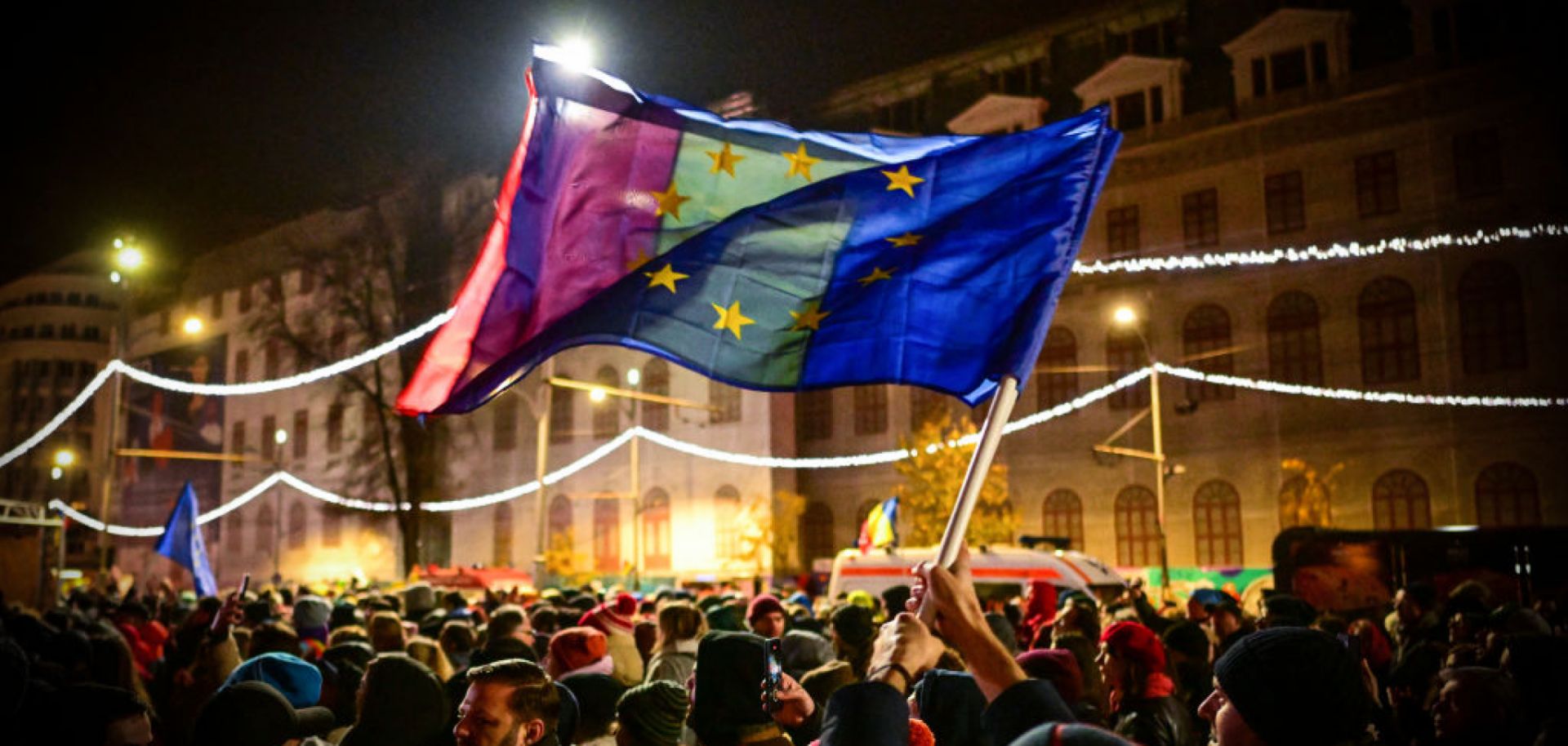
The annulment of Romania's presidential election on grounds of procedural irregularities and a Russian-backed influence campaign might further politically advantage anti-establishment parties in the election re-run, undermine public trust in the country's institutions and create a precedent for controversial election results in other parts of Europe. On Dec. 6, Romania's Constitutional Court annulled the first round of the presidential election, citing procedural irregularities and evidence of a Russian-backed online influence campaign supporting far-right independent candidate Calin Georgescu, who won the most votes. The prosecutor general's office is also reportedly considering opening criminal investigations into Georgescu's campaign. Georgescu, who unexpectedly secured 23% of the vote in the first round of the presidential election on Nov. 24 despite low polling during the campaign, was set to face off against the center-right Save Romania Union's liberal candidate Elena Lasconi, who received 19.3%, in the second round originally scheduled for Dec. 8. The annulment calls off their runoff, with a full election re-run now set to take place on Dec. 15 and a potential second round on Dec. 29. The court's decision followed President Klaus Iohannis' declassification on Dec. 5 of intelligence files exposing a Russian influence campaign aimed at promoting Georgescu on platforms such as TikTok and Telegram.
- Ahead of the Nov. 24 vote, most opinion polls placed Georgescu at around 5%. His surprise performance was fueled by a sudden surge in popularity on online platforms like TikTok, but it was also rooted in a broader trend of rising far-right and anti-establishment sentiment and growing war fatigue in Romania and across Europe.
- The election underscored widespread dissatisfaction among Romanian voters with the political establishment. Outgoing Prime Minister Marcel Ciolacu from the center-left Social Democratic Party and Nicolae Ciuca, leader of the co-governing center-right National Liberal Party, were both eliminated in the first round, signaling public frustration with the ruling coalition and mainstream political forces long accused of corruption, clientelism and ineffective governance.
- Iohannis revealed intelligence indicating that 25,000 TikTok accounts became "very active" in the two weeks leading up to the election, promoting pro-Georgescu content. The coordinated campaign involved influencers being paid in violation of election laws. Additionally, Romanian election websites faced 85,000 cyberattacks on the day of the election, further raising concerns about foreign interference.
- Lasconi denounced the court's decision to annul the election, calling it "illegal, immoral, and anti-democratic," highlighting the polarizing nature of the ruling and its significant impact on the country's political landscape.
The court ruling will likely spark accusations of judicial interference, which may bolster support for Georgescu or other anti-establishment candidates, but Romania's next Parliament will have more influence over the country's strategic direction than the president, regardless of who wins the re-run. Outgoing Prime Minister Ciolacu, who narrowly lost to Lasconi in the first round, will have another opportunity to mobilize his voter base in the upcoming election re-run. At the same time, many Romanians may see Ciolacu and his Social Democratic Party party as the main force behind the court's decision, which could alienate many voters and weaken his chances if he progresses to the runoff — a dynamic that may further advantage anti-establishment candidates like Georgescu in the final round. While Romanian presidents have limited authority over domestic policies, they wield significant influence over defense and foreign policy, as well as critical appointments like prime ministers, judges and intelligence agency heads, meaning a Georgescu victory could hurt the country's pro-Western alignment. Still, drastic actions, such as withdrawing the country from NATO or the European Union, would require a parliamentary majority. This means the appointment of a prime minister and a Cabinet will be more important than the election of a president in determining Romania's strategic direction. Romania held a legislative election on Dec. 1, and the results suggest that mainstream centrist parties will likely manage to form a moderate, pro-Western government, which will play a decisive role in shaping the country's political and strategic trajectory, regardless of who wins the presidency.
- Romania's presidents lack legislative powers beyond promulgating laws passed by Parliament or, in limited cases, returning them for reconsideration, and do not possess veto powers. However, the president represents Romania at EU and NATO summits, so a Georgescu victory would give him a significant platform from which to oppose or obstruct EU policies. From this position, he could influence or disrupt initiatives on critical issues, such as sanctions on Russia or continued support for Ukraine. However, should he embrace a stance completely opposed to the Romanian parliamentary majority's mandate, he could be removed from office.
- Georgescu has explicitly criticized Romania's membership of NATO, questioning the benefits Romania receives from the alliance, and in particular the placement of the U.S. anti-missile shield in Romania's southern village of Deveselu, labeling it a provocation vis-a-vis Russia. However, he toned down his rhetoric throughout the campaign, particularly after his victory in the first round, saying he did not intend to pull the country out of the European Union or NATO.
- The Social Democratic Party emerged as the largest party in the Dec. 1 parliamentary elections, obtaining about 23% of the vote ahead of the far-right Alliance for the Union of Romanians with 18% and the co-ruling center-right National Liberal Party with 14%. The liberal Save Romania Union party received 12% of the vote, followed by two other far-right parties — the pro-Russian SOS Romania party and the Party of Young People — respectively at 7.5% and 6%, and the ethnic Democratic Alliance of Hungarians in Romania party at 6%.
Beyond the immediate impact on the presidential election, the Constitutional Court's ruling could further undermine public trust in Romania's institutions, exacerbate socio-political tensions and establish a concerning precedent for other European countries. The ruling will exacerbate anti-establishment sentiments in Romania and cast further doubt on the independence of the country's judiciary and democratic institutions. Announced just days before the planned runoff, the decision has already intensified political tensions and risks sparking public outrage. Immediate protests from far-right supporters are unlikely, as far-right Alliance for the Union of Romanians leader George Simion (who had endorsed Georgescu for the second round) has urged supporters to channel their discontent at the polls only. However, unrest would become more likely should prosecutors ban Georgescu from running in the election re-run. Furthermore, anti-government demonstrations could intensify even from moderate, pro-EU forces (like Lasconi's Save Romania Union) as public trust in democratic processes and institutions erodes further, potentially destabilizing eventual coalition-building efforts that require collaboration with the Save Romania Union — either as part of the coalition or in Parliament. Outside Romania, the ruling may establish a precedent for how European governments address allegations of foreign interference in democratic elections, potentially emboldening other countries to invoke the Russian threat (real or alleged) to overturn an election result or disqualify candidates. This strategy could jeopardize the rule of law and democratic norms across Europe, particularly in countries with weaker institutional safeguards.
- Romania experienced widespread anti-government and anti-corruption demonstrations as recently as 2018, when hundreds of thousands of Romanians protested nationwide against the then Social Democratic Party government and its controversial proposed legislation to weaken anti-corruption laws and pardon politicians convicted of corruption. The Save Romania Union was among the political forces backing the demonstrations, which were Romania's largest since the fall of communism in 1989.
- For the outgoing Social Democratic Party-National Liberal Party ruling coalition to remain in power following the Dec. 1 legislative elections, the alliance would need support from the Save Romania Union, either directly as a coalition member or indirectly in Parliament. The Constitutional Court ruling could amplify significant ideological and political differences, complicating government formation negotiations or reducing the coalition's cohesion should these succeed, raising the likelihood of a premature government collapse and early elections.
