
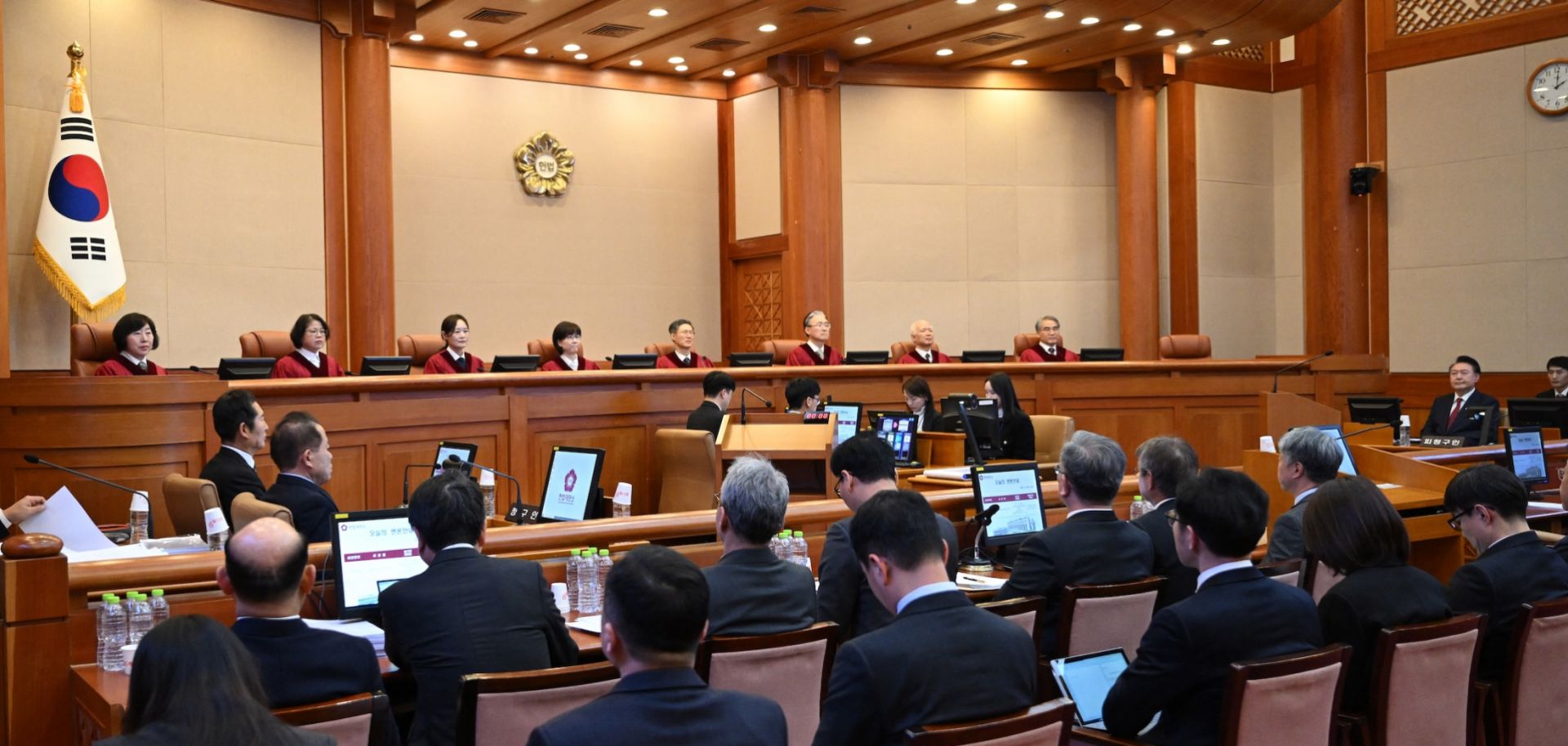
South Korean President Yoon Suk Yeol's impeachment would pave the way for a progressive government that shifts toward pro-labor policies and rapprochement with China and North Korea; but if Yoon remains in office, ongoing political instability, protests and potential fractures within the ruling party could weaken conservative governance ahead of the 2027 election. The South Korean Constitutional Court held its 10th oral argument session for President Yoon's impeachment trial on Feb. 20 and will hold its final session for concluding arguments on Feb. 25. Afterward, the court's deliberation — which will culminate in a ruling to either confirm, overturn or dismiss Yoon's impeachment — is expected to last into early or mid-March, though deliberations for some past impeachment trials of South Korean presidents have concluded faster. There are also criminal investigations into Yoon regarding whether his recent martial law declaration constituted an insurrection, with Yoon standing trial for both a criminal hearing and a Constitutional Court hearing on Feb. 20. Though the prosecution is pushing for rapid-fire hearings, the criminal proceedings may last into July, well after the impeachment trial is concluded.
- Following Yoon's Dec. 3-4 martial law declaration, which he claimed was necessary to protect the nation's democracy from internal saboteurs and North Korean agents, South Korea's unicameral legislature, the National Assembly, voted to impeach Yoon on Dec. 14. Thereafter, the Constitutional Court has 180 days to decide whether to confirm or reject this impeachment, though the justices have pledged to move quickly on this case.
- Following the final statements by the prosecution and defense in former President Roh Moo-hyun's impeachment trial, the Constitutional Court ruled later that same day on May 14, 2004, to overturn Roh's impeachment and restore his presidential powers. For former President Park Geun-hye, however, the court took 11 days after the conclusion of oral arguments to uphold her impeachment on March 10, 2017.
Yoon's actions suggest the court will likely uphold his impeachment, though there is still a low chance that his impeachment will be overturned or dismissed. The abundance of court evidence and local media coverage of Yoon's martial law actions suggest he acted unconstitutionally, particularly regarding his alleged instruction for the military to stop the proceedings of the legislature (which voted in the early hours of Dec. 4 to demand that Yoon rescind his martial decree) and to arrest the heads of both major political parties — powers that South Korea's constitution does not bestow on the president, even under martial law. Thus, if the court rules strictly based on the constitution, Yoon's impeachment will likely be upheld. There are, however, extenuating circumstances that could spur a low-likelihood scenario in which his case is overturned or dismissed. First, Yoon's defense will try to have the case thrown out on procedural grounds, and Yoon is quite skilled in the courtroom, given his past role as South Korea's chief prosecutor. Second, at least six of the court's eight sitting justices need to agree to either impeach him or overturn his impeachment; otherwise, the case would be dismissed, allowing Yoon to resume his presidential duties. Though South Korea is known for its strong judicial independence, the sitting justices have their own political leanings, with at least three of the eight believed to lean conservative, like Yoon. Likewise, there is a low likelihood that Yoon is not impeached but is later found guilty in criminal trials of insurrection, which would see him immediately removed from the presidency. As with previous presidents facing criminal sentences, Yoon would likely be pardoned by a future president, but his political career would be over.
- So far, Yoon has acted to obstruct all criminal and impeachment proceedings, including by refusing arrest by state investigators, staying silent or giving short answers during state questioning, attempting to delay his court trial, casting legal doubt on the court or individual judges' ability to rule on his case, requesting to have evidence thrown out, and having the presidential services decline police requests for evidence.
If Yoon is impeached, the opposition Democratic Party, or DP, will likely win early presidential elections, heralding pro-labor and green transition policies at home, as well as warmer ties with China and North Korea. If Yoon is impeached, South Korea will need to hold a presidential election within 60 days. Polls suggest that DP head Lee Jae-myung stands a good chance of winning a presidential race, particularly following Yoon's martial law bid and the resignation of popular People Power Party (PPP) leader Han Dong-hoon after he supported Yoon's impeachment against the wishes of PPP policy heads. However, Lee also faces ongoing corruption investigations that could disqualify him from office before any early presidential election is held. If this happens, it will be a much closer race between the PPP and DP for the presidency, as neither major party would have clear frontrunner candidates. However, the PPP's marred reputation from the martial law incident would still give the DP a slight advantage. A DP president would rule alongside a strong DP majority in the legislature (through mid-2028), and would thus be much freer than Yoon to pass his or her preferred policies. Under the DP, Seoul would pursue more pro-labor and green transition policies, including raising wages and scaling back nuclear energy relative to renewable energy sources. On foreign policy, the DP would seek to repair economic ties with China, a top South Korean trade partner, including by potentially easing up on supply chain security cooperation with the United States aimed at insulating trade from Chinese economic coercion. The DP would also significantly lower tensions with North Korea by reducing border military demonstrations and resuming diplomatic engagement and humanitarian aid. Additionally, a DP government would likely curb or outright end South Korea's budding trilateral security engagement with Japan and the United States by bringing up historical grievances related to Japan's World War II-era abuses against the Koreans. In addition to impeding official talks with Tokyo, this would reduce trilateral cooperation in monitoring and responding to North Korean missile launches, which could drive Japan to focus more on deterring North Korean aggression via Japanese military modernization.
- A Feb. 3-5 survey from South Korea's National Barometer Survey (NBS) showed that the most preferred presidential candidate was DP head Lee Jae-myung, with 32% support, followed by current PPP labor minister Kim Moon-soo (12%), PPP mayor of Seoul Oh Se-hoon (8%), and former PPP head Han Dong-hoon (6%). The PPP led the NBS party support poll with 39% compared to the DP's 37%, but party polls are usually unreliable indicators of presidential voting patterns in South Korea.
- Most pressing among Lee's corruption cases is his appeal of a November 2024 conviction that he made false statements during the 2022 presidential election. If his sentencing — of a one-year prison sentence suspended for two years — is upheld, it will disqualify him from running for office for five years. The concluding arguments for that appeal case are due by Feb. 26, after which the Seoul High Court is expected to issue a final ruling in mid-to-late March.
If Yoon is not impeached, South Korea's latest and ongoing period of political instability will linger as the DP pursues other avenues to oust Yoon and disrupt conservative policies. If the court either rejects Yoon's impeachment or fails to reach a decision on it, his presidential duties will be reinstated and the opposition will be barred from pursuing his impeachment on the same grounds again. However, Yoon would remain detained in relation to criminal charges of insurrection, meaning acting President Choi Sang-mok would continue to carry out his duties. Moreover, the DP would likely still pursue impeachment charges against Yoon under other auspices, as the DP and smaller opposition parties have been calling for Yoon's ouster since he took office in May 2022. To wit, the Rebuilding Korea Party was founded in March 2024 with the express goal of bringing about an early end to Yoon's presidency, though the party has only 12 seats in the 300-seat National Assembly. Thus, some degree of political instability would persist in South Korea if Yoon stays in office, particularly as the DP would maintain its efforts to push through its own policies while stalling those proposed by the PPP or Yoon (e.g. through frequent cabinet impeachments, holding up official appointments, and breaking norms about bipartisan consensus on key issues like budget passage). Moreover, if Yoon tries any other potentially illegal maneuvers to increase his executive power in the remainder of his term, including another martial law bid, it would only exacerbate political instability and related foreign investor concerns about South Korea.
- Following Yoon's martial law bid, foreign investors sold a net $4.3 billion of stocks and bonds in December, the largest monthly investment outflow from South Korea since March 2020, around the beginning of the COVID-19 pandemic.
Yoon remaining in office would likely also trigger disruptive street protests and threaten a split within the PPP, though it would yield short-term domestic and foreign policy continuity. Should the court overturn or dismiss Yoon's impeachment, it would likely immediately revive the large-scale dueling protests seen in the period between martial law and the National Assembly's impeachment vote, in which tens of thousands of people took to the streets from both anti- and pro-Yoon camps. These protests would grow further if Yoon is also eventually acquitted of criminal charges, though this appears unlikely given the severity of his actions under martial law. Protests would be driven by both DP proxies in society, including union groups heavily opposed to Yoon's pro-business policies, as well as citizen protesters. As with previous protests, the unrest would risk disrupting public transportation in Seoul, as well as slowing or temporarily halting manufacturing activity (e.g. in shipbuilding and electronics), depending on which unions participate. It would also risk more instances of vandalism and violent clashes with the police, as recently occurred surrounding Yoon's court cases. Likewise, if Yoon's impeachment is overturned but he is later convicted of insurrection by criminal courts (and thus forced out of the presidency), it would spur pro-Yoon protests with similar risks. With Yoon still in office and regularly scheduled presidential elections just two years away, some PPP leadership and lawmakers would want to distance themselves from Yoon to revive the party's image. This risks creating an internal rift within the PPP along pro- and anti-Yoon lines, which could dilute the electability of conservatives ahead of the 2027 presidential election. Policy-wise, a resumed Yoon administration would largely persist with preexisting priorities, such as a litigious and combative stance toward unions and a facilitative stance toward the country's nuclear and arms export industries. It would also persist in provoking North Korean escalation (e.g. via larger drills, border deployments and force demonstrations) and further strengthen trilateral U.S.-Japan-South Korea security cooperation, primarily focused on monitoring North Korean missile threats. Seoul would also look to expand its security role in the broader Indo-Pacific, including via high-level rhetorical support for U.S. interests (e.g. peace and stability across the Taiwan Strait) and military cooperation (e.g. joint exercises) with U.S. regional allies like the Philippines.
- In December, following a Seoul court's ruling to extend Yoon's police detention, nearly 100 pro-Yoon protesters trespassed on the grounds of that court, breaking windows and clashing with police, resulting in 90 arrests.
