
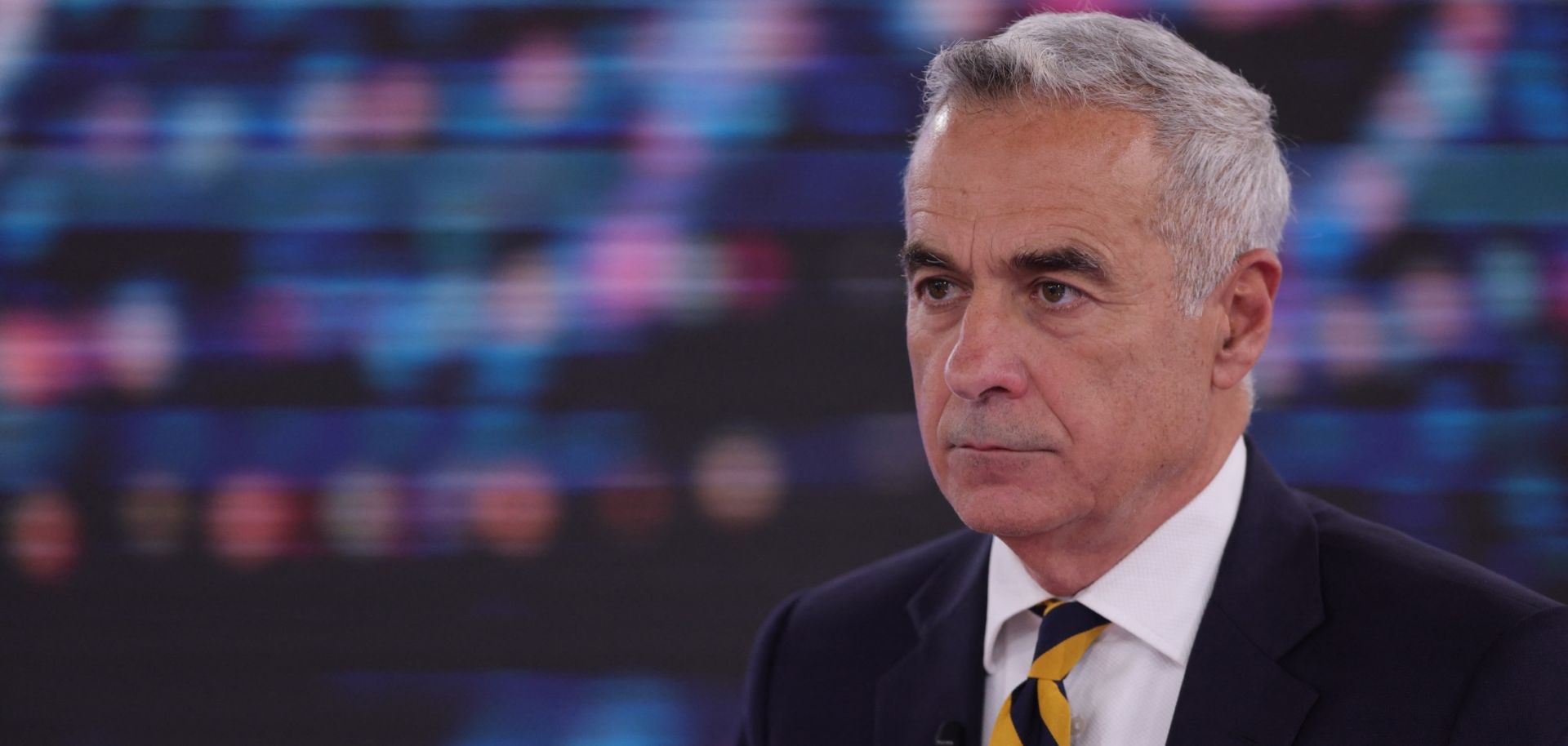
A victory by far-right candidate Calin Georgescu in the second round of Romania's presidential election could weaken the country's support for EU integration, NATO and Ukraine, while his surprising victory in the first round reflects a surge in anti-establishment sentiment ahead of Romania's parliamentary elections on Dec. 1, likely complicating coalition-building efforts and further destabilizing Romania's political landscape. Georgescu — a pro-Russia, far-right independent candidate formerly affiliated with the nationalist Alliance for the Union of Romanians (AUR) party — unexpectedly won Romania's Nov. 24 presidential election, securing 23% of the vote. Elena Lasconi, the leader of the liberal, center-right Save Romania Union (USR) party, came in second place with 19.18% — putting her just barely ahead of Prime Minister Marcel Ciolacu from the center-left Social Democratic Party (PSD), who secured 19.15%, followed by AUR leader George Simion with 13.9% and Nicolae Ciuca, the leader of the co-governing center-right National Liberal Party (PNL), with 8.8%. As the top two vote-getters, Georgescu and Lasconi will now advance to a run-off scheduled for Dec. 8. Romania will also hold parliamentary elections on Dec. 1.
- Georgescu's victory came as a shock, as he was never considered a frontrunner in the presidential race. Some pre-election polls projected Georgescu would only win 5% of the vote in the first round, while some polls even relegated Georgescu to the ''others'' category, grouping him among minor candidates.
- The election took place amid widespread public dissatisfaction with Romania's political establishment, as the two parties forming Ciolacu's ruling coalition have been accused of corruption, clientelism and poor governance.
- Georgescu's unexpected victory aligns with the broader trend in Romania and across Europe of surging support for far-right politicians who want to end the war in Ukraine.
While Romania's presidents only have limited powers, Georgescu's election to the post could still impede the country's pro-Western alignment by impacting NATO and EU policies; a Lasconi presidency, by contrast, would maintain Romania's support for further EU integration, NATO and Ukraine. While their role in domestic policies is limited, Romanian presidents wield considerable influence over defense and foreign policy, and also have the power to appoint prime ministers and judges. Georgescu's past criticisms of his country's NATO membership and U.S. military installations in Romania suggest that his election as president could shift the country's Western alignment, which could prove consequential for neighboring Ukraine, given Romania has served as a key logistical hub in support of Kyiv's war efforts. But as president, Georgescu would not have the power to pull the country out of international treaties or organizations like NATO or the European Union without a parliamentary majority backing him up. Against this backdrop, the upcoming parliamentary elections will be key in determining Romania's future political and strategic direction. However, the president represents Romania at EU and NATO summits, which means Georgescu could use this platform to oppose EU policies by influencing or vetoing initiatives on key issues such as sanctions on Russia and support for Ukraine. If, on the other hand, Lasconi wins the presidential run-off, it would guarantee a high degree of continuity in Romania's foreign and defense policies, keeping Bucharest fully committed to its NATO membership, and to politically and militarily supporting Ukraine. Meanwhile, her strong anti-corruption platform might translate into a push for judicial reforms and high-level corruption investigations in Romania, potentially fueling tensions with a government that will likely still include the clientelist parties of the current grand coalition government, PSD and PNL, both of whom embody the country's deeply entrenched political establishment.
- Those who voted for the nationalist AUR party leader, George Simion, in the first round of the presidential race will likely support Georgescu in the run-off, while most of the votes received by all other candidates are expected to go to Lasconi. The vote is thus expected to be tight, though Lasconi has slightly better odds of securing a victory.
- Georgescu has explicitly criticized Romania's NATO membership, questioning whether the benefits outweigh the potential risks — especially regarding the alliance's placement of a land-based missile-defense system in the southern Romanian village of Deveselu, which Georgescu has labeled as a provocation vis-a-vis Russia.
Georgescu's surprise victory in the first round of the presidential election indicates an anti-establishment surge in Romania, which means that the Dec. 1 legislative elections may result in a fragmented parliament and difficult coalition-building efforts. Romanians delivered a sharp rebuke to the ruling PSD and the PNL in the presidential race, with the leaders of both parties being eliminated in the first round. While voting dynamics differ between presidential and parliamentary elections, these results point to widespread dissatisfaction with the ruling coalition, setting the stage for a contentious legislative ballot on Dec. 1. At least some Georgescu voters will support AUR candidates in the parliamentary election, likely boosting the nationalist party's vote tally above the 20% it is currently polling at in most surveys, which could position it as a key player in forming the next ruling coalition. A strong AUR performance would complicate mainstream parties' efforts to create a centrist coalition that excludes the far-right, potentially leading to a fragmented, ideologically diverse alliance between the PSD and PNL, along with the center-right USR and/or other smaller parties. Such a multi-party coalition would be internally divided on issues like economic policy, judicial reforms and anti-corruption measures, slowing decision-making while leaving the government at constant risk of collapse. Alternatively, the PSD — which, according to opinion polls, is likely to emerge as the largest party in the next parliament — might seek a controversial alliance with the AUR, forming a government that combines left-leaning economic policies, a socially conservative agenda and nationalist rhetoric. While the AUR is unlikely to seriously threaten Romania's EU or NATO membership, the party's sovereignty-focused rhetoric and nativist policies could create friction with Brussels on migration, climate and agriculture. Moreover, the AUR's lack of governing experience and its ideological differences with the PSD means such a coalition would likely be unsteady and marred by internal policy conflicts, further destabilizing Romania's political landscape.
- In Romania, presidential elections typically see higher voter turnout than parliamentary ones, as they focus on individual candidates rather than party platforms and coalitions. Charismatic and reformist or anti-establishment candidates, often perceived as agents of change, also tend to perform better in presidential races, serving as a platform for protest voting against the political establishment. Outsider figures (including outgoing President Klaus Iohannis, who also ran as an independent) frequently gain more traction in these contests compared with parliamentary elections.
- According to the latest poll by Europe Elects (which averages different national polls in Romania) published on Nov. 9 for the next parliamentary elections, the PSD is first with 31%, followed by the AUR with 19%, the PNL with 18% and the USR with 14%, with numerous smaller parties making up the rest. However, the poll's failure to predict Georgescu's performance in the first round of the presidential election suggests the legislative vote may also yield surprises.
- The ruling PSD and PNL parties' recent triumphs in the June local elections provide some reason to believe they will perform better in the parliamentary elections than they did in the first round of the presidential race. Having won a combined 63% of the votes for local councils, the two parties secured a solid power base at the local level, strengthening their prospects in the Dec. 1 legislative ballot. Given Romania's high degree of electoral clientelism, mayors often play a crucial role in nationwide votes, leveraging their local influence, resource control and strong organizational ties to support national campaign efforts and influence voter turnout.
