
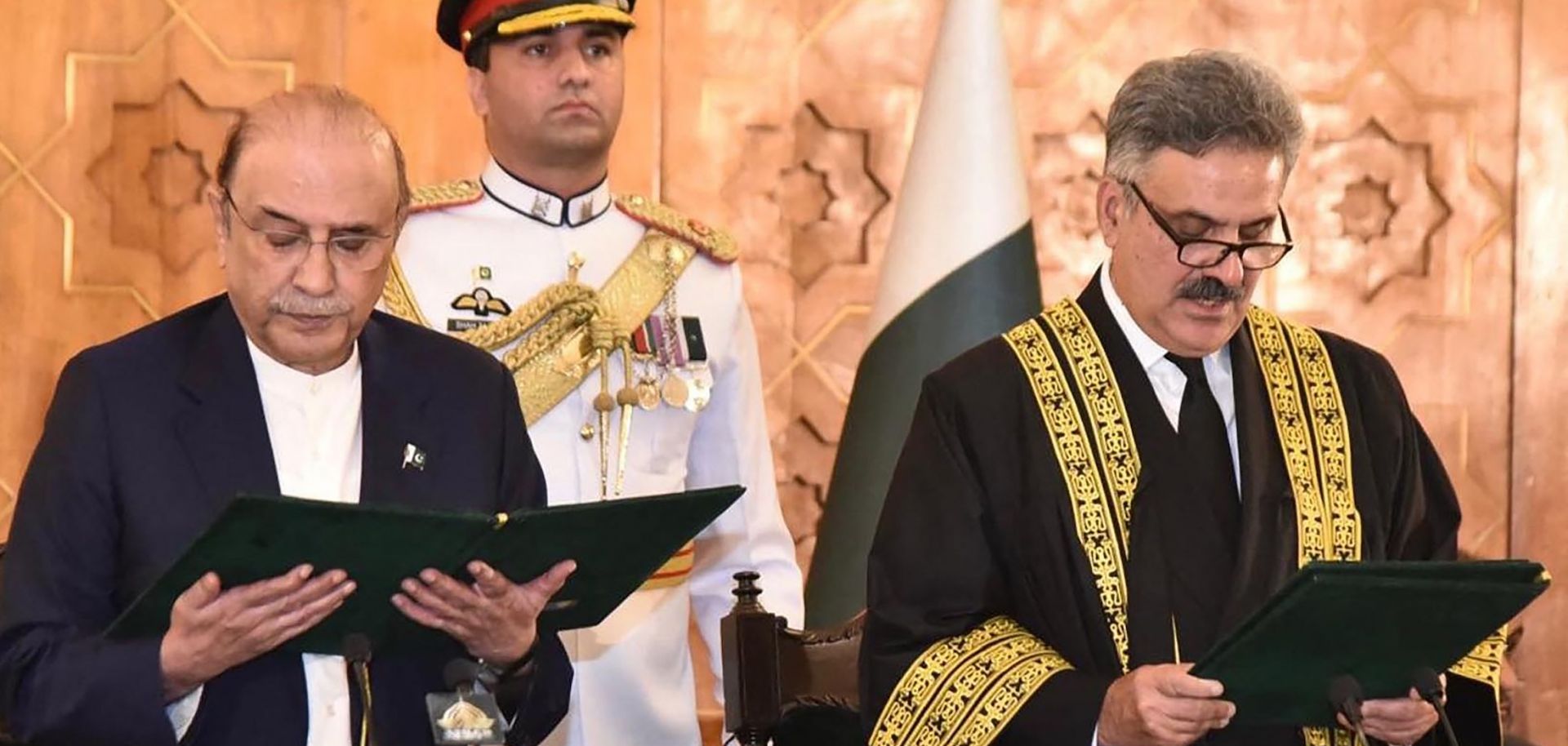
In Pakistan, a controversial judicial reform will grant the government more influence over the nation's top court by allowing it to appoint judges who align with its agenda, which will threaten the independence of the judiciary, deepen political polarization and likely provoke unrest. On Oct. 21, Pakistan's president signed the 26th Constitutional Amendment Bill into law after Parliament approved it. The bill removes the Supreme Court's ability to initiate cases on its own, establishes a three-year term limit for the chief justice of Pakistan, and authorizes a new special parliamentary committee to appoint the next chief justice from the three senior-most judges on the Supreme Court. Shortly after the bill's ratification, parliamentary leaders nominated lawmakers to sit on the 12-member special committee, with eight from the lower house (the National Assembly) and four from the upper house (the Senate). The committee then selected Justice Yahya Afridi to serve as Pakistan's next chief justice, usurping Justice Mansoor Ali Shah for the position, who was previously slated to take over on Oct. 25 as the senior-most Supreme Court judge. Opposition parties — including former Prime Minister Imran Khan's Pakistan Tehreek-e-Insaf (PTI) party and its ally, the Sunni Ittehad Council (SIC) — are on the special parliamentary committee, but both the PTI and SIC boycotted the chief justice vote to protest the new appointment process, arguing it granted Pakistan's executive branch outsized power over the judiciary.
- Under the previous system, Pakistan's chief justice served until reaching the retirement age of 65, and was then automatically replaced by the next senior-most judge on the Supreme Court. Per these rules, Justice Shah (who has served on the court longer than Afridi) was set to succeed outgoing Chief Justice Qazi Faez Isa, who turns 65 on Oct. 26.
The government accelerated the constitutional reforms amid fears the Supreme Court would side with the opposition and question the transparency of Pakistan's upcoming general election. Pakistan's coalition government campaigned vigorously for the constitutional amendments after Parliament rejected them in a previous vote held in September. The government feared that Shah's appointment as chief justice would increase the likelihood of the Supreme Court launching an investigation into alleged vote rigging in the general elections in February. These concerns were further bolstered by Shah's issuance of Supreme Court rulings favorable to Khan and his PTI party, including a July decision that affirmed the PTI's eligibility for legislative seats reserved for women and non-Muslim minorities, effectively revitalizing its status as a parliamentary party. But while the government eventually succeeded in pushing through the amendments, they were passed during a late-night session where lawmakers were allegedly intimidated and coerced into voting in favor of the reform.
The politicization of chief justice appointments risks undermining the Supreme Court's independence and ability to act as a check on Pakistan's executive and legislative branches. The constitutional changes shift the chief justice appointment process from an apolitical seniority system to one headed by a special parliamentary committee that is led by the prime minister and other executive representatives. This means the chief justice — Pakistan's highest judicial authority and final arbiter of the most politically significant cases — is no longer selected based on how long they have served on the Supreme Court, but on the preferences of a panel of mostly ruling party lawmakers. Indeed, while the new special parliamentary panel includes lawmakers from both the ruling coalition and the opposition, its composition is based on that of Parliament, which means governing parties hold the majority of seats just as they do in the legislature. This party representation structure inherently benefits the ruling government by enabling it to unilaterally push through chief justice appointments. With this power, the executive can now shape the Supreme Court's political alignment, ultimately weakening the judiciary's autonomy and ability to act independently of the government's agenda. The elimination of the Supreme Court's powers to initiate cases on its own will also diminish the accountability of the government and its officials, as it restricts the court's ability to address important public interest issues independently. Without this authority, the judiciary may be less able to challenge governmental actions or hold officials accountable for misconduct, thereby undermining its role as a check on government power.
The judicial reforms will likely further constrain Khan and his party's political influence by reducing their ability to obtain fair legal trials and enabling biased or politically motivated rulings against them. Concerns about the independence of Pakistan's judiciary have persisted for a long time, with accusations that the country's courts have historically served the military's interests. However, with several judges, such as Shah, recently issuing favorable rulings toward the PTI, the government and the army were likely inclined to pass this reform to prevent such judicial independence from undermining their control. Thus, weakening the judiciary further aligns with the broader objectives of the Pakistani military, which currently centers on constraining the PTI. This will, in turn, likely further erode public trust in the Supreme Court, which a growing number of Pakistanis already see as a tool of the ruling elite. As a result, the rule of law could further weaken, allowing for an increase in arbitrary or politically motivated decisions. In the near future, significant legal uncertainty is also likely as Pakistan's top court navigates its new jurisdictional boundaries, with much depending on the stance of incoming Chief Justice Yahya Afridi. Though there is no clear indication of his political leanings, his appointment suggests he may align with the government's desires.
- The International Commission of Jurists called the amendment a ''blow to judicial independence, the rule of law, and human rights protection'' in Pakistan, while Pakistan's Human Rights Commission echoed these concerns, specifically pointing out the executive branch's ability to appoint judges.
- The judiciary's lack of independence is highlighted by a recent incident where six senior judges publicly alleged intimidation and pressure from Pakistan's political establishment to avoid delivering favorable rulings in Khan's cases, citing interference from the country's premier intelligence agency.
As the PTI faces ongoing crackdowns and restrictions, the amendment will likely lead to heightened protests both domestically and internationally, drawing increased foreign attention to Pakistan's political situation, though responses from other countries are likely to remain largely rhetorical. With political polarization in Pakistan intensifying, the chances of unrest and public demonstrations are rising. Indeed, Khan's PTI party already staged nationwide protests on Oct. 18 against the constitutional reform, and has since pledged to organize additional mass protests following its recent approval. Meanwhile, the Pakistani government may again attempt to ban the PTI, which would only heighten the risk of social unrest by further angering Khan's many supporters. The government will likely also intensify its efforts to crack down on and systematically sideline Khan's party, with a compromised judiciary amplifying such efforts by restricting the PTI's ability to seek legal recourse. This suppression could discourage other opposition groups from pursuing legal avenues as well, likely triggering more protests and civil disobedience. Beyond the PTI, lawyer organizations and civil society groups in Pakistan are expected to announce plans for protests in the coming days, with a focus on defending judicial independence, which could also result in harsh crackdowns and confrontations with authorities, further escalating tensions. Additionally, due to the PTI's strong connections with the diaspora, protests could also spread to countries with large Pakistani communities, like the United States and the United Kingdom, especially if the Pakistani government's actions against the PTI escalate. Such protests could draw increased foreign attention to Pakistan's internal political situation, potentially prompting international governments to issue statements. However, given the lack of significant action from countries in the past over Pakistan's ongoing issues with undermining the judiciary and human rights violations, any international criticism is unlikely to go beyond mere rhetoric. This is underscored by the fact that no credit rating agency or financial institution like the International Monetary Fund has criticized the reforms — indicating that any economic repercussions are unlikely, which means the Pakistani government is also unlikely to reverse course on the controversial judicial reforms.
- On Oct. 23, U.N. Human Rights Chief Volker Turk expressed concern over Pakistan's 26th Constitutional Amendment, stating that it was ''adopted hastily and without broad consultation and debate.''
- Over 60 Democratic lawmakers in the U.S. House of Representatives recently sent a letter to President Joe Biden urging him to prioritize human rights in U.S. policy toward Pakistan and to secure the release of political prisoners, including Imran Khan. The lawmakers also called on Biden to leverage Washington's ''substantial influence'' over the Pakistani government to achieve these goals and address ''widespread human rights abuses.'' However, given the United States' focus on other priorities like the Ukraine and Gaza conflicts, along with Americans' still limited criticism of the Pakistani judicial reforms, Washington remains unlikely to sanction Pakistan or suspend economic aid to the South Asian country over the issue.
