

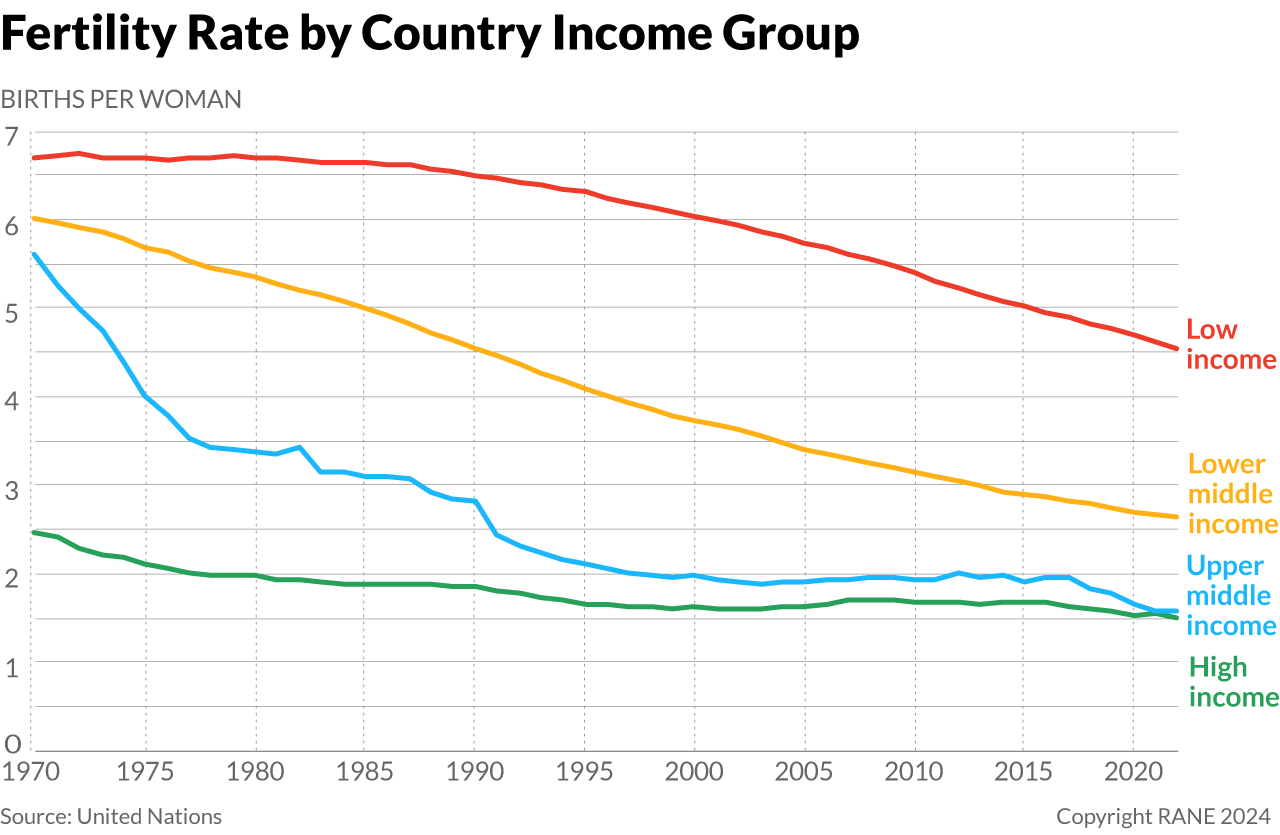
The world is undergoing extensive demographic changes that are slowing economic growth and raising public debt, increasing the risk of medium-term financial instability and conflict over resource distribution in many advanced economies while increasing political and economic instability in many low-income developing economies. Differing demographic developments around the world are giving rise to economic and political challenges. High-income (advanced) economies have been characterized by very slow population growth, stagnating population levels or even outright population decline, with Japan experiencing its first decline in population levels in 2011. This has led to a significant increase in the share of the elderly population and, in some cases, a decline in the working-age population in absolute terms. Meanwhile, upper-middle-income countries are undergoing very similar demographic changes, although they trail advanced economies by a decade or two. However, their demographic transitions frequently have been faster, largely due to rapid declines in fertility rates, which are largely driven by increased economic prosperity, rising levels of education (particularly among women), changes in cultural attitudes and higher costs of raising children, despite increased income levels. By contrast, low-income and many lower-middle-income (developing) economies continue to be characterized by rapid population growth and a swift increase in the number of working-age people.
- The world's population increased from 2.4 billion in 1950 to more than 8 billion in 2023. In its medium variant scenario, the United Nations projects the global population will peak at 10.3 billion in roughly 2080 and remain above 10 billion for the remainder of the decade.
- The replacement fertility rate describes the number of children a woman must have to ''replace'' herself by bearing a daughter, which is around 2.1 children per woman. A fertility rate of less than 2.1 will lead to population decline over the longer term. Decades of below-replacement fertility rates in advanced economies have begun to translate into stagnating population levels or outright population decline, particularly in countries characterized by low inward and large outward migration. Most countries experiencing population decline are located in Eastern Europe due to a combination of sharply lower fertility levels and net emigration, mainly to Western European countries.
- Other countries experience population decline due to mass emigration over economic crises, civil war or external armed conflict, such as Syria (until recently) and Venezuela. Ukraine, already demographically challenged before the full-scale Russian invasion in 2022, has lost an estimated 6 million-7 million people due to Ukrainians fleeing the war. As a result of the conflict and preexisting factors, Ukraine's population has fallen by a third since 1990.
Global demographic balances will continue to shift dramatically, with advanced and emerging economies aging rapidly in the context of slowly growing, stagnating or even declining populations, and developing economies experiencing rapid population growth. The differences in present demographic development between advanced, emerging and developing economies are stark. Virtually all advanced economies, such as those in East Asia and parts of Europe, have fertility rates below replacement level, which — absent substantial net immigration — will lead or has led to stagnating or declining working-age populations. Meanwhile, North and Latin America will register modest increases in population growth over the next quarter of a century, according to U.N. projections. Conversely, Africa, including North Africa and West Asia, a region dominated by low-income and lower-middle-income countries, will see significant population growth in the coming decades, including a sharp increase in working-age populations. In sum, all regions of the world except Africa, West Asia and South Asia will experience declining population levels over the next two generations unless fertility rates recover substantially and sustainably, which historically speaking is unlikely. The change in fertility, especially in low-income countries, has been taking place against the backdrop of increasing longevity and decreasing infant mortality, which further adds to overall population growth in the context of above-replacement fertility rates.
- Fertility rates have fallen virtually everywhere in recent decades, but they differ significantly across high-income, middle-income and low-income countries. In low-income countries, the fertility rate is 4.6 children per woman, in middle-income countries 2.1 (ranging from 2.6 in lower-middle-income countries to 1.5 in upper-middle-income countries), and 1.5 in high-income countries. Geographically, the average fertility rate of African countries is above 4, ranging from 6.6 in Niger to 2.3 in South Africa. By contrast, fertility rates are below replacement in Asia (1.9), North America (1.8) and Europe (1.5). In Asia, the rate varies from 2.9 in Central Asia to 1.2 in East Asia.
- By 2050, the population of sub-Saharan Africa will be 2.1 billion (compared with 1.2 billion today), Latin America 730 million (660 million today), North America 430 million (390 million today), South Asia 2.5 billion (2.1 billion today), Western Europe 112 million (125 million today), Northern Africa 370 million (270 million today) and East Asia 1.5 billion (1.7 billion today). These projections are based on the United Nation's medium variant scenario, which likely underestimates the speed at which fertility rates will decline in countries that are currently experiencing rapid population growth.
- The total fertility rate in a specific year is defined as the number of children that would be born to each woman if she were to live to the end of her childbearing years and give birth to children in alignment with the prevailing age-specific fertility rates. It is calculated by totaling the age-specific fertility rates as defined over five-year intervals, according to the Organization for Economic Cooperation and Development. In other words, the fertility rate is an unobserved variable.
Advanced economies often struggle to implement economic reforms that negatively affect elderly voters and costly social security regimes, and developing countries can struggle to integrate a growing working-age population into their workforces. While total population levels in advanced economies may not decline thanks to immigration, the elderly population will continue to increase relative to the working-age population. This emerging ''gray majority,'' however diverse it may be politically, shares an interest in defending pension and healthcare spending and opposes cost-saving reform of the social security regime. This raises the medium- and long-term challenges to government finances. As a result, governments face difficult choices in terms of raising taxes, reducing spending or allowing for a larger fiscal deficit to increase debt, which could jeopardize economic and financial stability by slowing economic growth. Meanwhile, societies that are rapidly expanding demographically also face significant economic challenges in terms of integrating an expanding working-age population into the economy. As these countries are often very poor, governments find it difficult to provide education and infrastructure to support strong, sustainable economic growth and facilitate the integration of young people into the economy. This so-called youth bulge often makes countries more prone to domestic political violence and instability, which weighs further on economic development, foreign investment and supply chain integration.
- All other things being equal, the combination of demographic stagnation in advanced economies and rapidly expanding working-age populations in Africa, the Middle East and Central Asia will translate into greater migration to Europe and Eurasia, including Russia. By comparison, North America will face less pressure given a demographically rapidly maturing Latin America, which will likely significantly reduce irregular migration to the United States over time. However, migration pressure is not simply a function of demographics, even though the latter plays an important role. Rather, political and economic conditions in sender countries with large population increases matter, as do the immigration policies of the target countries.
Rapidly aging societies face significant economic challenges, including slowing growth and rising budgetary pressures. To gauge how fast a population is aging, demographers often use the ''old-age dependency ratio,'' which compares the number of people aged 65 or older to the number of working-age people between the ages of 16-65. As this ratio grows, government deficit and public debt also tend to increase, as elderly people usually consume more than they generate in terms of income (via economic activity and being part of the labor force). This, in turn, typically forces governments to spend more on pensions and healthcare for aging adults, which subsequently intensifies political tensions over how resources are allocated and to whom, also known as distributional conflict.
- Unlike old-age dependency ratios, total dependency ratios take into account the ratio of people under the age of 16 (in addition to those over the age of 65) in comparing the non-working age population to the working age population. In countries across East Asia, North America and Europe, the total dependency ratios will continue to increase between 2025 and 2050, in some cases sharply. In Japan, the total dependency will reach 95% and the old-age dependency ratio will reach 80%, meaning that for every four people older than 65, there will only be five people of working age. By 2050, China's overall dependency ratio will increase from 23% to 55% amid the country's fast-accelerating demographic decline. India's old-age dependency ratio will rise from 10% to 20%, while the United States' will rise from 28% to 38%. By contrast, African countries' overall dependency ratio is expected to decline between 2025 and 2050.
To overcome labor shortages and combat population decline, governments in rapidly aging countries can seek to bring more people into the workforce and/or boost the productivity of their current workforce. The economies of demographically challenged countries are not doomed. In fact, in most cases, labor productivity growth of 1-1.5% should be enough to offset the drag generated by an aging workforce — something that can be accomplished in various ways. Liberal migration policies, for example, can help fill jobs by attracting foreign labor, but they often also lead to domestic political tensions and polarization. Third, where female labor participation rates are low, policies that help integrate women into the labor market, such as subsidized childcare, can help. However, the availability of this option is somewhat constrained in countries with high female labor participation rates. Governments can also enact policies aimed at keeping older people in the workforce for longer via disincentives (like raising the retirement age) and/or incentives (like offering more flexible work arrangements), which can not only help slow the impact of a declining working-age population, and can also alleviate the immediate pressure on the social security system and public finances. But such policies also carry the risk of backlash, not the least due to the increasingly large and influential ''gray majorities'' of the countries grappling with demographic declines. Natalist policies may somewhat slow population decline in the longer term, though in the recent past, they have proven financially costly and minimally impactful in terms of actually boosting birth and fertility rates. Given the drawbacks of these various policies, measures that seek to make the current workforce more productive, as well as policies that incentivize people to retire later, perhaps hold the most promise. In particular, investing in technological innovation — such as AI and automation — could offset the negative impact of declining labor on per capita income by accelerating productivity growth.
While low-income countries are in a more favorable demographic position compared with their high-income peers, they still face challenges connected to high unemployment, political instability and domestic conflict. Many low-income countries are currently experiencing a decline in fertility rates while their work-age populations are still expanding, which means that their labor force is growing larger relative to its dependent (young and elderly) population. If managed properly, this phenomenon (commonly known as a ''demographic dividend'') can lead to faster economic growth. An expanding working-age population means that there is more labor available, while a falling dependency ratio makes it easier to generate higher savings, provided the government pursues appropriate macroeconomic policies However, low-income countries are often unable to take advantage of the demographic dividend due to structural constraints, including inadequate education systems that leave young workers without the requisite skills to add much in terms of productivity growth. Poor countries also lack the capacity to make significant investments in education and infrastructure, which either holds back economic growth or caps it at a level insufficient to absorb a rapidly growing youth population into the workforce. This, in turn, often results in high youth unemployment, which contributes to domestic political instability that usually leads to destabilizing economic policies (including overborrowing and debt crises) and, in some cases, armed insurgencies and civil war.
