
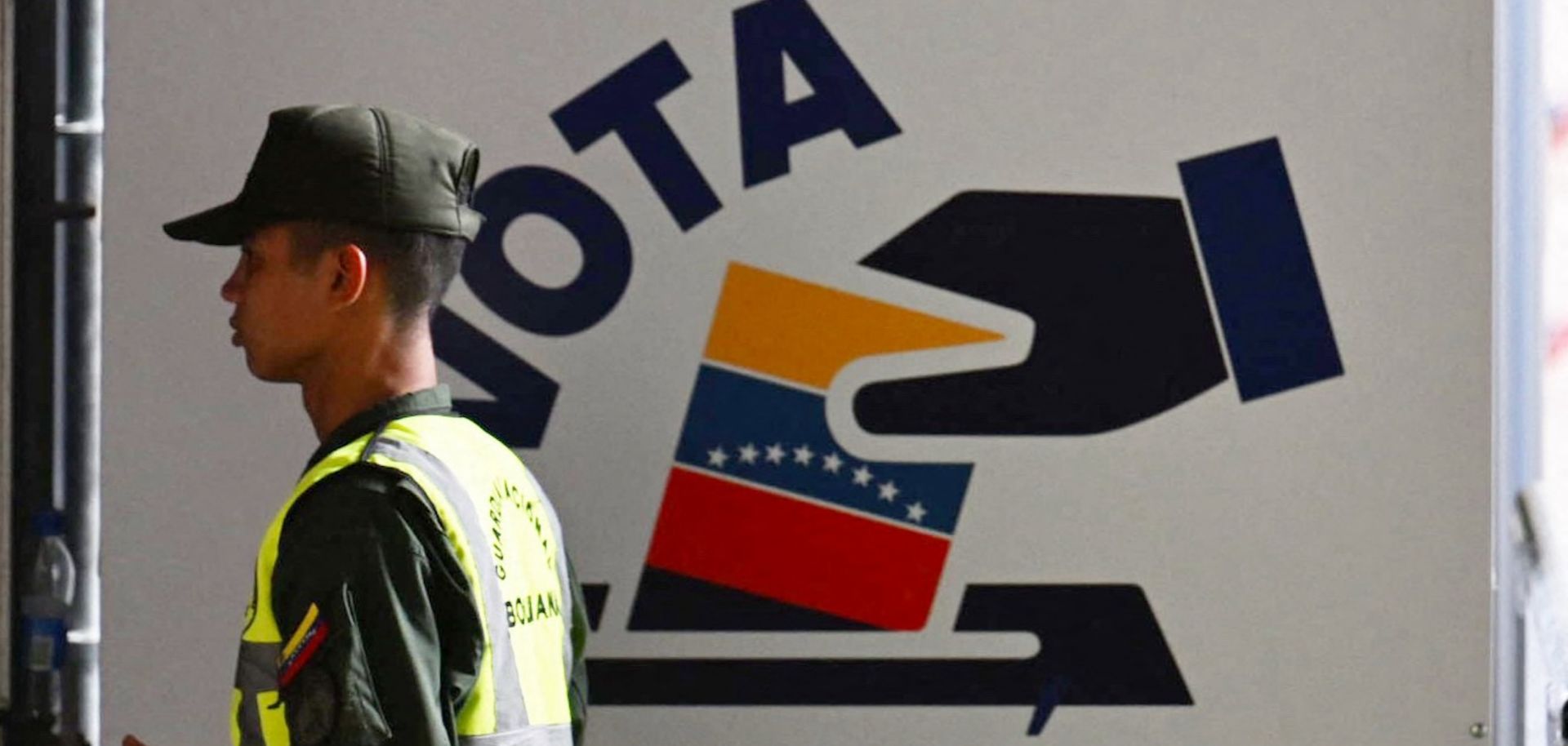
Venezuela's presidential election will be neither free nor fair, meaning the United States will likely uphold oil sanctions, which will fuel migrant outflows by deepening the country's economic crisis. Venezuela will hold presidential elections on July 28. Amid pressure from the international community, President Nicolas Maduro and opposition leaders signed the Barbados Agreement in October 2023 to ensure the presidential race would be competitive, which saw the United States temporarily suspend its sanctions on the country's oil, gas and mining sectors that made it illegal for U.S. firms to do business with Venezuelan state-run enterprises. However, to clear his path to victory, Maduro has since used his influence over judicial and electoral bodies, as well as the media, to sideline, silence and persecute opposition leaders, including Maria Corina Machado, who had been the opposition's leading presidential candidate before a Supreme Court ruling in January barred her from running for office. Against this backdrop, the United States reimposed sanctions in April amid the Maduro government's failure to ensure a free and fair election. After Machado's disqualification, Edmundo Gonzalez Urrutia, a 74-year-old retired diplomat, has taken over as the opposition's main presidential candidate, but Machado remains the face and primary leader of the Venezuelan opposition and has lent her political capital to Urrutia by attending several crowded rallies together across the country.
- This election marks the first time the Venezuelan opposition has united around a single candidate since 1998, when Maduro's predecessor and mentor, Hugo Chavez, ascended to power. Maduro is running for his third six-year term.
- The opposition has denounced an escalation in political persecution since campaigning for the presidential race began in July amid the arrest of dozens of opposition supporters and leaders, the harassment of businesses and service providers to their campaign (including restaurants and hotels), and alleged sabotage against vehicles used by Machado and her team.
- To further suppress opposition votes, the Maduro government has also manipulated the number and distribution of polling stations on election day, and has created obstacles for the roughly five million Venezuelan voters living abroad — who represent about a quarter of the electorate — to cast their ballots in the presidential election.
Regardless of the election's results, Maduro will leverage his control over Venezuela's bureaucracy and armed forces to remain in power and repress the likely nationwide protests against his continued rule. Maduro will likely stay in power, despite most polls indicating he is trailing Gonzalez Urrutia by at least 30 percentage points in a simple majority-wins vote. Maduro's options to remain president range from fraud and vote rigging on election day, to the widespread nullification of votes and orchestrated lawsuits to disqualify the opposition before or after the vote occurs. He could also resume military threats against neighboring Guyana or pursue other similarly extraordinary measures that would trigger a state of emergency, which would enable him to overhaul the election rules and timelines. Given Venezuelan citizens' vast support for the opposition and heightened dissatisfaction with their country's socio-economic crisis, any election outcome that is not an opposition victory will likely trigger anti-government protests. However, such demonstrations would unlikely be as widespread as those in 2019 amid a growing sense of fatigue and disillusionment among parts of Venezuelan society after multiple failed attempts at restoring the country's democratic institutions following Venezuela's authoritarian slide in recent decades. To suppress any post-election protests, the Maduro administration will likely deploy Venezuela's armed forces, whose continuous support and loyalty will remain critical in determining Maduro's ability to stay in power. But the government's efforts to crack down on any post-election protests are also unlikely to be as severe as they were five years ago, which resulted in the death of over 120 people, because Maduro now faces a more fragile situation domestically and abroad than he did in 2019.
- On July 17, Maduro said he needed to win reelection to prevent a "bloodbath" and a "civil war" since only a win for his party would ensure peace in Venezuela.
Maduro's permanence in power will likely result in stricter U.S. sanctions on the country's crucial oil sector, further dimming Venezuela's economic outlook in the long term. Maduro's reelection will likely prompt the international community — and particularly the United States — to increase pressure on Caracas amid an autocratic escalation. Between the July 28 vote in Venezuela and the U.S. election in November, Washington's response will probably remain tame, as U.S. President Joe Biden will avoid measures that could backfire on his Democratic Party — namely, harsher sanctions on Venezuela's oil sector, which would risk angering American voters by causing a spike in global gas prices. But once the U.S. election is over, the White House will likely resort to stricter measures against Caracas — especially if former President Donald Trump is reelected, given that Trump took a notably hawkish stance against the Maduro government during his first term. To increase pressure on the Maduro administration, in the longer term, the United States could move to further limit or even fully suspend licenses that have allowed certain oil companies to continue operating in Venezuela, despite U.S. sanctions. Washington could also reimpose a ban on Venezuelan sovereign bonds' secondary trading, which would further complicate Caracas' already difficult negotiations with creditors to restructure its debt. Indeed, with Maduro likely resorting to fraud and oppression to remain in power, such debt restructuring negotiations will be indefinitely postponed.
- Venezuela's GDP plunged 71.5% between 2013 and 2020, and despite recovering in recent years, the country's GDP is still projected to stand at 59% below levels of a decade ago by the end of 2024, according to the International Monetary Fund (IMF).
- Venezuela's oil production has sharply fallen over the past decade amid heightened corruption and inefficient management of the state-owned oil company PDVSA. After peaking at 3.453 million barrels per day (bpd) in December 1997, the country's oil output hit an all-time low of 392,000 bpd in July 2020, as severe U.S. sanctions and COVID-related dips in global energy demand exacerbated the oil sector's challenges. Most of this decline, however, occurred before the Trump administration sanctioned Venezuelan oil in 2019.
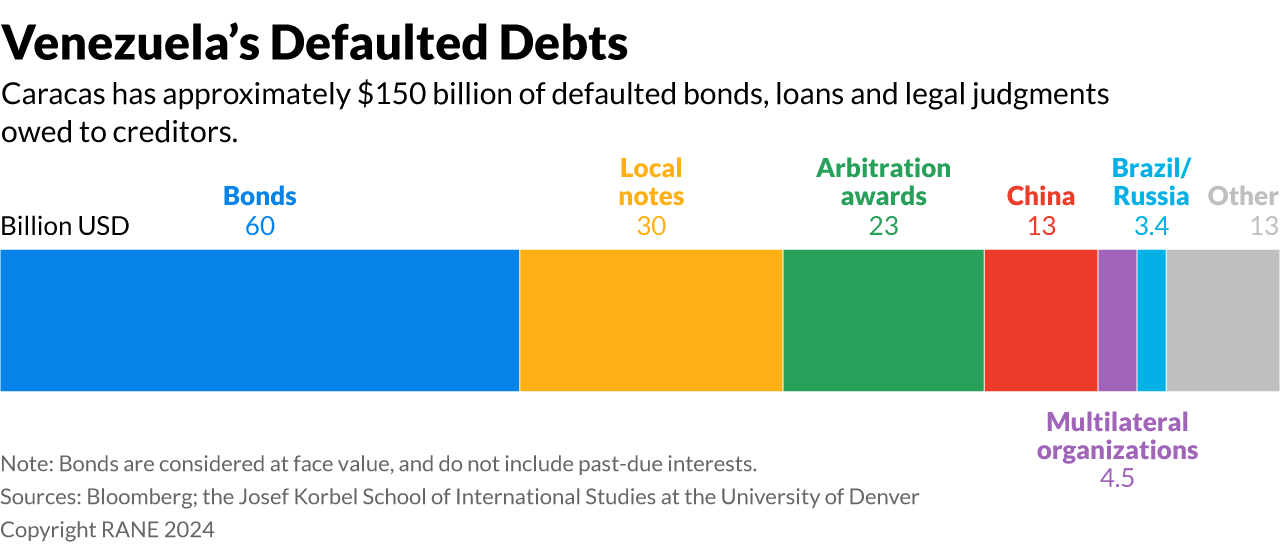
- Venezuela has defaulted on approximately $150 billion of debt, according to a University of Denver report. Venezuela's sovereign debt alone amounts to $60 billion at face value. A report by the think tank Chatham House indicates that U.S. investors currently control about 50-55% of sovereign and PDVSA debt, down from 75% to 80% before the 2019 U.S. oil sanctions.
- In 2019, then-U.S. President Trump recognized opposition leader Juan Guaido as Venezuela's rightful leader, and also imposed sweeping sanctions on Venezuela's oil sector in an effort to pressure Maduro to give up power. This, combined with the fact that Trump has strong anti-Maduro supporters in his base, indicates Trump would resume this hawkish stance against the Maduro government if he is reelected in November.
Venezuela's increasingly dire economic conditions and repressive political environment will fuel migration outflows, which will likely, in turn, pose additional social and security challenges across Latin America. Additional U.S. sanctions will further erode the Maduro administration's access to oil export revenue, which will increasingly undermine the government's capacity to provide even basic services to its people or import staple goods (like food, personal hygiene products and medicine), likely leading to shortages while exacerbating inflation. Venezuela's increasingly dire economic and political outlook under Maduro will, in turn, likely intensify the exodus of people who have fled the country since Venezuela's economic crisis took a turn for the worse in 2015. This will create more humanitarian, political and security challenges for nearby Latin American countries, as well as the United States, where Venezuelans are resettling. Amid the new influx of migrants crossing their borders, governments across the region will face fiscal and political costs of providing these Venezuelans basic access to healthcare, education and employment opportunities, which could burden their budgets and spark political backlash by stoking fears among their citizens that the migrants are taking jobs and straining government services for natives. The increased outflow of Venezuelan migrants will also likely worsen the security environment across the region, as organized criminal groups — especially the Venezuelan Tren de Aragua — have taken advantage of the diaspora to infiltrate neighboring countries, portending increases in violent crime and occasional turf wars with local gangs.
- More than 7.7 million people have left the country over the past decade amid the country's economic degradation that has pushed roughly 80% of Venezuelans into poverty, according to U.N. data.
- Venezuelans are now the second-largest source of undocumented immigrants crossing the U.S.-Mexico border, second only to Mexicans.
- Three-quarters of those who have left Venezuela over the past decade have resettled in countries across Latin America and the Caribbean, with Colombia being the main recipient (hosting 2.9 million Venezuelan migrants), followed by Peru (1.5 million), the United States and Brazil (which each host some 520,000 Venezuelan migrants), and Chile, Ecuador and Spain (with some 460,000 each), according to the United Nations.
In an unlikely scenario where the opposition wins the presidential election in an undeniable landslide, Maduro may be forced to negotiate a power handover as part of a broad deal that gives him and his allies immunity. Despite Maduro's efforts to undermine his political rivals ahead of the ballot, there is still a small chance that opposition candidate Urrutia could win the July 28 presidential election in a landslide big enough that vote rigging cannot prevent him from being declared the victor. Under this scenario, opposition leaders could leverage the strong mobilization capacity demonstrated throughout the campaign to ensure that vast social mobilization (e.g. protests), coupled with international pressure, prevents Maduro from nullifying Urrutia's victory. Against this backdrop, Maduro may agree to negotiate the terms of a transition of power. Such a deal would be mediated by regional leaders, and would likely include broad amnesty to incentivize Maduro and the upper echelons of his administration and the military to give up power, especially since they face multiple accusations of human rights violations, including an investigation at the International Criminal Court (ICC). This could include appointing Maduro to a lifetime position in the National Assembly, which would grant him parliamentary immunity. It could also see Venezuela removed from the Rome Statute so ICC decisions targeting other members of the regime would not be enforced. This scenario could delay the opposition taking over on the scheduled date of Jan. 10, 2025, as such negotiations would likely take time. In the long term, the resumption of democratic norms would lead to the lifting of sanctions, creating the conditions for a gradual economic recovery, which would likely alleviate the root causes of the ongoing migration crisis, although rebuilding the country's oil production capacity and productivity would probably take several years. But even if Maduro agrees to hold negotiations following a landslide opposition victory, the talks would not be guaranteed to yield a deal, as hard-line Venezuelan opposition leaders and human rights activists would be almost certain to advocate for holding Maduro and his inner circle accountable for their actions in office.
- Colombian President Gustavo Petro and Brazilian President Luiz Inacio Lula da Silva have reportedly sought to propose a transition plan in Venezuela that would aim to ensure no political persecution occurs in the country regardless of the result of the presidential election.
