
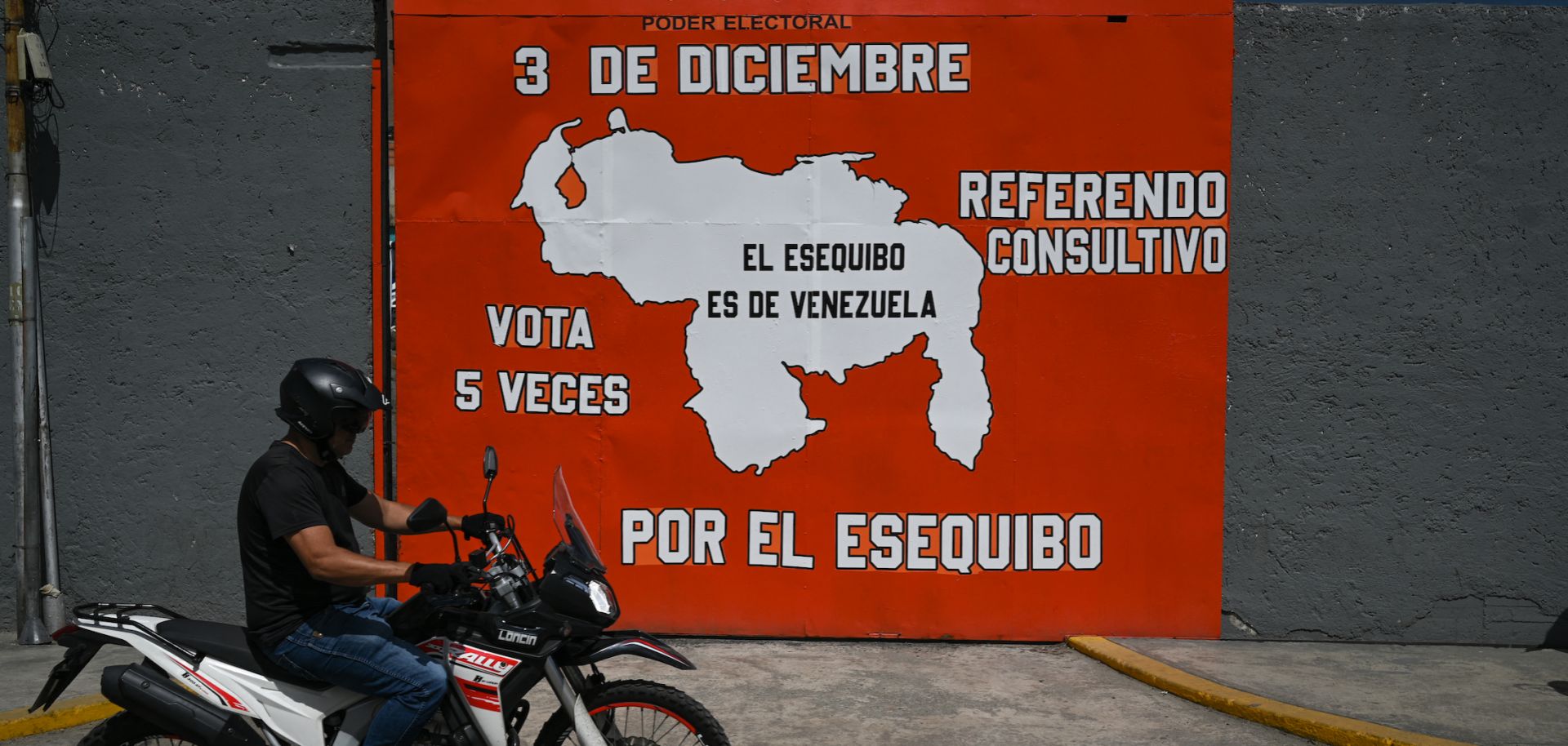
The Venezuelan government will likely use the results of the referendum on the Guyana territorial dispute to drum up political support ahead of the 2024 presidential election, but Caracas remains unlikely to launch a full-scale invasion of its eastern neighbor, despite Venezuelans overwhelmingly supporting their country's sovereignty claims to Guyana's Essequibo region. On Dec. 3, Venezuela held a national referendum that asked citizens several questions regarding their country's long-standing territorial dispute with Guyana. Over 95% of voters answered ''yes'' to the most controversial question on the ballot, which asked whether they supported the creation of a Venezuelan state in all of Guyana's territory west of the Essequibo River — a region that accounts for roughly two-thirds of the country — and its inhabitants given Venezuelan citizenship. Voters also backed the Venezuelan government's rejection of the International Court of Justice's jurisdiction on the long-running territorial dispute with Guyana, which dates back to the late 19th century when Guyana was still a British colony. The referendum was non-binding, meaning its results will not force Caracas to annex the territory and create a new state. But the outcome of the vote has further increased tensions in the region over what President Nicolas Maduro's government may do next. Ahead of the referendum, Brazil's ministry announced on Nov. 29 that it ''intensified defensive actions'' along its northern border; two U.S. military assistance teams also met with Guyanese defense forces on Nov. 27-28.
- The Essequibo region makes up two-thirds of Guyana's territory. The area also encompasses several mining resources onshore, as well as potentially extensive oil and gas reserves off its coast.
- On Dec. 1, the International Court of Justice (ICJ) issued a ruling ordering Venezuela to not take action that could aggravate its dispute with Guyana, which Caracas promptly rejected. While the ICJ ruling did not explicitly call on Venezuela to halt the referendum, the language used was widely seen as an attempt to deter Venezuela from holding the vote. The ICJ is also currently considering a 2018 request by Guyana to validate the 1899 Paris Arbitral Award, which gave territory to then-British Guiana.
- The Venezuelan government scheduled the referendum shortly after Guyana received bids for new offshore oil blocks in September. The referendum also appears to be in response to an ICJ decision in April 2023 that found the international court had jurisdiction over the case.
The referendum is part of a strategy to strengthen the government's popularity ahead of presidential elections where a key opposition leader will be allowed to run. The Venezuelan government is preparing to hold presidential elections next year, in its effort to secure greater U.S. economic and political concessions by creating the perception of a democratic opening. To give the election some degree of credibility, Caracas is allowing popular opposition figure Corina Machado to compete against Maduro in the presidential race. Against this backdrop, Maduro will try to offset Machado's popular support by exploiting nationalist sentiment over the Essequibo region. Many Venezuelans would react positively to any military operations or provocative moves against Essequibo, particularly as Maduro's government would point to Guyana's lucrative offshore oil and gas industry as a possible source of future Venezuelan wealth. In fact, Guyana's oil production is expected to increase to 1.3 million barrels per day by 2027 — nearly double Venezuela's current level of oil production — from 360,000 barrels per day today and zero from 2019, as ExxonMobil and its partners pour money into an offshore oil block that partially lies in the disputed waters off the coast of Essequibo.
- On Oct. 19, the U.S. Treasury's Office of Foreign Assets Control issued a six-month general license allowing Venezuelan state-owned oil company Petroleos de Venezuela to export crude oil and fuel to the United States. In exchange for the sanctions relief, Caracas agreed to hold free and fair elections and release political prisoners. The agreement followed Washington's move last year to relax restrictions on Venezuela to allow U.S. oil and gas giant Chevron — one of the largest foreign oil producers in Venezuela — to resume certain operations in the South American country.
- Machado unexpectedly dominated the opposition's presidential primary on Oct. 22, winning 93% of the vote. A week later, Venezuela's Supreme Court suspended the primary after Prosecutor General Tarek William Saab announced that his office was opening an investigation into the vote, citing potential election fraud, illicit financing, and the fact that the event took place without the authorization of the National Electoral Council. The suspension appears to violate the U.S. deal to hold free and fair elections, but on Nov. 30, the Maduro-led government reached a deal with the Venezuelan opposition on an appeals process for banned candidates like Machado to run in the election, with appeals needing to be filed by Dec. 15.
- Over the last decade, Venezuela has repeatedly used the Essequibo dispute to drum up popular support and protest Guyana's burgeoning oil industry. In 2013, Venezuela's navy seized an Anadarko-contracted oil and gas research vessel in disputed waters amid intense protests following close elections and the death of former Venezuelan President Hugo Chavez. After ExxonMobil discovered the Liza oil field in 2015, Maduro ordered the creation of a new military zone extending Venezuela's territorial claims deep into the eastern half of Guyana's maritime region, including the area encompassing the newly discovered Liza field. In 2018, Venezuela's navy harassed an Exxon-contracted research vessel just hours after Guyana's parliament ousted the government in a surprise no-confidence vote.
In response to the referendum's results, Maduro's government may pursue symbolic and/or escalatory measures, like proclaiming the annexation of the Essequibo territory, which could prompt the United States to reimpose sanctions. The Maduro government has many political and military resources at its disposal to increase pressure on Guyana. Low-cost moves that would increase domestic support ahead of the election without exposing Venezuela to significant repercussions include granting Guyanese living in Essequibo citizenship and including the region on official maps of Venezuela (without formally annexing the territory). These measures would largely be symbolic, as the government would know that most Guyanese offered citizenship would reject it and/or wouldn't be in a position to vote in next year's election or demand subsidies that the socialist state gives out. Venezuela's more aggressive options include declaring the formal annexation of the territory, creating a state government in Essequibo, and/or appointing an administrative leadership for the territory without making any concrete moves toward imposing these claims on the ground. Such moves would likely prompt the United States to reimpose its recently relaxed sanctions on the Venezuelan oil industry, as President Joe Biden tries to refute criticism that he's being too soft on Venezuela (following the recent election deal) — and on authoritarian governments more broadly (like Russia following its annexation of Ukrainian territory) — ahead of the U.S. 2024 election.
However, Venezuela remains unlikely to actually invade Guyana due to logistical constraints and the risk of international sanctions. While there's a chance Caracas could pursue these more aggressive measures, a full-blown military conflict, including a proper Venezuelan invasion, remains highly unlikely. Venezuela's military forces far outstrip those of Guyana, which does not even have a formal navy. However, a broad land conflict would be difficult for either side to engage in, as there are no paved roads connecting Venezuela to the Essequibo region. The dense jungle would also make it difficult for any military, including Venezuela's, to sustain a major military operation. If the Venezuelan military launches a land operation on Guyanese territory, it would thus likely remain limited in scope, such as a border incursion in an attempt to occupy a mining site or a village, or a handful of helicopter raids attempting to do so. A Venezuelan invasion of Guyana would also deepen Caracas' isolation in Latin America. While several left-wing governments in the region have friendly ties with Maduro's government, Latin American governments have a very low tolerance for military aggressions. Most would thus likely reduce or even sever their diplomatic ties with Venezuela in the case of an invasion.
Even without a formal invasion, Venezuela's actions will increase security risks for small oil and natural gas vessels in the region. In the coming months, the Venezuelan government will primarily focus its efforts at sea, as it has in the past. Venezuela's navy is more than capable of harassing small oil and gas research vessels, as well as Guyanese commercial fishing vessels. Such vessels would be the most likely targets of any aggressive maritime activity that the Maduro government engages in following the referendum. Caracas is less likely to launch a naval assault on a large tanker in Guyanese waters, near ExxonMobil's offshore projects, due to logistical constraints, and the fact that such harassment or attacks would risk provoking a larger U.S. response. So long as Venezuela continues to prioritize the lifting of U.S. sanctions to help bolster its ailing oil and gas sector, Caracas will likely be limited in how far it is willing to go against Guyana. However, if Venezuela pulls out of the political agreement with the United States or violates the agreement, it could signal that Caracas is considering a more aggressive move against Guyana, including annexation of the Essequibo region or large-scale harassment against more oil and gas infrastructure there.
- While Venezuela may prefer to target smaller research vessels than tankers, seismic surveying activities in Guyana have become less frequent, with ExxonMobil now in the development phase of the Stabroek block. But such activity is slated to again increase in the coming years as Guyana offers other companies new blocks and exploration deals.
- Chevron's ongoing acquisition of Hess Corporation, ExxonMobil's main partner in the development of the Stabroek block, will further constrain Venezuela's ability to target ExxonMobil-led production in Guyana. Caracas is hoping that Chevron boosts investment into Venezuela to raise oil production, but if Venezuela harasses Chevron and its soon-to-be assets in Guyana (which are much more lucrative than its assets in Venezuela), the company may reduce its operations in Venezuela, which are far less lucrative than its Hess Corporation's Guyana assets.
