
For nearly 50 years, Venezuela has claimed almost all territory west of the Essequibo River as its own. In 1899, an international arbitration ruling granted the land to the United Kingdom, from which Guyana subsequently became independent. But in the late 1940s, Venezuela rekindled the dispute; by 1962, it had begun actively seeking to reclaim the territory.
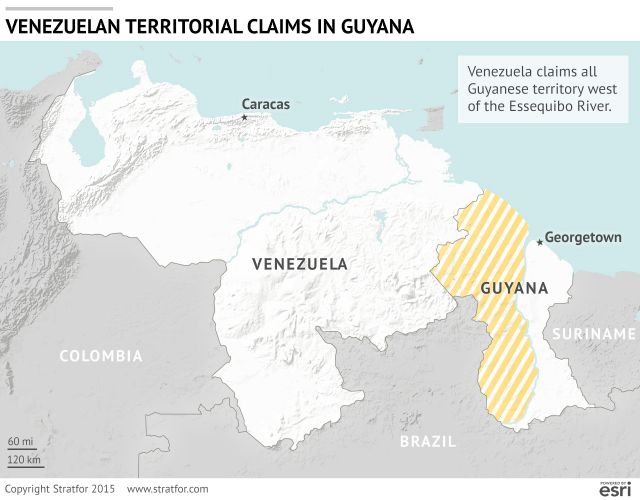
ExxonMobil's discovery earlier this year of offshore oil deposits in maritime areas that are not legally defined by any agreement between the two countries further stoked the conflict. Since then, Maduro's government has frequently used the oil discovery and the broader disagreement to boost its own support at home, claiming that the United States and international oil companies are illegally claiming offshore oil resources at Venezuela's expense. In recent weeks, tensions have escalated even more: Venezuela held military exercises involving several thousand troops in the eastern state of Bolivar, while Guyana claimed that Venezuelan river patrol craft on the Cuyuni River violated its border.
The current disagreement between Venezuela and Guyana bears some similarities to Venezuela's ongoing border contest with Colombia. Just as Maduro's government has attempted to portray itself as a protector of Venezuelan interests against alleged Colombian criminals to domestic audiences, it is now casting itself as the defender of Venezuela's territorial claims west of the Essequibo River.
But Guyana will not abandon its efforts to pursue its border claims at the International Court of Justice over the next several years. The Venezuelan government likely realizes that it cannot stop Guyana, and the costs of using the military to press Guyana into withdrawing its territorial claims may be too high for Venezuelan officials' liking. Meanwhile, the possible rewards of such action are uncertain. The United States could respond to any measures more aggressive than the token military exercises seen so far with targeted sanctions against Venezuelan leaders, who currently appear to be more focused on securing their lasting hold on the government before December's elections than on resolving long-standing border issues. Still, Venezuela's claim to the Essequibo region is politically popular among citizens regardless of political affiliation, meaning that domestic resistance to any added Venezuelan pressure on Guyana to back down could be minimal.
Consequently, further inflammatory political rhetoric concerning the Essequibo dispute may emerge from Venezuela and Guyana in the coming months. It is unlikely, however, that Venezuela will be able to do much to minimize Guyana's claim to the region over the long term. Short of military action, which would be logistically difficult and politically problematic for Venezuela, Caracas has few tools at its disposal with which to pressure Guyana. Thus the best the Venezuelan government can hope for is to maintain the status quo for as long as possible using dialogue — and on occasion, threats — to exploit the quarrel for political gain at home.
