
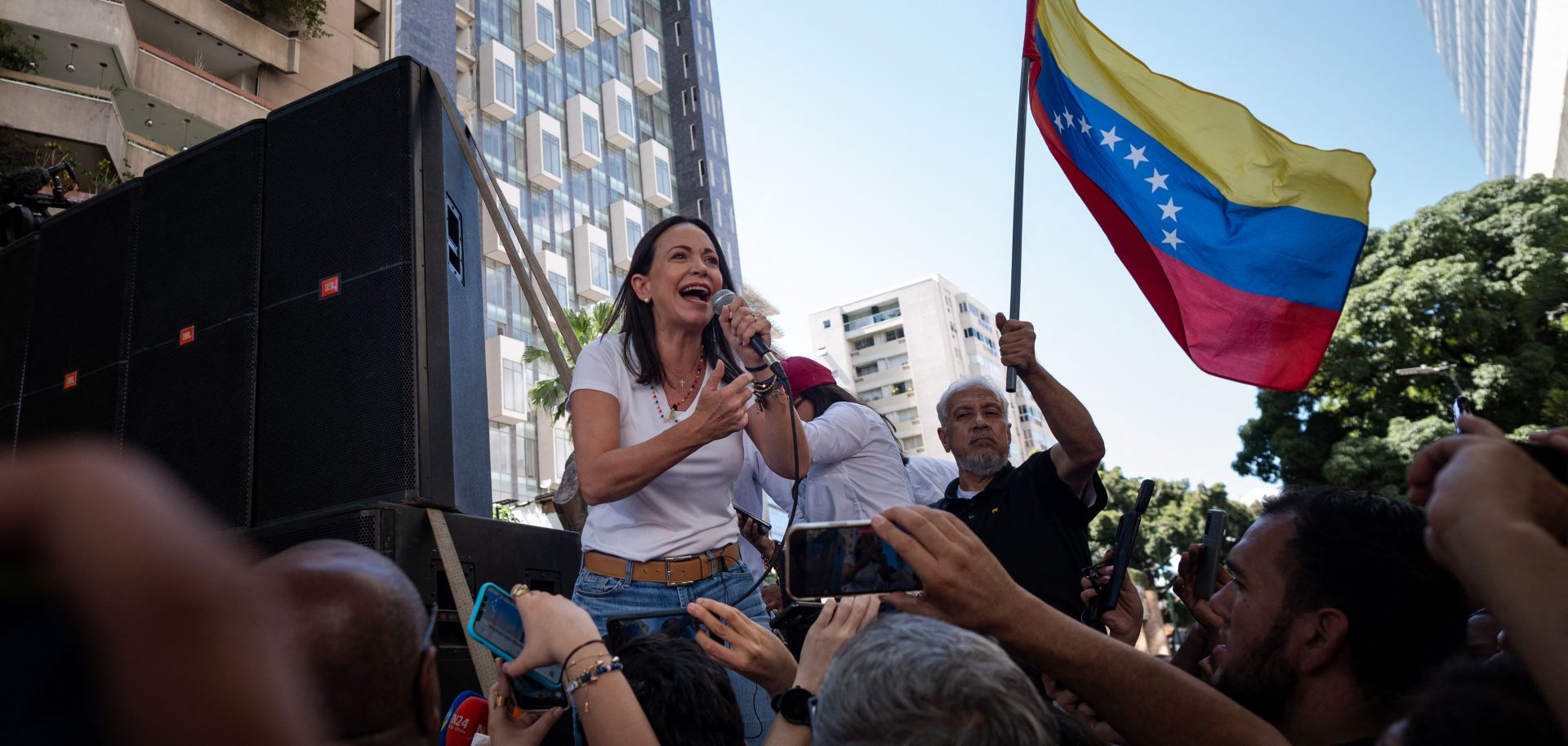
In Venezuela, a Supreme Court ruling barring the leading presidential candidate from holding office effectively terminates a deal between the opposition and the government of President Nicolas Maduro to hold relatively free elections, opening the door to additional government repression and the snapback of U.S. sanctions. On Jan. 26, Venezuela's highest court, the Supreme Court of Justice (TSJ), upheld an earlier ruling against Maria Corina Machado, the leading opposition candidate in the 2024 presidential elections, that bars her from holding public office for 15 years. The court alleged that Machado took part in a ''corrupt plot'' with former U.S.-recognized interim President Juan Guaido to ''dispossess'' Venezuela of state assets, including some $32 billion tied to Citgo Holdings and 31 tons of Venezuelan gold held abroad. Machado stated that the court's decision essentially nullified a set of internationally-mediated agreements that the opposition's Unitary Platform and the Venezuelan government signed in Barbados on Oct. 17, called the Barbados Agreement, which designed an electoral framework for free and fair elections in the latter half of 2024.
- The TSJ also upheld a ruling on Jan. 26 that barred Henrique Capriles, another prominent opposition candidate, from holding office until 2032.
The court's decision comes after Machado had consolidated opposition support, and follows a pattern of government interventions to curtail the opposition's electoral chances. On Oct 22, Machado won a primary organized by the opposition with 93% of votes cast from over 2 million Venezuelans and became the Unitary Platform's candidate. Machado is a pro-market candidate who has advocated policies like privatizing Venezuela's state-run oil firm PDVSA. Shortly after the primary, President Maduro called the vote an electoral ''farce.'' A week after the vote, the TSJ ordered the opposition to ''suspend'' the primary process, and mandated organizers to hand over tally sheets that include the identification of voters, something the government has previously used to target opposition supporters. In recent weeks, the Maduro government has also launched a campaign to arrest dozens of Venezuelans, including opposition figures and members of Machado's staff, while Venezuelan prosecutors have hinted that future repression is likely, serving as a clear warning to those that challenge Maduro's authority.
- The National Electoral Council (CNE), Venezuela's main electoral regulator, was stacked with Maduro loyalists after most of the magistrates in the electoral body resigned in June 2023. The opposition decided to bypass the CNE and independently host the October 2023 primaries after the regulator tried to delay the vote until November.
- On Jan. 25, Venezuelan Attorney General Tarek William Saab announced that 32 people, including civilians and members of the military, had been arrested for attempting to assassinate President Maduro and other high-ranking officials in coordination with the U.S. Central Intelligence Agency and Drug Enforcement Agency. At a press conference afterward, Saab predicted ''there [would] be new arrests'' and referenced the political opposition.
With the Barbados agreement virtually dead, Maduro's government will seek to capitalize on the opposition's weakness, potentially fast-tracking elections and targeting other opposition leaders. The TSJ's decision to bar Machado from participating in the 2024 elections hobbles the opposition, which does not have a clear replacement candidate (the second-place finisher in the October primary garnered less than 5% of the vote). Machado's disqualification will likely divide the opposition, as different parties put forward new candidates and debate strategies to counter government repression. Any fracturing of the Unitary Platform would benefit the ruling party's re-election chances. Maduro, meanwhile, will likely move to hamstring the opposition further in the coming months, wielding hollowed-out and corrupt institutions to guarantee his victory in 2024. The October negotiations that yielded the Barbados Agreement were supposed to pave the way for a free and fair election by inviting international observers to monitor electoral procedures, giving opposition equal access to media during the campaign, and broadly scheduling election day for the latter half of 2024. For Maduro, the Barbados Agreement provided his government with the veneer of democratic opening — a precondition the United States has set for easing its yearslong ''maximum pressure'' sanctions campaign on Caracas, which has cratered Venezuela's oil industry, depriving the government of an essential source of revenue and contributing to the country's economic collapse. However, with the opposition united behind an increasingly popular candidate ahead of the 2024 elections, Maduro likely calculated that sanctions were a fair price to pay for his retaining power, and thus moved to defuse the threat posed by Machado. The government has shown little interest in actually carrying out the reforms it pledged to enact as part of the Barbados Agreement (including, for example, updating voter rolls). But following Machado's disqualification as a presidential candidate, all of the points agreed to during the Barbados negotiations are now liable to change, creating significant uncertainty and confusion for the opposition. Maduro could, for example, accelerate the timeline for elections, making the opposition scramble to find an appealing candidate who would only have limited time to campaign. But with the judicial system controlled by the government, any future opposition candidate would face the same targeted repression campaign that ended Machado's electoral prospects.
In response to Machado's disqualification, the United States has reimposed some sanctions and has threatened to enact harsher ones if Caracas does not allow for free and fair elections, but this is unlikely to keep Maduro from quelching threats to his power. Following the TSJ's ban of Machado, the U.S. Office of Foreign Assets Control on Jan. 29 revoked an operational license that enabled transactions with Venezuela's state-owned gold company, CVC Compania General de Mineria de Venezuela CA (''Minerven''), and ordered companies to wind down their operations with the associated firm by Feb. 13. The same day, a White House official said that Venezuela had ''until April'' to ''allow opposition members to run for office and release political prisoners'' or the United States would also reimpose sanctions targeting Venezuela's oil and gas sector. These sanctions were only eased following the government's deal with the opposition, and their relaxation was conditioned on the Maduro government carrying out reforms outlined in the Barbados Agreement. If the Venezuelan government holds the election after April, President Maduro would benefit from the two additional months of production and sale of crude oil (which account for roughly two-thirds of government revenue), and may still decide to keep Machado off the ballot. Similarly, the opposition may hope Maduro will reverse the ban under the specter of harsh sanctions, and invest resources in promoting Machado's campaign, only to see the campaign tanked in April with her ban remaining in place, giving the opposition just months to both find and rally support for an alternate candidate — all while facing government repression. Either way, Maduro is ultimately unlikely to permit a candidate as powerful as Machado to stand against him. Meanwhile, companies operating in Venezuela's oil and gas sector will be forced to gamble their operations on Maduro's political whims, and will face significant compliance and operational risks leading up to and immediately following the U.S. decision to reimpose sanctions.
- Minerven was originally slapped with U.S. sanctions in March 2019 as part of then-President Donald Trump's ''maximum pressure'' strategy, with then-U.S. Treasury Secretary Steven Mnuchin stating the gold refiner had ''propp[ed] up the inner circle of the corrupt Maduro regime.''
- In November 2022, the U.S. Office of Foreign Assets Control permitted U.S. energy giant Chevron to ''resume production, import, and export'' of Venezuelan petroleum products.
- In October 2023, the U.S. State Department conditioned sanctions relief on ''defin[ing] a specific timeline and process for the expedited reinstatement of all candidates'' (which the Maduro government has not done) and the release of wrongfully detained Americans and Venezuelan political prisoners in Venezuela (which Caracas has partially fulfilled).
