
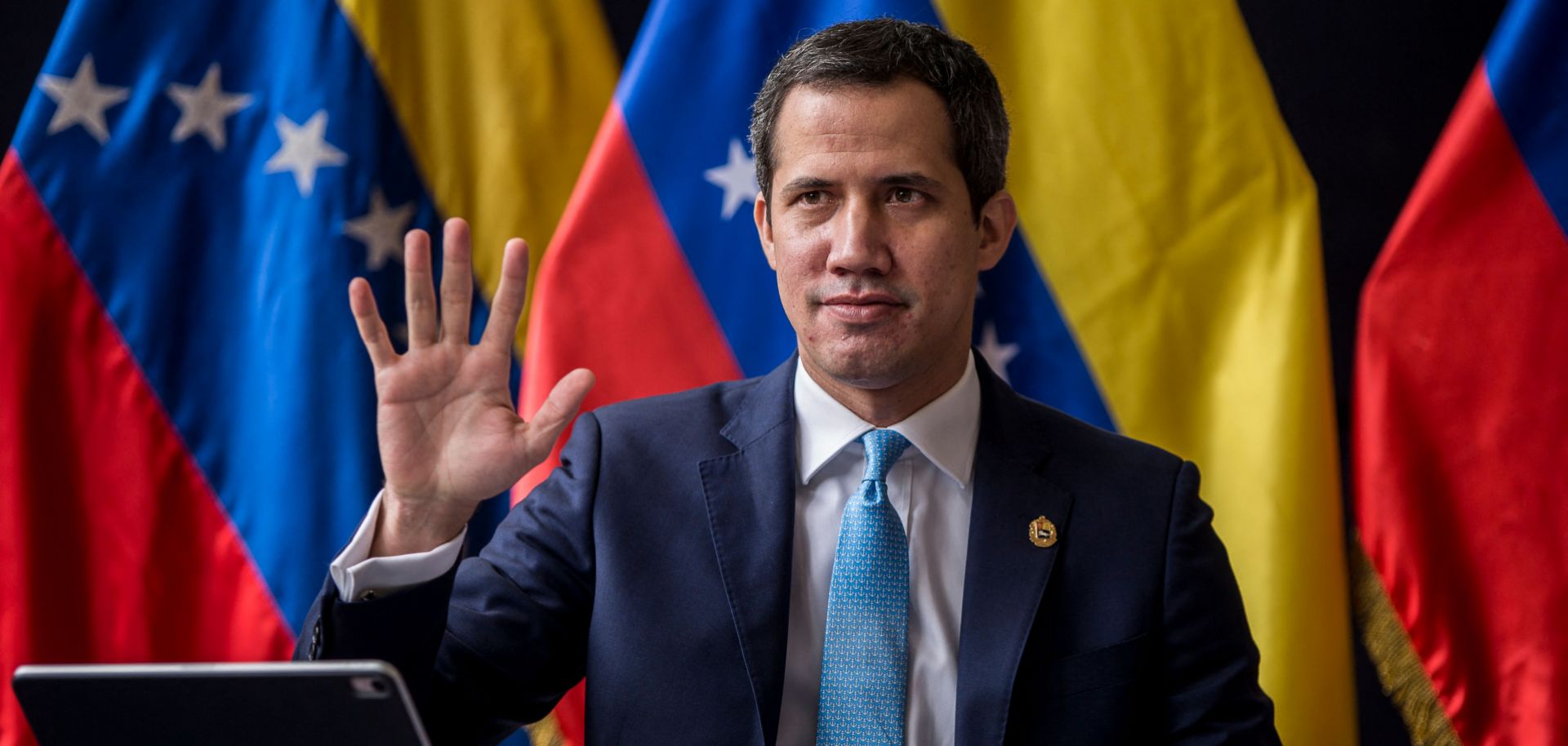
Venezuelan opposition leader Juan Guaido gestures during the installation of the National Parliament for the legislative period 2022-2023 in Caracas, Venezuela, on Jan. 5, 2022.
The end of Venezuela's interim government reflects the weakness of the opposition ahead of upcoming negotiations with Nicolas Maduro's regime in 2023, maintaining the high likelihood of fraudulent elections in 2024 that preserve the authoritarian leader's hold on power. On Dec. 21, the Venezuelan opposition voted to dissolve the interim government led by Juan Guaido, which was formed in 2019 as a way to call for new elections following Maduro's widely disputed electoral victory in 2018. The non-binding motion to remove the temporary ruling body was backed by three of the four major Venezuelan political parties that comprise Venezuela's opposition coalition, with only Guaido's Popular Will party voting against. Lawmakers will vote on whether to ratify the motion on Dec. 29.
- 72 members of the opposition-led parliament voted in favor of the motion to dissolve the interim government, 23 voted against and nine abstained. The motion also proposes establishing ''boards'' to oversee issues related to Venezuela's central bank and the state-owned energy company PDVSA, along with an executive committee to look after matters related to the ''defense of assets'' abroad.
- Guido has been the leader of Venezuela's opposition since 2019, when he declared himself as the country's temporary president using a constitutional clause with the backing of the then-opposition-led National Assembly until free and fair elections could take place in the country.
The dissolution of the interim government is meant to revitalize the opposition ahead of the 2024 presidential election. But this strategy will likely fail as the election will not be free and fair. The three opposition parties that supported the motion argued that the interim government had not accomplished its goal of holding legitimate elections and was losing its legitimacy, and that the government's removal would enable opposition parties to better prepare for the 2024 presidential election. Opposition parties have boycotted previous elections due to their fraudulent nature, but they changed tactics to participate in the 2021 election and have since signaled that they would continue to run in future ballots. However, the Maduro government is unlikely to hold free and fair elections in 2024, and will likely instead use its control over the National Electoral Council to ensure that members of the ruling socialist coalition remain in government and the dominant force in the National Assembly.
- In 2019, over 50 nations — including the United States, the European Union and a plethora of South American countries — recognized Guido's interim government over that of the authoritarian leader Maduro after the latter was accused of falsifying the 2018 election results to stay in power. But this foreign support has steadily declined, with the European Union officially dropping its recognition in January 2021 and several South American countries also withdrawing their support for the interim government in recent years.
- On Dec. 21, former congressman and opposition coalition member Alfonso Marquina stated that some foreign governments had withdrawn their support for Venezuela's interim government after deeming that the strategy of installing a temporary ruling body until democratic elections were held had ''already [been] exhausted.''
- A poll conducted by Ipsos in May showed that the Maduro government remained widely unpopular, with only a 5% approval rating. But the same poll showed that Venezuelans were also dissatisfied with Guaido, with the opposition leader's approval rating falling to 17%.
- Election auditing bodies, including the Organization of American States and the United Nations, have denounced fraudulent elections in Venezuela since the Maduro government came into power in 2013. Maduro's leftist predecessor and mentor President Hugo Chavez (who served from 1999-2013) also faced allegations of election rigging.
The interim government's removal highlights the opposition's divided strategy, which will undermine its negotiating position in upcoming talks, as well as its greater effort to oust Maduro's government. Negotiations in Mexico City between the Maduro government and opposition parties are slated to restart in 2023, more than a year after the process was stalled in late 2021. The opposition will likely offer to ease U.S. oil and gas sanctions on the regime in exchange for political concessions related to the 2024 election, such as ending discriminatory practices against members of opposition parties. However, internal divisions — along with the lack of popular demonstrations and the United States' increased interest in importing Venezuelan oil amid the global energy crises — have weakened the coalition's ability to pressure the Maduro government. Once negotiations resume, Caracas may concede to low-level items in exchange for sanctions relief, like releasing some political prisoners and reinstating opposition party cards (which enable Venezuelan voters to claim allegiance to dissident parties). But the Maduro regime remains unlikely to agree to anything that would threaten its ability to influence the 2024 elections, like appointing more pro-opposition figures to the National Electoral Council. Talks between the Maduro government and the opposition are thus almost certain to eventually collapse, as the latter's refusal to relinquish any of its power will leave little room for progress. This indicates that Venezuela's authoritarian government will remain in power for the foreseeable future and that the vast majority of U.S. oil and gas sanctions on the country will also continue in the medium term.
- In October 2021, the Venezuelan government suspended Mexico City talks with the opposition after just one round of talks and a small group of joint agreements, due to the U.S. extradition of Venezuelan diplomat Alex Saab on corruption charges.
- The U.S.-backed opposition movement in Venezuela first held talks with the Maduro regime in 2019 after violent anti-government demonstrations in the country forced Caracas to the negotiating table.
