
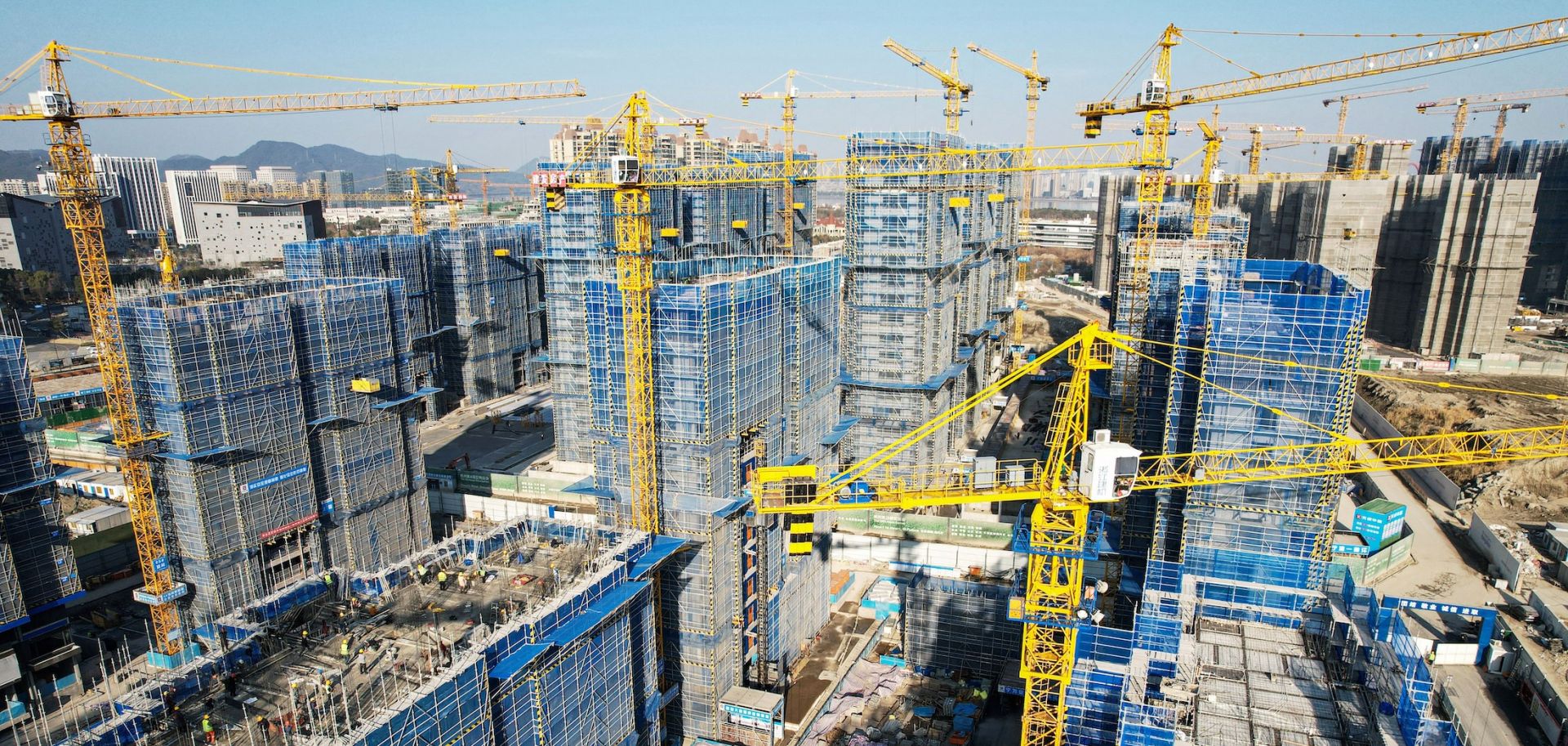
China's efforts to rein in unsustainable investment in the infrastructure and real estate sector will not lead to a systemic financial crisis, but broader reforms aimed at substantially reducing excess savings or creating more profitable investment opportunities that would help rebalance the economy toward more sustainable medium-term growth will remain unlikely in the coming years. Chinese economic policymakers have been seeking to rein in unsustainable investment in infrastructure and the real estate sector amid macro-financial risks caused by a very high savings rate in the context of a declining profitability of investment. The very structure of Chinese investment, which is concentrated in infrastructure and housing, is generating declining and increasingly negative financial returns. A declining profitability of investment is to be expected, as China approaches the technological frontier and the marginal productivity of capital declines, and as highly profitable investment projects become scarcer. The recurring misallocation of capital or overinvestment is forcing policymakers to scale back investment, most notably investment by local governments in infrastructure and, more recently, by real estate developers in housing. These policies aim to limit economically unproductive and financially unprofitable investments that do not support sustainable growth and instead increase financial instability risks. This is very challenging given the high levels of debt China has accumulated, as well as the financial interrelationship between housing, banks, local governments and the central government — whereby local governments depend on land sales to real estate developers to fund their expenditures, and banks suffer losses in case of real estate sector-related financial distress.
- Activities related to the real estate sector account for an estimated 30% of China's GDP. This is much higher than in advanced economies, where such activities account for 10-20% of GDP.
- Total debt outstanding is very high, particularly for an emerging economy, if less so for an economy with a high savings rate. China's debt has doubled in the past 15 years, increasing from 150% of GDP in 2009 to 300% of GDP today. This extraordinarily rapid increase, combined with such high debt levels, raises concerns about the country's creditworthiness and financial stability. Declining economic growth and low inflation, let alone deflation, risk exacerbating credit and financial risks by making it harder to service the debt.
- China's economic growth has decelerated from more than 10% in 2009 to around 5% in 2023. The International Monetary Fund projects Chinese growth to further decelerate to less than 4% in the next few years. The incremental capital-output ratio, which measures the amount of capital required to generate one unit of economic output, has more than doubled in recent years, suggesting that the efficiency of investment has more than halved. Investment is too high, or investment opportunities are too limited."
To avoid the so-called middle-income trap, Chinese policymakers have been facing a difficult balancing act in terms of shifting investment and the economy away from unsustainable infrastructure and real estate sector investment while limiting macro-financial risks and sustaining robust economic growth. China is facing the so-called middle-income trap, whereby a country's economic model becomes unviable as it approaches middle-income levels, and a sudden, substantial downward shift in economic growth takes place, often in the context of a broader economic or financial crisis. The middle-income trap is a frequently observed empirical reality, but not a theoretical inevitability, provided policymakers pursue a forward-looking policy aimed at reforming the economic growth model and managing macroeconomic and macro-financial risks properly. If Chinese policymakers pursued structural reforms aimed at enhancing productivity growth, it would create more profitable investment opportunities and a more economically productive allocation of the country's large savings. And if those structural reforms were accompanied by prudent financial policies aimed at maintaining stability (by, for example, ensuring adequate bank capitalization), as well as supportive macroeconomic policies to limit the economic fallout from macro rebalancing, it would also help better manage macro-financial and macroeconomic risks.
- The middle-income trap refers to the risk of fast-growing, low per-capita economies experiencing a dramatic slowdown of economic growth as they approach middle-income levels. The evidence in favor of this phenomenon is fairly strong, as it can be explained by the declining return on capital investment at the end of the catch-up growth phase, which is characterized by physical capital accumulation.
Despite significant policy efforts, China has made little progress in reducing excess savings and rebalancing the economy toward more sustainable medium-term growth. As far back as 2008, then-President Hu Jintao called for economic rebalancing. The initial impetus for this was China's problematic dependence on exports and export-sector-focused investment for growth against the backdrop of the global financial crisis in 2008, which reduced demand for Chinese exports and posed risks to China's external asset holdings. At around the time of the global financial crisis, China's account surplus exceeded 10% of GDP, which also led to trade tensions, particularly with the United States. But after implementing a massive infrastructure investment program in a bid to diversify drivers of growth and offset the negative growth impulse from the global crisis, macro-financial risks in China increased in the context of rapidly rising debt levels, particularly among local governments, which in many cases led to over-indebtedness and an increase in concomitant financial risks. This prompted policymakers to rein in local- and provincial-level infrastructure investment through stricter enforcement of local borrowing, including off-balance sheet structures like local government financing vehicles (LGFVs). Since 2020, Chinese policymakers' efforts have focused on tackling over-investment in the real estate sectors. Thanks to policies aimed at reining in excessive investment, China has managed to avoid broader financial instability, but it has so far failed to bring about macroeconomic rebalancing. Savings are lower than they were 15 years ago, but investment has remained virtually unchanged.
- In August 2020, China introduced its so-called ''three red lines'' policy, which imposed ceilings on debt-to-cash, debt-to-assets and debt-to-equity ratios for real estate developers. The policy aimed to reduce real estate developers' excessive debt and, indirectly, rein in excessive investment in the sector. The policy has since led to significant financial distress among developers and a sharp real estate downturn in China.
- Between 2009 and 2023, China's national savings rate — or the amount of GDP that households, businesses and the government saved, rather than consumed — fell from more than 50% of GDP to 45% of GDP. However, since 2009, the country's investment rate — or the amount of GDP that households, businesses and the government invested — has remained virtually unchanged at 42% of GDP.
Chinese policymakers have so far taken only modest countercyclical macroeconomic measures for fear of undermining macroeconomic rebalancing on the expectation that the country's economic growth, as well as its housing market, will recover over time. Policymakers have several options to provide short-term countercyclical support to limit the economic downturn (and the risk of deflation due to lackluster domestic consumption). They can pursue a more expansionary fiscal policy aimed at spurring consumption, a more expansionary monetary policy primarily aimed at increasing investment, or measures aimed at allowing for a weaker exchange rate to boost exports. Such policies would help counter the cyclical drag from the real estate sector adjustment, and would also reduce savings by increasing consumption, especially among Chinese households. China has so far refrained from resorting to quasi-fiscal and investment-fueled government spending, unlike in the years following the global financial crisis, as this would exacerbate imbalances due to China's infrastructure-focused growth. Chinese policymakers also seem to expect the economy to eventually recover on its own. But the option remains on the table. However, according to the IMF, housing demand in China will decline sharply by 35-50% over the next two decades due to China's declining population and slowing urbanization, which will decrease the need for new housing. This raises the question of where savings will go if they are not converted into housing. To lower the savings rate, Chinese policymakers could implement broader fiscal reform aimed at raising household incomes by, for example, providing social security or health care benefits, which would increase domestic and especially household consumption. Policymakers could also implement productivity-enhancing, market-oriented economic reforms that would allow for a financially productive conversion of savings into investment.
- China's working-age population has already peaked and overall population levels have been in decline for two years.
- China's central bank has taken a cautious approach to loosening monetary and financial conditions over the past couple of years. The government has refrained from administering a large-scale fiscal stimulus, and has instead provided limited fiscal support to cash-strapped local governments to counteract the fiscal drag from lower spending. Local governments' reliance on land sales and other real estate sector-related activities has reduced the amount of money available to support local government spending. The Chinese central government is in a position to provide greater support, should it choose to do so, despite relatively high public sector debt.
Despite signs of local financial stress and the Chinese economy's slowdown, macro-financial risks will remain manageable due to the government's ample ability to intervene in case financial distress threatens to turn systemic. Systemically important national banks' loans to both real estate developers and mortgages appear manageable. By contrast, smaller regional banks, as well as non-bank financial institutions, are at greater risk. The slowdown in China's real estate sector activity is also affecting local government finances, spending and economic growth. Should financial losses accumulate, the central government has a strong enough financial balance and sufficient scope for intervention to preempt local financial distress from turning into a systemic financial crisis. It can also exercise regulatory forbearance by, for example, allowing banks not to take capital charges against non-performing loans. In case of a run on a bank, the government can simply take over that bank, and write down equity holders and junior creditors, while guaranteeing deposits. China's government and the central bank would not only be able to absorb the losses, if necessary, but they would also have wide-ranging discretion about how to distribute financial losses across different creditor classes.
- At more than 100% of GDP, China's government debt — and especially its so-called augmented government debt, which includes local governments' off-balance sheet liabilities — is high. But gross debt does not account for the extensive assets the public sector holds. The IMF estimates the public sector's net financial worth may not be negative. Virtually all debt is owed to residents. Capital control prevents destabilizing capital flights.
- China's international balance sheet is solid. The country's large foreign exchange reserves (which exceed $3 trillion), along with its capital controls and net foreign creditor position, negate the possibility of a balance-of-payments crisis or an external debt crisis. China's banking sector's net external assets amounted to $169.6 billion, including net yuan liabilities of $287.3 billion and net foreign currency assets of $456.8 billion. This suggests that the banking sector would benefit from a weaker currency, all other things equal.
The central government can also backstop China's banking system, further limiting the risk of a systemic financial crisis. The same rationale applies to large, systemically important banks that already benefit from implicit government backing. The government can and will backstop financial risks related to systemically important financial institutions should they run into trouble. If these smaller banks get into hot water and begin threatening financial sector stability, Chinese authorities will step in through recapitalization, forced mergers or an orderly resolution. In case of systemic crisis risk, the authorities can simply bailout part of the banks' creditors (like retail depositors). The government or government-owned Chinese banks can provide a backstop through liquidity guarantees, takeovers or financial support, without necessarily rewarding moral hazard to force the private sector to internalize economic and financial risks (losses borne by risk-takers), thereby improving the efficiency of capital allocation and reducing financial and macro-financial risks. Similarly, the bailout and restructuring of local government debt simply leads to a reshuffling of the national balance sheet/assets and liabilities between central government, local, banks, investors and households. Ultimately, it is the authorities' ability to provide financial support and largely determine to what extent to bail out or bail in creditors that enable the Chinese government to intervene should destabilizing financial distress emerge. Capital controls and a net international creditor position make it impossible and unnecessary for depositors to move money out of China, further enhancing the government's ability to deal with macro-financial risks.
- The deteriorating financial position of local governments in China, as well as the eroding financial viability of local government financing vehicles (LGFVs), will eventually require a central government bailout or a debt restructuring. However, local government debt problems remain unlikely to trigger a systemic financial crisis in China due to the central government's ability to provide guarantees and allow problem banks to continue operating for a short period of time (under a policy known as regulatory forbearance). About two-thirds of the total LGFV debt is in the form of bank loans; the IMF estimates that one-third of LGFVs are financially nonviable.
- China's bank sector as a whole is characterized by low levels of non-performing loans and overall fair capital adequacy ratios. More importantly, the property sector and mortgage loans represent a much smaller share of assets among large banks than smaller banks and various non-bank financial institutions.
While a systemic financial crisis is unlikely, the risk of a further economic slowdown amid insufficient demand and continued over-investment will be substantial as policymakers are unlikely to implement productivity-enhancing, market-oriented economic reform in the next few years. The government pledged to let the market play a ''decisive'' role in China's economy in 2013, but it has since made little progress toward greater market-oriented liberalization. The Chinese government and state-owned companies are currently playing a greater role in capital allocation than in previous decades, while government officials are also playing a more important role on corporate boards. Meanwhile, private-sector investment remains low, while public-sector investment has increased in the past few years. This greater government intervention is taking place against the backdrop of increasing international economic fragmentation and technological decoupling, as well as China's demographic decline and intensifying geopolitical competition with the United States. Nevertheless, China has opted for less risky and more sustainable growth, even if it means lower growth. The country's economic growth is unlikely to exceed 5% unless the government shifts toward a greater market-based allocation of savings flanked by growth-enhancing structural reform and a fiscal policy geared toward reducing the national savings rate by increasing household incomes and private consumption. Overall, a broad push for market-oriented productivity-enhancing reform in China will remain unlikely in the context of the broader politicization of international economic relations and Beijing's goal of reducing related economic vulnerabilities. Meanwhile, a shift toward greater macroeconomic stimulus would become more likely if economic growth were at risk of falling substantially below 5%, or if deflationary pressure were to significantly increase.
