
If Israel conducts an assassination campaign against Hamas leaders abroad, it would likely provoke more antisemitism and rebukes from Western governments, risk regional blowback, slow down postwar normalization efforts, generate retaliation from Hamas, and keep the threat of regional escalation, including potentially greater involvement from Iran, on the table next year. Over the past month, a steady stream of media reports have detailed alleged plans among Israeli leaders to assassinate Hamas leaders in foreign countries once the intensity of the current conflict in the Gaza Strip declines. On Dec. 1, The Wall Street Journal first reported that Israeli Prime Minister Benjamin Netanyahu had directed the country's intelligence services to track down top Hamas officials living in Lebanon, Turkey and Qatar. According to the report, debate among Israeli security chiefs has focused more on when and how to carry out assassinations, rather than if to do so in the first place. Then, on Dec. 3, the Israeli public broadcaster Kan aired an undated recording in which the head of Shin Bet, Israel's main domestic intelligence agency, stated he had received a clear order from the Cabinet to ''eliminate Hamas'' officials in Lebanon, Turkey and Qatar or wherever else they reside, no matter how long it takes. Numerous other media outlets have also reported alleged details of the anticipated assassination campaign.
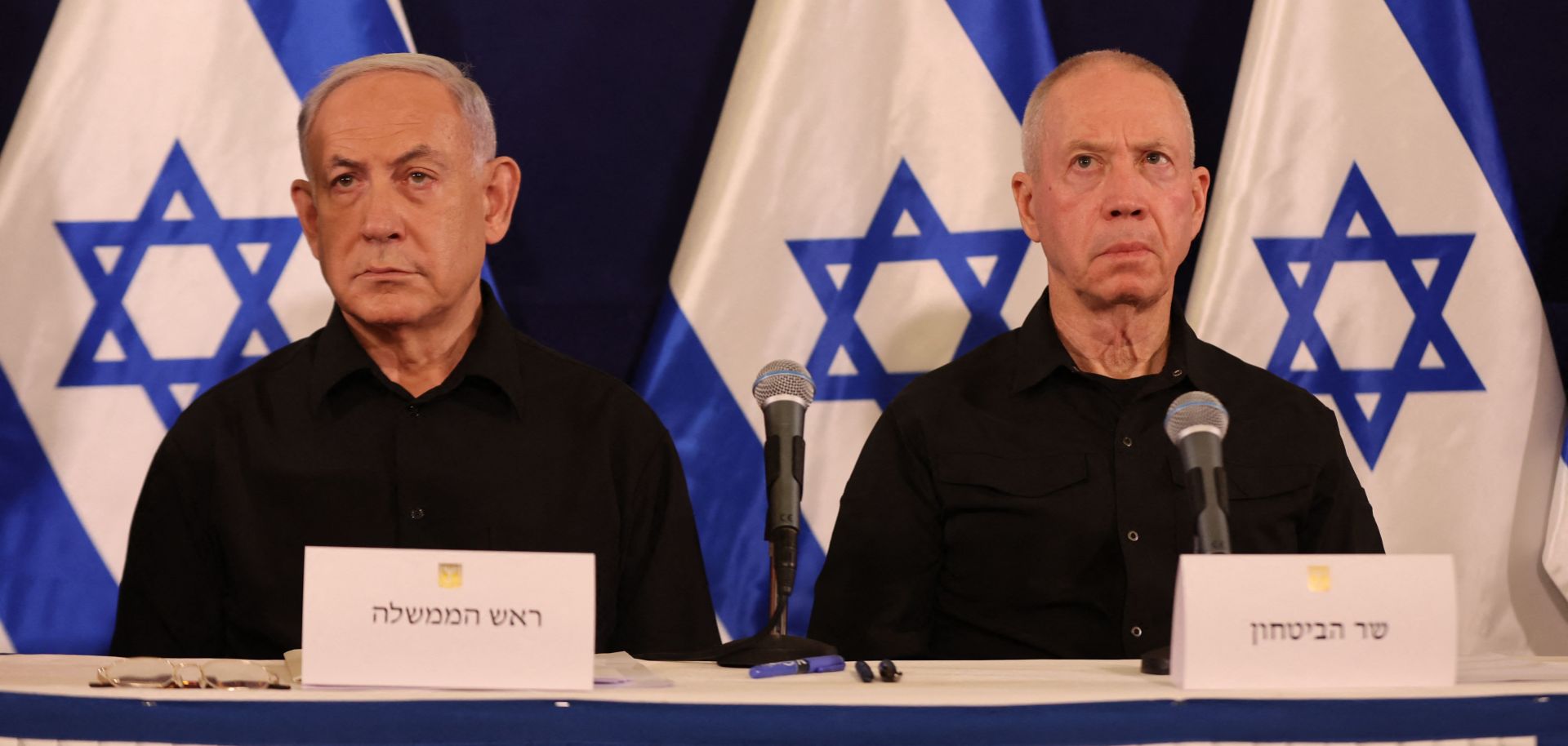
- In responding to a reporter's question in a public address on Nov. 22, Netanyahu strongly hinted at a covert assassination campaign by saying he had ''instructed'' Mossad, Israel's main foreign intelligence agency, to ''act against the heads of Hamas wherever they are.'' In the same speech, Defense Minister Yoav Gallant said that Hamas leaders were ''marked for death'' and that ''the struggle is worldwide.''
- Responding to intense popular pressure following the Oct. 7 Hamas assault that killed approximately 1,200 people and shattered Israel's sense of security, Israeli leaders have taken a maximalist position in pledging to destroy Hamas and its infrastructure, not just in the Gaza Strip but across the globe. Historically, Israel's security strategy has relied significantly on the threat of massive retaliation and, in order to make good on that threat and deter future attacks, Israeli leaders likely calculate that they need to kill Hamas officials and other key affiliates wherever they are.
Israel has a long history of conducting assassinations abroad, earning its intelligence services both fame for their prowess but also significant opprobrium. Even before Israel secured independence in 1948, Jewish paramilitary groups under the British Mandate of Palestine assassinated multiple European and Arab officials on foreign soil as part of their campaign to create a Jewish state. Then, shortly after independence, Israeli security services began a series of attacks against former Nazi officials across the globe. Israel's most infamous assassination campaign came after the 1972 Munich Massacre, when Palestinian terrorists from the Black September group killed 11 members of the Israeli Olympic team. Following that event, Israel launched ''Operation Wrath of God'' in which its spies assassinated numerous Black September and other Palestinian militant leaders across Europe and the Middle East. But as part of that campaign, Israeli spies also suffered one of their worst embarrassments when they killed a Moroccan waiter in Norway who they mistook for a top Black September official, leading to a diplomatic crisis and forcing Israeli intelligence services to minimize operations in the West for years thereafter. More recently, in 2010, Israeli assassins killed the founder of Hamas' military wing in Dubai, but were caught on surveillance cameras prior to the assassination in an operation that led to years of diplomatic estrangement with the United Arab Emirates.
- When previously serving as prime minister in 1997, Netanyahu himself also suffered a major embarrassment after ordering Israeli spies to kill Khaled Meshaal, the then-leader of Hamas' political wing, in Jordan. In an operation that went deeply awry, two Israeli assassins were captured after spraying Meshaal with a toxin that wounded but did not kill him. After the Jordanian government threatened to abrogate its peace treaty with Israel and amid pressure from then-U.S. President Bill Clinton, Netanyahu was forced to send the head of Mossad to Amman with the antidote for Meshaal and only got the Israeli spies released by freeing dozens of Palestinian prisoners.
In the region, Israeli assassinations would be most likely in Lebanon and Syria, possible in Turkey and least likely in Qatar, while extra-regional countries like Malaysia are also potential locations for Israeli attacks. Of the three countries mentioned in media reports (Lebanon, Turkey and Qatar), Lebanon is the most likely place where Israel would focus an assassination campaign, as the country has for years hosted a number of key Hamas leaders. Moreover, Hamas militants have increasingly used southern Lebanon to launch cross-border attacks into northern Israel with the tacit and at times explicit consent of the Iran-backed Lebanese militant group Hezbollah, whose influence dominates the country. Turkey is also a potential location for Israeli assassinations as it, too, has hosted Hamas leaders and Israeli security services already extensively engage in covert operations to counter Iranian intelligence activities in the country. But compared with Lebanon, Israeli assassinations in Turkey would be much riskier, given Israel's much more important ties with Ankara, and the fact that Turkey is a NATO member. Of the three countries mentioned in media reports, Qatar is the least likely to see Israeli assassinations, despite the Arab Gulf nation hosting Hamas' political office. This is primarily because Qatar has played a key role in facilitating negotiations and prisoner/hostage exchanges between Israel and Hamas; Israel will thus be loath to provoke backlash that would disrupt relations with a crucial interlocutor, at least as long as Hamas holds large numbers of Israeli hostages. Though not named in media reports, Syria will likely also see Israeli assassinations on its soil given its political and military support for Hamas. Hamas only re-established relations with Damascus in October 2022, meaning fewer Hamas officials visit Syria, let alone reside in the country, compared with the three other countries. However, Israel already routinely conducts attacks in Syria and likely cares little about any fallout in already antagonistic relationships. Farther afield, countries that openly support Hamas, such as Malaysia (where Mossad allegedly conducted a kidnapping last year and an assassination in 2018, both against alleged Hamas members) could also see Israeli attacks.
- Some media reports allege that Netanyahu promised Qatar that Israel would not attack Hamas officials living in the country as a condition for Qatar's mediation with Hamas.
While Israeli attacks in the United States and Europe are extremely unlikely, those elsewhere would fuel more antisemitism and anti-war protests in the West, while at a minimum likely drawing private rebukes from Western governments, which may put more public pressure on Israel if attacks cause civilian casualties and/or are clearly publicly exposed. Unlike Operation Wrath of God, the prospect of Israeli attacks on European, let alone American, soil is all but impossible for two main reasons. First, unlike in the 1970s, Palestinian militant leaders do not have safe havens in the West, meaning there are few if any targets for Israel to go after. Second, Israel will need whatever support it can get from the United States and European allies like France, Germany and the United Kingdom as it faces widespread condemnation for its military operations in Gaza, which will likely only grow during Israel's expected occupation of the strip after the end of active combat there — and that support would be imperiled by an Israeli attack in the West. Nonetheless, amid historic levels of antisemitism in the West and growing popular opposition to Israel's military campaign in Gaza, Israeli assassinations would stoke more antisemitic activities like property damage, harassment and targeted attacks against Jewish individuals and physical locations. Moreover, Israeli assassinations would also lead to more protests against its actions, especially if the anticipated occupation of Gaza generates an insurgency that leads to a new round of fighting and, in turn, new accusations of Israeli war crimes. Thus, driven both by domestic political calculations (especially in the United States, where President Joe Biden is already losing crucial support among young voters ahead of the election in November 2024) and a desire to prevent violent reprisals in the Middle East, Western governments would likely at least privately encourage Israel to limit the scope of any campaign of assassinations in its near-abroad. However, should Israeli assassinations lead to civilian casualties and/or if Israeli operations are publicly exposed with clear evidence like video footage, Western governments would likely take increasing public steps to pressure Israel to tone down its assassination campaign. Such efforts could include more public rebukes and sending envoys to visit Israel with clear messages. Western governments may even threaten to withhold military or economic aid, though this would likely only occur in combination with other developments, such as accusations of major Israeli atrocities during the expected occupation of Gaza.
Within the region, Israeli assassinations would risk causing diplomatic and economic blowback, while delaying, but not necessarily scuttling, postwar normalization with other key regional states, most notably Saudi Arabia. Both Lebanon and Turkey, the two places where Israeli assassinations would be most likely, have warned Israel against conducting assassinations on their soil. Attacks in either country could thus provoke blowback. Among other things, Ankara could once again sever diplomatic relations and cool trade ties; these only have been revived in the past two years after a decade of frosty relations following an incident in 2010 in which Israeli forces stormed a Turkish aid ship, killing 10 Turkish activists trying to break Israel's blockade of Gaza to deliver humanitarian aid. If Israeli assassinations occur on its soil, Lebanon, for its part, could renege on the historic deal it signed with Israel in 2022 to demarcate its maritime border and proceed with hydrocarbon exploration. The deal has so far withstood the pressures of the current conflict, but a major Israeli assassination campaign in Lebanon could change the status quo. Elsewhere, high-profile Israeli assassinations would probably impede efforts to revive ties with four countries that have normalized ties with Israel in recent years: Bahrain, Morocco, Sudan and the United Arab Emirates. While none of these states has revoked their recognition of Israel, a major Israeli assassination campaign, especially in the context of an expected occupation of the Gaza Strip, would at a minimum make it harder to revive tourism and investment flows. But most impactfully, a large Israeli assassination campaign would likely further delay the prospect of Saudi Arabia recognizing Israel. Prior to the current Gaza war, Saudi Arabia and the United States had been negotiating a potential defense pact as part of a larger deal for Saudi Arabia to normalize relations with Israel, but that plan was put on ice once Israel began its military campaign in Gaza. Israel, Saudi Arabia and the United States still have mutual interests in cooperating against Iran that will keep open the possibility of an eventual deal. However, Israeli assassinations in regional countries — especially any Arab Gulf states — would make it politically challenging for Riyadh to publicly move forward with discussions over such a deal.
- On Dec. 6, Turkish President Recep Tayyip Erdogan warned Israel that it would ''pay a very heavy price'' if it conducted assassinations on its soil. The public statement came two days after Bloomberg, citing an anonymous senior Turkish intelligence officer, reported that Turkey warned Mossad through backchannel communications not to attack Hamas officials in Turkey.
- On Dec. 12, the Lebanese energy minister said that as long as the hostilities between the two countries are ''within the current equation,'' there should be ''no impact'' on the maritime deal with Israel. However, he warned that escalation is possible and said it was ''in the hands of the Israelis.''
- Multiple media leaks since the start of the Gaza war indicate that visits by top U.S. and Saudi officials to each others' capitals have included discussions over an eventual defense deal as part of Saudi-Israeli diplomatic normalization once the intensity of the Gaza war declines.
Finally, an Israeli assassination campaign would generate inevitable retaliation from Hamas, keep open the risk of regional escalation with Hezbollah in Lebanon and various other Iranian proxies, and potentially even provoke greater involvement from Tehran itself should Israel kill targets close to the Iranian government. Most immediately, Israeli killings of Hamas leaders would spark reprisals from Hamas, likely in the form of ambushes against Israeli soldiers in Gaza, rocket launches into Israel, and at least attempts to conduct attacks both within Israel and against Israeli (and more broadly Jewish) targets in foreign countries. Many of the Palestinian militants that Israel has assassinated over the decades were replaced by leaders who were just as aggressive, if not more, than their slain predecessors. An Israeli assassination campaign targeting Hamas may thus merely further radicalize the group's existing leaders and prompt them to plot more audacious reprisals. Israeli attacks would also risk retaliation from pro-Iranian militias in Iraq and Syria, as well as the Iran-backed Houthis in Yemen. However, the risk is likely greatest in Lebanon given the continual, albeit geographically contained, cross-border fighting that has been happening in tandem with the conflict in Gaza. Moreover, Israeli officials have already publicly speculated about the possibility of an offensive in southern Lebanon once major combat in Gaza ends, meaning that Israeli assassinations in the country could easily trigger tit-for-tat attacks that quickly spiral into a larger conflict. There would also be significant room for unintended escalation as either side could miscalculate amid the ongoing fighting and high tensions. While Iran, which backs Hezbollah, has so far calibrated its response to avoid becoming directly involved in the current crisis, the prospect of a direct confrontation between Hezbollah and Israel could force its hand as, compared with Hamas (which Iran also supports), Hezbollah is by far Tehran's military strongest and politically closest proxy. The risk of greater Iranian involvement would be even higher if Israeli assassinations in Lebanon, Syria or elsewhere kill targets closely linked to Tehran. Such a scenario could result in a wide spectrum of Iranian retaliation, ranging from more aggressive cyberattacks against Israeli critical infrastructure, to providing more support for regional proxies to escalate the intensity and/or geographic scope of their attacks against Israel, U.S. and other Western targets. In a worst-case escalation scenario, Iran could even use its own missiles to strike Israeli targets — a prospect that would all but ensure a massive Israeli response and risk sparking a direct military confrontation between Israel and Iran.
- Illustrating the risk of escalation, representatives for Iran's Islamic Revolutionary Guard Corps (IRGC) and other top Iranian leaders have warned Israel that Iran would retaliate for what it says was an Israeli airstrike that killed a top IRGC-Quds Force official in Syria on Dec. 25.
