
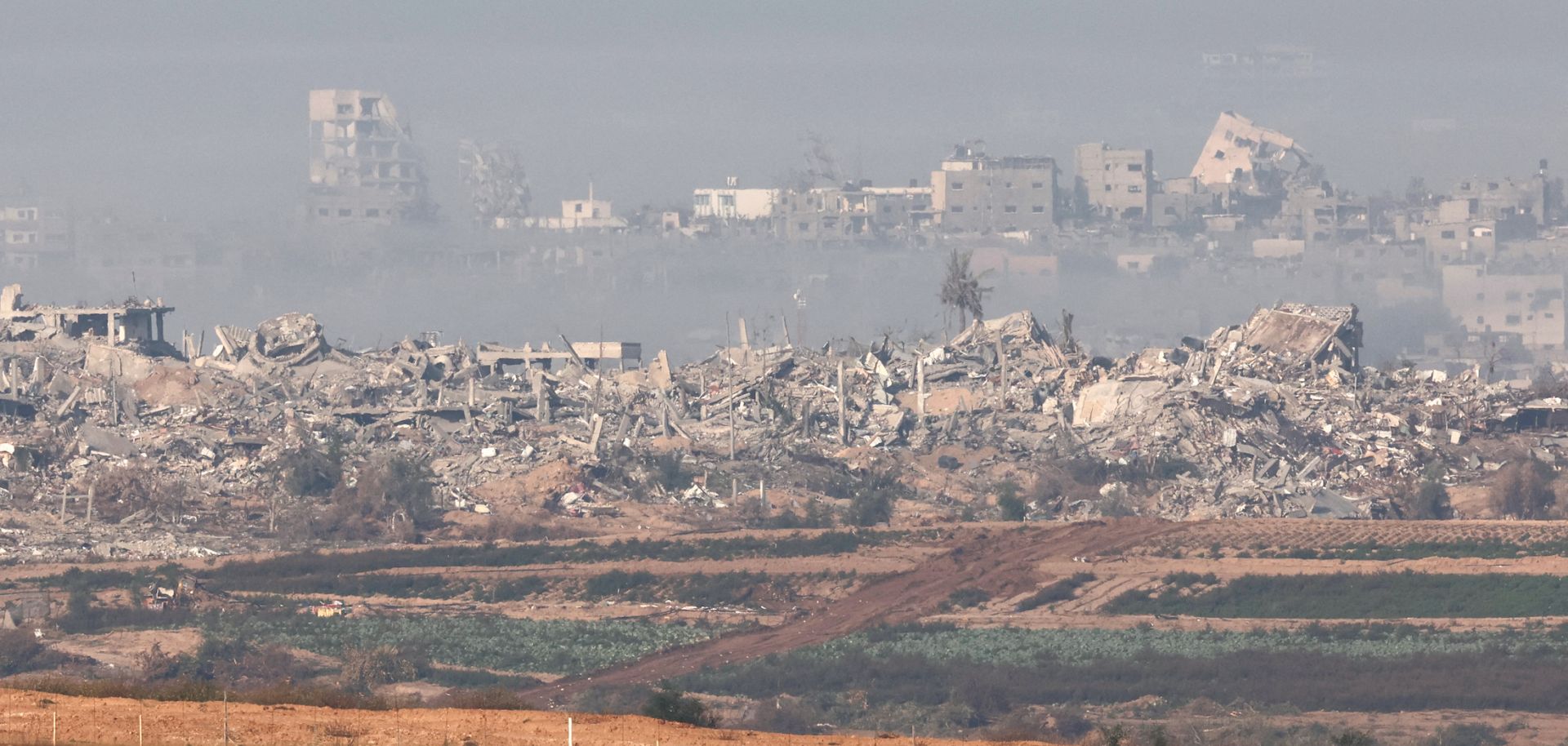
Israel's military campaign is likely moving into its final stages, presaging an Israeli reoccupation of the Gaza Strip and probable extended insurgency in the territory. On Dec. 4, Palestinian witnesses on the ground in Gaza reported Israeli tanks advancing toward the city of Khan Younis, the largest city in the southern part of Gaza. The reports came two days after Israel's Defense Minister Yoav Gallant said the Israeli military had resumed fighting at full force after the collapse of a week-long cease-fire with the Palestinian militant group Hamas in the Gaza Strip. The Israeli military released an evacuation map online for Palestinians to avoid major combat operations, showcasing the Israeli military's imminent intent on carrying out major military operations in southern Gaza. The advance in the south follows weeks of fighting in the north, which has left most of Gaza City under Israeli military control with significant remaining pockets of Hamas fighters in refugee camps. Since fighting resumed on Dec. 2, there has been little sign that temporary pauses in the fighting might resume, as Hamas escalated its demands to include a complete cessation of fighting before it would release further hostages, and Israel countered that it would not halt fighting until hostages were released. Finally, Israeli media reported on Dec. 1 that U.S. Secretary of State Antony Blinken told the Israeli War Cabinet that the United States would only be able to support Israel's military invasion of Gaza for a limited time, though it was unclear whether or not Blinken gave a definite time frame for the Cabinet to act.
- Israel previously declared southern Gaza a safe zone for civilians fleeing the north, the location of the largest urban area in the Gaza Strip. Some 1.7 million Palestinian refugees are estimated to be in the south, where U.N. sources report that aid is unable to reach refugees due to ongoing combat operations.
- Israel's War Cabinet has maintained that its overall goal in Gaza is to topple Hamas from power, a goal demanding that the Israeli military carry out operations. Israeli media has reported that the United States continues to back this overall goal even as Washington pressures Israel to mitigate civilian casualties.
Compared to its invasion of the north, Israel will face fewer obstacles in completing its operations in the south due to significant Hamas casualties and the smaller size of southern cities. Israel has maintained a massive numerical and technological superiority over Hamas since the beginning of the war on Oct. 7, giving Israel the ability to push on whichever part of the Gaza Strip the Israeli army deems militarily important, an advantage deepened by nationwide mobilization following the Oct. 7 attack. As a result, Israel can fight in the north and the south simultaneously while also deterring Lebanon's Hezbollah and Iranian-aligned militias to the north of Israel. In over 30 days of fighting in the northern part of the Gaza Strip, the densest parts of Gaza City have already fallen to Israeli occupation, demonstrating the relative speed with which the Israeli military can overrun the comparatively smaller cities of Khan Younis and Rafah along the Egyptian border. Operations in southern Gaza are likely to be even faster as the Israeli government seeks to demobilize its society and get ahead of diplomatic pressure to compromise its war goals.
- Israel mobilized 300,000 reservists in addition to its regular army ahead of the Gaza invasion. This mobilization faced down an estimated 25,000 to 35,000 Hamas fighters in the Gaza Strip. There are also thousands of other militants in Gaza, like fighters from Palestinian Islamic Jihad, which have also engaged in running gun battles with the Israeli military.
- Beyond Gaza's densely packed cities, the strip is geographically flat and relatively maneuverable for the Israeli military. Before Gaza's surge in population, the Israeli military overran Gaza multiple times in the Arab-Israeli wars of 1956, 1967 and 1972.
Once Israel has taken control of the major cities in the southern part of the Gaza Strip, Israel will likely declare an end to major combat operations and start to demobilize its economy and armed forces. Israel's government and society are eager to declare victory and start to normalize daily life after two months of unprecedented national mobilization and growing pushback from its key supporter, the United States. As a result, Israel is likely to declare the end of major combat operations after its forces have taken control of the remaining cities in the southern Gaza Strip, even if there remain pockets of resistance or if high-profile Hamas and Palestinian Islamic Jihad targets remain at large. The end of major combat operations will also ease diplomatic pressure on Israel, as there will likely be a decrease in the tempo and scale of Israeli military operations that are causing civilian casualties. The declaration of the end of major combat operations will enable the wartime government to start demobilizing certain reserve units not associated with continued deterrence operations against Iran and its regional allies. It will also signal to Iran and its allies that Israel does not intend to expand its military operations against Hezbollah, Lebanon or Iranian-aligned forces region-wide, possibly enabling Iran to step back from continued confrontation and escalation with the Israelis.
- Israel's economy is showing signs of strain, with many businesses reporting difficulty in remaining open and companies in the vital tech sector saying that few business deals are taking place against the backdrop of the uncertainty of the war and productivity gaps caused by reservist mobilizations of workers.
- Iran and Hezbollah's political drivers for carrying out comparatively limited attacks on Israel are driven by a desire to show solidarity with the Palestinian national cause during a time of war. But these drivers, which are already constrained by Tehran and Hezbollah's desire to avoid sparking a regional conflict, will weaken once major Israeli combat operations wind down.
In a less likely but plausible scenario, further Israeli military maneuvers in the south may convince Hamas to try to trade its remaining hostages for the evacuation of certain leaders and fighters from the Gaza Strip. On Nov. 30, The Wall Street Journal reported that Israeli and American diplomats were looking for a possible plan that would replicate the evacuation of the Palestinian Liberation Organization from Beirut, Lebanon, in 1982. Under this plan, Hamas would evacuate from the Gaza Strip to end fighting earlier. Although this outcome would be optimal for Israel and the United States, which are both seeking quick victories, there has been little to suggest that Hamas would be willing to take up such an offer. Hamas' calculation, however, may change in the coming days and weeks as Israel's forces now close in on the final southern cities under the militant group's control. Out of a desire to preserve experienced leaders or to safeguard veteran fighters, Hamas may become more willing to entertain such a suggestion that would allow its fighters to withdraw from the strip and end major fighting.
- The PLO took the exile offer from Israel in 1982 after the Israeli military besieged Beirut and seemed certain to eventually wear down the city and capture or kill the PLO's senior leaders. Despite that diplomatic breakthrough, Israel continued operations against the PLO, including in Tunisia in 1985, until the Oslo Accords in 1993.
No matter how Israel completes its control of the south, the Israeli military will face unrest and a possible insurgency from remaining militants that will likely strengthen over time and could reignite regional escalation. As Israel gains ground in the south, Hamas and other militants are likely to try to blend into the civilian population to lay the groundwork for an insurgency during the ensuing Israeli occupation. Although it will take time for these groups to organize into coherent cells and networks able to carry out sustained operations, these fighters will nevertheless serve as the nucleus of an anti-Israel insurgency in the Gaza Strip that will strengthen as humanitarian conditions stabilize and civilians can return home. Israel has already said it is likely to expand some sort of buffer zone within Gaza, which will also likely be a target of insurgents in the long run. Meanwhile, the Israeli military will be responsible for security in the entire Gaza Strip until it can find a civilian government to take over its responsibilities there. Given how difficult it will be to find a pliable and plausible civilian government, this means the Israeli military will likely remain in charge of the Gaza Strip for the medium term. A resumed Israeli reoccupation of the Gaza Strip will be deeply unpopular, and remaining militants will be able to recruit from the civilian population to strengthen their insurgency while smugglers from Egypt, using tunnels and seaborne routes, will likely provide limited supplies to Gaza. Israel is also likely to face an insurgency in part because it will not be able to maintain the level of mobilization to fully control the civilian population compared with during the past month when its invading forces overwhelmed the local population. If there is a major uprising against Israeli forces or a significant clash between Israeli troops and Palestinian civilians during Israel's occupation, it could return the political incentive for Iran and its allies to carry out attacks on Israeli and U.S. forces regionwide, although the same constraints on their desire to escalate to a full-blown war will remain.
- There are several common soldier-to-civilian ratios used to design counterinsurgency strategies, ranging from a very high one soldier for every 10 civilians to the more common 20 soldiers for every 1,000 civilians. With the latter measurement, the Israeli military would likely need to deploy somewhere close to 40,000 to 45,000 troops to Gaza, or somewhere around 25% of Israel's active forces.
- Even when Israel faced a less populated Gaza Strip during its occupation from 1967 to 2005, the Israeli military struggled to control the area, which was part of the impetus for Israel to withdraw from the strip in 2005.
