

Multilateral efforts to protect shipping in the Red Sea from Iran-backed Houthis in Yemen will struggle to prevent attacks in the short term, which will increase pressure on the United States to respond with more escalatory actions that it seeks to avoid. On Dec. 18, U.S. Secretary of Defense Lloyd Austin announced the creation of Operation Prosperity Guardian, a new multilateral task force designed to protect commercial shipping from increased attacks by Iran-backed Yemeni Houthi militant group by "bringing together multiple countries [including] the United Kingdom, Bahrain, Canada, France, Italy, Netherlands, Norway, Seychelles and Spain." On Dec. 9, Houthis announced they would begin targeting all merchant ships heading to Israel via the Red Sea in protest of Israel's ongoing military campaign in Gaza. Since then, the Iran-backed militant group has conducted at least 10 attacks on commercial vessels transiting the region, severely disrupting maritime trade. In response to the ongoing attacks, four of the world's five largest container-shipping companies — including Denmark's Maersk, France's CMA CGM, Germany's Hapang-Lloyd and Switzerland's MSC, which together comprise over 50% of global container-shipping capacity — have announced plans to suspend shipping through the Red Sea in recent days. On Dec. 16, oil and gas supermajor BP also said it was halting all shipments through the region. The U.S. Navy, meanwhile, recently moved the Dwight D. Eisenhower-led Carrier Strike Group 2 (CSG-2) from the Persian Gulf into the Gulf of Aden — signaling a potential shift in Washington's strategy, which has so far seen it take a restrained approach in responding to provocations from Houthis and other Iranian proxies in the region for fear of spurring a broader escalation with Tehran.
- In response to rising safety concerns, smaller shipping companies have announced changes to their operations in the Middle East as well. OOCL, a Hong Kong subsidiary of China's COSCO Shipping, announced on Dec. 16 that it would stop shipments to and from Israel. On Dec. 18, Taiwan's Evergreen also announced it would suspend shipping through the Red Sea and stop handling Israeli cargo.
- Houthi attacks have included missile and drone strikes on ships, causing fires on board on multiple occasions. The latest attacks occurred on Dec. 18 and targeted the MSC Clara and the Norwegian-owned Swan Atlantic. Swan Atlantic's owner said the vessel had been struck by an unidentified object. As of early Dec. 18, MSC Clara's owner had not yet commented publicly on any incident. On Dec. 16, the destroyer USS Carney shot down 14 attack drones, while the British Destroyer HMS Diamond also shot down one drone.
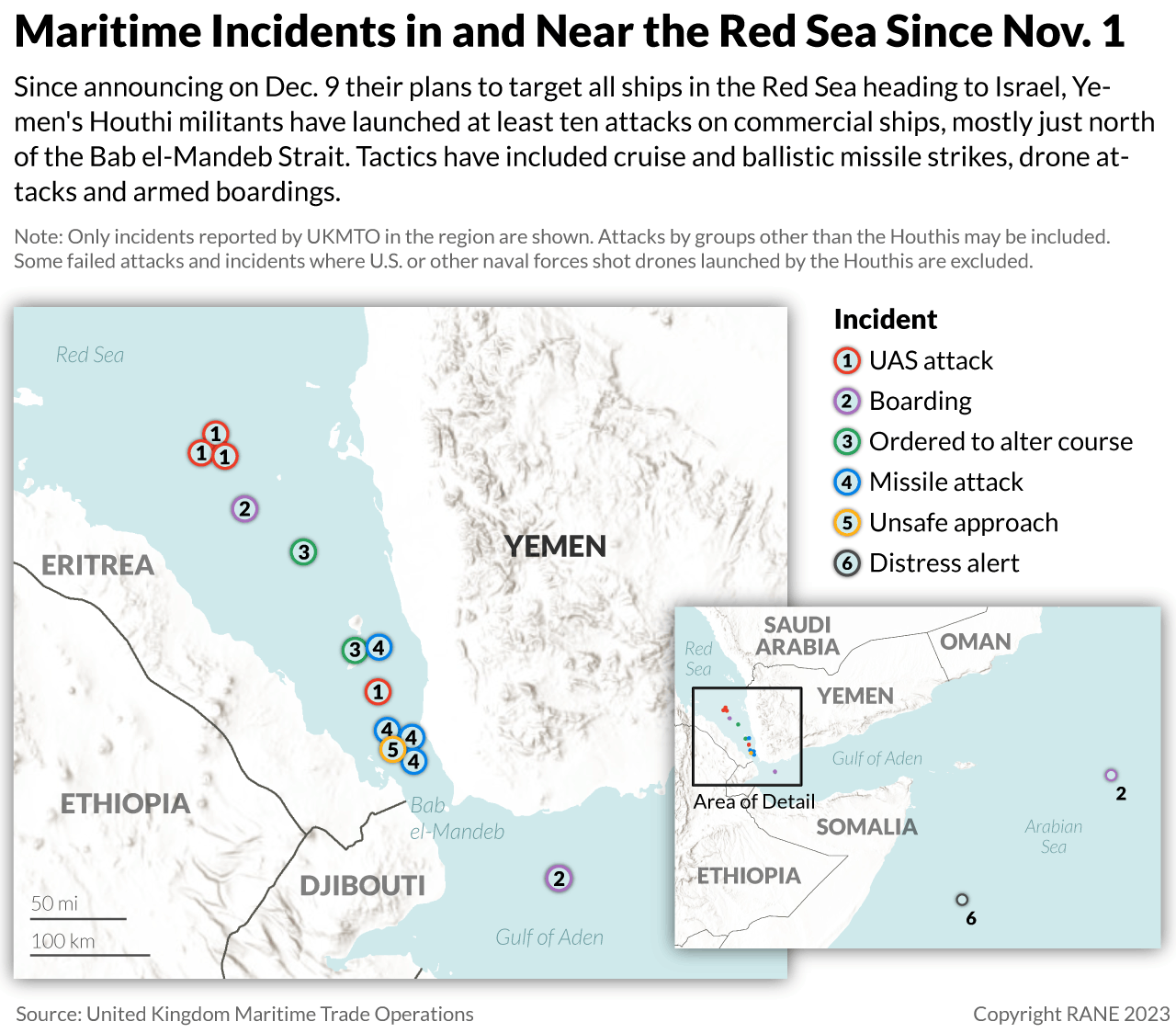
Despite uncertainty over its precise structure and scope, Operation Prosperity Guardian will increase the likelihood of preventing or limiting the impact of Houthi attacks, but shipping companies will probably still limit transits through the Red Sea. The new U.S.-led protection force will operate under the existing Combined Task Force 153, which focuses on securing the Red Sea and the Gulf of Aden under the 39-member Combined Maritime Forces (CMF) based in Bahrain. But the number of troops and vessels that U.S. partners will commit to Operation Prosperity Guardian, as well as the size and timing of those deployments, remain unclear. Earlier this month, U.S. officials said that discussions with other members of the CMF had focused on the task force escorting ships through the Red Sea. From a practical perspective, Operation Prosperity Guardian and any convoys that it organizes will increase the likelihood of naval forces shooting down drones or missiles en route to target a commercial vessel. A naval convoy could also deter the Houthis from approaching merchant ships and demanding ship captains change their course or head toward Yemen — a tactic Houthis have frequently deployed before conducting a more significant attack. Moreover, a larger ship presence will improve the United States and its partners’ ability to react to any incident in the Red Sea by, for example, enabling them to more quickly respond to a distress call to an attempted boarding or hijacking. That said, it is unlikely that shipping companies will take advantage of any convoys to resume full operations through the Red Sea. This is because, logistically, joining an escort or a convoy still presents some challenges for ships, such as the need to congregate in the Red Sea and potentially even slow down — which makes them easier targets for the Houthis. Moreover, there are alternative routes available — namely, around the southern coast of Africa — which, while longer and more expensive, offer a workaround.
Regardless of the new task force, Houthis will likely continue conducting attacks, as their actions have so far spurred little blowback and may even be helping them gain leverage in negotiations related to Yemen's civil war. Thus far, the Houthis have faced few practical consequences for their attacks on commercial shipping. Saudi Arabia has not pulled out of ongoing cease-fire talks with the Houthis in Yemen's civil war, likely for fear that such a withdrawal could prompt the militant group to launch retaliatory attacks against Saudi infrastructure instead of maritime traffic in the Red Sea. Indeed, Saudi Arabia has reportedly called on the United States to refrain from any direct military strikes on the Houthis due to concerns of potential blowback. Meanwhile, the United Arab Emirates — which backs a different faction within Yemen than Saudi Arabia and faces a lower risk of increased violence in Yemen — is reportedly pushing the White House to re-designate the Houthis as a foreign terrorist organization. Abu Dhabi allegedly also wants Washington to carry out military action against the militant group to degrade its capabilities and establish some level of deterrence. Both of the actions that the United Arab Emirates is calling for would have more practical consequences for the Houthis compared with the reputational damage they're incurring as a result of their recent maritime attacks. But such escalatory moves would also risk dragging the United States into the Yemeni civil war, which Washington is loathe to do. However, without greater consequences, the Houthis will likely maintain their new maritime strategy, which is just now starting to see success, with major shipping companies avoiding the Red Sea and, in some cases, suspending serving the Israeli market. And this success — combined with increased support from pro-Palestinian citizens in Yemen (and the Muslim world more broadly) who oppose Israel's military operations in Gaza — may even grant the Houthi movement more leverage in peace negotiations with the Saudis and the Yemeni government, potentially paving the way for greater concessions in the future.
- For years, Saudi Arabia has been trying to reduce tensions with the Houthis as part of the kingdom's broader effort to extract itself from the nearly 10-year civil war in Yemen, where it backs the Yemeni government. The latest round of cease-fire talks in Yemen with the Houthis wrapped up in September and included discussions on reconstruction efforts, removing foreign forces in Yemen, and reopening Houthi-controlled ports and the Sanaa airport.
- A U.S.-led military campaign aimed at degrading Houthis' capabilities could be an extended operation due to the group's decentralized structure, making it difficult for a single strike to degrade Houthis' capabilities on the whole or deter other parts of the group.
The White House appears hesitant to conduct military strikes against the Houthis for fear of triggering a potential escalation with Iran. But if the militant group continues to escalate its attacks on commercial shipping in the Red Sea and/or conducts an attack on a U.S. or CTF-153 naval ship, President Biden may be forced to approve at least an initial strike on the Houthis. Since the latest Hamas-Israel war began in early October, the Biden administration has sought to limit the ways the crisis could escalate regionally, including by restraining U.S. action. The United States, for example, has only carried out a handful of attacks targeting the militant groups responsible for the dozens of attacks against U.S. military targets in Iraq and Syria over the past two months, demonstrating Washington's desire to maintain restraint due to concerns about escalation. U.S. defense officials have also refrained from publicly concluding that some of the Houthi missile and drone attacks were targeting the U.S. naval presence in the Red Sea. For Biden, military strikes in Yemen that lead to escalation with Iran would open him up to significant criticism of worsening the Middle East crisis ahead of next year's closely contested U.S. presidential elections. Nevertheless, the situation off Yemen's coast may be nearing a point where it becomes a political liability to not act, as if the Houthis continue to cause major shipping disruptions through repeated attacks, it will also make Biden look weak and non-responsive to Houthi provocations — a threat that the Biden administration had already been criticized for downplaying prior the outbreak of the Gaza war. Against this backdrop, a Houthi attack that causes U.S. casualties would thus likely force the White House's hand. But even short of that, should the Houthis continue to disrupt Red Sea shipping or conduct an attack that damages U.S. naval assets (akin to the USS Cole incident), President Biden may be forced to authorize a limited military response to strike one or several Houthi targets. The U.S. Pentagon is reportedly preparing different strike options that could be used to target the Houthis. The U.S. Navy's moving of the CSG-2 into the Gulf of Aden from the Persian Gulf may be an initial sign of a shifting strategy, as moving the carrier group sends a message of deterrence to the Houthis, expands U.S. options to retaliate against the Houthis, and better positions U.S. assets to handle any retaliatory response to a U.S. strike.
