
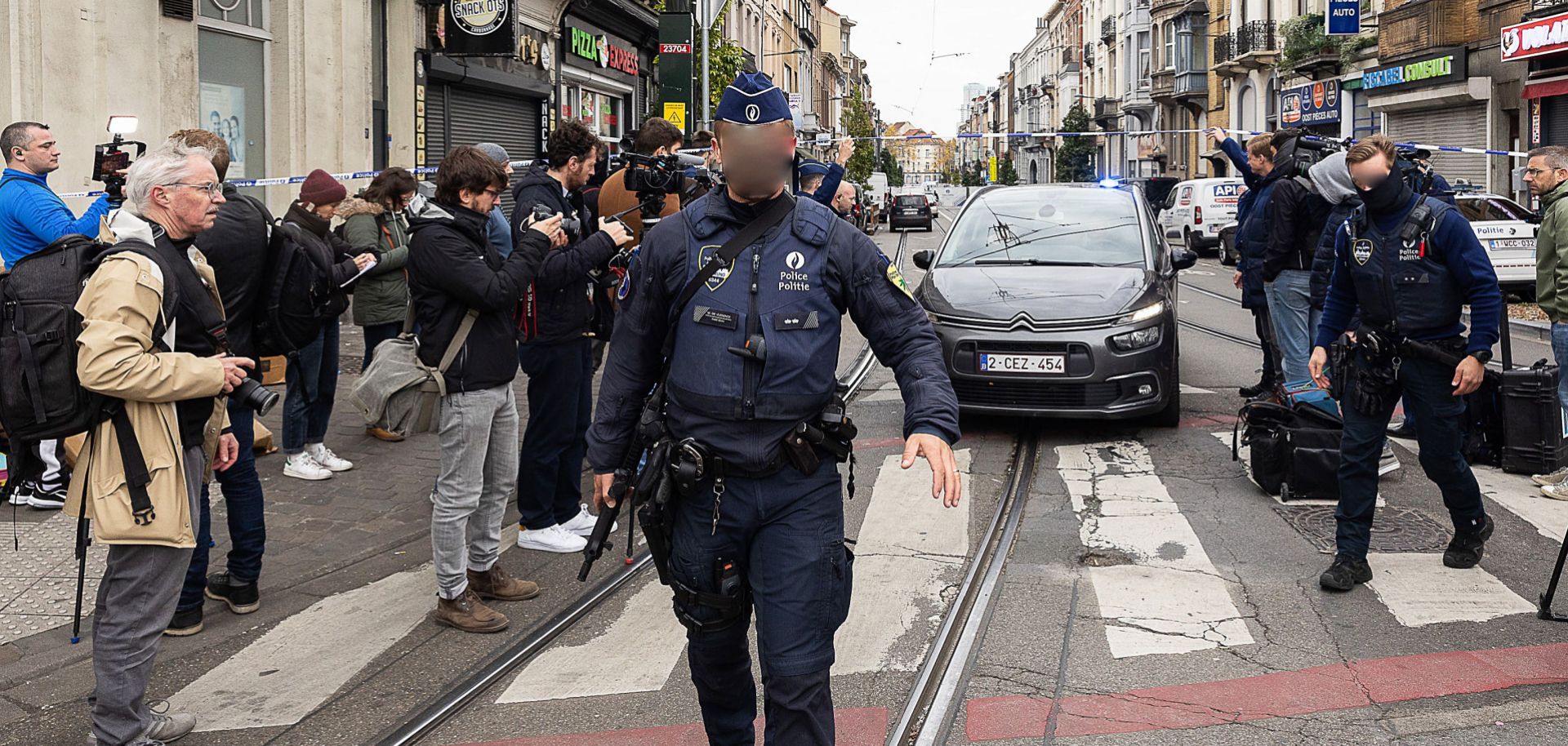
The conflict between Israel and Hamas has sent security services across the world into a panic over the potential for Islamist extremist attacks linked to the war. Already, lone actors in Belgium, Egypt and France have carried out lethal attacks, while affiliates of al Qaeda and the Islamic State have encouraged their followers to commit violence against Westerners, and particularly Jews. These risks will only grow as Israel's ground incursion into Gaza deepens, as it will undoubtedly lead to even more Palestinian casualties and accusations, regardless of veracity, of Israeli atrocities. Strong U.S. (and to a lesser extent European) support for Israel will further feed extremist narratives that frame the West, led by Israel, as the oppressor of Muslims. And should the Israel-Hamas War become a larger regional conflict, terrorist threats would rise even more.
At some point, however, the war will end and Israel (and its Western supporters, namely the United States) will have to confront difficult questions of what comes next. The conflict has shattered the status quo in the Gaza Strip, and very well may do so in the wider region if tensions escalate further, meaning there is no going back to a pre-Oct. 7 environment. And if history is any guide, out of that shake-up may emerge a new Islamist extremist movement, though one that may not take full shape for many years, perhaps even decades. After all, the past half-century illustrates that terrorist groups are often born (or revived) as unintended consequences of major military action. Thus, while today Israel may be fighting Hamas, it may only be the prelude to the rise of another group in the future.
Newton's Third Law
Sir Isaac Newton famously promulgated three foundational laws of motion to describe the relationship between an object and the forces acting on it. His third law in simple terms says that for every action there is an equal and opposite reaction. While this law of physics does not transfer as precisely to other disciplines, it largely describes what many Western militaries have encountered when they have intervened in Muslim countries: in short, violent backlash.
While the circumstances and contexts are all different, the West's record in the past 50 years attests that military campaigns not only often prompt a terrorist reaction, but in fact, one that is different and unexpected compared to the threat that the Western state in question aimed to counter. Israel already saw this in the late 1970s and early 1980s, when it sent its troops into southern Lebanon to try to clear the region of fighters from the Palestine Liberation Organization who had been launching cross-border attacks. While Israeli forces eventually succeeded in curtailing the PLO threat, their intervention (which took place amid the complex Lebanese Civil War) spurred the rise of Hezbollah, the Iranian-backed Shiite militia group that was wholly unknown before Israel's invasion but eventually came to dominate Lebanon. In hindsight, the heavy political pressures and security concerns weighing on Israeli leaders make their decision to invade understandable, but also show the unintended consequences of their actions: They traded one threat for another — arguably larger and more intractable — one that persists to this day.
Of course, no country has also learned the lessons of unintended consequences more so than the United States. In fact, the modern jihadist movement is widely seen to have coalesced in the mountains of Afghanistan, where the United States lent its support for the Islamist mujahideen to battle the Soviets after their invasion of Afghanistan in 1979. As with Israel's strategic calculus in invading Lebanon, the dynamics of the Cold War also meant that U.S. backing of this guerrilla force made much strategic sense at the time. After all, the two superpowers frequently fought each other via proxies, so there was ample precedent, and it was certainly seen as much safer to fight via intermediaries rather than have the nuclear-armed American and Soviet militaries directly confront one another. But U.S. support for the mujahideen eventually reverberated far beyond Afghanistan, sending the guerrillas who fought there to join or start insurgencies across the Caucasus, Levant, North Africa and South Asia — some of which still rage today — and leading to the creation of al Qaeda. Again, with hindsight, one can see the tragic line of causation from U.S. support for the mujahideen to al Qaeda's violent campaign that culminated in the 9/11 attacks, but at the time, the U.S. decision to arm and finance the mujahideen seemed sound — and their eventual victory did help hasten the Soviet Union's collapse.
More recently, the United States encountered a similar story of violent and unexpected backlash from its 2003 invasion of Iraq. While meant to overthrow Saddam Hussein, a task it admittedly completed quickly, U.S. forces quickly found themselves bogged down fighting an insurgency for which they were unprepared and from which eventually emerged the Islamic State. A group that previously had been small, obscure and barely a threat before the U.S. invasion was revived and rebranded in its wake, first fusing with al Qaeda and later breaking off to pursue its distinctive form of extreme violence. Though the history of misjudgments that led to the U.S. decision to invade Iraq is well-known, even the most prescient critics of the war hardly envisioned the maniacal violence of the Islamic State that would dominate the mid-2010s.
Pandora's Box
Israeli Prime Minister Benjamin Netanyahu has made clear that the goal of the Israel Defense Forces operation in the Gaza Strip is the complete destruction of Hamas, a terrorist group that he (and, regardless of their opinion of their prime minister, most Israelis) believe is an existential threat that can no longer be tolerated after its Oct. 7 attacks. Whether Hamas can truly be eradicated is an open question, and an IDF operation that fails to deal a death blow to the group may simply see it reemerge in the future as even more radical, perhaps not just focused on Israel but the West more broadly. But even if the IDF succeeds in retaking full control of Gaza, killing large numbers of Hamas fighters and destroying most of the group's weapons and infrastructure, Israel may simply be trading a current threat for a future one.
Most immediately, the IDF is facing a huge global backlash, not only from Muslim-majority countries but also from many in the Global South — and a growing number in the West — due to the large number of Palestinian civilian casualties in the conflict. Regardless of whether history judges that the IDF generally stuck to the laws of war, ultimately this does not matter, since the current narrative in many countries is one of war crimes. Across the media, countless videos, images and first-hand accounts of the humanitarian crisis in Gaza imply — and in many cases, explicitly portray — Israel as the perpetrator of allegedly wanton violence. This is of course intensified by the spread of misinformation and growing evidence of high levels of deliberate disinformation to paint the war in a particular light. Even when evidence eventually comes to light exculpating the IDF from incidents like the explosion at al-Ahli Arab Hospital on Oct. 17, it hardly changes minds — especially when the IDF takes responsibility for other attacks that led to mass Palestinian civilian casualties, like the Oct. 31 bombing of the Jabalia refugee camp. The fact that a disproportionate number of Palestinian casualties appear to be children only reinforces a narrative of Israel as a callous oppressor, regardless of the fact that Hamas uses civilians as human shields, whether by launching attacks from densely populated communities or by building tunnels underneath civilian infrastructure.
The result of this violence is already coming into view: reinvigorated and virulent antisemitism, hatred of Israel and disdain for Western governments supportive of Israel — all of which suggest that the war is fertile ground for radicalization. From the capitals of large Muslim countries in South and Southeast Asia to the streets of London, New York and Paris, the intensity of anti-Israel protests attests to the seeming opening of Pandora's box that the Israel-Hamas War has triggered. While there is of course a huge difference between marching in the streets and committing violence, it stands to reason that at least some people may be vulnerable to extremist radicalization, especially if the war lasts for many months and further IDF operations lead to more Palestinian mass casualty incidents. Already, the war is seen not merely as another flashpoint, but as something fundamentally different: a seminal event that risks stoking long-term outrage and, in turn, anti-Israeli and anti-Western violence.
To this end, though the war currently remains largely limited to the Gaza Strip, the risk of further regionalization of the conflict in which Hezbollah in Lebanon, other Iranian proxies elsewhere in the region — or, in an extreme case, even Iran itself — get more involved would add further fuel for future terrorist backlash. The more regional actors get involved, the more complex the war will become and the more incentives there will be for existing terrorist groups to exploit the violence for recruitment and for new groups to develop. In a wider regional conflict scenario, not only will groups like al Qaeda and Islamic State also feel pressure to get involved, but one can easily imagine regional states developing their own proxy groups, at least some of which may present long-term threats. And if tensions escalate to the point of direct Iran-Israel or Iran-U.S. confrontation, the prospect of an Iranian-backed campaign of Shiite Islamist terrorism against the West would rise dramatically, reviving and perhaps exceeding the high point of Iran-linked terrorism in the 1980s and 1990s.
Finally, even when current IDF operations cease, what follows will likely only further raise the risk of violent backlash against Israel and the West. In an interview that aired on Nov. 6, Netanyahu said that Israel will have "overall security responsibility" in Gaza for "an indefinite period," a strong suggestion that IDF forces will be stationed in the territory for a prolonged period. While what precisely this will look like in practice remains unclear — for instance, whether IDF operations will occur throughout all of Gaza, the northern half or just select areas — fundamentally, a return to Israeli control in some form (after pulling its forces and settlers out of Gaza in 2005) will stoke anger and presumably violence long after the current conflict ends, even more so if postwar governance involves the permanent reallocation of land from Palestinians to Israelis. But even if not, a likely yearslong IDF presence in Gaza will create fertile conditions for radicalization and terrorism. While displaced Palestinians may provide the most immediate pool of potential terrorist recruits, violent threats to Israeli and Western interests would amplify far beyond Gaza, as the Palestinian plight may once again become a rallying cry for extremists across the globe, potentially inspiring an entirely new, younger generation toward militancy.
The Day After
Just over a month into the Israel-Hamas War, the only certainty is that the status quo has been broken. What will emerge is unclear, but the IDF's operations in Gaza, even if justified, also risk unleashing violent forces that will resist being controlled. U.S. President Joe Biden warned as much during his visit to Israel last month, when he told his hosts that their "all-consuming rage" against Hamas' attacks was entirely understandable, but cautioned them against becoming "consumed by it." As he noted, the United States found itself in a similar position after 9/11, and "while we sought justice and got justice, we also made mistakes." Even if the IDF succeeds in largely destroying Hamas, it will come at a large cost — in reputation, protest and, in all likelihood, terrorist backlash for years to come.
