
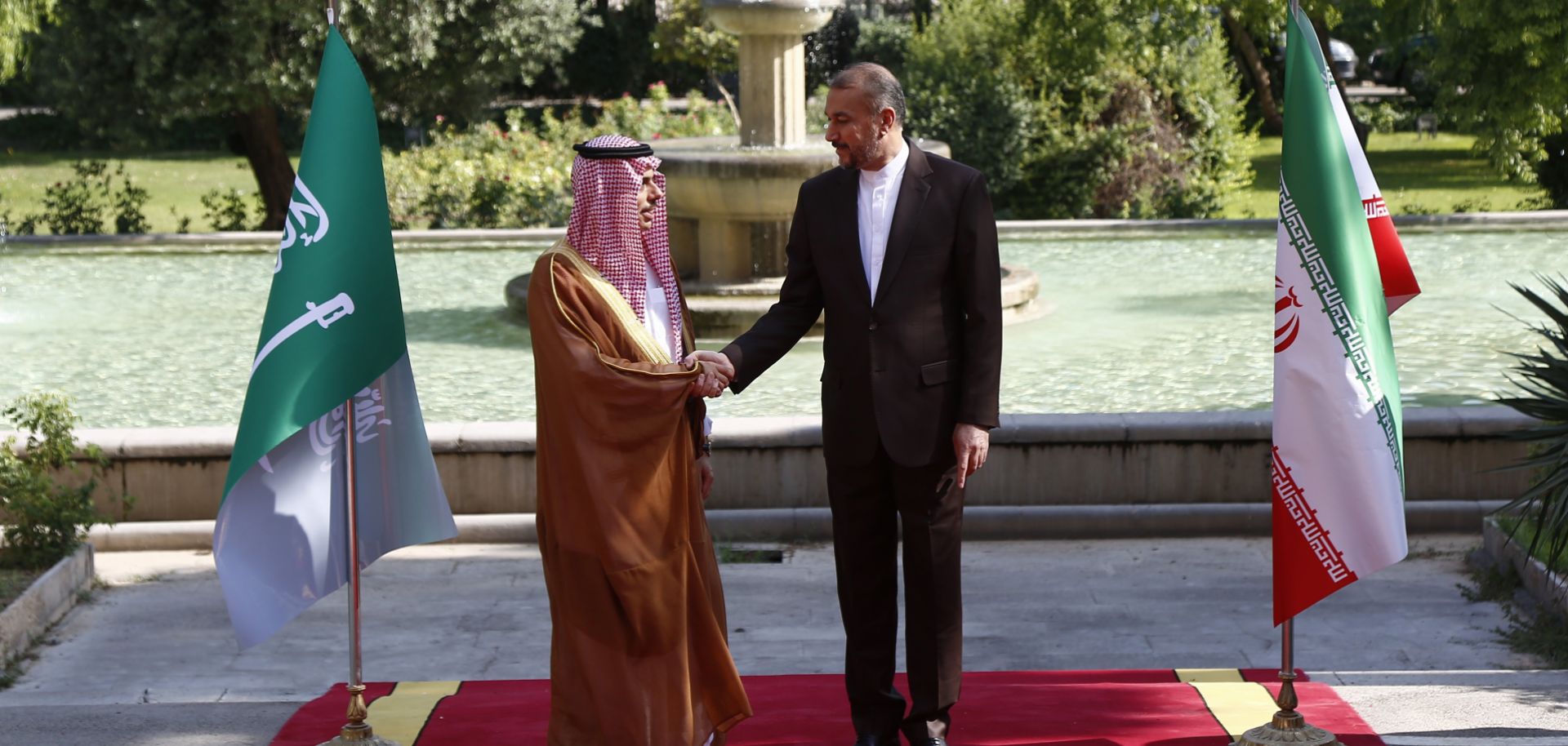
Relations between the Middle East's most powerful countries — including Saudi Arabia, Egypt, Turkey and Iran — are in a remarkably more harmonious place compared with years past. But while this has made the region more peaceful, old wounds still risk reopening. In recent years, diplomatic ties across the Middle East, North Africa and the Arab world have significantly improved. Saudi Arabia and Iran's rapprochement agreement in March 2023 after a seven-year break in diplomatic ties was the most notable recent example among several similar cases across the region. Although the drivers for these rapprochements are diverse and many sore spots and conflicts persist in the region, they are all part of a broader trend of improved relations across the Middle East.
- Saudi Arabia's foreign minister visited Iran on June 17, in the latest sign of tangible progress in the two Persian Gulf rivals' China-brokered rapprochement. The Saudi-Iran rivalry has been one of the chief drivers of security risks in the broader region, including Iran-backed maritime attacks, cyberattacks, and proxy militia violence against each other. Iran has also long feared that Saudi Arabia would help facilitate a U.S. or Israeli attack against it.
- Turkey and Egypt exchanged ambassadors for the first time in 10 years on July 4, marking a diplomatic breakthrough after years of mistrust over Ankara and Cairo's opposing support for political Islam in governments across the Middle East.
- On May 19, Syrian President Bashar al Assad attended the Arab League summit in the Saudi city of Jeddah for the first time since civil war broke out in his country in 2011, which saw the bloc suspend Syria's membership. Many Arab League member states that initially supported Syrian rebels fighting against the Assad regime have ceased their support over the course of the 13-year war, amid a growing acknowledgment in recent years that Damascus appears poised to win the conflict.
- Multiple Arab states in the Middle East and North Africa have normalized their ties with Israel over the past few years, including the United Arab Emirates, Morocco and Oman. Saudi Arabia — the most powerful Arab Gulf state — has yet to formally normalize its diplomatic relations with Israel and remains unlikely to do so under the reign of King Salman, who has tied the issue to Palestinian statehood. But Riyadh has increasingly welcomed Israeli businessmen and commercial activity.
The ongoing rapprochement between Middle Eastern countries can partially be attributed to doubts about the United States' future commitment to the region amid its growing competition with China and Russia. Historically, the United States has been a crucial security backer for many countries in the Middle East. However, in today's increasingly multipolar world, there is a growing sense of uncertainty among U.S. partners regarding where Washington's strategic focus, political energy and military resources lie. Regional powers such as Saudi Arabia, Egypt, Turkey, Israel and the United Arab Emirates are questioning how the United States might leverage its security and political relationships in the region to counter China and Russia's influence. In particular, they're concerned they might be pressured to cut their ties with Moscow and Beijing, which compared with Washington, are both far less likely to demand compliance on issues like human rights in exchange for their economic, political and financial support. They're also unsure how the United States' increased focus on China and Russia will impact the U.S. military footprint in the region, which has already declined in recent years. This uncertainty is driving some U.S. allies in the Middle East to restore their relations with former rivals in an effort to reduce their exposure to future threats that Washington may be unwilling or unable to help defuse.
Another important driver for the warming of relations between former rivals in the Middle East is the need to create investment and trade opportunities in times of global economic uncertainty. For decades, rivalries in the region have hindered countries' economic growth by disrupting the flow of goods, money and people across their shared borders. But up until recently, countries saw the political imperatives underpinning their various disputes with one another as worth the economic costs. That calculation, however, has changed in recent years as the global economy faced significant challenges — beginning with the COVID-19 pandemic in 2020, followed by Russia's 2022 invasion of Ukraine and rising global interest rates. As the world grappled with the repercussions of back-to-back crises, more MENA countries began recognizing the importance of working together to find collective solutions that would mitigate the adverse consequences on their economies and boost their overall resilience in the face of mounting global challenges. This has, in turn, driven some nations to set aside the political rivalries that once harmed their economies (or at the least forestalled their growth), in the hopes of unlocking new commercial opportunities and attracting more foreign investment.
- Egypt and Turkey's bilateral trade increased by 22% in 2022, and will likely further increase amid the two countries' recent efforts to normalize ties, which will enable Egyptian and Turkish companies and investors to increase cooperation. Egypt and Turkey are home to two of the largest economies in the Middle East and experienced unofficial and official boycotts at the apex of their diplomatic rupture.
- The potential benefits of Israeli investment and trade have also helped drive Arab states to normalize their ties with Israel in recent years. Due to numerous past wars with Arab states over Palestinian statehood, Israel has historically maintained a relatively isolated position within the Middle East, leading to limited economic ties with its neighbors. However, this is slowly changing amid normalization efforts under the Abraham Accords, which has seen Israeli commercial delegations increasingly visit countries like the United Arab Emirates, Morocco and Saudi Arabia in search of investment deals.
Aligned national security priorities are also helping bring former regional rivals together. In the case of Egypt and Turkey, the former's fear that the latter will foment discord in Egypt by supporting the Muslim Brotherhood and other political Islamist groups has faded, as Cairo has effectively curtailed such groups' domestic political power. As a result, Turkey and Egypt reappointed ambassadors to one another on July 4 for the first time in 10 years, marking a major step toward normalization. Additionally, Saudi Arabia and Iran have a shared national security interest in boosting communication so they can de-escalate potential conflicts, even though their rivalry remains potent. To this end, the two governments agreed to restore bilateral relations on March 10, and Iran has since reopened its embassy in Riyadh, though Saudi Arabia has yet to do the same in Tehran. Meanwhile, Iran's growing nuclear threat has helped pull Western-leaning countries in the region together by motivating some Arab states (including the Arab Gulf states) to normalize relations with Israel, especially in the absence of significant progress on U.S.-Iran nuclear talks.
- Shortly after Saudi Crown Prince Mohammed bin Salman came to power in 2017, he attempted to marshal regional allies against Iran's proxy forces and against political Islamist movements, including those in Qatar. However, this effort largely failed, as evidenced by events like the anti-climatic end of the 2017 Qatar blockade. This failure left Saudi Arabia more open to the idea of dealing with Iran diplomatically to mitigate conflict risk.
- According to the United Nations in July, Iran's enriched uranium stockpile is currently 20 times higher than the allowable amount under the 2015 Joint Comprehensive Plan of Action (JCPOA) nuclear deal. This degree of enrichment increases the possibility that Iran could develop a nuclear weapon.
Despite the region's growing economic pragmatism and aligned security priorities, the drivers of many deep-seated rivalries remain. This means the current state of alignment will fluctuate as local and regional conflict dynamics, as well as domestic and global economic conditions, shift. The circumstances surrounding each relationship are unique:
Israeli-Arab relations
Several Arab Gulf states (and Morocco) are normalizing ties with Israel due to the promise of economic investment, shared concern about Iranian threats, guarantees of military equipment and commercial cooperation from the United States, and a fading prominence of the Palestinian statehood cause among young Arabs. Even Arab states that are pursuing normalization more cautiously, such as Bahrain and Saudi Arabia, will likely maintain their trajectory, especially if the risk of conflict with Iran increases. This gradual construction of long-term Arab-Israel ties will help reduce Israel's risk of conflict with other countries that remain disinterested in normalization, including Algeria, Lebanon and Kuwait.
Plausible risks that could reverse or slow the normalization trend include a severe escalation in Israeli military activity against Palestinians, or a severe escalation in Palestinian militant activity against Israelis, both of which are possible in the current climate. In addition, a serious breakdown in U.S.-Israeli ties would slow regional rapprochement, as the United States would no longer offer Arab countries security guarantees in return for normalizing relations.
Syria's regional normalization
The broader Arab world is coming to terms with the reality that Syrian President Bashar al Assad's government is here to stay. For Assad, whose government is no longer being treated like the pariah of the Arab world, the political benefits of normalization are clear, even if the rest of the region is still wary about ramping up economic cooperation due to the enduring sanctions risks.
Changes that would reverse this normalization trend include a rapid uptick in Syria's exports of the amphetamine drug fenethylline (often marketed under the name Captagon), which would spoil the nascent goodwill that many of the Arab states feel toward the Syrian government. A dramatic increase in the Syrian government's military campaigns against rebel groups could also cool the pace of normalization by threatening the security of other nearby countries and increasing reputational risks for nations quickly easing ties with Syria.
Saudi-Iranian relations
Saudi Arabia and Iran normalized ties in March 2023 after a seven-year hiatus over Iranian demonstrators' swarming of Saudi consular buildings in 2016. Saudi Arabia agreed to reopen diplomatic lines primarily to assuage its anxiety over faltering U.S.-Iran nuclear talks, which left Saudi Arabia open to Iranian attacks. Other Arab Gulf states, including the United Arab Emirates, are following Saudi Arabia's lead by testing out the merits of rebuilding ties with Iran. This spreading regional rapprochement eases the risk of direct, cross-Persian Gulf conflict, as well as of damaging cyber attacks from or against Iran.
Risks that would reverse this trend include a surge in violence in one of the proxy theaters in which Saudi Arabia and Iran have competing interests, including Yemen, Lebanon and Iraq. A dramatic advancement of Iran's nuclear capabilities would also shake Saudi Arabia's confidence that its security is assured via rapprochement, likely pushing Riyadh to fortify its relationship with the United States at Iran's expense. Additionally, an Iranian cyber attack on Saudi Arabia or a Saudi ally would damage the rapprochement.
Turkish-Arab relations
In the immediate wake of the Arab Spring in the early 2010s, the collapse of authoritarian governments in countries like Egypt and Tunisia provided an opportunity for Turkey to expand its political power in the region by bolstering Islamist groups like the Muslim Brotherhood. Turkish-funded media channels help broadcast these groups' message region-wide, which soured Ankara's relations with some of the most powerful countries in the Middle East and North Africa — including Saudi Arabia, the United Arab Emirates and Egypt. But after entering a financial crisis in 2019, Turkey began kicking out Islamist media personalities and channels to appease these wealthy countries, in the hopes of securing needed foreign investment and cash infusions. And as a result, Ankara's tense relations with Riyadh, Abu Dhabi and Cairo have eased in tandem with these countries' fears about Turkey spreading political Islam across the region.
Risks that would reverse this trend would include Turkey going back to supporting political Islam and/or Islamist media in the region, perhaps as part of a bid by President Recep Tayyip Erdogan to gin up support among his more conservative supporters.
