
Editor's Note: Though Yemen has always suffered from instability, its recent history has been especially violent. With the Arab Spring came protests in Sanaa that escalated the feud between former President Ali Abdullah Saleh and Brig. Gen. Ali Mohsen al-Ahmar. The fighting in Sanaa eventually devolved to open warfare, and Saleh was severely wounded in an assassination attempt in June 2011. To ease tensions within the country, in 2012 the Gulf Cooperation Council mediated an agreement under which Saleh was replaced by current embattled President Abd Rabboh Mansour Hadi. However, after launching a campaign to push back against rebels and secessionist forces throughout the country, it became clear that the military was not a unified organization capable of maintaining order within the country.
In 2014, Hadi began pursuing a federal system to better distribute power among Yemen's different political groups, but obstacles to the plan emerged. The country's Houthi rebel group wanted more power within the new system and stepped up its campaign against the government in Sanaa, advancing all the way to the capital and eventually forcing it into U.N.-brokered peace talks in August. Per the agreement, Yemen formed a new government to appease the Houthis. However, the group was unhappy with the terms of the new proposition for the country's constitution. Despite agreeing to a cease-fire Jan. 19, Houthi rebels stormed the presidential palace in Sanaa and surrounded Prime Minister Khaled Bahah's residence Jan. 20. Although on the surface the Houthis' actions resemble a coup, the militants are actually pursuing a different strategy. Their recent moves are aimed at demonstrating their strength — they are not interested in directly ruling Yemen. Instead, they seek to increase their influence within Yemen's federal system. Stratfor has been tracking the conflict in Yemen closely, and below is a routinely updated chronicle of the most recent developments.
Aug. 25
The Saudi-led offensive against rebels in Yemen has lost its initial momentum. After breaking out of Aden and advancing into the lightly defended areas of Lahj and Ibb provinces, anti-Houthi advances have now reached areas where forces loyal to former Yemeni President Ali Abdullah Saleh, which include the Houthis, are more concentrated.
In the west, fighting has been focused on the city of Taiz, where the urban terrain and entrenched Houthi positions have slowed the offensive significantly. Houthi forces are, however, reportedly still consistently losing ground. Just as when they began losing control of Aden in July, Houthi forces have started to fire rocket artillery from positions removed from the city, indicating that severe opposition is forcing them to adopt maneuvers to stall approaching forces.
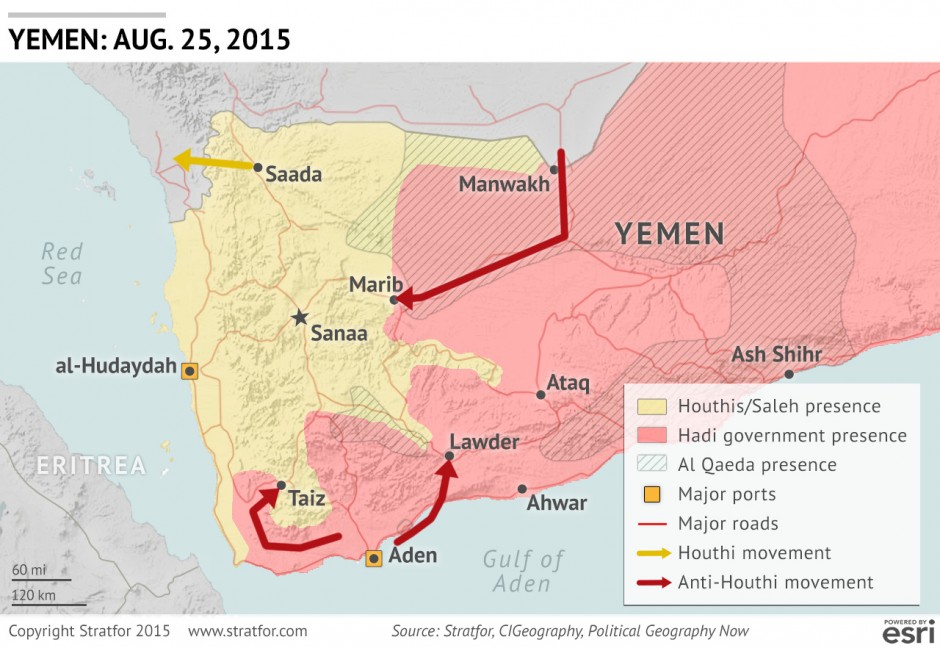
To the east, where anti-Houthi forces have already captured the city of Lawder, Houthi forces have successfully ambushed units in the Mukayras area, preventing northwestern operations into Bayda province. As forces reorganize following the breakout from Aden and as more resources are brought into the area, anti-Houthi forces will eventually be able to overpower Houthi and pro-Saleh forces in Yemen's southern regions. Still, the loyalists' momentum has undeniably faded.
In the north, Saudi Arabia is working to open another front in Marib. There have been reports of coalition forces reinforcing local fighters there, but no significant gains or offensive operations have emerged so far. Reports now indicate, though, that larger formations of armored vehicles arrived in Marib over the weekend, and a decisive offensive push driving west toward Sanaa, the capital, will likely become apparent soon.
Houthi fighters have not sat idly by while losing ground in southern Yemen. Instead, they have increased cross-border operations into Saudi Arabia in retaliation for Saudi operations in Yemen. According to reports, Saudi forces have vacated positions on the border in several areas and are instead simply suppressing Houthi activity with artillery. In most of the mountainous border area, Houthi forces do not present a strategic threat, though they have ambushed several Saudi military units, causing Saudi forces to abandon a substantial amount of equipment.
Meanwhile, a sustained bombing campaign has begun in Aden against the groups that recently regained control over the city – the Southern Resistance and troops loyal to embattled Yemeni President Abd Rabboh Mansour Hadi. There are also reports that al Qaeda in the Arabian Peninsula militants are openly moving through certain areas of the Aden Peninsula. But though the jihadist group has exploited the crisis to establish stronger control over certain locations in Hadramawt province, it is not entirely clear yet whether the fighters seen in Aden are actually members of al Qaeda in the Arabian Peninsula. They could instead be remaining elements of Houthi or pro-Saleh forces that are now conducting subversive actions in the rear of the coalition-supported forces.
Aug. 11
Anti-Houthi forces supported by the Saudi-led coalition have built up significant momentum in Yemen. To the south, Southern Resistance fighters have renewed their efforts after capturing Aden, pushing north and northeast from the port city. Greatly assisted by an influx of combat power, including Saudi-operated armored units, they captured Lahj and al-Anad air base last week and are advancing. The Southern Resistance recently liberated the city of Zinjibar, a major gain that allows them to push farther into Abyan governorate where they intend to link up with friendly forces locked in battle with Houthi- and Saleh-aligned elements near Lawder.
The Houthis, along with forces loyal to former Yemeni President Ali Abdullah Saleh, are in an increasingly precarious position after the liberation of several localities in the Ibb and Dhamar regions. This has led them to dig in and fortify some of their stronger urban positions, namely the cities of Taiz and Ibb. The Southern Resistance has given Houthi defenders in Ibb — 46 kilometers (28 miles) northeast of Taiz — 48 hours to withdraw from the city. Despite their impetus to drive on, rebel forces are reluctant to simply push into population centers, in part because of the risk of inflicting collateral damage and in part because of the perils of clearing well-defended urban terrain.
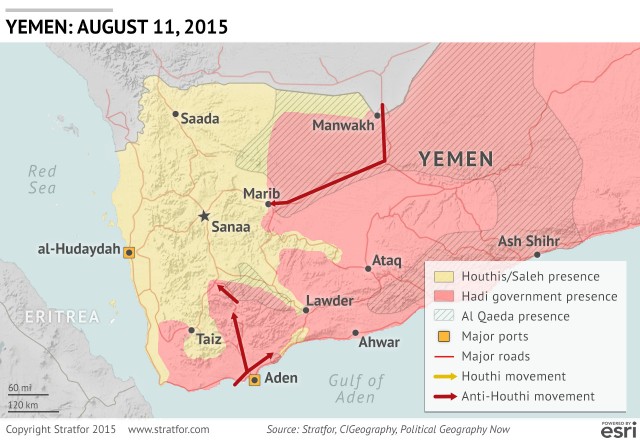
Yemen's capital, Sanaa, remains firmly under Houthi and Saleh control for now, but coalition-supported forces have closed to within 100 kilometers (60 miles) of the city. As well as encroaching from Dhamar governorate to the south, coalition-backed Yemeni fighters are massed in Marib, 120 kilometers (75 miles) east of Sanaa, having moved in from Saudi Arabia via the al-Wadiya border crossing earlier this month. Before moving on the capital, coalition-backed forces are likely to neutralize the surrounding area first, defeating Houthi and Saleh elements in the key popular centers of Taiz, Ibb and Dhamar city.
The civilian population in Sanaa is largely anti-Saudi, which could complicate efforts to seize the city. Significant protests are common against the Saudi-supported operation to pacify Yemen and against naval blockades that are preventing an influx of essential goods. A number of tribal groups have sided with the anti-Houthi movement, helping to accelerate the pace of operations in places such as Ibb. This boost and Saudi armored, air and logistic support mean that rapid gains are likely to continue, especially in less urbanized areas.
Aug. 6
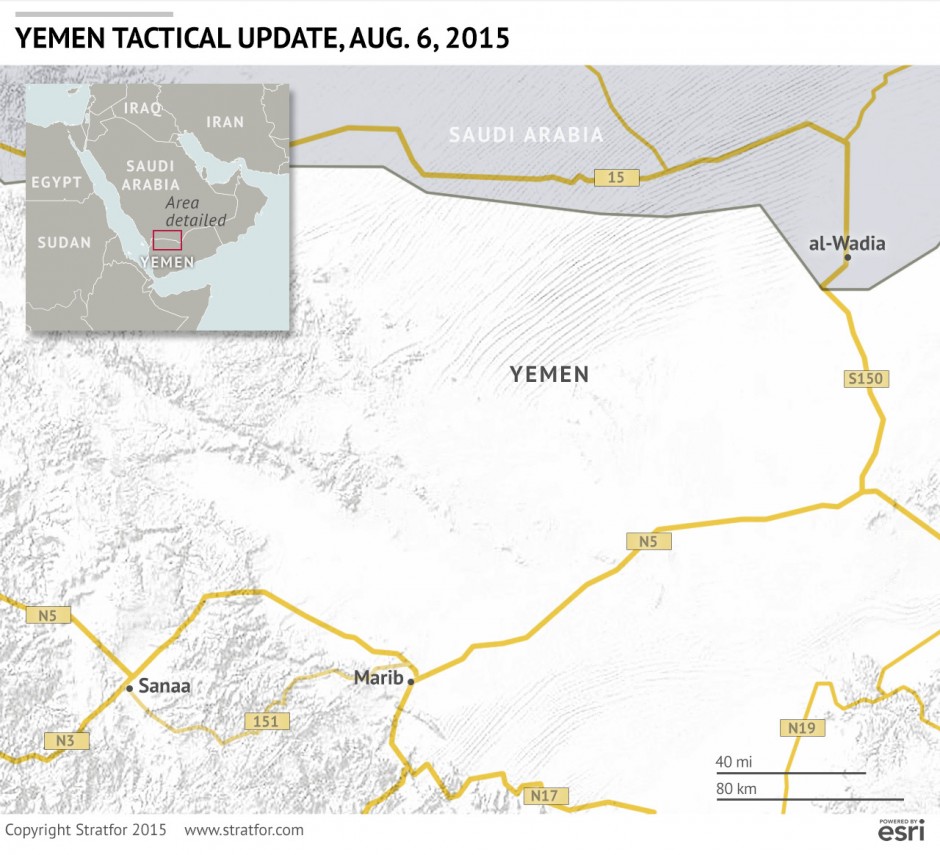
Media reports citing Yemeni military sources indicate that dozens of tanks, armored vehicles and personnel carriers accompanied by hundreds of Saudi-trained Yemeni troops entered Yemen overnight from Saudi Arabia via the al-Wadiya border crossing.
If confirmed, this development is significant. Stratfor has long anticipated a push by coalition ground forces toward Sanaa through Marib. The terrain along this route is favorable, making a push through it more viable than one toward Sanaa south through Sadaa or north from Aden and Lahj. The highway network in Yemen, specifically S150 and N5, permits movement and resupply from Saudi Arabia. The terrain from the al-Wadiya border crossing to Marib also allows armored units room to maneuver — especially with air support.
Once coalition forces reach Marib, however, the terrain becomes more challenging. The landscape becomes rugged in the 153-kilometer (95-mile) corridor along highway N5 between Marib and Sanaa. The terrain along highway 515, the equally long southern route from Marib to Sanaa, is even more rugged and restrictive.
By pressing on Sanaa from the east, the coalition would force the Houthis and allied supporters of former President Ali Abdullah Saleh into a two-front war, a position further complicated by the Houthi need to maintain forces in the north to protect the movement's heartland in Sadaa from a Saudi thrust from the north. If the coalition could seize control of the capital, Sanaa, it would be an important symbolic victory. It would also deprive the Houthis of significant resources from taxes and black market fuel sales. Taking Sanaa might also flush Houthi leader Abdul-Malik al-Houthi, former President Ali Abdullah Saleh and other senior opposition leaders out of hiding.
Elsewhere reports have emerged that Yemeni opposition forces launched an attack against Saudi forces in Najran. As coalition and southern resistance forces have pushed rebel forces out of the Aden area, al Qaeda in the Arabian Peninsula has also allegedly seized three new towns near Aden. In Abha, a town in southwest Saudi Arabia close to the Yemeni border, a suicide bomber attacked a Salafist mosque used by a Saudi state security unit known as the Special Emergency Force. The bomber, who was reportedly disguised as a janitor, killed 13 people, including 10 members of the unit.
There has been no confirmed claim of responsibility yet, although a claim purportedly from the Islamic State is circulating on Twitter. The target and location of the attack mean that it could have been the work of either the Houthis or the Islamic State. The Islamic State's Wilayat al-Najd affiliate group has attacked Shiite mosques in Saudi Arabia's Eastern Province in recent months. This was a similar soft target and apparently not as well protected as Shiite mosques, but to date the Islamic State has not attacked Salafist mosques in Saudi Arabia. If it is confirmed that the Islamic State was responsible, it will broaden the scope of the threat it poses to Saudi Arabia.
Aug. 3
A large force of Southern Resistance fighters backed by Saudi-led coalition armored fighting vehicles have reportedly seized control of al-Anad air base, located north of the city of Lahj. The deployment of 3,000 ground troops — 1,500 Saudi and Emirati personnel and 1,500 trained Yemenis — with main battle tanks and infantry fighting vehicles is a notable escalation in the Saudi-led coalition's involvement in Yemen. It is also a sign that Riyadh is willing to take additional casualties.
As the tide of war in Aden began to shift toward the Hadi-aligned Southern Resistance in previous weeks, Riyadh exploited the opportunity to begin moving heavier equipment into the port of Aden. An influx of light armored vehicles greatly assisted the anti-Houthi movement in retaking the city. With the Aden Peninsula coming back under Hadi control, the Saudi-led coalition has deployed significant numbers of men and materiel by ship. The added complexity and logistic burden imposed by forward mounting an armored force left Riyadh with little choice but to deploy its own personnel to use the equipment. This is a significant commitment to the campaign, but a necessary one. To operate a large-scale armored formation requires a high level of training, expertise and support, beyond what the Yemeni resistance forces alone could muster.
Al-Anad is the first objective for the Saudi-backed fighting force. It is the largest air base in Yemen, and formerly the home of U.S. forces engaged in counterterrorism operations against al Qaeda in the Arabian Peninsula. The United States withdrew its forces from the base in March 2015 when it came under attack from Houthi militants backed by remnants of the Yemeni armed forces loyal to former president Ali Abdullah Saleh. The Houthi thrust was an attempt to dislodge forces in al-Anad that were loyal to Yemen's internationally recognized government, led by President Abd Rabboh Mansour Hadi.
Since then, the base has changed hands several times. It has also been severely damaged during the fighting, and its arms storage facilities have been heavily looted. Situated approximately 48 kilometers (30 miles) north of Aden, al-Anad lies near the southern limit of the Houthis' military expansion and far from the group's northern power base. The facility is also at the confluence of Aden's coastal plain and the southern portion of Yemen's mountainous backbone. The southern approach is favorable terrain for coalition armor. Backed by air power, Saudi tanks and fighting vehicles have ample space to maneuver, creating a problem for the Houthi defenders.
However, the terrain just north of al-Anad tells a different story. It is very mountainous, with limited routes along which armor can move. This will provide Houthi and Saleh-aligned forces with a defensive advantage, more so than they had in Aden or Lahj. The heavily channeled terrain provides ample opportunities for mines and improvised explosive devices and offers positions for anti-armor ambushes. The defenders will also be able to shell the base and its approaches from elevated positions in the mountains. Additionally, the fact that the Saudis have bombed several bridges on important highways — part of the Saudi air campaign meant to cut Houthi supply lines running from the group's stronghold in northern Yemen to the south — will now actually hinder mobility for the coalition forces themselves through the mountain passes.
At this point, the coalition clearly has the upper hand in the area surrounding Aden. They have been able to reopen the port and the airport in Aden, establishing essential air and sea bridges to move personnel, supplies and equipment. The coalition will also likely attempt use al-Anad as a supply hub once the airfield there is secured. Still, their airlift capability is limited compared to what they can bring in via the port. The Saudi-led coalition undoubtedly has superior logistics, firepower and manpower, and has amassed an impressive modern fighting force. However, the farther the coalition moves from this beachhead into the hostile terrain of Yemen's mountains, the more exposed they will be to ambushes and counterattacks. Saudi forces took heavy losses in the 2009 war with Yemen, when Riyadh's offensive operations against the Houthis were staged in the mountains of northern Yemen.
Despite months of fighting against forces loyal to Hadi, the southern movement, and tribal forces backed by al Qaeda in the Arabian Peninsula, the Houthis are still far better armed than they were in 2009, thanks to the vast quantities of military ordnance they successfully looted from government stockpiles over the past year. Dislodging them from their mountain strongholds will be a formidable undertaking, but the coalition forces are beginning to show their commitment. Still, the true motivation behind Riyadh's latest actions in Yemen remains to be seen. It could be either the beginning of a sustained effort to totally defeat the Houthi- and Saleh-aligned forces on the battlefield, or an effort to ratchet up pressure to force a political settlement that would end the conflict.
Yemeni rebel leader Abdul-Malik al-Houthi said in an Aug. 2 speech that a political settlement with the country’s exiled government was still possible, despite the ouster of the Iran-backed rebels by their Saudi-backed counterparts from the port city of Aden. The Houthis would welcome any mediation effort by a neutral party, whether Arab or international, he said. Meanwhile, the prime minister of Yemen’s exiled government, Khaled Bahah, arrived Aug. 2 in Aden, nearly two weeks after his forces retook the city.
