
Editor's Note: Though Yemen has always suffered from instability, its recent history has been especially violent. With the Arab Spring came protests in Sanaa that escalated the feud between former President Ali Abdullah Saleh and Brig. Gen. Ali Mohsen al-Ahmar. The fighting in Sanaa eventually devolved to open warfare, and Saleh was severely wounded in an assassination attempt in June 2011. To ease tensions within the country, in 2012 the Gulf Cooperation Council mediated an agreement under which Saleh was replaced by current embattled President Abd Rabboh Mansour Hadi. However, after launching a campaign to push back against rebels and secessionist forces throughout the country, it became clear that the military was not a unified organization capable of maintaining order within the country.
In 2014, Hadi began pursuing a federal system to better distribute power among Yemen's different political groups, but obstacles to the plan emerged. The country's Houthi rebel group wanted more power within the new system and stepped up its campaign against the government in Sanaa, advancing all the way to the capital and eventually forcing it into U.N.-brokered peace talks in August. Per the agreement, Yemen formed a new government to appease the Houthis. However, the group was unhappy with the terms of the new proposition for the country's constitution. Despite agreeing to a cease-fire Jan. 19, Houthi rebels stormed the presidential palace in Sanaa and surrounded Prime Minister Khaled Bahah's residence Jan. 20. Although on the surface the Houthis' actions resemble a coup, the militants are actually pursuing a different strategy. Their recent moves are aimed at demonstrating their strength — they are not interested in directly ruling Yemen. Instead, they seek to increase their influence within Yemen's federal system. Stratfor has been tracking the conflict in Yemen closely, and below is a routinely updated chronicle of the most recent developments.
May 11
A humanitarian cease-fire began at midnight in Yemen, initially for five days but with the option of being extended. The call for a cessation of hostilities is the result of a confluence of factors that could edge the Saudi-supported anti-Houthi movement and the Houthis toward the negotiation table. Leading up to the cease-fire, the Saudi-led air campaign has maintained its punishing intensity, but it has not been able to overcome the gridlock on the ground. Riyadh also deployed additional ground forces to the border town of Najran to protect against Houthi cross-border incursions in the wake of last week's indirect fire attacks.
The air campaign has not been without its hazards. A Moroccan F-16 Fighting Falcon flying as part of the Saudi-led coalition crashed over Yemen on May 11. Initial reports said contact with the aircraft was lost after an unknown projectile hit it. Houthi fighters claimed to have shot it down, but there has been no confirmation of the exact cause of the crash. Imagery from the crash site shows no clear marks from enemy ground fire. On closer examination, however, the nature of the debris field indicates that the aircraft broke up in flight before plummeting to the ground. The Moroccan pilot failed to eject before the crash and recent pictures show his body among the wreckage. It is only the second documented case of a coalition aircraft crashing during Saudi-led air operations.
The first incident involved a Saudi F-15 that went down over the Red Sea in March, requiring the deployment of a U.S. Navy search and rescue helicopter to recover the two pilots. Losses are to be expected in this type of conflict, especially with the high tempo of sorties the Saudi-led coalition is maintaining.
The Battle for Aden
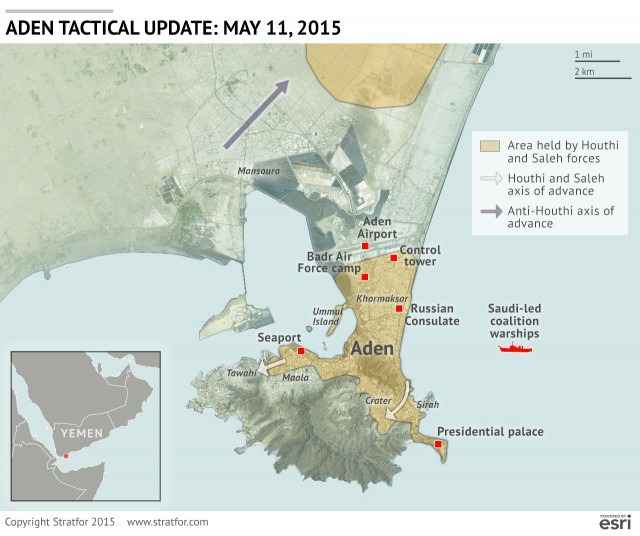
In Aden, Houthi forces made gains throughout the peninsula, despite being mostly dislocated from their immediate supply lines. As well as pushing deeper into Tawahi, the Houthis took full control of the Crater district. Just north of the Aden Peninsula, anti-Houthi forces seized control of the Dar Saad district, which further improves their position as well as their ability to lock Houthi and Saleh-aligned forces in the isolated peninsula. Intense fighting continues in and around Aden airport and it is unclear which side holds the terminal. Because of its location at the natural choke point before the peninsula widens, the airport is key terrain. Holding it enables the Southern Resistance fighters to isolate all the Houthi and Saleh fighters deeper in the peninsula, regardless of the territorial gains made in the Tawahi and Crater districts.
May 9: Saudis and Houthis Reach a Decision Point in Yemen
Following several days of attacks by Houthi forces on towns just across the Saudi border, Riyadh has offered Yemen's Houthi fighters a humanitarian cease-fire. At the same time, rumors of a potential limited ground incursion into Yemen are growing louder. The Houthis have forced the Saudis to make a decision. With the option of either sitting down at the negotiating table under a cease-fire or being drawn into a ground incursion inside Yemen, Riyadh will have to carefully evaluate its strength and the risks involved in either situation.
While military operations in Yemen have significantly constrained the movement of the Houthis and their allies; the air campaign has not yet been able to reverse their earlier gains; and the threat along the Saudi border has not been eliminated. A humanitarian cease-fire lasting at least five days, allegedly to begin on May 12, leading to a negotiated settlement would offer Saudi military decision-makers both short-term results and a more sustainable long-term stability.
April 30-May 5
Ground fighting continues in Taiz, Lawder, Lahj, Dali and Marib between Houthis and elements aligned with former Yemeni President Ali Abdullah Saleh on the one hand and anti-Houthi forces on the other. Although no significant gains have been made by either side, the Saudi-led air campaign has limited the ability of the Houthis to project power across the country.
The battle for Aden is ongoing, with the heaviest fighting focused near the airport, which anti-Houthi fighters allegedly still control. Coalition aircraft have been pounding Aden heavily, dropping ordnance on Houthi and Saleh positions in the Maala port district, around the airport and in the northern Dar Saad district of the city. Over the weekend, anti-Houthi fighters in Aden received a much-needed uplift in manpower. If observers on the ground were correct, these reinforcements reportedly came from the United Arab Emirates and are soldiers of Yemeni descent. The new troops were involved in fighting adjacent to the airport, likely in an attempt to exploit the recent gains made by the Southern Movement militia.
Although there is no hard evidence that Saudi or UAE special operations forces are accompanying the new fighters, it is probable that coalition specialists are present in Aden in some form, helping organize anti-Houthi forces as well as coordinating air assets. The deployment of reinforcements to Aden illustrates the Saudi intent to directly influence ground operations. The air campaign is doing a good job of interdicting the movement of Houthi and Saleh forces, and increased cooperation between local resistance groups and periodic uplifts in combatants will be instrumental in staging further counteroffensives. Houthi forces have made some gains, however, mainly around the port district, but the loss of the airport imposes a huge barrier to their attempts to take control of Aden.
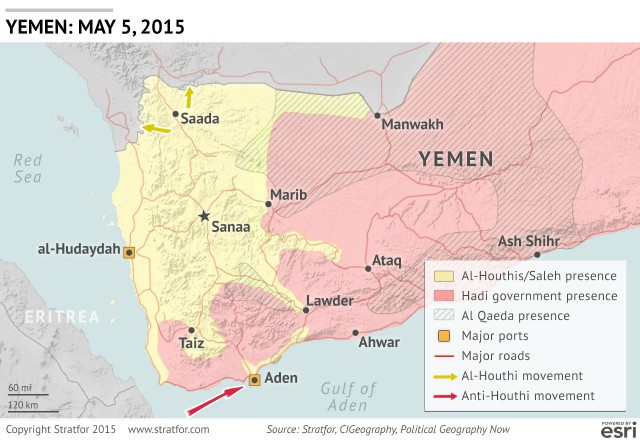
On Yemen's northern border, Houthi fighters conducted several more incursions into Saudi Arabia. Saudi forces have allegedly been forced to abandon several border posts, and in the city of Najran, flights to the airport were suspended and schools closed because of shelling by Houthi mortars and rocket artillery. These incursions into Saudi Arabia by the Houthis are not isolated, but it is the first time a population center has been directly targeted. Riyadh will continue to have problems closing down its porous border with Yemen, but Houthi fighters are likely to remain a threat only in the immediate vicinity of the border, lacking the ability to conduct deep cross-border operations.
More Monthly Updates:
