
Editor's Note: Though Yemen has always suffered from instability, its recent history has been especially violent. With the Arab Spring came protests in Sanaa that escalated the feud between former President Ali Abdullah Saleh and Brig. Gen. Ali Mohsen al-Ahmar. The fighting in Sanaa eventually devolved to open warfare, and Saleh was severely wounded in an assassination attempt in June 2011. To ease tensions within the country, in 2012 the Gulf Cooperation Council mediated an agreement under which Saleh was replaced by current embattled President Abd Rabboh Mansour Hadi. However, after launching a campaign to push back against rebels and secessionist forces throughout the country, it became clear that the military was not a unified organization capable of maintaining order within the country.
In 2014, Hadi began pursuing a federal system to better distribute power among Yemen's different political groups, but obstacles to the plan emerged. The country's Houthi rebel group wanted more power within the new system and stepped up its campaign against the government in Sanaa, advancing all the way to the capital and eventually forcing it into U.N.-brokered peace talks in August. Per the agreement, Yemen formed a new government to appease the Houthis. However, the group was unhappy with the terms of the new proposition for the country's constitution. Despite agreeing to a cease-fire Jan. 19, Houthi rebels stormed the presidential palace in Sanaa and surrounded Prime Minister Khaled Bahah's residence Jan. 20. Although on the surface the Houthis' actions resemble a coup, the militants are actually pursuing a different strategy. Their recent moves are aimed at demonstrating their strength — they are not interested in directly ruling Yemen. Instead, they seek to increase their influence within Yemen's federal system. Stratfor has been tracking the conflict in Yemen closely, and below is a routinely updated chronicle of the most recent developments.
June 25
A U.S. drone strike killed four suspected Al-Qaeda in the Arabian Peninsula militants in southeast Yemen. The attack targeted a camp in militant-controlled Mukalla.
June 22
Negotiations between the major belligerents in the Yemen conflict have officially ended in Geneva. Representatives from the government of Yemeni President Abd Rabboh Mansour Hadi, Houthi militias and forces loyal to former President Ali Abdullah Saleh parted ways with little to show for their time. The failure to reach an agreement was expected, given the unwillingness of any side to accept compromise in any form.
As a result, fighting continues throughout Yemen. The overall situation on the ground has continued to shift by small increments, but no significant gains have materialized on either side of the conflict, despite the best efforts of the Saudi-led air campaign, which continues at full strength.
Houthi fighters and former military personnel loyal to Saleh have exerted direct pressure on Saudi Arabia by carrying out cross-border raids, a major concern for Riyadh at a time when it needs to foster public support for military operations in Yemen. Several military positions in the Saudi provinces of Jazan and Najran were targeted over the weekend. In one particular attack near Abu Arradeef in Jazan province, Saleh loyalists managed to take control of a Saudi military base after a sustained bombardment from multiple launch rocket systems.
In Yemen, the Southern Resistance remains effective against Houthi forces in the city of Taiz, though the anti-Houthi group's most notable successes since the end of last week occurred north of Aden. After weeks of consistent but limited gains on the northern outskirts of Aden, Southern Resistance fighters finally reached the suburbs of Lahj, which are still under Houthi control. Lahj is the main Houthi anchor position between the port city of Aden itself and the Southern Resistance-controlled al-Anad air base to the north of it.
With the onset of Ramadan, Southern Resistance fighters revealed their intent to consolidate the liberation of Ad Dali and Aden governorates by the feast of Eid, which occurs at the end of the traditional Muslim period of fasting. Beyond wanting to secure its immediate gains, the Southern Resistance may have a more pressing motive. The group is allegedly receiving more Yemeni personnel with valuable foreign training to assist it in its attempts to recapture Aden. However, claims that the Southern Resistance is facing difficulties in paying its fighters casts some doubt over its ability to maintain its offensive operations.
June 20
A vehicle bomb detonated at Sanaa's Qubbat al-Mahdi mosque in the Old Town area of the city June 20, killing three and injuring an unspecified number of others. Islamic State bombed Houthi rebel political headquarters and two mosques June 17. Peace talks between the Houthis and representatives of President Abd Rabboh Mansour Hadi ended without a deal June 19.
Analysis: The Islamic State launched multiple suicide bombings in Sanaa aimed at Houthi rebels' political headquarters and two mosques June 17, the eve of Ramadan. According to the Yemeni Health Ministry, the attacks killed at least four people and wounded at least 50 more.
It was the Islamic State's fourth attack against mosques in Sanaa. The first and most deadly occurred March 20, when suicide bombers killed over 140 people in the bombing of two mosques during midday Friday prayers. Because al Qaeda has eschewed assaults on places of worship, the attack was unexpected and Islamic State suicide bombers were able to easily sneak into the mosques. Read the full analysis: The Islamic State's Pretense of Strength in Yemen.
June 18
A fistfight erupted on the sidelines of U.N.-mediated peace talks between Yemen's warring factions in Geneva. Yemeni opponents of the Houthi rebels that drove the government out of Sanaa interrupted a news conference held by Houthi officials, throwing shoes and shouting insults at them. Fights then broke out between Houthis and protesters, who were escorted out. Participants in the negotiations, scheduled to wrap up either June 19 or June 20, have reported little progress in the talks. Hamza al-Houthi, head of the Houthi delegation, stayed composed during the confusion.
June 12
In the battle for Yemen, forces opposed to the Houthi rebels appear to have the upper hand, at least for now. Indeed, over the past week, anti-Houthi fighters have made consistent, albeit limited, territorial gains against the rebels and against forces loyal to former President Ali Abdullah Saleh.
In Aden, anti-Houthi forces expanded their territory in the northern and western outskirts of the city. Meanwhile, they have taken ground in the fight near the airport in Aden. In Dali province, the general appointed by President Abd Rabboh Mansour Hadi to lead the contingent of the 33rd Brigade that is still loyal to the government (most of it is not) has refilled his ranks by gathering former military officers. He has also recruited Southern Resistance fighters, who also oppose the Houthis and who have claimed some recent success of their own in Dali. Elsewhere, the counteroffensive against the Houthis in Marib city has proved effective, and the rebels' attempts to enter the city appear unrealistic.
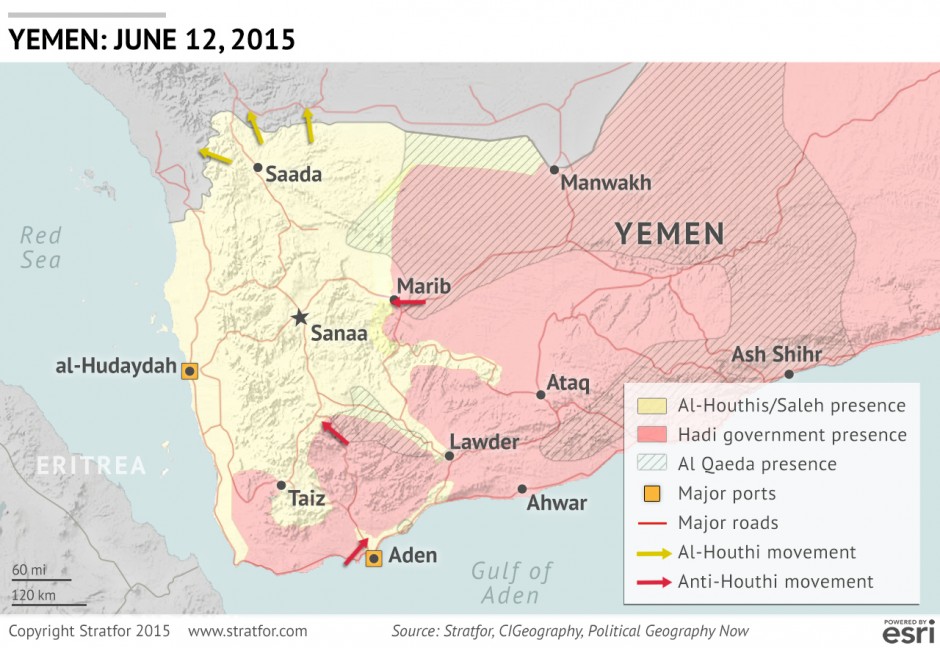
All these gains were made in no small part because of the Saudi-led air campaign, which has degraded the capabilities of the Houthis and Saleh loyalists. But that air campaign is becoming more controversial as it causes more collateral damage. In fact, the campaign came under fire after it destroyed parts of the old city in the center of Aden — a protected World Heritage site. Meanwhile, Saudi Arabia has been unable to quell Houthi activity along its border with Yemen — attacks against military outposts and shelling into Saudi territory continue unabated.
Delegations from the different sides of the conflict have arrived in Geneva to discuss the conflict. The official talks begin June 14, but preliminary talks involving a smaller number of delegates will begin June 12. But because the Hadi delegation continues to insist on a Security Council resolution — something that would require the unconditional disarmament and withdrawal of Houthi forces — the talks will probably not bear much fruit.
June 2
The tide of battle in Yemen appears to be turning in favor of the anti-Houthi movement. After a long period of stagnation, Houthi elements and supporters of former Yemeni President Ali Abdullah Saleh are being gradually pushed back from a number of active frontlines. Though gains are taking time to materialize, progress is being made in places such as Marib, Taiz and Dali. Anti-Houthi forces pushed beyond the city limits of Dali proper, advancing in the direction of Ibb. This is problematic for Saleh, who was compelled to move fighters from Ibb to the city of Taiz, which remains split between Houthi forces and those opposing them.
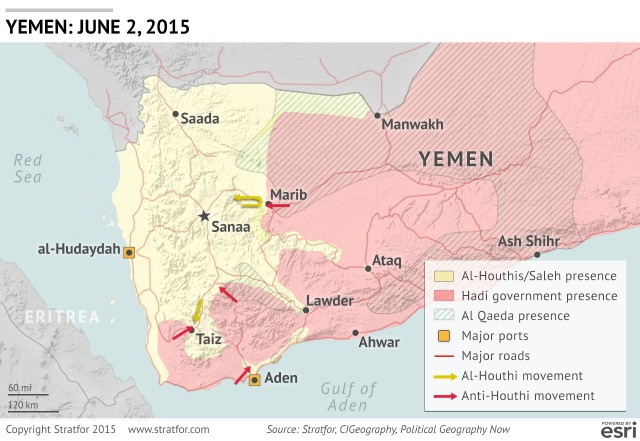
The alleged success of anti-Houthi forces in Marib is notable because the Houthis had claimed to be diverting efforts to the eastern fronts, following offers of support from sympathetic tribesmen and after becoming gridlocked in the south. In Aden, Houthi offensives have been continually blunted against the opposition, which managed to recapture terrain on the outskirts of the city. In the Aden peninsula, centralized Houthi forces are maintaining their blockade on anti-Houthi fighters located in the Western point of the peninsula, allegedly by using artillery fire to turn away ships laden with much-needed supplies. Meanwhile, Saudi-led coalition aircraft have continued to pound Houthi positions from the air, focusing heavily on the vulnerable border areas.
On the diplomatic front, a new date for the planned Geneva talks was established June 1. Rather than negotiating a new political settlement, however, the Geneva talks scheduled for June 10-14 are being framed as an opportunity to discuss the implementation of an existing U.N. Security Council ruling. It is believed that 14 delegates from the various sides of the conflict will be present. Unlike previous negotiations, which ended up being postponed, ousted Yemeni President Abd Rabboh Mansour Hadi and his Cabinet have already said they are ready to support the talks.
