
Editor's Note: Though Yemen has always suffered from instability, its recent history has been especially violent. With the Arab Spring came protests in Sanaa that escalated the feud between former President Ali Abdullah Saleh and Brig. Gen. Ali Mohsen al-Ahmar. The fighting in Sanaa eventually devolved to open warfare, and Saleh was severely wounded in an assassination attempt in June 2011. To ease tensions within the country, in 2012 the Gulf Cooperation Council mediated an agreement under which Saleh was replaced by current embattled President Abd Rabboh Mansour Hadi. However, after launching a campaign to push back against rebels and secessionist forces throughout the country, it became clear that the military was not a unified organization capable of maintaining order within the country.
In 2014, Hadi began pursuing a federal system to better distribute power among Yemen's different political groups, but obstacles to the plan emerged. The country's Houthi rebel group wanted more power within the new system and stepped up its campaign against the government in Sanaa, advancing all the way to the capital and eventually forcing it into U.N.-brokered peace talks in August. Per the agreement, Yemen formed a new government to appease the Houthis. However, the group was unhappy with the terms of the new proposition for the country's constitution. Despite agreeing to a cease-fire Jan. 19, Houthi rebels stormed the presidential palace in Sanaa and surrounded Prime Minister Khaled Bahah's residence Jan. 20. Although on the surface the Houthis' actions resemble a coup, the militants are actually pursuing a different strategy. Their recent moves are aimed at demonstrating their strength — they are not interested in directly ruling Yemen. Instead, they seek to increase their influence within Yemen's federal system. Stratfor has been tracking the conflict in Yemen closely, and below is a routinely updated chronicle of the most recent developments.
July 29
A car rigged with explosives detonated outside the al-Fayd al-Hatimi mosque in eastern Sanaa, killing three people. The local Islamic State affiliate, Wilayat Sanaa, claimed responsibility for the attack and said it was retaliation for Ismaili support of the Houth rebels, according to messages posted on Twitter. Meanwhile, the internationally recognized Yemeni government said it will incorporate the anti-Houthi Popular Resistance militiamen into the army.
July 28
A humanitarian truce in Yemen failed to take hold as Saudi-led airstrikes resumed July 28 against Houthi rebels who continued to fight with loyalists. The truce was implemented just a day earlier and was scheduled to last five days to enable aid workers to deliver humanitarian relief to the country. Airstrikes targeted Houthi positions north of Aden, the port city recaptured by anti-Houthi forces last week, and also struck rebel positions in Lahj province.
July 27
Saudi forces retaliated against Houthi rebel shelling of a border region in Yemen. No additional details were provided about the incident, which comes just hours after another "humanitarian cease-fire" between rebels and Saudi-backed forces in Yemen was scheduled to begin. Additionally, Saudi-led coalition jets mistakenly hit positions held by pro-government forces in Lahj province in southern Yemen
July 26
Yemeni forces allied with the Saudi-led coalition fought Houthi militia for control of the al-Anad air base July 26, local residents said. The fighting for Yemen's largest air base north of Aden comes hours before a five-day cease-fire is supposed to take effect to allow for the delivery of humanitarian aid. But the truce, which the Arab coalition announced July 25, was cast into doubt when Houthi leader Abdul-Malik al-Houthi was reported to have rejected it, arguing it would only benefit the Islamic State and al Qaeda.
July 25
The Saudi-led coalition in Yemen called a five-day humanitarian truce that will begin midnight, the Saudi Press Agency reported. The coalition specified it would respond if Houthi rebels violate the cease-fire.
July 24
Representatives of former Yemeni President Ali Abdullah Saleh have been meeting with diplomats from the United States, the United Arab Emirates and Britain, the leader of Saleh’s Congress party said July 24. The negotiations are taking place in Cairo and are aimed at finding a solution to the conflict in Yemen, he said. An official statement from the Congress party later denied any meetings. Western diplomats contacted by Reuters downplayed the meetings, saying they are part of regular discussions with Yemeni officials.
July 23
Houthi forces fired rockets at Aden's airport July 23, one day after the facility reopened. Three of the rockets landed near the runway, where a Saudi cargo plane carrying 20 tons of humanitarian aid was parked. Aden's airport has been closed for the duration of the four-month conflict in Yemen, but it reopened after Saudi airstrikes helped forces loyal to exiled President Abd Rabboh Mansour Hadi gain control of most of Aden.
July 22
A Saudi military plane landed in the Aden airport, the first since anti-Houthi forces seized the airport from Houthi rebels. Planes carrying unspecified relief supplies are expected to land in the next two days.
July 21
A car bombing claimed by the Islamic State killed four in rebel-controlled Sanaa. Another eight people, including several children, were wounded in the attack. Sunni extremists have carried out attacks against Shiite targets in Yemen since March. According to unnamed sources, another 11 Houthi fighters were killed in separate attacks overnight.
July 17
After months of intense fighting, the battle for Aden appears to be over. Advancing from the direction of the airport and through the Khormaksar district into the neck of the peninsula, Southern Resistance forces made good use of their new armored capability, liberating the Crater district from the Houthis and capturing key rebel leaders in the process. The Southern Resistance armored thrust then continued through the Maala port district and on to Tawahi. Rather than die in place, many Houthi fighters have surrendered. The isolated pockets of resistance that do remain are in tactically untenable positions and will likely not hold out long. The city of Aden is for all intents and purposes under Southern Resistance control.
Some Houthi forces were able to escape the final push and are headed northeast, where reports suggest they intend to regroup in Abyan governorate. One of the instrumental factors in Aden's fall to the Southern Resistance was the surrender of the 39th Armored Brigade, which was loyal to former Yemeni President Ali Abdullah Saleh. Losing the brigade, stationed at the military base at the airport, was a major blow for the lingering Houthi fighters in Aden.
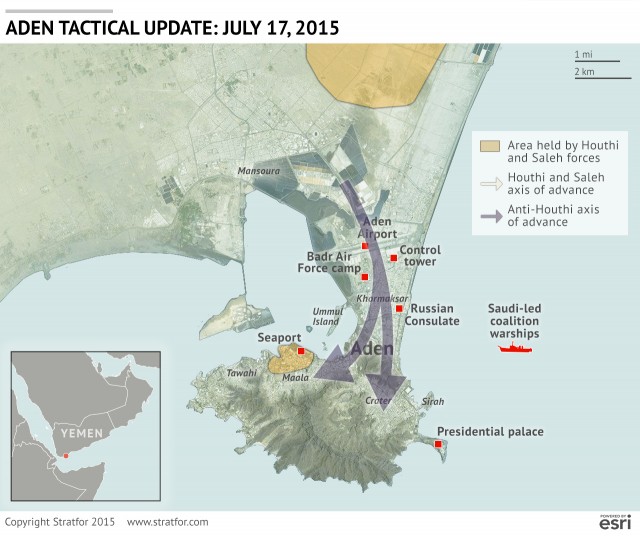
Keen to exploit the fledgling victory, Yemeni President Abd Rabboh Mansour Hadi immediately dispatched government and security officials to the city. Hadi seeks to rapidly reestablish as least a perception of political control over the peninsula. However, beyond the current pragmatic cooperation between military forces loyal to Hadi and the Southern Resistance militia, these parties are not politically aligned. Hadi is the internationally recognized president of Yemen but the Southern Resistance is the strongest physical element on the ground. Without a common and present enemy threat to act as a unifier, conflict over the political control of areas liberated from Houthi fighters is a disquieting possibility.
Both sides will attempt to limit such a conflict from emerging until their mutual interest in combating Houthi and Saleh forces results in some kind of resolution. At the same time, the success in Aden gives reason for Hadi and the Southern Resistance to pursue military action over negotiations, mainly because of the prospect of continued military success in the near future.
July 14
The U.N.-brokered cease-fire that was supposed to bring a temporary halt to fighting in Yemen over Ramadan failed before it even started. Supposedly taking effect midnight on July 10, the humanitarian truce was largely ignored by forces on the ground — fighting continued through the weekend. Forces loyal to Yemeni President Abd Rabboh Mansour Hadi claim they were not ordered to commit to the cessation of hostilities, though disrupted communications may have been partially responsible. Rumors suggest that new negotiations are being prepared but only if former Yemeni Prime Minister Khaled Bahah replaces Hadi as president. At the moment this remains an outside possibility. Even with serious negotiations or a more durable cease-fire underway, it is highly likely Yemen will simply move into another phase of conflict rather than achieve a peaceful resolution.
Saudi-led airstrikes against Houthi positions resumed July 13, killing at least 21 civilians and wounding 45 others in Sanaa, witnesses and medics said. Because of the paucity of Houthi targets outside of population centers, Saudi air power has been increasingly striking closer to populated areas, incurring higher levels of collateral damage as a result. Airstrikes also hit the Houthi stronghold of Saada in northern Yemen.
The Battle for Aden
Meanwhile, in Aden, Southern Resistance fighters made significant gains July 14, recapturing the port city's contested airport and an adjacent military base from Houthi rebels. The fighters were aided by Saudi combat aircraft and have continued to push farther south into Aden's Khormaksar district. Houthi opposition to the Southern Resistance is now reportedly weak, with many rebels surrendering or withdrawing from the city. Unconfirmed reports indicate that Republican Guard forces loyal to former President Ali Abdullah Saleh removed their support for the Houthis in Aden, leaving them to deal with the Southern Resistance offensive alone.
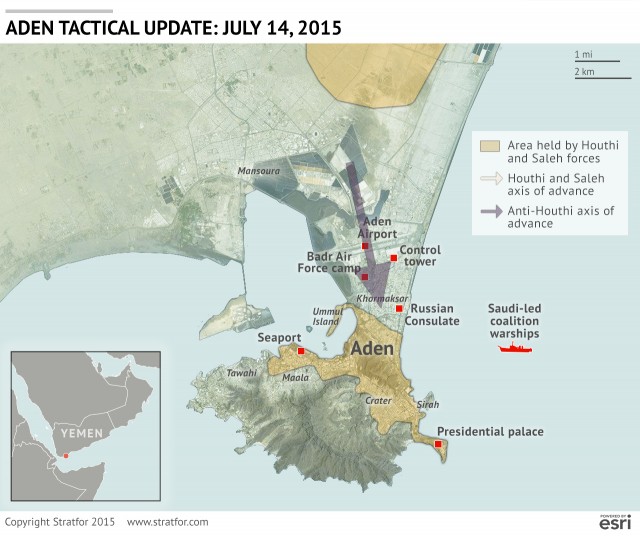
A further boon to anti-Houthi forces in Yemen arrived in the form of a large delivery of modern armored vehicles, likely from Saudi Arabia or the United Arab Emirates. These protected mobility vehicles were used extensively in July 14 operations in Aden. In addition to improving the Southern Resistance's overall mobility, the RPG-protected vehicles can deliver personnel close to the fighting and provide intimate fire support from onboard heavy weapons. This improved capability, combined with the weakened position of the remaining Houthis in Aden, has significantly tipped the balance of power in favor of the Southern Resistance. Based on recent developments, the battle for Aden could be in its final stages. Following an anti-Houthi victory in Aden, Southern Resistance forces will likely be redirected toward the battle fronts in Lahj, Taiz and Abyan, where Houthi rebels have also faced severe resistance but have as yet remained unbroken.
July 10
An unnamed Saudi official said that the U.N.-backed humanitarian pause in the conflict in Yemen will be "useless" because Houthi rebels do not have full control of their forces. During a five-day truce in May, the Saudi-led coalition accused the Houthis of violating the terms.
Analysis: Following continued attempts by U.N. representatives to establish a cease-fire during Ramadan, Yemen's belligerents have finally reached an agreement. That the cease-fire is being enacted without a withdrawal of Houthi forces, something previously demanded by the government of President Abd Rabboh Mansour Hadi, indicates the minimal impact this cease-fire will have on a resolution of this conflict in the long term and Hadi's limited ability to force the issue with the Houthis despite the Saudi intervention. Read the full analysis here: Yemen's Cease-Fire Will Not Bring Permanent Peace.
July 9
The United Nations envoy to Yemen, Ismail Ould Cheikh Ahmed, announced a humanitarian pause in the Yemen conflict set to begin July 10. The temporary truce will last through the end of Ramadan on July 17, allowing civilians in the country to receive humanitarian aid. Despite the announcement of the truce, warring factions in Yemen have so far failed to reach a permanent resolution to the conflict. The envoy held talks with officials from both the exiled government and Houthi rebel leaders in Sanaa.
July 7
An estimated 176 fighters and civilians were killed in airstrikes and clashes in Yemen on July 6, local residents and pro-Houthi media said July 7. This would make it the deadliest day in Yemen since the Arab coalition bombing campaign began in late March. Given the unwillingness of any side in the Yemen conflict to accept a compromise in negotiations, fighting continues across the troubled nation.
July 6
Yemen's internationally recognized government has said it expects to reach a deal on a cease-fire soon. Meanwhile, the Yemeni government staged more airstrikes in Sanaa. Thousands have been killed in airstrikes since March, and aid organizations have largely been unable to deliver supplies to the country. U.N.-brokered peace talks have been tumultuous.
July 4
Yemen's Houthi rebels said July 4 that they are in discussions with the United Nations about a humanitarian pause to fighting until the end of the Muslim holy month of Ramadan. The cessation of fighting would allow deliveries of much-needed humanitarian aid in the embattled country. On July 2, the U.S. State Department called for a humanitarian pause to the conflict to allow aid groups to deliver food, fuel and medicine.
