
April 29
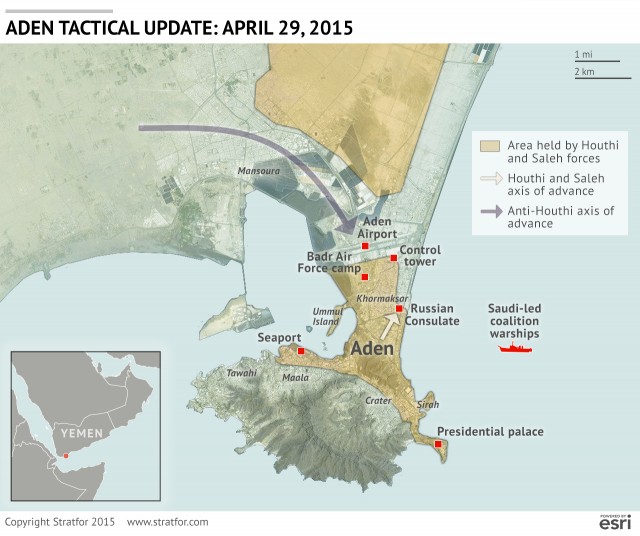
The battle for Aden is becoming increasingly desperate for the remaining Houthi and Saleh-aligned forces on the peninsula. In a bold move, opposition fighters from the ardently anti-Houthi Youth Resistance made a significant push from the Mansoura district of Aden toward the airport. Houthi and Saleh fighters are now completely cut off from their supply lines, though they still control the Badr Air Force Camp south of the airport, along with the control tower and surrounding buildings. Despite losing ground to the north, however, the Houthis were able to recover territory along the eastern coastline of the Aden Peninsula, including the disputed seaport. They were also able to take and hold the Russian consulate, a key defensive node.
Buoyed by success, the Youth Resistance is calling for all able-bodied fighters to flock to the front line. Because of the rapid gains made against them, Houthi and Saleh forces in Aden city have now become trapped between the Khormaksar, Maala and Crater districts. It is a position that will be difficult to maintain, so long as they are wedged between the offensive coming from the north, and the anti-Houthi contingent in the Tawahi and Crater districts that continue to hold their ground. If the Houthis are unable to receive supplies or reinforcements soon, the battle for Aden may well be in its final stages. The sustained interdiction of Houthi supplies and reinforcements, resulting from previous successful offensives near Lawder, Lahj and Taiz, has given the anti-Houthi forces a tactical advantage on the ground.
Elsewhere in Yemen
Fighting in Taiz governorate continues, though interruptions have periodically occurred as a result of local humanitarian cease-fires. The Saudi-led coalition parachute-dropped supplies and weapons to resistance fighters opposing Houthi and Saleh-aligned forces in and around Taiz city.
In Abyan governorate, anti-Houthi forces continue to make substantial gains near Lawder. The coalition air campaign is showing no signs of abating, causing attrition to Houthi and Saleh targets around Sanaa, as well as in Marib, Aden and other locations around Yemen.
April 24-28
Despite the transition from Operation Decisive Storm to Operation Restoring Hope, Saudi-led coalition airstrikes continue with no reduction in intensity, targeting Houthi and Saleh-aligned forces across Yemen.
Fighting endures in Taiz and Lahj governorates as well as along other main supply routes and logistic corridors. In the ongoing battle near Lawder, abutting the northeastern Houthi supply lines into Aden, Southern Movement fighters have been making significant gains. They have established control over key locations and severely damaged a Houthi convoy attempting to move through the area.
By blocking essential supplies, the fight for Aden has turned into a mutual starvation war of sorts. Houthi and Saleh forces inside Aden are isolating pro-Hadi and other anti-Houthi fighters in several districts at the bottom of the peninsula, while Southern Movement fighters that have fought their way into Aden from the north are isolating those Houthi and Saleh forces by complicating their resupply and reinforcements. The Houthi and Saleh forces have in turn taken control of the banking sectors in the governorates surrounding Aden and are preventing the local population from accessing essential funds and salaries.
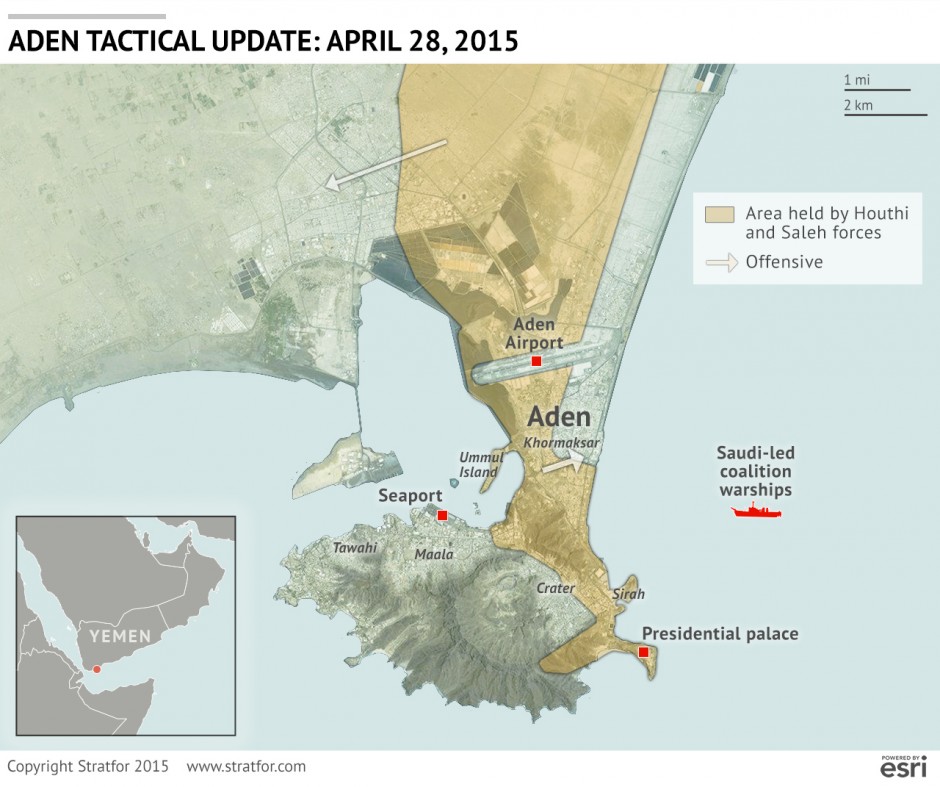
Inside the city of Aden itself, Houthi and Saleh forces have been trying to hit back against the Southern Movement offensive from the north, which occurred last week. They have taken positions at the University of Aden and the hospital (both in Khormaksar district) and have been engaged in heavy fighting with Southern Movement fighters there. Coalition aircraft and ships also continue to strike Houthi and Saleh positions in Aden.
Just north of the Aden Peninsula, Houthi forces have pushed west, trying to recover key terrain they lost earlier to local militias, exposing them to the risk of being cut off from their supply lines from the north.
In an effort to prevent aid getting through to Houthi and Saleh elements elsewhere in Aden, Saudi aircraft bombed Sanaa International Airport, preventing an Iranian cargo aircraft from touching down. It was believed that the aircraft contained aid for the Houthis, but could also have contained weapons or military equipment. Sanaa airport remains closed to air traffic. Bombing the runway was a creative solution to preventing Iran from landing supplies — without shooting down the plane — but it also means than any other humanitarian flights will no longer be able to use the airport as long as it is closed, or Saudis prevent aircraft from landing.
A Saudi military spokesman said the Iranian aircraft did not coordinate with coalition authorities and the pilot ignored a warning advising him to turn back. The denial of supplies fits into the larger picture of preventing Iranian-facilitated logistic support from reaching Houthi and Saleh fighters. A convoy of Iranian cargo ships, allegedly carrying weapons, was diverted April 23, following multiple statements saying that they would not be allowed to dock in Yemen. The United States even diverted an aircraft carrier from the Persian Gulf to track the convoy. As well as Saudi and Egyptian vessels, there is a sizable U.S. Navy presence in the Gulf of Aden.
April 23
A shift occurred in the Saudi-led military campaign in Yemen; interpreted by some as a cessation of hostilities, or an end to the Saudi-led air campaign. In reality the change is much more nuanced and indicative of Riyadh's broader strategy. The interplay of consecutive operations in a military campaign and the efforts to achieve a negotiated solution to the crisis are driving a change in focus, not an actual end to military operations.
Read the full analysis: The State of Play in Yemen
April 21-22
Iran dispatched a naval convoy of freighters to international waters near the border of Oman and Yemen, raising new fears of a potential confrontation in the region. The convoy, last reported to be stationary, is assumed to be a possible attempt to support Houthi fighters and forces loyal to former Yemeni President Ali Abdullah Saleh. It comes in spite of a blockade implemented by Saudi, Egyptian and UAE ships. U.S. officials, as well as the Saudi-led coalition, suspect that the convoy contains arms. Consequently, the United States has rushed an aircraft carrier and a guided missile cruiser to the area. Overall, Iran has a weak military hand to play in Yemen. Deploying the convoy there may be more about shaping a political narrative than achieving a military objective on the ground.
Read the full analysis: Iranian Naval Presence Raises the Odds of Confrontation
April 17-20
In an effort to support the offensive to capture Aden, Houthi militias and forces loyal to former Yemeni President Ali Abdullah Saleh have fought hard to maintain supply lines to the southern port. This has been no easy task, with the opposition continually interdicting and harassing vulnerable logistic chains. Over the weekend, the anti-Houthi Southern Movement succeeded in isolating Houthi and Saleh-aligned forces in Aden, making a push to the west of the city and taking ground adjacent to the Imran port area, cutting off several supply routes.
Not only does this — combined with the other operations in Lahj and Lawder — leave Houthi and Saleh forces stranded in Aden with finite supplies of ammunition and fighters, but it also cuts off their withdrawal route. Further compounding the Houthi position, Southern Movement fighters located at Lahj and al-Anad air base made a bold push south, handrailing the eastern coastline of the peninsula. Maintaining their momentum, they succeeded in taking control of Aden International Airport and the Russian Consulate, effectively insinuating themselves in the Houthi rear. The Houthis and Saleh-aligned forces remaining in Aden attempted to retake the ground lost over the weekend but with no success. Reports indicate the Southern Movement militia consolidated in the Russian Consulate and is continuing to push further south.
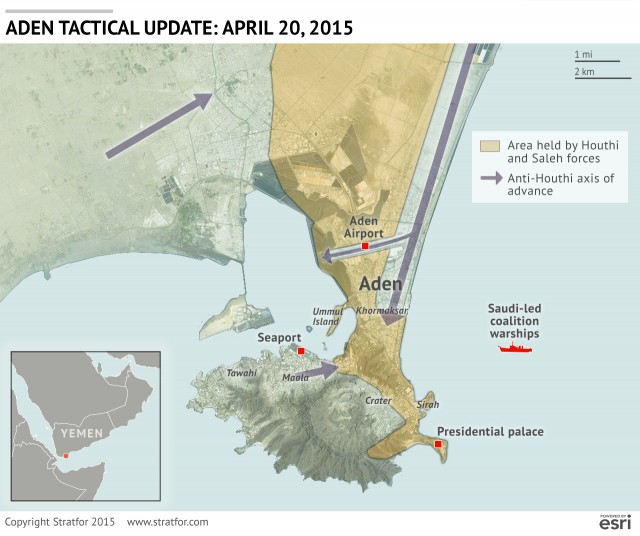
Though fighting continues along static lines in the Maala and Crater districts of Aden, the opening up of a second front is a serious diversion for Houthi and Saleh fighters. Committed in both directions, facing an aggressive enemy with ready access to fresh manpower and supplies, the Houthis run a considerable risk of becoming fully encircled in the geographically isolated Aden Peninsula. If the Southern Movement continues to push home its advantage, the battle for Aden could take a rapid turn in favor of the anti-Houthi militias.
A victory in Aden would not only boost morale among the populist militias, but it would also provide a staging post from where the anti-Houthi Southern Movement, backed by several military units still loyal to beleaguered President Abd Rabboh Mansour Hadi, could expand. Previously committed forces would be freed up to reorient toward Lahj, Lawder and potentially further afield in places such as Taiz province, where anti-Houthi forces have already made gains. By focusing outward, the Southern Movement can open up new offensives, support existing ones, or expand captured areas. Besides securing the fallback refuge of Hadi — currently residing in Riyadh — holding Aden provides the anti-Houthi forces with a bridgehead that could be used to receive supplies or even reinforcements from the Saudi-led coalition.
Outside of Aden
In another turn of events, the U.S. Navy carrier USS Theodore Roosevelt is steaming toward the coast of Yemen, reportedly to assist in the operation to interdict Iranian supply shipments to the Houthis. The carrier, which replaced the USS Carl Vinson on April 17, was intended to support coalition operations against the Islamic State in Syria and Iraq. The very fact that the carrier is being reassigned is a good indication of Washington's priorities in the Persian Gulf. The USS Theodore Roosevelt will join the amphibious readiness group already operating off Yemen's coast, led by the USS Iwo Jima.
Also of note, a huge explosion occurred in the Fajj Attan hill district of Sanaa on April 20, following a Saudi airstrike on a Republican Guard military base. The detonation was reportedly so large that blast damage was recorded well over a kilometer away. Scores of buildings were severely damaged, and a Yemeni official from the Health Ministry reported 25 fatalities and over 350 wounded as a result of the explosion, many injured by falling glass. Several foreign embassies were also damaged.
The Republican Guard base was occupied by troops loyal to Saleh and had been hit repeatedly following the commencement of Saudi coalition airstrikes. It appears that the target of the April 20 airstrike was a Scud missile storage depot. Examining footage of the strike, it appears that the outsize explosion may have resulted from a direct hit on the fuel storage facilities. Scuds are liquid-fueled missiles, and the fireball and black smoke immediately after detonation are consistent with petroleum tanks igniting. It is not known how many Republican Guard personnel were killed, but gauging from the number of civilian casualties, the death toll inside the base must have been heavy. If usable Scud warheads remain at the Fajj Attan location, the base will likely receive further airstrikes. At present the location of Saleh is unknown, but the assumption is that he is orchestrating his forces from a well-defended bunker.
April 14-16
The Saudi-led air campaign is continuing at a high tempo, but the target set is shifting from high-grade targets to objectives with a lower payoff. This is partially thanks to the successful targeting of large-scale weapons depots and specific materiel. With the majority of high-value targets engaged, bombs are starting to fall on opportunity targets. The airstrikes are also becoming more discriminating through necessity; with their mobility reduced, Houthi rebels and forces loyal to former President Ali Abdullah Saleh are embedding themselves in population centers. The Houthis are also exploiting Yemen's difficult mountain terrain to avoid airstrikes. The constant threat of close air support — and its particular effectiveness on ground columns, massed vehicles and personnel — has slowed Houthi ground offensives on the whole, while keeping anti-Houthi forces in the game.
As an additional boost to the forces opposing the Houthi and Saleh onslaught, large numbers of previously neutral military units have, in the past few days, confirmed their allegiance to embattled President Abd Rabboh Mansour Hadi. The perceived success of the air campaign, coupled with the fact that to do nothing is to eventually become a target, either from the air or on the ground, are likely explanations. Notably, even a number of previously pro-Saleh units have come out in recognition of Hadi's right to rule, pledging their allegiance in the process.
Capitalizing on Chaos
Taking advantage of the tumultuous situation in Yemen, al Qaeda in the Arabian Peninsula has been pressing its advantage, consolidating control in the coastal region of Mukalla. Al Qaeda fighters successfully took control of the Mukalla seaport, Riyan air base and the al-Dhaba oil export terminal on April 16. Riyan air base was home to both the 27th Infantry Brigade and the 190th Air Defense Brigade, both loyal to Hadi. The brigades initially refused to hand control of the facility to al Qaeda in the Arabian Peninsula, but after brief clashes the military units withdrew. Not only does al Qaeda control the air base, it allegedly has access to the remaining air defense equipment not removed or disabled.
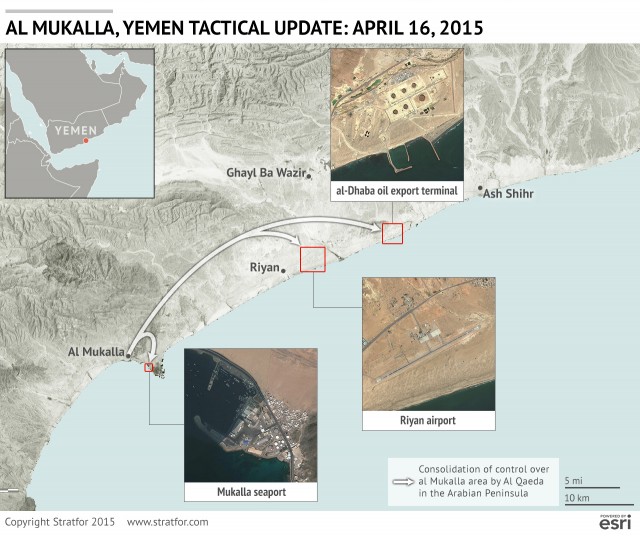
The two military groups were in a difficult position to begin with. By opposing the Houthi and Saleh militias, the pro-Hadi forces found themselves inadvertently aligned with al Qaeda in the Arabian Peninsula, which is vehemently anti-Houthi and supports combat operations against them. This tension was likely a driving factor in the withdrawal of the military; an engagement with al Qaeda would have been detrimental to both, diluting combat power at a time when the Houthis present the biggest threat.
To some extent, al Qaeda in the Arabian Peninsula already controlled Mukalla, Riyan, Ghayl Ba Wazir and Ash Shihr. The significance of the group's April 16 move is in the consolidation of control over the area, as a result of taking direct ownership of critical infrastructure. Al Qaeda in the Arabian Peninsula is actively blunting the Houthi offensives. A good example of this is the sustained vehicle-borne improvised explosive device campaign against Houthis in the Lawder area over recent days. Despite its anti-Houthi stance, al Qaeda in the Arabian Peninsula is gladly using the situation in Yemen to expand its actual control in different parts of country, where no one is capable or willing to oppose it.
Yemen's Contested Battlespace
The situation in the southern port city of Aden remains largely the same. Houthi and anti-Houthi forces continue to fight for key terrain, though the Houthis have the advantage of holding the high ground, occupying positions in the mountains around Aden as well as the Crater district. They are using these elevated fire positions to good effect, engaging the anti-Houthi forces in the city with sniper and harassing fire. Nevertheless, anti-Houthi fighters managed to clear some of the Houthi positions on the Crater slopes, but the high ground is heavily contested.
Northwest of Aden, the battle for Taiz continues in the mountainous province. The pro-Hadi 35th Armored Brigade narrowly escaped encirclement by Saleh loyalists, mainly thanks to the efforts of rural militias. These militias are fighting in support of the 35th in opposition to Houthi and pro-Saleh forces.
The offensive by Saleh forces in Dali, 100 kilometers (60 miles) north of Aden, has effectively been halted. The fighting has further diminished the pro-Saleh 33rd Armored Brigade, which was already depleted by Saudi airstrikes earlier in the campaign.
Near the city of Marib, 120 kilometers east of Sanaa, the Houthis continue to push from the west. The fighting has yet to reach the city, however, because tribal militias are throwing everything against the Houthis in an effort to stop their advance, sustaining heavy casualties in the process. Given the intensity of the close combat, it is uncertain how long the militias will be able to hold out.
April 11-13
The conflict in Yemen shows no sign of abating. Intense fighting continued throughout the weekend, and now, a number of distinct battlefronts have emerged. Houthi militants and forces aligned with Yemen's former president, Ali Abdullah Saleh, are fighting for control of a number of key localities in the south of the country. At the same time, they are expanding east into Yemen's oil-rich territories, which brings Houthi and Saleh forces into direct conflict with al Qaeda in the Arabian Peninsula as well as other opposing forces.
In the mountainous province of Taiz, the 35th Armored Brigade, a unit that swore loyalty to Yemen's incumbent president Abd Rabboh Mansour Hadi, is assaulting the 22nd Armored Brigade, which is loyal to Saleh. The pro-Hadi formation is greatly supported by Saudi-led coalition airstrikes, and heavy fighting is taking place across the undulating, close terrain of Taiz. In Ad Dali province, tribal fighters are heavily engaging Houthi militias in the town of the same name, and reports from the ground indicate that the tribes are inflicting significant casualties on their opponents. Elements of the Saleh-aligned 33rd Armored Brigade have repositioned to assist, having suffered heavy attrition from the Saudi air campaign in Bayhan district.
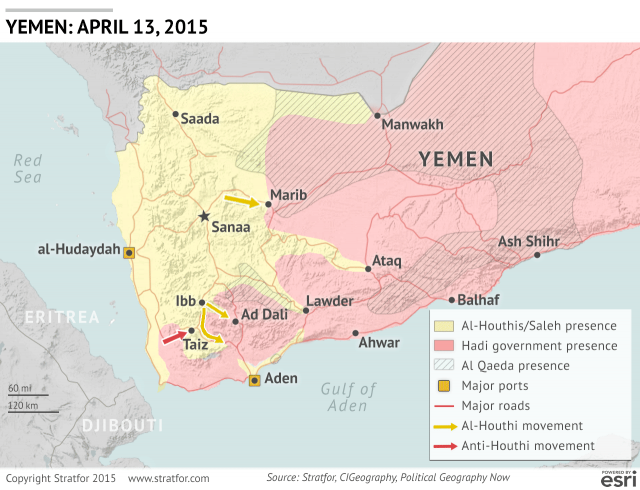
Houthi and Saleh reinforcements from Ibb are moving through Taiz toward Aden, potentially to fight anti-Houthi forces around Lahj and al-Anad air base on the way to the port city. The anti-Houthi forces have successfully interdicted Houthi supply lines to the south and have isolated the remaining Houthi and Saleh forces in Aden, severely threatening the offensive. Despite this, the fight for Aden's port remains fierce, particularly around the Hadjiv traffic circle. The Saudi-led air campaign, supported by naval artillery fire, continues to strike Houthi and Saleh positions throughout the city, including the presidential palace. Immediately northwest of Aden, in Sheikh Othman, anti-Houthi militias and forces loyal to Hadi continue to attack.
Aside from the fight for control over Aden, separate offensives are ongoing in the east of the country, where the al Qaeda in the Arabian Peninsula heartland and Yemen's main oil infrastructure are located. Remaining military units have been preparing themselves to face the Houthi advance, including the 2nd Naval Infantry Brigade following its declaration of loyalty to Hadi. The brigade is cooperating with local tribes to set up the defense of the town of Belhaf and its liquefied natural gas facility operated by Total. In addition, local tribes in Hadramawt province have stated their intention to raise an army of 20,000 fighters to oppose the Houthi movement. So far, the Houthis have been able to make significant advances in the east. They captured the capital of the Shabwa governorate, Ataq, last week and are beginning to push into the town of Marib. The Saudi-led coalition has targeted them at both locations to disrupt their advance.
Finally, to the north, the Houthis conducted another border incursion into Saudi Arabia over the weekend. The move comes at a time when Riyadh is actively trying to clear civilians from villages along its southern border. Conventional Saudi ground forces have yet to penetrate south, but Egypt reportedly deployed troops to Perim, and island in the Bab el-Mandeb strait, to conduct a battle damage assessment following airstrikes against Houthi forces.
April 9-10
Fighting across the Aden Peninsula has stagnated in recent days but remains focused on the Maala and Crater districts. Reports indicate that the tide is turning against Houthi militants and forces loyal to Yemen's former president, Ali Abdullah Saleh. In Sheikh Uthman, a satellite city that is effectively a northern suburb of Aden, anti-Houthi forces and elements of a brigade still loyal to Yemeni President Abd Rabboh Mansour Hadi are threatening to cut off opposing forces inside Aden.
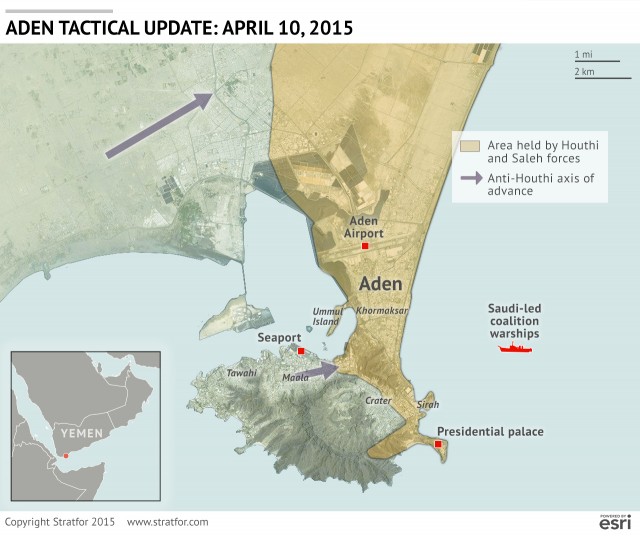
Elsewhere in Yemen, anti-Houthi forces continue to disrupt the supply lines of Houthi and pro-Saleh militias north of Aden. By holding al-Anad air base and interdicting the flow of arms and personnel in Lawder province, anti-Houthi forces have impacted the success of the offensive against Aden.
In Shabwah province, however, the Houthi offensive is proceeding largely as planned, with the town of Ataq falling to the militants. Although resistance was reportedly scant, the success of the offensive was in no small part thanks to the presence of the 21st Mechanized Infantry Brigade, a formation based in the area that aligned with the Houthi and Saleh movement when Ataq came under pressure.
Al Qaeda in the Arabia Peninsula has already begun a guerrilla campaign against Houthi and Saleh forces near Ataq, using at least one vehicle-borne improvised explosive device in what is likely to be a campaign of continued resistance. In Ibb province, located halfway between Sanaa and Aden, al Qaeda fighters have been taking over positions previously abandoned by Houthi forces.
April 7-8
Heavy fighting continues to define the battle for Aden. Coalition airstrikes and naval gunfire from Saudi and Egyptian vessels have persistently engaged Houthi and Saleh-held areas of the city. The frontline has not shifted significantly and fighting remains focused predominantly on the edges of the Maala port locality and the Crater district. In a blow to the Houthi and Saleh-aligned forces in Aden, however, essential supply lines linking the city with other concentrations of fighters and resources have been effectively severed.
Further north, anti-Houthi militias are fighting to keep control of the al-Anad air base (which they captured April 6), heavily buoyed by Saudi close air support. Besides attempting to take the air base back, the Houthis are trying to re-establish control of the road linking Aden to Taiz, but so far they have not been able to do so. To the east, units of the 111th Infantry Brigade, which remains loyal to President Abd Rabboh Mansour Hadi and was originally stationed in Ahwar, are closing down the town of Lawder, blocking nearby roads. Troops from the Saleh-aligned 15th and 117th infantry brigades are fighting resistance battles around Lawder district itself, attempting to reconnect with Houthi and Saleh forces in Aden.
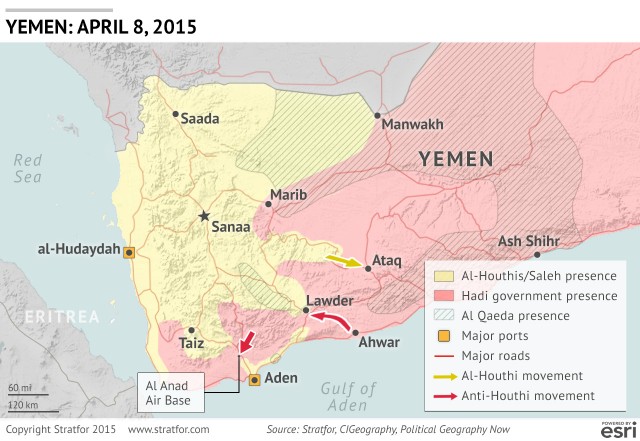
While the Saleh-aligned units in Lawder are reportedly still receiving supplies from Bayda to the northwest, if Houthi forces and their affiliates in Aden are separated from their supply lines for an extended period of time, it could damage their ability to continue the Aden offensive. Being logistically isolated will also dampen their resistance to smaller counteroffensives by tribal militias and al Qaeda in the Arabian Peninsula fighters in other locations across what is an increasingly disconnected pocket.
Elsewhere, however, Houthi forces continue to advance where they can. They are moving on the town of Ataq, capital of the Shabwa region, and could push even further east into the areas of Yemen where critical energy facilities are located. The presence of al Qaeda in the Arabian Peninsula in these locations could yet slow this advance, however.
Al Qaeda in the Arabian Peninsula is exploiting the divisions within Yemen for its own ends, extending its reach across the country. Most recently, the terrorist organization took control of a border post near Manwakh, on the Saudi border. The group has also been active near Lawder, but rather than showing loyalty to forces aligned with Yemen's erstwhile president, their main interest is in combating Houthi influence in the region. This has resulted in al Qaeda in the Arabian Peninsula coming into conflict with local anti-Houthi militias, and at Mukalla, tribal fighters are still attempting to mount an offensive to push al Qaeda out of the area.
April 4-6
Over the weekend, Houthi and Saleh-aligned forces recovered ground they were forced to abandon April 3 under pressure from Saudi-led coalition airstrikes. Aside from retaking the presidential palace in the southeast corner of the peninsula, militants also occupied positions on Mount Shamsan overlooking Aden's Crater district, an area that remains strongly contested. On the northern edge of the Aden peninsula, Houthi fighters are pushing hard into the Maala district, where the seaport is located. Although the strategic port remains disputed for now, the security situation is rapidly deteriorating.
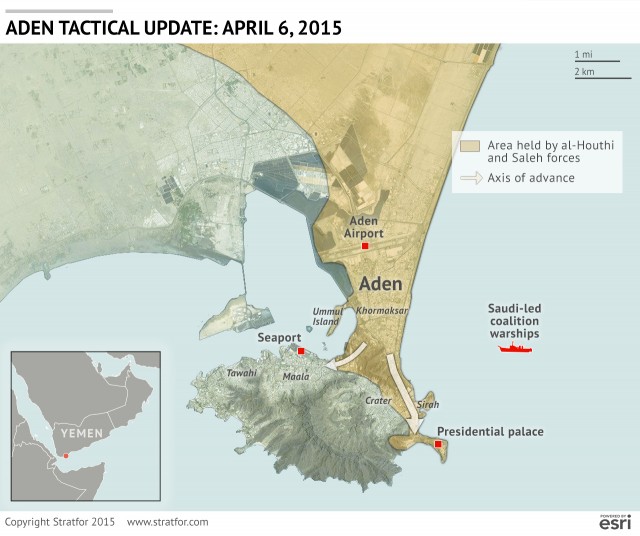
On April 4, gunfire from the shore forced a pair of rigid inflatable boats operated by the French navy to turn away from their approach. The French government was attempting the evacuation of 44 civilians of various nationalities from Aden but was forced to enlist the help of the self-proclaimed Yemeni coast guard to shuttle the civilians to ships waiting in open water. Successful evacuation attempts had been carried out days earlier, but as the French effort on April 4 proved, negotiating the port is increasingly treacherous. This creates a problem for fighters opposing the Houthi and pro-Saleh forces in Aden because resupply by sea is now increasingly difficult. Although some supplies were delivered by guided parachute last week, urban fighting is notoriously ammunition-intensive.
Besides placing a burden on logistics and making the extraction of personnel increasingly hazardous, a contested port means that there is now an increased risk to any forces seeking to dock and disembark troops to help secure the peninsula. Though the Houthis and Saleh-aligned militants have made gains, including taking control of al-Ummal island, the forces opposing them continue to put up strong resistance, backed by close air support and supply drops from the air. So far, they have not suffered a defeat that they cannot recover from.
Wider Yemen
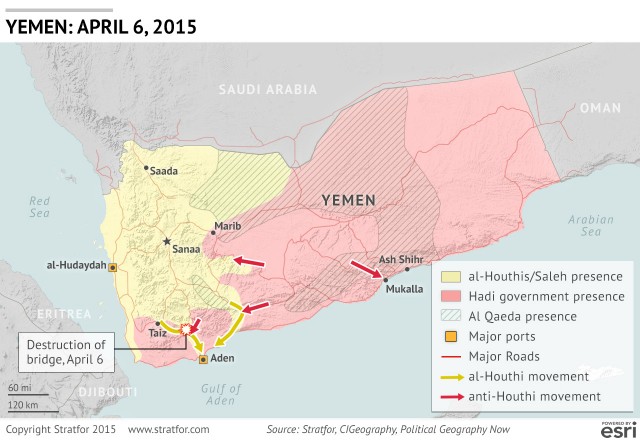
To the north of Aden, tribal militias opposing Houthi fighters are staging a number of different offensives. At least some of the tribal thrusts appear designed to cut off the Houthi and pro-Saleh fighters attacking Aden, isolating them from their main body. Near Lawder, the 15th and 117th infantry brigades, loyal to Saleh, are at risk of being cut off. Another offensive near the al-Anad air base north of Aden — now under control of local militias opposing Houthi fighters — could conceivably sever the Taiz to Lahj axis, which the Houthis use as a main supply route. A major bridge along this mobility corridor was destroyed April 6, further hampering the ability of the attackers to bring up supplies and reinforcements.
Simultaneously, tribal offensives in and around the Marib region have begun against the remains of the Saleh-affiliated 33rd Armored Brigade, which was heavily deteriorated by airstrikes. Elsewhere, tribal militias reportedly mounted attempts to capture the port city of Mukalla, Hadramawt region, from al Qaeda in the Arabian Peninsula. The Saudi-led coalition has been focused on reducing Houthi and pro-Saleh combat power on the ground. In addition to concentrating on the cities of Aden and Sanaa, airstrikes have attacked Houthi positions on Perim island in the Bab el-Mandeb strait as well as near the Saudi border, where ordnance was dropped on manned trench systems south of Najran. Although the opposition forces have mainly consisted of anti-Houthi militias and tribal fighters, Saudi special operations forces have reportedly been active in the conflict. Such forces would likely be operating in an advisory capacity as well as guiding in close air support.
April 3
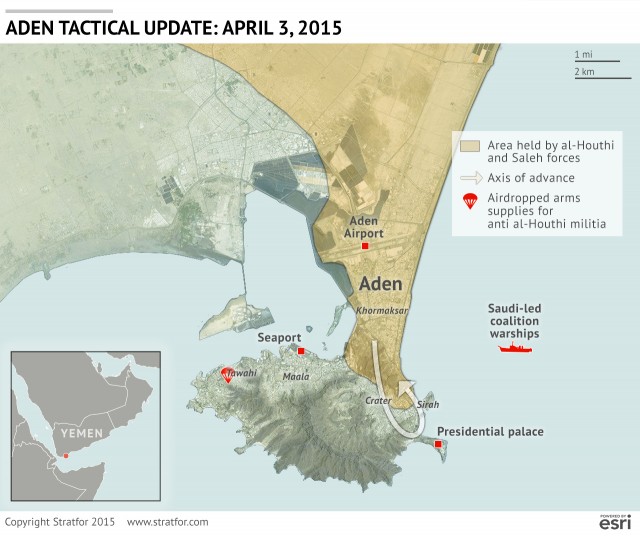
Continued airstrikes by the Saudi-led coalition have forced Houthi and Saleh-aligned forces to withdraw from their front lines in the southern port city of Aden. Having occupied the presidential palace earlier in the week, Houthi militants were forced to give up their positions in the face of persistent bombing from the air. Falling back from the Shira and Crater neighborhoods and harried by pro-Hadi fighters opposing them on the ground, the Houthi and Saleh militants are now consolidated in the Khormaksar neighborhood.
Several airdrops of weaponry and medical supplies have bolstered the forces loyal to ousted Yemeni President Abd Rabboh Mansour Hadi. The airdrops came down in the Tawahi districts of Aden, delivered by guided high-altitude parachutes, directed by an integral global positioning system. This advanced technology is almost exclusively used by the United States, though the United Arab Emirates has submitted contracts to procure it in the past. It remains unknown whether Riyadh has access to the technology, but Washington previously offered logistical support to the ongoing campaign in Yemen. Among the weapons delivered were small arms, anti-tank weapons, telecommunications equipment and medical supplies.
April 2
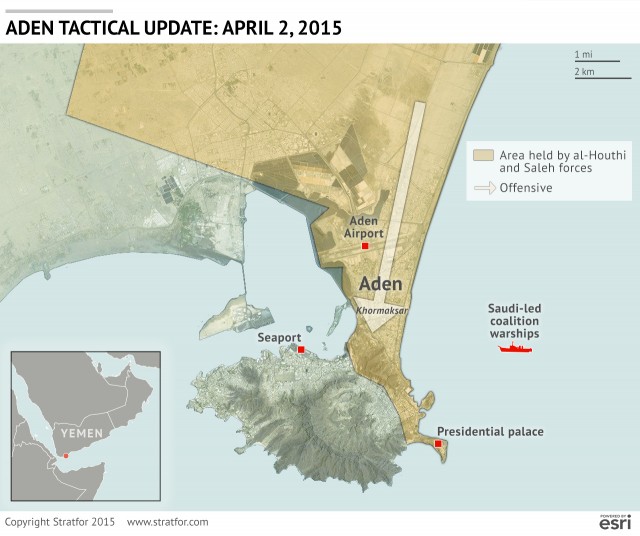
Houthi-aligned forces made significant gains in the Yemeni port city of Aden on April 2. Saudi airstrikes had slowed their advance into the central Khormaksar area, but by the end of the day, the Houthi militants and forces loyal to former President Ali Abdullah Saleh were able to establish control over central Aden and the presidential palace.
The rebel gains mean the window of opportunity for a Saudi-led ground operation may be closing rapidly. Forces loyal to embattled President Abd Rabboh Mansour Hadi and militias that oppose the Houthis control only the western portion of the Aden Peninsula, and Houthi mortar shelling is targeting the port now. These developments significantly increase the amount of effort required to deploy forces to the city — and it increases the risk they will incur once there. Such an operation would no longer be a defensive one, but would instead require an offensive action to liberate substantial portions of Aden.
If Saudi Arabia intends to block the rebel forces from taking Aden, it appears it will not be able to mount a response to the rapidly evolving situation on the ground in time. However, Riyadh could still launch such a blocking action, and continued Saudi airstrikes and bombardments by coalition warships indicate attempts to influence the tactical situation on the ground may continue. Stratfor sources also say that Saudi Arabia and Egypt continue to position forces that could deploy to Aden.
While the city is a strategic port in Yemen, the Houthis will be able to make little use of the harbor and the airfield because of the Saudi-led coalition's naval blockade and no-fly zone. However, the advance does eliminate a core pocket of pro-Hadi forces while destroying the symbolic value of Aden as the last resort of non-Houthi Yemen.
From Saudi Arabia's perspective, however, losing parts of Aden is not catastrophic. Military operations in Yemen have focused on forcing the Houthis to the negotiating table for discussions on returning to the status quo. To do this, Houthi military power — and that of their allies — must be deteriorated first. The Saudi-led air campaign is an important tool to this effect, and Riyadh could decide to wait and slowly choke Saleh and the Houthis' combat capabilities.
At the same time, a ground offensive could still be possible, even if it happens somewhere other than Aden. Saudi Arabia still has forces massed on Yemen's northern border, where skirmishes are already ongoing. These forces could be used to penetrate Yemen, with the possible intent to liberate Sanaa. Such an operation, however, would be even more costly than a defense of Aden, and Riyadh will not make this decision lightly. Even if they were to lose Aden, the Saudis would still maintain a wide range of options to deal with this crisis. How Saudi Arabia manages the coalition it has built to share the burden of responding to the situation in Yemen will be a critical aspect in shaping the overall strategy and levels of commitment the coalition is willing to accept.
