
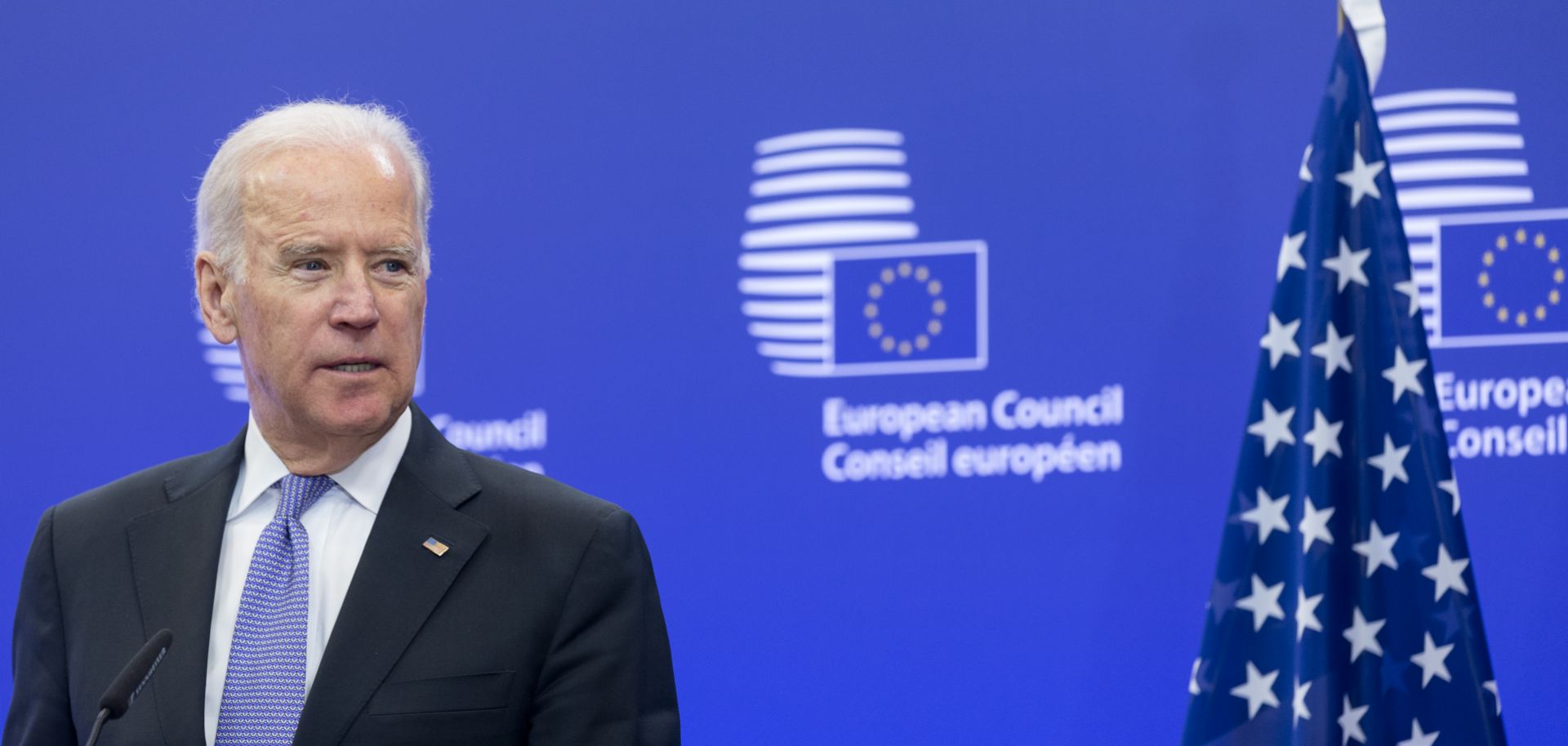
Then-U.S. Vice President Joe Biden participates in a bilateral meeting at the European Council headquarters in Brussels, Belgium, on Feb. 6, 2015.
Cooperation between the United States and Europe on issues including trade, defense, climate change and China will deepen under U.S. President-elect Joe Biden, who will seek closer coordination with Germany and France without abandoning Washington’s bilateral relationship with the United Kingdom. After Biden was declared the winner of the U.S. presidential election on Nov. 7, countries including Germany, France and the United Kingdom sent their congratulations and called for increased cooperation with the United States.
- The president of the European Commission, Ursula von der Leyen, said that the European Union "stands ready to intensify cooperation" with the new U.S. administration.
- During the electoral campaign, Biden said he would reverse outgoing president Donald Trump’s unilateralism on global issues and strengthen the United States’ international alliances.
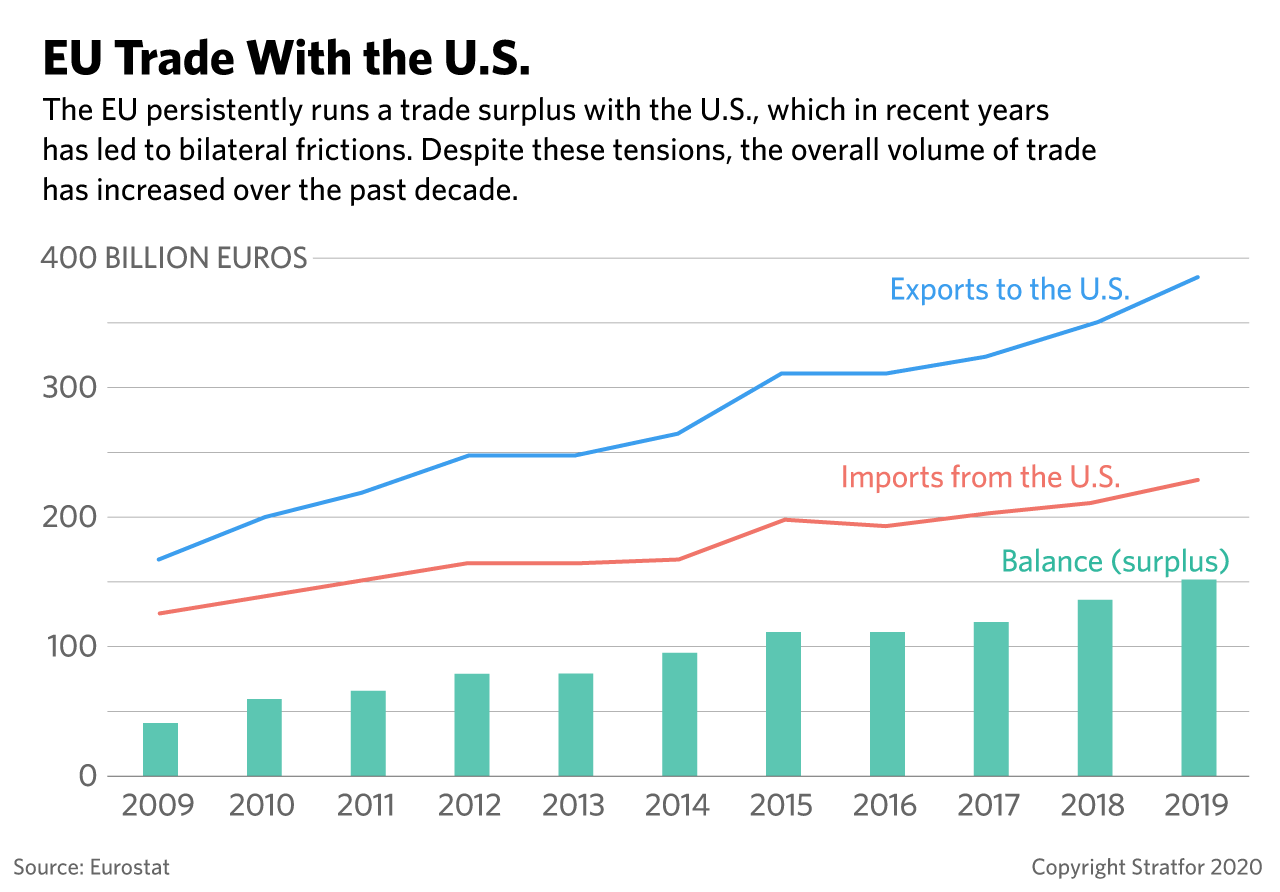
The United States and the European Union will likely end their current tit-for-tat policy of tariffs and counter-tariffs and seek negotiated solutions, but the two sides will continue to have trade disputes. The United States runs a significant trade deficit in goods with the European Union (almost $180 billion in 2019) and Biden has promised to boost American manufacturing, strengthen rules for U.S. agencies purchasing American products, and increase taxes for companies taking their production abroad. In the meantime, the recessions created by the COVID-19 crisis in Europe will make the European Union more willing to protect its manufacturers and farmers and to raise taxes for large digital companies, most of which are American.
- In mid-2018, the United States imposed a 25 percent tariff on steel imports and a 10 percent tariff on aluminum imports from the European Union and other countries. The European Union reacted by imposing some 6.4 billion euros ($7.5 billion) in retaliatory tariffs against U.S. products.
- In late 2019, the United States imposed tariffs on EU products such as wine, whisky and olive oil as a part of a dispute over European subsidies for the aerospace company Airbus.
- On Nov. 9, the European Union decided to impose $4 billion in tariffs on U.S. goods in retaliation for American subsidies granted to aircraft manufacturer Boeing. This is probably part of a strategy to seek leverage in the upcoming negotiations with the Biden White House over trade.
- France has said it will begin collecting a tax on digital companies such as Facebook, Amazon, Apple and Google this year, while the European Union is considering a similar tax at the continental level.
The White House will seek coordination with its European partners on taking a tough stance on China on issues such as investment in critical infrastructure. Similar to the Trump administration, the Biden administration sees the rise of China as a challenge to U.S. interests and will request its partners around the world, including in Europe, to keep tight oversight of Chinese investment in their territories, especially in sensitive areas of the economy such as telecommunications and energy infrastructure. The United States will also likely seek greater coordination with the European Union to increase diplomatic and political pressure on China over the political crisis in Hong Kong, as well as China’s alleged human rights violations against religious minorities in the country.
- Throughout 2020, a combination of U.S. pressure and national security concerns led Germany, France and the United Kingdom, among others, to severely restrict Chinese tech giant Huawei from participating in the development of their 5G infrastructure.
- The European Union has repeatedly asked Beijing to provide European investors in China with a level playing field compared with domestic investors.
- Because of its strong trade ties with China, Germany has a dual strategy to deal with Beijing: It criticizes China on human rights issues, but keeps the dialogue open on trade and other economic issues. Germany will continue to seek this balance under a Biden presidency.
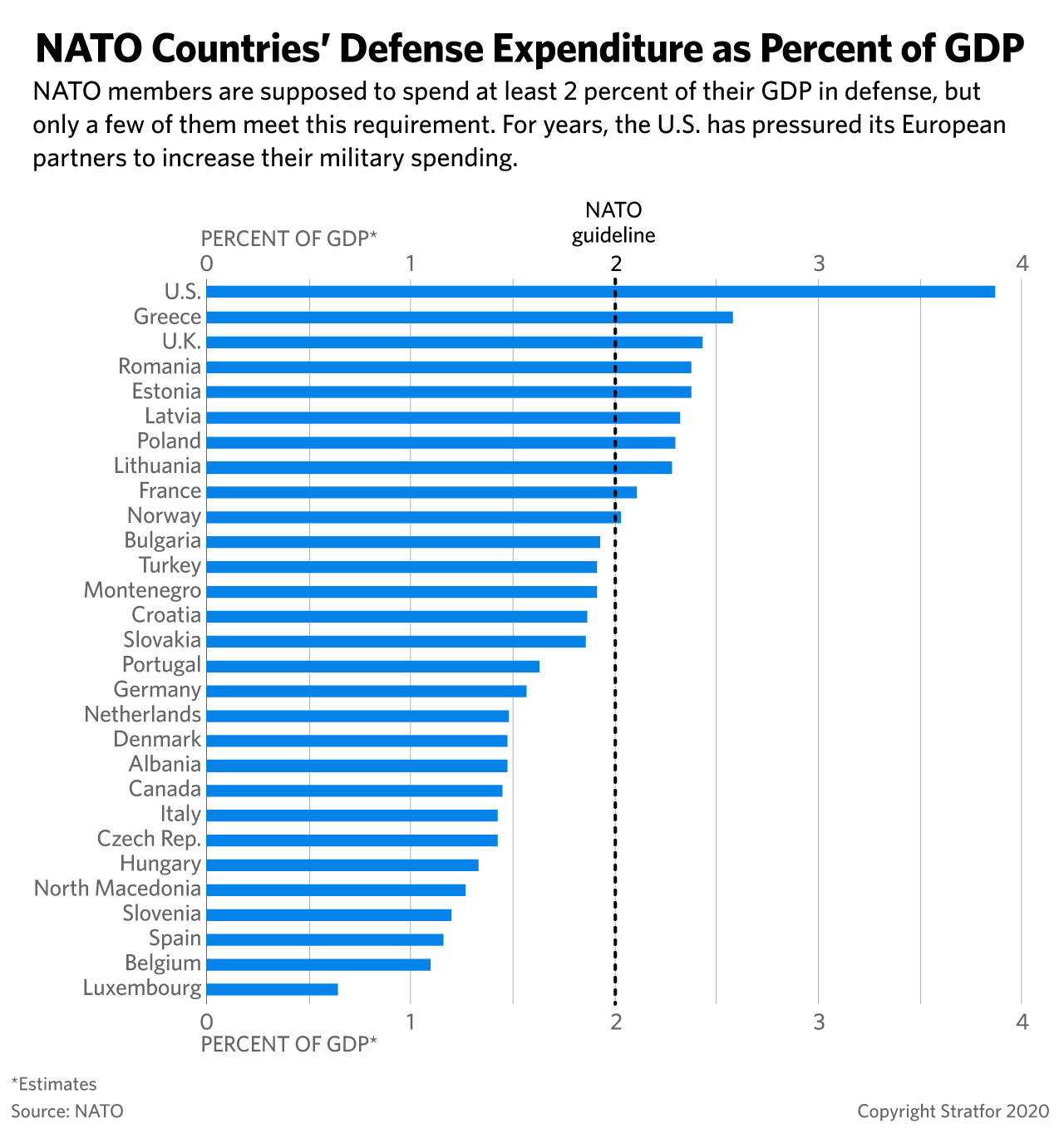
The Biden administration will be more vocal in its support for NATO and its collective defense clause than the outgoing Trump administration, but will still insist its European partners spend more on defense. The Trump administration raised questions about Article 5 of the NATO agreement, which calls for member states to defend each other in case of external military aggression. On the contrary, the Biden administration will reassure its allies of the United States’ military protection. Still, the White House will insist that its European allies meet the alliance’s target of spending at least 2 percent of GDP in defense, a demand that U.S. governments have made for decades. Many EU member states will struggle to meet this target at a time of deep pandemic-induced recessions, which will force the United States to continue protecting its allies while still pressuring them to spend more on defense.
- According to 2020 estimates, only nine European NATO member states (the United Kingdom, Greece, Estonia, Romania, Poland, Latvia, Lithuania, France and Norway) spend at least 2 percent of their GDP on defense.
- Countries including Spain, Italy, Belgium and the Netherlands spend less than 1.5 percent of their GDP on defense, which means that they will struggle to meet the alliance’s goal.
- In recent years, France has pushed for greater military autonomy in the European Union, in the shape of greater coordination in defense spending and more integration of their defense planning. Central and eastern European countries are skeptical of this push, out of concern that it could create a rift with the United States.
Biden’s pledge to implement environmentally-friendly policies will open the door to greater U.S.-EU cooperation in the fight against climate change. However, possible EU policies such as the introduction of a carbon tax could still lead to disputes with the White House. The United States officially withdrew from the Paris climate agreement on Nov 4, but Biden has promised to rejoin shortly after he takes over. This will create space for Washington and Brussels to work together on issues such as the implementation of shared standards for carbon dioxide emissions for different sectors of the economy, as well as increasing pressure on countries like China to speed up their energy transition. However, the European Union is currently considering policies such as introducing a “carbon tariff” on imports from highly polluting countries, which could potentially target U.S. goods.
- According to the European Union’s Green Deal initiative, the bloc will become carbon neutral by 2050. One of the policies potentially included in the plan is a tariff on imports from countries that are not doing enough to reduce their carbon emissions. Such a tax would target countries like China and India, but potentially also the United States.
- France considers that the European Union should not sign free trade agreements with countries that do not participate in the Paris climate agreement. The United States’ return to the agreement could resurrect the talks over a U.S.-EU deal, though significant obstacles remain.
The United States’ political relationship with countries like Germany and France is likely to improve, while countries like Poland and Hungary could come under greater U.S. pressure to change some of their domestic policies, especially on social issues. The Biden administration is likely to see Germany as the European Union’s political leader, and seek greater cooperation with Berlin on the defense of multilateral institutions like the World Trade Organization and the World Health Organization, which both were heavily weakened during the Trump years. The Biden administration is also likely to seek greater cooperation with France on issues such as the fight against terrorism and climate change. The Biden White House will remain supportive of countries in central and eastern Europe, especially when it comes to reassuring them against potential Russian aggression. However, it will also be more vocal in its criticism of policies on issues like immigration, the rule of law, and LGTBQ rights in countries like Poland and Hungary. These countries could be more willing to soften some of their domestic policies because of U.S. pressure.
- Trump has praised nationalist and anti-immigration policies in countries like Poland and Hungary. This will probably change under a Biden administration.
- After Russia’s annexation of Crimea in 2014, then-U.S. President Barack Obama increased troop deployments to central and eastern Europe. Trump has also promised to further increase the United States’ military presence in Poland. This policy will likely continue under Biden.
- The Trump administration has supported infrastructure projects to reduce central and eastern Europe’s dependence on Russian energy, a policy that is likely to also continue under Biden.
- While German-U.S. relations will improve overall, Berlin’s support for the Russia-backed Nord Stream 2 pipeline will continue to create diplomatic frictions with the White House because of the existing U.S. sanctions on the pipeline.
The United States will continue to see the United Kingdom as a key political and military ally, but because of Brexit, the White House will look for additional interlocutors in Europe. London will have to compete with the likes of Berlin and Paris when it comes to debating Europe’s role on global issues. Biden’s victory increases the probability of a free trade agreement between the European Union and the United Kingdom. The United Kingdom will not sign a trade deal with the White House in the near future, which means that London will prioritize a deal with Brussels. The White House will also pressure the United Kingdom to keep the border between Northern Ireland and the Republic of Ireland open, which will make it easier for London to reach a deal with Brussels.
- The United Kingdom is a member of the U.N. Security Council and is a recognized nuclear power. London also has a global military reach and is a long-time U.S. security ally. None of these factors will go away under Biden, but Britain’s exit from the European Union means that the White House will now look more to Berlin, Paris and even Brussels to discuss European issues.
- Issues such as U.S. pressure to include agricultural products and different food standards were obstacles in the trade negotiations between London and the White House in 2020. These issues will continue to be problematic in 2021 because the United States’ offensive trade interests have not changed. With low prospects of a trade deal with the United States in the short term, the United Kingdom will seek to secure a trade deal with the European Union. But a trade deal between the United Kingdom and the United States is still possible on a longer timeframe.
- Biden has said that his White House will not sign a trade deal with the United Kingdom if it enforces a threat to introduce customs controls between Northern Ireland and the Republic of Ireland. The reintroduction of border controls would violate the 1998 Good Friday Agreement in Ireland, of which the United States is a guarantor.
