
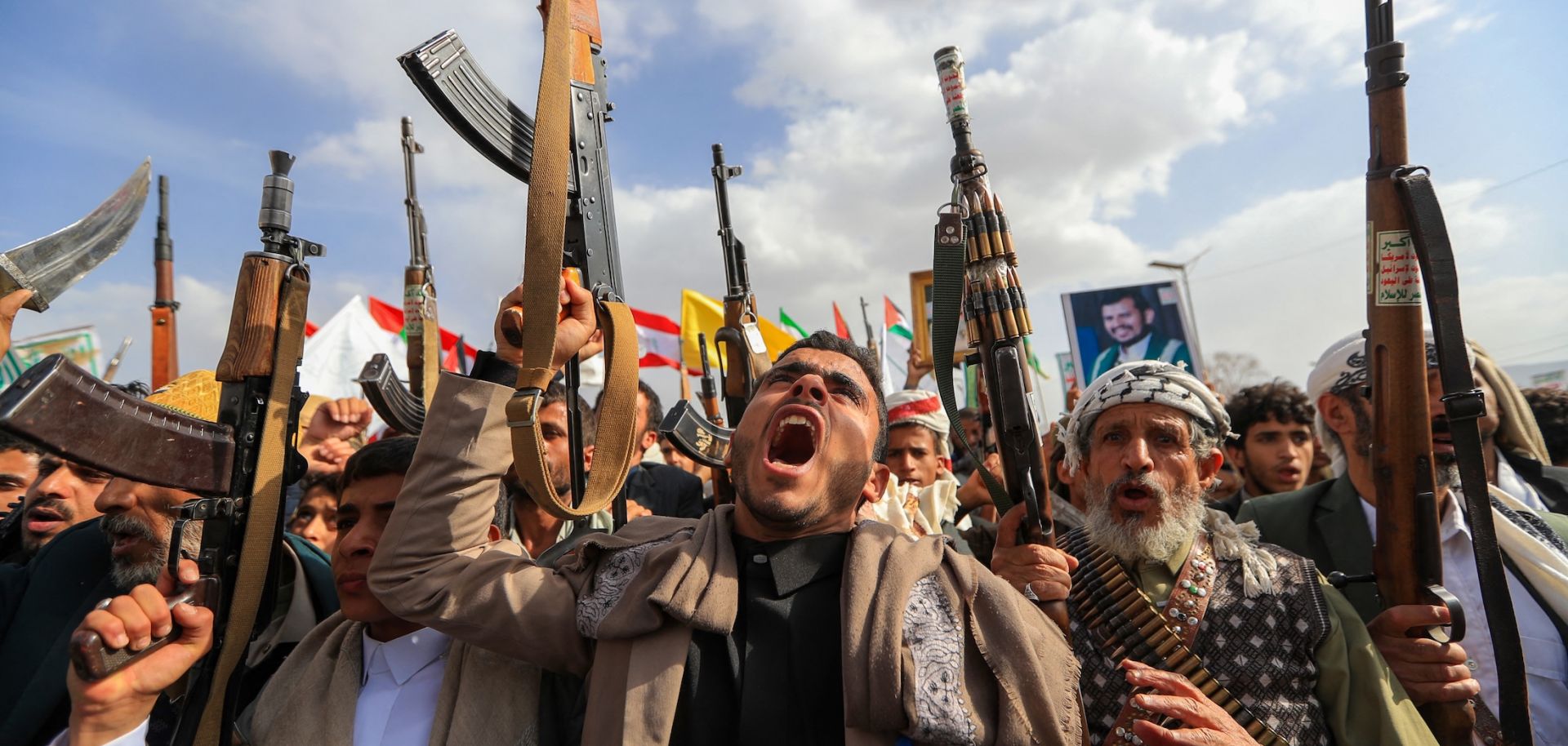
Armed Yemeni supporters of the Iran-backed Houthi movement brandish their weapons during a protest against U.S. strikes on Iran in Sanaa on July 10, 2026.
(Mohammed HUWAIS / AFP via Getty Images)
Armed Yemeni supporters of the Iran-backed Houthi movement brandish their weapons during a protest against U.S. strikes on Iran in Sanaa on July 10, 2026.

The recent exchange of airstrikes between Saudi Arabia and Yemen's Iran-backed Houthi rebels signals the end of their unofficial truce, but for now, a limited tit-for-tat cycle of attacks remains more likely than an immediate return to sustained cross-border conflict or full-scale civil war in Yemen. On July 13, the Iran-backed Houthis in Yemen launched several missiles and drones toward the Abha International Airport in southern Saudi Arabia, hours after accusing Saudi forces of bombing the Sanaa International Airport. According to the Saudi-backed Yemeni Internationally Recognized Government (IRG), the Saudi strikes were conducted to prevent an Iranian aircraft carrying a Houthi delegation from landing at the Sanaa airport. Meanwhile, the Saudi-backed Yemeni Defense Ministry said its "patience has run out" and warned that further Iranian or Houthi violations of internationally recognized Yemeni airspace would trigger a kinetic response, pointing toward the Saudi-led coalition's decade-old air blockade against the Houthis. In the wake of the Saudi attacks, Houthi spokesperson Yahya Saree declared that the unofficial truce reached with Riyadh in 2022 was over. 

  • According to a July 13 report by Axios, Saudi Crown Prince Mohammad Bin Salman (MBS) sought and secured the support of U.S. President Donald Trump to conduct the attacks against the Sanaa airport. This endorsement was pursued because Saudi Arabia would want and need the United States' help should full-scale warfare with the Houthis break out again. 

The recent strikes between Saudi Arabia and the Houthis represent the first major direct military exchange since their unofficial 2022 truce, signaling an effort by both sides to reassert their redlines amid stalled ceasefire talks and rising regional tensions. The unofficial truce in April 2022 halted seven years of hostilities between Iran-backed Houthi rebels and Arab nations, which led to multiple Houthi attacks on Saudi soil. Although tensions have periodically flared since then, the agreement has, until now, prevented cross-border exchanges of fire. The July 13 strikes follow several weeks of rising friction. The Houthis have recently stepped up their attacks against Saudi-backed IRG forces in contested areas of Yemen, while simultaneously mobilizing fighters for what Houthi officials have been describing as an eventual escalation of hostilities. Then, on July 9, Yemen's government warned Iran and the Houthis against using direct flights between Tehran and Sanaa to transport military personnel. The Saudi strike on the Sana'a airport thus appears aimed at enforcing that warning and ensuring the flight route does not become a channel for Iranian military support. The bombardment also upholds Saudi Arabia's long-standing air blockade and signals that Riyadh is still willing to act against Houthi defiance, despite its broader desire to avoid a full return to war. Meanwhile, for the Houthis, the retaliatory attacks on Saudi Arabia's Abha airport reflect an intent to defend their own redlines, preserve deterrence and show that Saudi enforcement actions will carry a cost. 

  • In early July, the Houthis launched one of their most serious offensives in years against IRG positions in Hodeidah, likely in a bid to pressure the Yemeni government, test Saudi-backed forces and improve their leverage in stalled negotiations. The Houthis have used drones, artillery and sniper fire along contested front lines near Yemen's western coast, killing at least 15 IRG soldiers. Meanwhile, the Yemeni government claimed that its forces have killed over 50 Houthi fighters and injured dozens more during the recent clashes. 
  • Before the July 13 attacks on Sanaa, Saudi Arabia had been keeping diplomatic channels open with both the Houthis and their main backer, Iran. These efforts were designed to deny the Houthis a pretext to strike the kingdom during the past several years of regional instability, during which the rebel group intervened on behalf of Palestinians in Gaza, Hezbollah in Lebanon and, most recently, Iran itself

While the attacks end the four-year truce, they do not necessarily signal an immediate return to war between Saudi Arabia and the Houthis or a reignition of the Yemeni civil war, but the likelihood of more frequent conflict in both theaters is increasing. The Houthi attack on Abha (as opposed to a far more high-profile target like Riyadh), combined with Saudi Arabia's decision so far not to retaliate further, suggests this round is still more likely to remain a bounded exchange designed to reassert redlines rather than trigger an immediate return to full-scale war. Riyadh has strong incentives to avoid a broader campaign, including preserving its diplomatic channels with Iran and avoiding direct entanglement in the U.S.-Iran conflict. Saudi Arabia also wants to protect its aviation and energy infrastructure, as well as its Vision 2030-linked investments, from renewed Houthi missile and drone attacks. This suggests the Saudi strike on Sanaa was likely intended as a limited enforcement action to maintain the air blockade. However, the four-year taboo on direct Saudi-Houthi attacks has now been broken, which will raise the likelihood of periodic tit-for-tat attacks in the coming weeks and months as both sides try to shape the boundaries of escalation and generate leverage in yearslong stalled negotiations. The Houthis will likely exploit the wider U.S.-Iran conflict and Riyadh's preference to avoid renewed war to more openly threaten a return to military action, while also attempting to bait Saudi Arabia into further responses, for example, by organizing more direct flights between Sanaa and Tehran. At the same time, clashes between increasingly emboldened Saudi-backed Yemeni forces and the Houthis will likely increase along contested front lines, even if they do not immediately devolve into a return to a full civil war. Overall, the truce is unlikely to collapse immediately, but the risk of a broader breakdown has increased, particularly if limited attacks become more frequent, if U.S.-Iran escalation draws the Houthis more directly into the regional conflict, or if Houthi attacks on Saudi Arabia trigger a wider Saudi, U.S. or Israeli response.

  • Iran's ongoing attacks on ships in the Strait of Hormuz have increased the Houthis' leverage over Saudi Arabia by making the Red Sea route more critical for Saudi oil exports. This route forces vessels to sail past hundreds of miles of Houthi-controlled coastline before reaching the narrow Bab el-Mandeb Strait, another critical chokepoint linking the Red Sea to the Gulf of Aden and wider global markets. In a broader confrontation, the Houthis could also attack Saudi Arabia's East-West pipeline on the Red Sea, which has provided the kingdom with a vital means to bypass Hormuz. 
  • Saudi Arabia would become increasingly tangled in a strategic bind if direct Sanaa-Tehran flights became more frequent. This is because pushing back too aggressively could jeopardize Riyadh's yearslong detente with Tehran and trigger renewed Houthi attacks on Saudi soil. But showing restraint could enable the Houthis to expand their capabilities, undermine Saudi and IRG deterrence and the blockade, and gain leverage in talks to extract concessions in Yemen's stalled peace process.

While unlikely compared to limited conflict, the current escalation does create a pathway toward wider hostilities between Saudi Arabia and the Houthis that would, in turn, raise the risk of reigniting the Yemeni civil war and drawing in Israel, the United States and/or Iran. While unlikely given the constraints on a major military campaign, the Houthis may still view the current escalation as an opportunity to break out of the stagnant status quo of negotiations, particularly if they assess that Saudi Arabia remains reluctant to return to full-scale war. This could lead the group to continue limited missile and drone attacks to pressure Riyadh and improve its negotiating position, though repeated attacks would increase the risk of miscalculation and could eventually force a stronger Saudi response. If the Saudi-Houthi conflict reignites, Houthi attacks on Saudi Arabia would likely increase in frequency and geographic scope. Potential targets include border areas, airports, energy infrastructure (such as the East-West pipeline), shipping in the Red Sea and high-profile economic sites, creating direct risks to aviation, tourism and investor confidence in Saudi Arabia. Regionally, Yemen would become a more active pressure point in the wider U.S.-Israel confrontation with Iran, as Tehran would likely encourage the Houthis to maintain pressure on Saudi Arabia and Red Sea shipping while avoiding a direct conventional fight with Riyadh. This would also raise the likelihood of Israeli involvement, particularly given Israel's recent signals that its confrontation with the Houthis is not over. However, overt Israeli support for the internationally recognized Yemeni government would remain a politically sensitive topic within Yemen. As a result, intelligence support, targeting coordination or direct Israeli strikes against Houthi missile, drone and port infrastructure would be more likely than open Israel-Yemen coordination. Finally, all of these dynamics would likely prompt the return to full-scale war in Yemen between the Houthis and the IRG, given that both sides have been mobilizing for months in preparation for an eventual confrontation.

RANE
SUBSCRIBERS ONLY

Expert analysis when it matters most.

Get access to RANE's decision-grade geopolitical intelligence.