
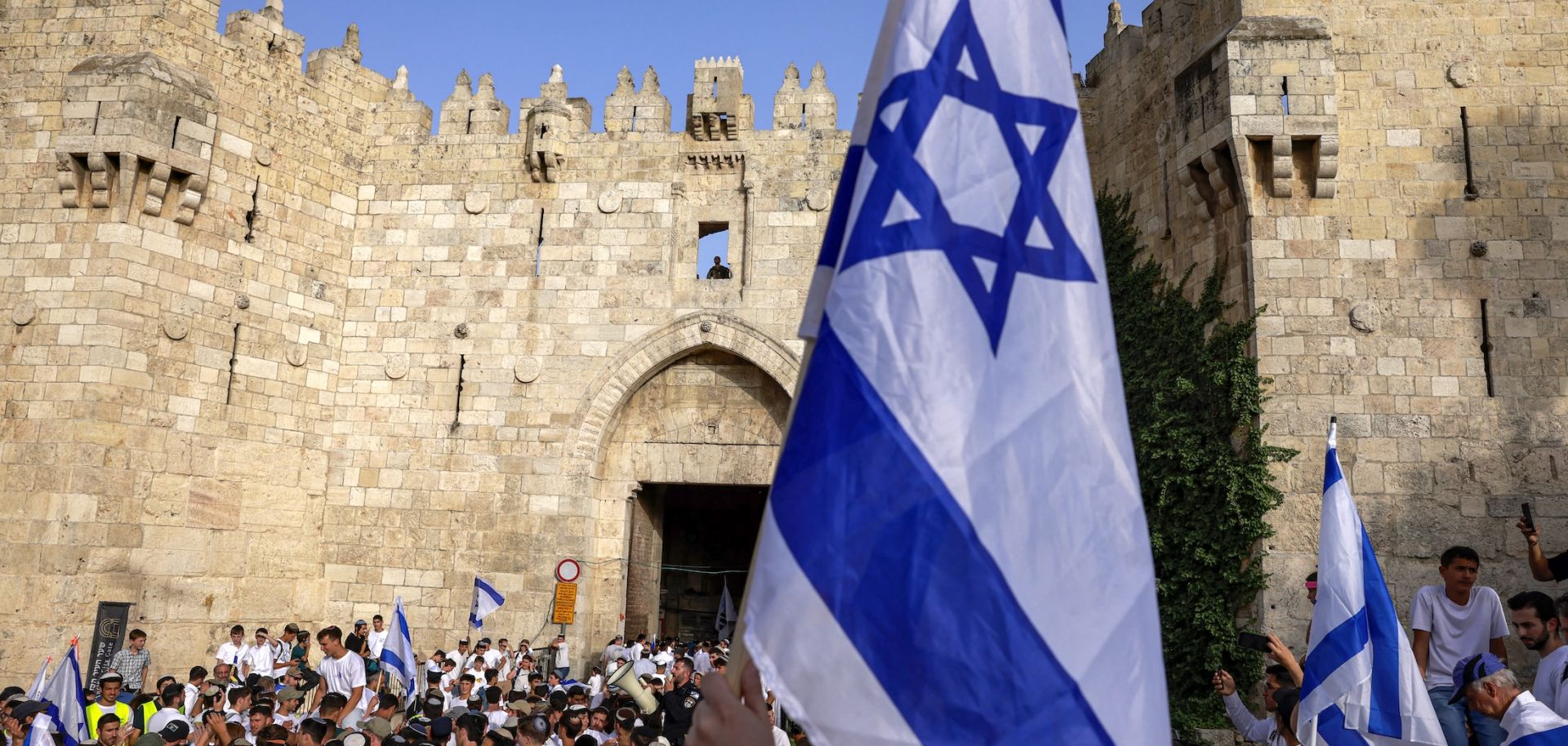
Right-wing activists gather with Israeli flags outside the Damascus Gate of the walled Old City of Jerusalem on May 26, 2025, during a flag march for Jerusalem Day, commemorating the Israeli army's 1967 capture of the city's eastern sector during the Arab-Israeli war.
(MENAHEM KAHANA/AFP via Getty Images)
Right-wing activists gather with Israeli flags outside the Damascus Gate of the walled Old City of Jerusalem on May 26, 2025, during a flag march for Jerusalem Day, commemorating the Israeli army's 1967 capture of the city's eastern sector during the Arab-Israeli war.

A Minor Power With Middle Power Characteristics

Israel is a minor power with middle power characteristics. Its military and economy are backstopped by the United States, enabling Israel, a country of only 10 million people in some 8,500 square miles, to project power throughout the greater Middle East and parts of the globe as though it were a middle power. But as its true geopolitical nature is that of a minor power, it is highly vulnerable to geopolitical shocks and sustained pressure that can drain the country's political will and economic resources. Moreover, Israel is an incomplete minor power: its core around the holy city of Jerusalem is divided between Israel and the Palestinian territories. To secure itself, Israel will seek a path to an independent middle power status, which can only be achieved by unifying the geographic core permanently, either through slow annexation, violent conquest or risky assimilation.

Israel's Geographic — and Spiritual — Core 

Israel's core is split between its heartland and the Palestinian territories. This is not the historical norm, and, in past centuries, powers that ruled over the area of modern Israel controlled land from the Mediterranean in the west to the deserts of Jordan to the east. The southern borders were typically defined by yet more deserts in Egypt and Arabia, while the Syrian deserts and the mountains of Lebanon anchored the borders to the north. This is a small area, but these barriers create a geographic zone of control that, absent rival great powers in the region, lends itself to a distinct political universe and identity boxed in by sea and desert. There is also a natural heart to this area: the highlands, in what is now called the West Bank, which is fertile enough, defensible enough and resource-laden enough to support indigenous civilizations. In the core of this heart is Jerusalem, a city built for ancient trade routes that worked through the hills of what used to be called Canaan. 

From Jerusalem, Israel's core moves into the fertile plains alongside the Mediterranean, from which agricultural communities from the Stone Age onward have made their living. To the east, the core ends at the Jordan River, which cuts a deep canyon into the landscape that provides natural defensive capabilities. Around the core, hills both help shield the area from the harsh deserts and provide defensive advantages, creating chokepoints where today's Israel Defense Forces (IDF) build outposts and patrol routes. The long Mediterranean coast gives Israel's geographic core ready access to European and African civilizations and has long made the region mercantile. The cool, prevailing winds from the sea are also why Israel has a milder climate than much of the nearby Egyptian coast. 

But this core comes with significant geographic downsides. It is small, covering barely 2,300 square miles. While it receives more rainfall than the nearby deserts, it still has a warm climate where water resources can be scarce at times. Timber is a rare and fragile resource, as trees take decades to regrow. It lacks significant mineral reserves to develop industries for commerce and war to fend off rivals. And, most disadvantageously of all, it is sandwiched between two geographically superior regions: Egypt and Anatolia. Both of these regions are capable of sustaining much larger and more powerful civilizations, which, when united, typically press down the Mediterranean coast until they meet. While the deserts of Arabia and Syria serve as Israel's eastern frontier, they also channel invaders through Israel. As a result, for most of recorded history, the territory that makes up Israel's geographic core has been a province of some empire or another, typically coming from either Anatolia or Egypt. Consequently, Israel has often been a borderland, a frontier between empires and civilizations in which cultures and religions mixed to form unique identities but which lacked the geopolitical heft to assert independence unless nearby civilizations were in chaos or decline. 

Israel's position as a borderland is key to understanding its sacred status to the world's three great monotheistic religions: Judaism, Christianity and Islam. Israel's geographic position as both a melting pot of various cultures and ideas, as well as its position along the eastern Mediterranean, made it an ideal place for new religions to take root and spread. According to Judaism's Torah, the first Jew, Abraham, moved from Ur, then a center of civilization in Iraq, to Israel, precisely to make a new civilization in the unordered tribalism of this ancient borderland. The story of Jesus Christ's execution and resurrection might have remained a local one without the connections to the Roman Empire's Mediterranean trade networks that spread it. And Islam, too, found itself facing Jerusalem, the nearest major mercantile city to the Hejaz in what is now western Saudi Arabia. Though the holiness of the region is a matter of faith, geography played a significant role in placing Jerusalem at the heart of these monotheistic traditions. 

But as a borderland, Israel was also subject to regular conquest, as seen by the occupations of the Hittites, the Egyptians, the Assyrians, the Babylonians, the Persians, the Greeks, the Romans, the Muslims, the Crusaders and eventually the Ottomans and British. As Israel became the heart of Judaism, its Jewish populations were routinely subjected to the outcomes of defeat, namely exile, slavery, displacement and subjugation, in between periods of toleration. 

This was not uncommon in the region. But Judaism, and consequently Christianity and Islam, were comparatively unique religious innovations. They claimed to have direct connections to a single God and a monopoly on the truth of the universe. This was in stark contrast to the pagan religions that shared the region, many of which were relativistic in their worldview and which more readily accepted traditions and doctrines from one another. The monotheists neither respected nor tolerated other faiths, and either through force of argument or force of arms defended themselves aggressively. Israel thus has a second core, a spiritual one, anchored in Judaism, that has managed to endure long periods of life in far-flung geographies. 

This was key because it meant that when Jewish political entities were crushed, Jewish religious and social communities could survive, even thrive. Even periods of exile and severe repression were not enough to snuff out Jewish identity — and in fact, became some of its hallmarks. There were three periods of exile. The first was detailed in Exodus, where Jews were enslaved in Egypt; the second, the Babylonian exile; and finally the Roman exile, which lasted until the 20th century. Jewishness did not remain unchanged through this process, but it did survive intact. And unlike Christianity and Islam, which had other holy cities, Jewishness remained tied distinctly to the Jerusalem core as a spiritual homeland. 

Still, Christian and Muslim powers tussled over Jerusalem for centuries. The steady disunity of the Abbasid caliphate eventually allowed a few thousand Frankish zealots to capture Jerusalem in 1099, but as the region reorganized under Muslim Ayyubid and Mamluk dynasties based in Syria and Egypt, these European settlers found their Crusader states unsustainable and were ejected by 1291. The next handover came when the rising Ottomans conquered the eastern Mediterranean, taking Jerusalem in 1517; they lasted four hundred years, until the United Kingdom defeated them in 1917. During this long era, there were no chances for an independent state out of Israel, merely a handover from one overlord to another. But this changed in 1917, when Britain, entering its imperial twilight, approached Jerusalem as a temporary custodianship rather than a permanent protectorate. The era of European — and eventually, American — power in the Middle East would open the door to the reemergence of an indigenous state based around the Jerusalem core.

But this would not be a state made up of its local inhabitants, at least not those already there in 1917. The Romans had cast the Jews into a vast diaspora as punishment for recurrent revolts, but as Jews scattered as far afield as England, Ethiopia and India (and some still within provincial Israel, too), their religious traditions kept alive the notion of a long-lost Israeli kingdom with a very specific geography. This hallmark of Jewish identity remained strong for centuries, sustained by the perceived holiness of their chosen land. This is critical to understanding why the settler movement began in the late 19th century, as without these traditions, Judaism would have either transformed into something else or failed to provide the social glue necessary for such a significant demographic undertaking as the colonization of Israel. This ancient religious feeling married itself to the rising political ideology of nationalism in Europe in the 19th century, forming Zionism, the belief that Jews should have their own nation-state, and that it should be based in the geography of ancient Israel. 

Zionism would have likely been yet another 19th century religious movement that petered out had the status of provincial Israel not been in flux at the same time. While the Ottomans tolerated a limited number of Zionist settlers, they did so in the context of their multicultural empire (and a desire for investment from wealthy Zionist-Europeans). However, they were by no means encouraging the return of Israel, and had the Ottomans not lost to the United Kingdom in World War I, the settlers doubtless would have eventually aroused their ire and brute suppression as so many ethnic minorities of their empire did from time to time. It was because British control overlapped with the formation of Zionism that Israel returned to the map. 

Israel's Geographic Core

Israel's Geopolitical Pillars

  • Geography
    • Gain complete control of the core around Jerusalem in the highlands and coastal plains. 
    • Establish buffer zones along unstable borders in Egypt, Lebanon and Syria. 
    • Offset impacts of an increasingly hot climate with reforestation, water management and technological investments.
  • Politics
    • Prevent the emergence of a strong Palestinian state.
    • Integrate ultra-Orthodox Jews into the economic and security strategy.
    • Develop new political and legal structures to address modern-day challenges. 
    • End international isolation through recognition. 
    • Maintain a great or superpower patron. 
  • Economics
    • Deepen economic and trade connections with new sources of resources, capital and technology, such as the Gulf Arabs, Asia and Africa. 
    • Prevent economic isolation from key markets, like Europe and the United States.
    • Evolve an export strategy to produce in-demand, resource-light and knowledge-heavy goods and services. 
  • Security
    • Prevent the emergence of new hostile entities on the borders.
    • Maintain security cooperation with the United States and/or friendly middle powers.
    • Suppress Palestinian militancy and nationalist movements.
    • Maintain a qualitative military edge over even friendly regional nations, particularly in air power and air defense. 
  • Society
    • Encourage Jewish emigration to Israel.
    • Balance between secular and religious Jews' social goals.
    • Prevent the emergence of radical or hard-line Jewish groups that undermine the national consensus. 
  • History
    • Avoid a repeat of the Holocaust, the fall of Jerusalem to Rome and the following diaspora, and the split between Judea and Israel.
    • Avoid the mistakes of the 1973 Yom Kippur War, the 2006 Hezbollah war and the 1982-2000 occupation of Lebanon.
    • Implement the lessons of the 1948 and 1967 wars against future rivals.
  • Technology
    • Develop indigenous, high-demand technology for export.
    • Leverage technology to develop new trade and political connections to further ease international isolation.
    • Develop technologies to offset the impact of climate change. 
    • Deepen technological ties with global tech leaders like the United States, Europe and China. 

From Exile to Reconstitution

After the Roman expulsion of the Jews in 135 CE, the region's identity fundamentally changed. It was no longer Israel, but Roman "Palestinia," and its inhabitants' identities morphed alongside their imperial conquerors. For the long history that followed until 1917, the region assumed different names that reflected its various conquerors, and its former Jewishness was a non-issue for its imperial masters. This identity transformation shifted the region away from being a civilizational core and toward an existence as a borderland of various empires. "Israel" was a buried construct, as lost as Assyria or Babylon, by the time the Zionists agreed to rebuild it in the late 19th century. 

The formation of Israel was driven by an emerging nationalist feeling, much like the formation of Germany or Italy in that era. But Israel was different in that Zionists sought to combine the nationalist tactics that unified the German city-states and kingdoms with the New World colonization strategy that had produced the United States. Zionists would bring together the disparate Jewish communities around the world in a single place and fuse them into a modern European-style nation-state in an entirely new geography. What was even more unique is that this was an ideal based upon an ancient history fused with religious thought — a restoration of a lost kingdom, not a New World nation-state or a romantic unification of already-linked language speakers.

Most importantly, the United Kingdom was open to this idea. As London sought an evolved imperial model, it hoped to create a commonwealth of nation-states still subordinate to Britain economically and militarily, and believed a Jewish state in Palestine could help it influence the Middle East and retain control of the all-important Suez Canal. Hence, the United Kingdom established a mandate for Palestine, designed to evolve into a loyal client within this framework. Foreign Secretary Lord Arthur Balfour's famous 1917 declaration that Palestine would be open for Jewish settlement assumed that the United Kingdom would be in the Middle East for decades, if not centuries, in one form or another to manage the formation of a Jewish state, and to use it as a lever for long-term influence. But this was a misreading of the future; Britain's empire was not consolidating but tottering, and only three decades later would begin its rapid, terminal decline. London would not be around long enough to manage much of anything. 

But Palestine was not an empty land. While the Romans had expelled many Jews, those who remained or resettled adapted their identities to their imperial masters; first they drifted toward Roman culture, then Greek, then finally Arab and Muslim, which they retained as the Ottomans did not Turkify their Arab domains. By the time the Ottoman Empire fell, tensions were already brewing between the Jewish settlers and the local Arab population, but the Arabs were fractured by centuries of external control. The Ottomans had long played off differences between tribes, families and different classes, keeping the Arabs of Palestine divided and subordinate to Constantinople. Only with the United Kingdom's entry into the region — and its new strategy to build an enlightened empire — were these tactics diminished, and Arabs began to rapidly coalesce around their own national identity: that of the Palestinians. 

The stage was set for decades of tumult. Two budding nationalities laid claim, for similar reasons, to the same Jerusalem core, but only one of these rivals was endowed with centuries of experience with European political, economic and military history, while the other was just emerging from the shadow of being an exploited borderland. Consequently, the Zionists had the human capital to rapidly establish a state, but the Palestinians did not. Meanwhile, the United Kingdom could not find a strategy to manage the conflict between the two, as its commonwealth pitch was unsatisfactory to both the Jews and Arabs, who each sought an independent state, and repression was not an option since the demands of the empire, and eventually World War II, overwhelmed the British military. So instead, the United Kingdom rushed about putting out fires emerging between the Zionists and Palestinians, until the Great Arab Revolt of 1936-39 forced London to reckon with the reality that it had no politically acceptable strategy except a stage-managed exit from Palestine.

The Zionists recognized this trend early on and had maximalist territorial hopes of taking the whole of Mandatory Palestine. However, they had far murkier ideas regarding what to do with the Arabs already living there. Though fictions were pitched like "a people without a land for a land without people," early Zionists were well aware that the Arab population was in the way of a Jewish nation-state. Since Zionism was fused not only with nationalism but with the humanitarianism that was attractive to many European minorities, few Zionists were willing to overtly embrace the brute reality of colonizing an inhabited land. Even so, reality required them to confront the problem that Palestinians could not always be bought out. 

More hard-line Zionist elements gained the upper hand in this debate, pulling Zionism toward a strategy of displacement on the assumption that Palestinian Arabs would be absorbed by the region's large Arab states. This assumption proved notably incorrect, but it drove a wave of Zionist militancy in the 1920s, 30s and 40s, which struck not only Arab targets but British ones as well, as right-wing Zionists believed that weakening the British was critical to enabling their policy of expulsion. In the meantime, Palestinian divisions began to ease under this assault, but the pace of unity remained well behind the Zionists in terms of civil and political development. Palestinians therefore found themselves ineffective and, at times, grasping onto unreliable partners, like Nazi Germany, which they hoped might aid their cause against the Zionists without fully understanding the Nazis' own imperial plans for the Arab world. 

The Jewish-Arab conflict paused for World War II, as the Zionists feared that weakening the British was tantamount to aiding the Nazis, and the Arabs feared heavy-handed British crackdowns. But when the war was over, simmering civil conflict broke into open civil war, as Zionists, flush with surplus wartime weapons, began to battle a retreating United Kingdom and Palestinians increasingly backed by nearby Arab powers. In fact, by the mid-1940s, it was clear that Europe's brief domination of the Levant was already over; Lebanon had become independent in 1943, Syria and Jordan in 1946, and Egypt had shifted to an independent, if pro-British, monarchy in 1922. As these states all struggled to forge their own national identities after centuries of domination, they quickly embraced the animating religious cause of Palestine as a means to unite their disparate populations. But it was not only nationalist politics that drove Arab countries' interest in Palestine: true religious feeling, and a desire to see Jerusalem held by a Muslim power, was steeped in centuries of traditions and histories. Surging anti-colonial movements, then gaining ground after World War II, also saw the Zionist movement in a settler-colonial light, as just another European movement trying to displace native inhabitants. Though the budding United Nations attempted a last-minute compromise, in the fog of a world so recently at war, in a region that had not known true independence since before the Romans, every actor believed they had the upper hand against their rivals. The stage was set for the first Arab-Israeli war as Arab states, Palestinians and Zionists sought to fill the power vacuum left by the British. 

1948: The Partition Plan

The 1948 war fundamentally reshaped the geopolitics of the Levant and the region. The Arab powers lacked the unity and military know-how to defeat the Zionist militias, which rapidly organized into a European-style army that, with lightning speed, defeated Arab armies still often resembling the Ottoman armies of the past. Far-right Zionists carried out strategic attacks on Arab civilians to cause a population exodus, one that was furthered by Arab propaganda that predicted imminent victory over the outnumbered Zionists as families left homes in a belief they would soon return. Zionist conventional victories soon put Arab states on the back foot, and the United Nations, backed by the United Kingdom, intervened to freeze the conflict to prevent further regional instability in late 1948. The modern state of Israel was born, but not accepted. And it had conquered only half of its own geographic core. 

Israel Through the Cold War 

The new state of Israel faced several geopolitical challenges. It remained resource-poor. Its small population was a mere 800,000, of whom around 150,000 were non-Jewish Palestinians of dubious loyalty to the brand-new state. It was dwarfed economically, militarily and demographically by the much larger and still hostile Arab states, especially Egypt. It had no natural allies at the time, and its political system was unsettled. Moreover, it was a nation of immigrants who brought different traditions from around the world. If Israel was to survive, it had to overcome all these challenges.

With the Arab powers temporarily deterred by defeat in 1948, Israel needed to address internal governance and social balance. Israelis could not agree on a uniform constitution, so instead, in 1950, the Knesset passed the so-called Harari Decision that established the country's ad hoc Basic Laws. This conferred a degree of political flexibility on Israel's young parliamentary democracy, allowing future generations to reshape its political structures more readily than in more established constitutions, such as that of the United States. Importantly, the Harari Decision staved off conflict between secular and religious Israelis, a competition that had immediately begun to bud after independence as Israelis debated whether Israel should be secular like a modern European state or religious like the ancient Israel of the Torah. Though the fluid nature of the Basic Law created uncertainty, it also provided the flexibility the rapidly changing new nation-state needed to survive. The plastic nature of the Basic Law also allowed Israel to manage its Arab population with greater flexibility, first through extended martial law and then eventually through special exemptions and concessions, like exemptions from the IDF's draft, that kept the community largely loyal, if unassimilated. 

To overcome the constraints of its small resource base, Israel invested heavily in novel agricultural and industrial strategies, from the kibbutz agricultural system to import substitution, in order to wean itself off reliance on expensive imports. After the 1967 Six-Day War against Arab states, Israel also invested in expanding its own military-industrial sector and development of higher technologies, seeing technological advantages as key to warding off military aggression. These could be expensive at times, and strained the national budget and standard of living, but thanks to the ideological unity of Zionism writ large and the flexibility of the Basic Laws, Israel found a delicate balance between imposing hardship and absorbing inevitable civilian pushback. Governments came and went — often well before their term was up — but core political stability did not waver among the Jewish population. 

With internal governance groping toward balance, the external challenges had to be addressed. In 1948, Israel had managed to capture only part of the Jerusalem core, with the rest falling to Jordan, which annexed the West Bank in 1950. Jordanian forces in the hills could lob artillery into Jerusalem and throughout much of the core, while Jordan's own core around Amman remained well outside of Israeli strikes. Meanwhile, Egypt had set up a provisional Palestinian government in Gaza, which it had occupied after 1948, where Egyptian forces and Palestinian guerrillas could launch raids into the Mediterranean plains. Syrian forces were entrenched on the Golan Heights, able to advance into the lowlands around the Sea of Galilee and shell budding Jewish communities there with impunity. Israel needed to address all of these geographic challenges, with an emphasis on gaining control of the Jerusalem core. 

To do so, it needed to arm itself. Israel had managed to import World War II-era Czech weapons that gave its budding IDF tactical equality against the poorly equipped and organized Arab coalition. After the war, Israel aligned with the old imperial powers — the United Kingdom and France — against their Arab enemies, importing more European military equipment that supplemented the Israeli-European military traditions to modernize the IDF into a mobile, high-tech fighting force. But Israel's relationship with the old imperial powers did not last, as the United Kingdom began its exit from the region after the disastrous Franco-Israeli-British 1956 Suez war, and France soon pivoted to the Arab powers as its regional influence declined during Algeria's war and eventual independence. In the context of the Cold War, Israel had little choice once the Europeans left the regional stage; it could either align with the Soviets or the Americans. But the Soviets were making deep inroads with the Arab powers, which had grown largely anti-Western after over a century of European imperialism. This left the Israelis by default with the United States.

This relationship, however, was neither new nor entirely strategically motivated. American missionary colonists had been present in Ottoman Palestine since the early 19th century, where they founded the American Colony in Jerusalem. Additionally, U.S. evangelicals saw the return of Israel as a key plank in their own religious traditions and sought to push the United States closer to Israel in pursuit of prophetic revelation. Meanwhile, in the aftermath of the Holocaust, many U.S. Jews saw Israel as a nation-state of last resort should antisemitism ever sweep the United States as it had in Europe. An ideological pillar that pushed Washington toward Israel gradually took shape from these dynamics, and the Cold War added urgency and deep strategic weight. The United States wanted to discredit the Soviets' strategy in the Middle East, and the fact that the Soviets' primary allies happened to be Arab states holding territory Israel needed for security deepened the U.S.-Israeli alignment. In 1967, this relationship helped produce the spectacular Israeli military victory over Egypt, Jordan and Syria that left it in control of territory from Suez to the Golan.

More notably, in 1967, Israel nominally completed the conquest of its core, when its armies blitzed into the Jordanian West Bank. For the first time since antiquity, Jerusalem's core was unified under a single indigenous political power. But the conquest came with serious liabilities: the Palestinians themselves. 

In 1948, Israel's advancing armies pushed thousands of Arab residents to flee the fighting into Egypt, Jordan, Lebanon and Syria, in an event the Arabs would later call the "Nakba," or catastrophe. Many Arabs believed they would eventually be allowed to return home, but Israel's social imperatives of Jewish unity ensured that once Arabs left the country, they could not be allowed to return. In 1967, when war came again, Arabs in the West Bank and Gaza Strip did not flee, and instead Israel found itself the military occupier of an Arab population nearly the same size as its Jewish one. The core was politically complete but demographically divided.

West Bank Annexation

Meanwhile, the Arabs had stopped seeing themselves as tribes and clans and more and more as their own aspirational nation-state — that of the Palestinians. While Palestine was an old identity, its rapid emergence as a distinct geopolitical entity took place in tandem with the development of Israel. As there was no Israel in 1900, so, too, was there no tangible Palestine. But by the time Israel was founded in 1948, Palestinian identity had emerged as well, though it was less organized than that of Zionist Israel. This led to a notable challenge for the Israelis, as Palestinians did not see themselves as Arabs who could simply pick up and move to another Arab state, and other Arab states did not see Palestinians as brethren who could be readily assimilated without destabilizing their own political systems. 

Tensions between Palestinians and other Arabs contributed to severe instability in Lebanon and Jordan, as Palestinians sought to use these countries to continue their struggle against Israel. In the case of Jordan, the monarchy saw Palestinians as a threat to its own survival, leading to the events of Black September in 1970, in which the Palestine Liberation Organization (PLO) attempted to overthrow the Jordanian monarchy. In Lebanon, the Palestinians upset the already delicate sectarian balance of Christians, Sunnis and Shiites, feeding into the civil war that began in 1975. These events reinforced Arab states' perception that Palestinians could not be readily assimilated and would contribute to instability, leading to regular repression of their communities in places as far afield as the Gulf Arab states. Nonetheless, pan-Arabist narratives grew so strong in the post-colonial era that Arab states could not abandon the Palestinian national movement outright. 

This was not the first time a people without a state had been trapped behind the borders of a rival. The region was rife with other examples, like Armenians in Turkey, Arabs in Iran and Kurds across Syria, Iraq and Iran. But unlike these examples, Palestinians had foreign sponsors, including nominally the United Nations itself, which had proposed a Palestinian state in 1947 before war broke out. Israel was also full of Holocaust survivors, who were loath to replicate the brutal social engineering of the Nazi era to solve the demographic challenge of the Palestinians. Israel could not expel the Palestinians, since the other Arab states would fight wars to stop that. It could not assimilate the Palestinians, as their identity had grown too strong for such efforts, while offering them citizenship would swamp Israel with Arab parties that might vote Israel out of existence. And it could not annihilate the Palestinians, as the Turks had the Armenians, both because Israelis themselves opposed such action and because the international community, including the United States, would impose crippling isolation on Israel if it did so. Israel was trapped with its Palestinian subjects, with no clear path for managing them and retaining control of the Jerusalem core. The quest for a viable management strategy would define Israel's overall strategies from 1967 onward. 

The Strategy of Modern Israel To Gain Its Core 

After the 1967 victory, Israel, backed by the United States, steadily discredited the Arab military powers. First, Jordan entered a detente with Israel after the events of Black September in the 1970s (and signed a peace treaty in 1994), and then a U.S.-brokered treaty with Egypt in 1979 ended the threat of the Arab world's largest power. Lebanon collapsed into civil war in 1975, while Syria, suddenly the lone hostile power on Israel's borders, decided to turn its eyes toward controlling Lebanon during its civil war rather than risk another military defeat to Israel. Supplementing this shift was the development of Israel's nuclear weapons program, which by the 1970s was the worst-kept secret in the region, and which effectively ended the conventional military option for an Arab state to reconquer the former mandate. Even as the Soviet-backed Arab states weakened, or even switched sides to the U.S. camp, as Egypt did, U.S.-Israeli ties strengthened throughout the 1970s and 1980s, in large part because of the emergence of a new rival: Iran.

The Radical Challenge: Iran and Hamas

Iran's 1979 revolution was the product of many complex domestic and international forces, but for Israel, it supplanted Egypt's immediate geographic threat with the more distant threat of an Islamist regime that had tied much of its legitimacy to the Palestinian cause. Meanwhile, the conventional Arab threat had been deterred, defeated or co-opted, but a new threat, led by Iran, was growing: that of guerrilla forces that Israel had fewer options to combat. Palestinian insurgents, who eventually coalesced into the PLO, had been raiding Israel since the 1950s, but by the 1970s and 80s, the victory of the Viet Cong over the United States had inspired militant movements globally to believe that they could, through sustained pressure, erode their adversaries into defeat, even if they rarely won a conventional battle. 

As the Palestinian guerrilla conflict adapted, Iran, seeking to stabilize its own new theocratic republic, latched onto the unifying Palestinian narrative, and then a more broadly anti-Israel one, that enabled it to build influence in Lebanon, Syria and even inside the Palestinian territories. This was a major challenge to Israel, as unlike with Egypt, Syria, Lebanon and Jordan, Israeli tanks could not blitz into Iran to threaten the survival of its regime. For that matter, Iran could not deploy large armies to Israel's borders, either. As a result, a distant and lasting hostility took hold. But most notably, Iran was as anti-American as it was anti-Israel, so as the Soviet threat diminished, the Iranian threat helped keep Israeli and American regional strategies aligned. 

The collapse of the Soviet Union did alter the relationship, however. Namely, Israel began to tout its value as a U.S. partner in Washington's post-Cold War euphoric vision to spread its liberal democratic values globally. This partnership required concessions from Israel, particularly on the Palestinians in the occupied Gaza Strip and West Bank, where uprisings and violence were routine. As the United States believed it could stand up a Palestinian democracy that would share the Jerusalem core, Israel was forced out of necessity to play along. The result was the Oslo Accords and the creation of the Palestinian Authority, which emerged in 1993. The Americans hoped that the partition of the Jerusalem core, backed by the superpower, would do what the British and the United Nations could not. But the imperatives of a single state to control the core doomed the project from the start.

1993: The Oslo Accords

Israel once again adapted and sought to undermine the Oslo Accords wherever it could, expanding Israeli settlements in the West Bank, encouraging Palestinian factionalism and appeasing the United States with maneuvers like removing Israeli settlers from Gaza in 2005, which itself was not in the Jerusalem core. But encouraging Palestinian factionalism would have its own consequences; out of this process emerged hard-line militants like Hamas, which came to govern Gaza, and Palestinian Islamic Jihad, far-right movements with an ideology that favored extended, expensive conflict in a way that the more secular, Soviet-influenced Fatah, which led the Palestinian Authority in the West Bank, and the PLO did not. These more extreme movements found quick alignment with Iran, which continued to reject Israel's existence. 

Notably, Hamas and those like it saw conflict as the primary means of achieving a Palestinian state rather than diplomacy and politics. Its rival, Fatah, had emerged against the backdrop of an international system that suggested a diplomatic pathway through an institution like the United Nations was possible with enough conciliation, and this belief prevented Fatah from adopting tactics like deploying suicide bombers or fighting conflicts meant to generate Palestinian civilian casualties. Hamas, on the other hand, saw Fatah's failure to earn a state through diplomacy as proof that only extended conflict could wear Israel down to the point of collapse; diplomacy would be a secondary strategy, and international institutions mere bystanders. While Fatah cited U.N. security resolutions, Hamas cited Islamist teachings to justify sacrifice. This was a type of adversary Israel struggled to deter, as it had no capital to conquer, no armies to encircle, no airfields to strike, just an endless supply of young recruits who would use cheap weapons to disrupt daily life in Israel and tie down its army in the Palestinian territories. 

But Israel could not abandon the goal of controlling the Jerusalem core. If anything, the emergence of Hamas, with Iran behind it, strengthened the hawkish, far-right forces in Israel who argued that Israel had to more quickly consolidate the core through demographic engineering — namely, the settler movement. 

Meanwhile, Israel experimented with finding strategies that might deter the new insurgents along its borders, from Hamas to Hezbollah, as well as Iran itself. It found that large ground campaigns, like the 2006 invasion of Lebanon and the occupation of southern Lebanon from 1982-2000, were politically and diplomatically expensive, and moved away from them. Instead, it focused on pinpoint, often aerial, campaigns to aggressively target enemy leaders and infrastructure, even if no knockout blow came like that of the encirclement of Egypt's Third Army in 1973. Thus, Israel came around to the idea of managed attrition, in which limited strikes and skirmishes would be used to keep militant groups off-balance, but which would shy away from the 2006-style expansive wars that might pull Israel into long ground campaigns it could ill afford. 

In tandem with these developments close to home, Israel adapted its Iran strategy. Initially, Iran was a distant irritant, especially when it was tied down by Iraq in the 1980s and 1990s. But when the United States deposed anti-Iran Iraqi President Saddam Hussein in 2003, Iranian influence surged all the way to Beirut, enabling Iran's Islamic Revolutionary Guard Corps to set up a land bridge that turned Israel's guerrilla enemies into foes closer to conventional armies. Meanwhile, Iran's nascent nuclear program also grew in capability; Israel had already destroyed Iraq's nuclear program in 1981, and then Syria's in 2007, but Iran's more distant geography and more advanced facilities proved a stiffer challenge for the IDF. Israel saw Iran as a key rival it had to deter to remove the last major state champion of militant Palestinian nationalism, a key part of the struggle for control of the Jerusalem core, and it also viewed Iran's nuclear program as potentially existential. Should Iran develop nuclear weapons, its pro-Palestinian regime might be permanent, and it might pass a nuclear weapon on to a group like Hamas, or, in a moment of Islamist extremist fervor, launch nuclear weapons at Israel. For Israel, the destruction of Iran's nuclear program grew in importance. 

From the fall of Saddam Hussein in 2003 onward, Israel's strategy became more overtly anti-Iranian. Evolving precision warfare was meant to degrade Iran's partners and proxies, like Hamas and Hezbollah, while Israel's diplomatic strategy hinged on convincing the United States to take action against Iran that would dismantle its nuclear program permanently and end Iran's missile and proxy threats to Israel. Meanwhile, Israeli settlements continued to slowly expand around the Jerusalem core, enduring the Second Intifada in the 2000s, and recurrent rocket wars with Hamas in the 2000s and 2010s after Hamas took control of and then entrenched itself in the Gaza Strip. The United States did step in to address Iran's nuclear program, but through diplomacy, in the form of the Obama-era Joint Comprehensive Plan of Action (JCPOA). The agreement limited Iran's nuclear program but did not eliminate it, and it did little to end the missile or proxy threats to Israel, let alone end Iran's role as a backer of the Palestinian cause. Israel successfully lobbied the Trump administration to abandon the JCPOA and return to confrontation in 2018, but the United States, wary after decades of intervention in the Middle East, did not follow up with a major attack on Iran to destroy the program then. 

Then, on Oct. 7, 2023, Israel's strategy of managed attrition experienced major blowback when Hamas invaded southern Israel. Instead of preventing Hamas from organizing into a major threat, the recurrent rocket wars of the 2010s had produced a degree of complacency in Israel, where the security establishment had wrongly assumed that Hamas was deterred from major action. In the aftermath, Israel rapidly switched strategies again, this time to a risk-prone, targeted yet geographically expansive regional strategy to more rapidly accomplish its goals of breaking the web of influence that supported Palestinian nationalism as well as destroying Iran's nuclear program. In Gaza, it would aim to remove Hamas from power, even at the cost of a long, expensive ground war. Elsewhere, it would blow past previously assumed red lines to deter and degrade Iran and its proxies. This campaign would eventually culminate in the campaigns of 2024-26, in which first the Israelis, and then the United States, would embark on four waves of attacks against Iran, including the massive strikes that began on Feb. 28, 2026. 

Israel's Future: Two Decades of Outlooks and Risks

Israel's next 20 years will focus on finding a path to a more secure middle power status and avoiding slow erosion back into a borderland. Israel will not have the geographic or demographic heft to push its way into middle power status alone, and will instead rely on multiple partners to pursue this goal, including an increasingly disinterested United States. But with the global environment increasingly multipolar, Israel will have more opportunities — and risks — to pursue its path of unifying the Jerusalem core. 

Israel's Regional Relations

Should Israel unify its core, it would draw closer to the middle power status of Egypt, Turkey and Iran, with a large enough geography, population, economy and military power to balance these other states, while being regularly courted as a potential partner by the remaining great powers of the globe. But if Israel fails to unify its core, it would become an increasingly dysfunctional, securitized nation-state, endlessly fighting over the same territory, eroding its economic, military and diplomatic status, and providing leverage to its neighbors. 

To secure the core, Israel's traditional strategy must be to weaken, or even discredit, Palestinian nationalism. To do that, Israel must not only find a solution to the drivers of Palestinian nationalism but defeat its external sponsors, like Iran, Hezbollah and the Houthis, as well as the soft championship of Qatar, Turkey and Saudi Arabia. To achieve that, Israel will need to either maintain a tight relationship with the United States or find replacements for U.S. aid and support. All of these things will have to happen simultaneously and sustainably. 

Other challenges complicate Israel's path toward unity. To start, climate change is straining the cost of living, and the growth of Israel's ultra-Orthodox population is producing a large segment of the population that currently does not serve in the military or participate in the economy at scale. Additionally, the growing divisions between secular liberals and religious nationalists, the unending search for new export markets, and the formation of new regional alignments that are pushing back against Israeli policies and championing the Palestinian cause offer yet more obstacles. These will have to be addressed if Israel is to maintain its minor power status and not start to erode back into a borderland. But most of all, Israel will have to account for its changing relationship with the United States and incorporate that new dynamic into its pursuit of the Jerusalem core.

There are several paths Israel could take to achieve this. The baseline scenario is a continuation of its current strategy, wherein Israel continues to build new settlements and de facto expand its demographic and political control of the West Bank, calculating that a slow burn will not produce substantial international isolation or Palestinian unrest. In this scenario, Israel would seek to isolate Gaza's future from the West Bank, leaving Gaza as a Palestinian enclave with no real sovereignty, but at the same time avoiding building settlements in Gaza or annexing it outright. Israel would continue its hawkish, post-Oct. 7 preemptive attacks on pro-Palestinian militants in Lebanon, Gaza, Iran and Yemen, until these hard-liners are either out of power or come to terms with Israel, in a repeat of its Cold War strategy with Egypt and Jordan. Israel would leverage its economic and technological might to warm relations with the soft sponsors of Palestinian nationalism in Turkey, Qatar, Saudi Arabia and elsewhere or, failing that, drift toward their rivals like the United Arab Emirates to engage in a subtle cold war against those champions. As America's interest in Israel declines, Israel would offset this relationship with a combination of indigenous military and economic development and new trade and diplomatic partners, including with American rivals like Russia and China. Finally, Israel would grant limited economic, social and political freedoms to limited numbers of Palestinians, hoping to weaken Palestinian nationalism by dividing it up by region and class, leaving a two-state solution far from fruition but improving the standard of living for some Palestinians in the West Bank and Gaza. 

This one-and-a-half-state solution strategy would not fully unify the core, but it would move Israel closer to complete unification later in the century. It would also put the least amount of strain on Israel's national unity and economy and would not overtly strain Israel's foreign relations, enabling Israel to adjust to the changing geopolitical landscape rather than experience sudden cut-offs. But it would not be without risks, as expansion into the West Bank might spark new intifadas, attacks against regional rivals could spark regional wars, and alignments against pro-Palestinian sponsors could drag Israel into proxy conflicts and competitions that drain national resources. 

A secondary scenario is more militant. Rather than maintain its post-Oct. 7 hawkishness, Israel could escalate and decide to aggressively unify the Jerusalem core at the expense of foreign relations, national treasure and domestic unity. In this scenario, Israel decides not only to expand settlements, but to annex territory, expel Palestinians from West Bank territory at scale, and to engineer Palestinian emigration. Some Palestinians may be moved to Gaza, while others could be sent abroad. In the most extreme cases of militarism, far-right Israeli governments might fight high-intensity military campaigns designed to depopulate the West Bank, with mass Palestinian civilian casualties intended as an outcome. Abroad, Israel would be even more aggressive, seeking to not only deter but dismantle Hezbollah, the Houthis, Iran's Islamic Republic and potential replacements, involving Israel more deeply in lasting regional military conflicts. Here, Israel would back uprisings, coups and civil wars, developing proxies and clients to directly challenge its rivals on their own turf. Israel would support secessionists at times, while its powerful air force might also serve as a key military arm for factions on the ground. Against soft power rivals like Turkey and Qatar, Israel would align with openly anti-Turkey and -Qatari elements in the region, including domestic challengers, backing anti-government forces in both countries and aligning tightly with rivals like the United Arab Emirates to closely coordinate against them. Meanwhile, to offset diminishing U.S. support, Israel would seek partners well outside the West, including Russia, China, India, Indonesia and throughout sub-Saharan Africa, where it would trade not only its technology but military know-how to pay for its aggressive strategy. 

This strategy would come with high risks, of course. Not only would it likely guarantee an uprising in the West Bank and potentially even Gaza once more, but it would also drag Israel into a wide geography of hard-to-win conflicts in Lebanon, Yemen and Iran. Turkey and Qatar would develop a stronger interest in backing anti-Israeli forces in those places as well, turning Israel's tense relationship with Turkey into a more overt cold war that Israel, a minor power, would struggle to win. Finally, this hawkish strategy would more rapidly unwind relations with the West, particularly Europe, as Europeans pull back from trade and diplomatic relations with Israel, and might result in a major break with the United States well ahead of Israel's ability to replace Washington. 

There is a third, and notably least likely, resolution to the challenge of the Jerusalem core. Israel cannot allow a second state to share the core, as such an arrangement would almost certainly result in competition and conflict that would steadily erode Israel's minor power position. However, Israel might be willing to take a significant risk by co-opting the core's existing Palestinian elements. In this scenario, Israel unifies the core through not only annexations but nationalization, bestowing Israeli citizenship to limited numbers of Palestinians in and around Jerusalem, effectively expanding the rolls of Israeli Arabs overnight. Cities close to Jerusalem, like Ramallah and Bethlehem, and even those farther away, like Jericho, Hebron and Nablus, would become Israeli, with their Palestinian residents given Israeli citizenship. This gambit would notably weaken Palestinian nationalism, splitting the Palestinian nation into Israeli and Palestinian contingents, as Israeli Palestinians find their political and economic interests aligned with Israel rather than the remnants of the Palestinian territories. It would also be a major setback for both hard-liner and moderate backers of the Palestinian movement, complicating their narratives for continued confrontation with Israel. And it would likely be a relative boost to foreign relations, weakening the anti-Israel activists demanding Palestinian rights and slowing the values gap growth between Israel and the United States.

However, this option would severely challenge Israeli internal unity. Palestinian Israelis would not assimilate immediately into the existing Israeli Arab communities, but would bring their own political and cultural traditions with them, ushering in political and social uncertainty at scale. Right-wing and far-right Israelis would be outraged and demand segregationist policies against Israeli Palestinians that would fuel militancy and undermine the country's economic competitiveness. Significant bouts of violence would be possible, which would likely fuel far-right movements in both Jewish and Arab communities. In the most extreme case, Israel would find itself pulled into a civil war, its middle power dreams dashed by years of sustained conflict.

Still, this least likely scenario would grow more probable should Israel experience significant and lasting isolation and find itself unable to adapt to the loss of U.S. aid over the next two decades. It would mimic the 1950s, when the Israelis, still isolated, once nationalized the Arab population rather than leave them in open-ended martial law. 

Regardless of which option Israel chooses, the country's future will remain a delicate balancing act focused on unifying the Jerusalem core and finally emerging as a middle power. However, a variety of deep-seated geographical and cultural divisions will threaten to fracture the modern state, ensuring that Israel's quest for the core will not come without cost.

RANE
SUBSCRIBERS ONLY

Expert analysis when it matters most.

Get access to RANE's decision-grade geopolitical intelligence.