
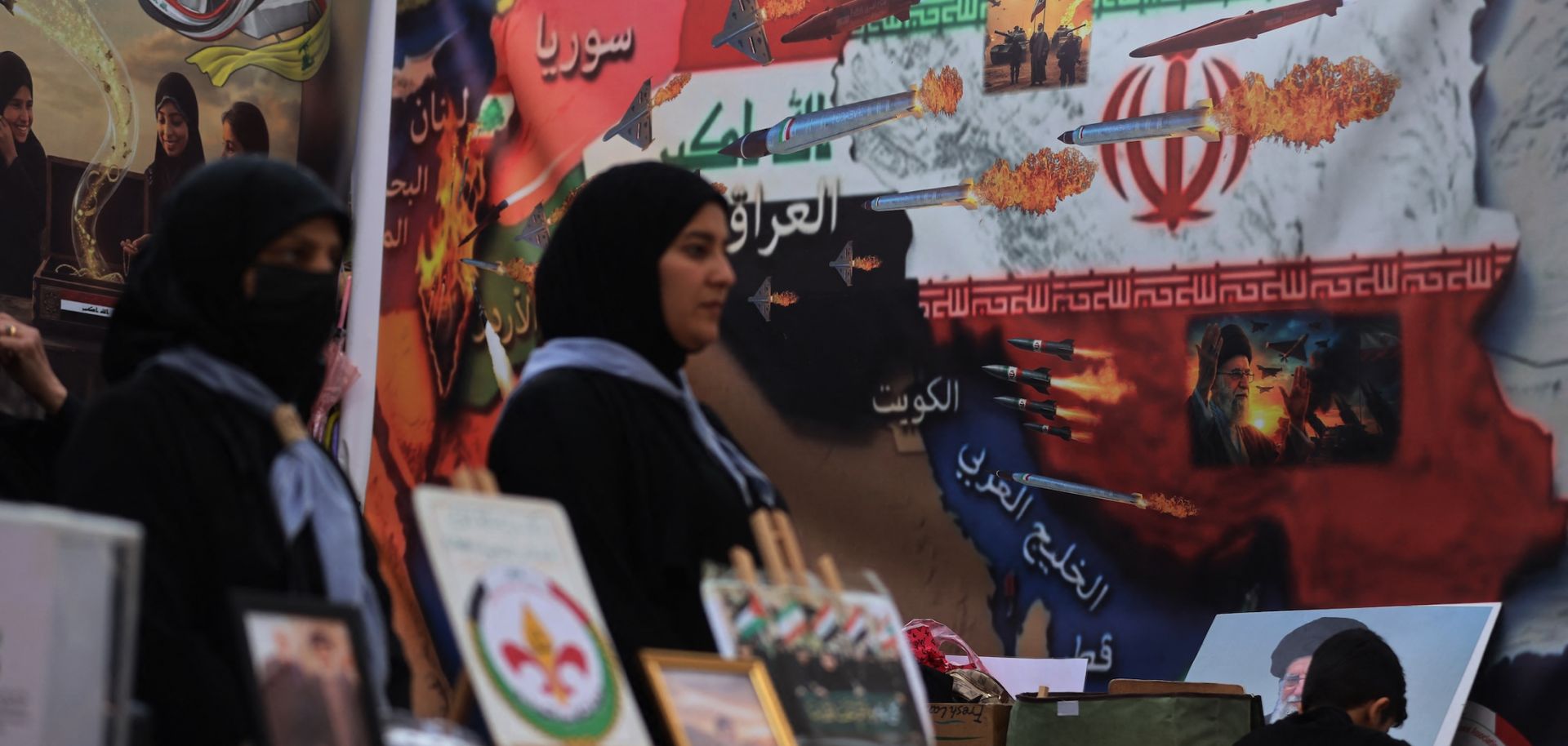
In Iraq, violent spillover from the Iran conflict will further strain pre-existing domestic divisions, while likely stalling the government formation process and fueling U.S. pressure for militias to disarm; reduced state revenue from disrupted oil exports will also hamper public service provision and push Iraq to increase borrowing. On April 2, the U.S. embassy in Baghdad urged Americans to leave the country, warning that "Iraqi terrorist militia groups aligned with Iran may intend to conduct attacks in central Baghdad in the next 24-48 hours." The alert followed U.S. claims that Kataib Hezbollah, an Iran-backed militia within Iraq's Popular Mobilization Forces (PMF), had kidnapped an American journalist working in Baghdad on March 31. Since the United States and Israel began striking Iran in late February, PMF militias have conducted numerous retaliatory attacks across Iraq, including against the U.S. embassy in Baghdad, U.S. military bases and hotels frequented by Americans in the Kurdistan Region of Iraq, or KRI. The PMF violence is a direct response not only to the strikes on Iran but also to U.S. and Israeli attacks against the militias themselves within Iraq, which have killed dozens of PMF members and injured even more.
- Originally established in 2014 to combat the Islamic State, the PMF is an umbrella group of Iran-backed Shiite militias that was incorporated into Iraq's security services in 2016. Although the PMF is technically part of the Iraqi armed forces and reports to the Iraqi prime minister, Iran exerts significant influence over some of its militias. However, the extent of each individual militia's relationship with Tehran varies.
- U.S. and Israeli strikes have targeted the PMF's headquarters and officials like Falih al-Fayadh, chairman of the Popular Mobilization Commission, whose Mosul residence was attacked on March 24, though he was not there at the time.
- PMF militias attacked the home of Kurdistan Region President Nechirvan Barzani in Duhok on March 28. Iran also allegedly conducted a March 24 rocket attack on Erbil, which killed at least six and wounded 30 members of the KRI's internal security forces.
The recent U.S.-Israeli and PMF attacks illustrate how the Iran conflict has spilled over into Iraq due to competing U.S. and Iranian interests. Iraq's caretaker Prime Minister Mohammed Shia al-Sudani has called for restraint from both sides in an effort to mitigate the domestic security and economic fallout from the regional crisis. But despite Baghdad's efforts to balance ties between Washington and Tehran, Iraq has nonetheless found itself caught in the crossfire. The Iran war has severely disrupted Iraq's heavily oil-dependent economy, leading to a decline in oil production and exports, as well as interruptions in gas supplies from Iran. The ongoing violence within Iraq is also worsening internal sectarian and intra-Shiite tensions, further complicating the already contentious government formation process following elections in November — particularly concerning Kurdish parties' failure to nominate a president and the controversial nomination of a pro-Iranian figure as prime minister candidate.
- Iraq's government formation process remains stalled over two key issues. First, the two main Kurdish parties cannot agree on who to nominate as the country's next president (who is a Kurd under Iraq's informal power-sharing agreement), or how to allocate government posts. Second, the Shiite Coordination Framework (SCF), a pro-Iranian umbrella group of Shiite parties with ties to PMF militias, has nominated controversial former Prime Minister Nouri al-Maliki as its candidate for the premiership. His candidacy, however, faces some opposition within the SCF and strong disapproval from the United States, which threatened to cut aid if al-Maliki, seen as favoring Tehran, becomes prime minister.
- Around 80% of Iraq's oil is exported through southern terminals and the Strait of Hormuz. Iran's closure of the strait has thus significantly hindered Iraq's oil exports, which fund the vast majority of the government's budget. Iraq has also had to cut production due to high-to-critical storage levels.
- Following the Israeli attack on Iran's South Pars gas field on March 18, Iran temporarily halted gas exports to Iraq, though these exports have since been partially restored. Iran reportedly supplies over one-third of Iraq's total gas and power supplies. However, the actual amount is likely lower due to intermittent Iranian supply cuts, aging Iranian infrastructure, and Iraq's initiatives to diversify its energy suppliers away from Iran.
The violence in Iraq stemming from the Iran conflict shows no sign of slowing, which will likely continue to stall the government formation process and, over time, fuel the U.S. push to disarm Iran-backed Iraqi militias. The ongoing violence will exacerbate internal tensions — not only between Iraqi Kurds and some Shiite groups but also among Shiite factions. Some Shiite groups are adopting a more pragmatic, restrained approach, calculating their next move as they await a de-escalation between the United States and Iran. In addition, the Feb. 28 assassination of Iranian Supreme Leader Ayatollah Ali Khamenei and the limited profile of his successor, Mojtaba, will create an opportunity for influential Iraqi Shiite voices, such as Grand Ayatollah Ali Sistani and Muqtada Sadr, to increase their political influence, which could further complicate domestic dynamics given that both Sistani and Sadr support for Iraqi nationalism and limited Iranian involvement in Iraqi politics. Iraq's government formation process will thus very likely remain stalled as long as the Iran conflict continues. This means that a weak caretaker government under Prime Minister al-Sudani will remain in place but have little success in reining in the Shiite militias conducting attacks, portending persistent violence and targeted attacks against Americans, U.S. military and diplomatic assets and Washington's Iraqi Kurdish allies — and, in turn, U.S.-Israeli strikes against PMF targets. But even as the Iran conflict eventually de-escalates, the persistent risk of PMF attacks against U.S. interests in Iraq and U.S. efforts to further erode Iran's influence in Iraq will likely result in increased U.S. pressure on Baghdad to disarm the militias, including renewed threats of or additional sanctions against the groups and key individuals, or even threats to curb cooperation with Baghdad. This U.S. pressure will remain a consideration for the formation of the next Iraqi government, and a deteriorating economy due to the Iran war will likely make the next Iraqi government vulnerable to U.S. threats to further undermine Iraq's economy. Even so, Iraqi militias will push to maintain domestic influence and power and will likely resist U.S. calls to disarm to varying degrees.
- Sistani is Iraq's top Shiite cleric and was a key figure in the formation of the PMF. He has called for a halt to fighting, outlining a path for Shiite groups to remain outside of the conflict and to adhere to international laws and norms. Sadr, a powerful Shiite nationalist cleric, has called for nationwide peaceful demonstrations on April 4 against U.S. and Israeli aggression; however, he stopped short of supporting Iran. The nationalist Sadrists and ethnic minorities within Iraq also have a vested interest in weakening the PMF to increase their own influence.
- In January, the administration of U.S. President Donald Trump threatened to impose sanctions targeting the Iraqi government — including its oil revenues — in order to prevent Iranian-backed groups from being included in the next government. Much of the Iraqi central bank's liquidity is in U.S.-controlled accounts, meaning the United States could impose financial pressure through a dollar crunch to curb Iraqi militia activities, though U.S. concerns about economic and political instability in Iraq could reduce the likelihood of reimposing such threats.
Diminished oil exports will cut Iraq's state revenue and strain Baghdad's already tight budget, likely resulting in more extensive power cuts, potential unrest and increased borrowing. Although oil exports via the Kirkuk-Ceyhan pipeline through Turkey have resumed, at 250,000 barrels per day, they are just a fraction of the 3.4 million barrels per day Iraq exported prior to the war. As a result, Iraqi state revenues — around 85-90% of which are derived from hydrocarbons — will decrease significantly due to limited oil exports. This will widen Iraq's fiscal deficit, which in late 2025 was estimated at around 8.8% of GDP for 2026-27. The decline in state revenues, combined with Iranian gas cuts and rising global oil and LNG prices, will likely strain Baghdad's ability to import additional energy sources to meet growing demand this summer. This will likely result in more extensive power cuts and blackouts, which are already highly politically sensitive. Furthermore, Iraq's significant dependence on the Strait of Hormuz for vital imports, such as medicines, food, and consumer products, suggests the country is likely to experience shortages for as long as maritime traffic through the strait is disrupted. Additionally, the ongoing loss of crucial oil revenue will increasingly strain Iraq's ability to pay public sector workers, who account for around 40% of the total workforce. While the government is estimated to have enough funds to pay those workers for another one or two months, Baghdad will likely need to secure alternative funding sources, such as borrowing from the central bank, to ensure payments continue to be met. This combination of potentially unpaid wages, goods shortages and worsening power blackouts will, in turn, increase the likelihood of potentially violent protests in Iraq.
- A prolonged economic crisis could push Iraq to seek another bailout from the International Monetary Fund (IMF). But such a deal would likely come with politically unpopular conditions, including austerity measures and efforts to improve financial transparency, which could complicate the process of reaching, let alone sustaining, a new IMF program.
- In recent days, Iraq has begun exporting oil through truckloads via Syria, but the capacity for overland exports is far smaller than that of ship cargoes through the Strait of Hormuz. Iraq is also reportedly considering building a new pipeline that would connect Basra to Jordan's Aqaba port, and reviving the Kirkuk-Baniyas pipeline that links Iraq to Syria's Baniyas port. But these medium- to long-term projects would have little impact on Iraq's current oil export constraints.
