
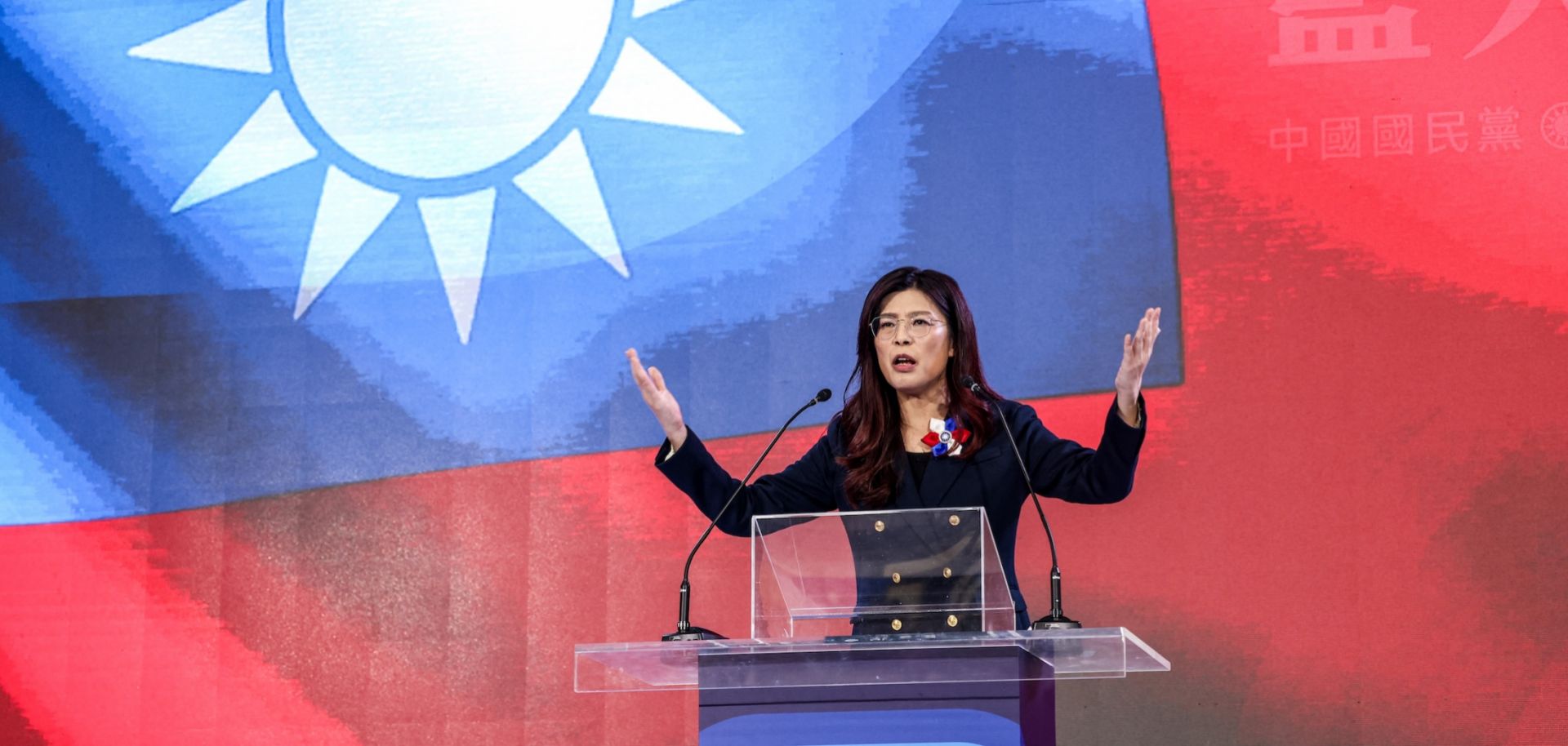
The effort by Taiwan's opposition leader to revive talks with China will likely produce modest economic benefits, hurt the party's electoral prospects and not significantly alter U.S. policy on Taiwan, though talks could also paradoxically increase the chance of military conflict in the coming years. China's Taiwan Affairs Office (TAO) announced on March 30 that the chairwoman of Taiwan's main opposition Kuomintang (KMT) party, Cheng Li-wun, would visit China from April 7-12 at the invitation of Chinese President Xi Jinping. TAO Chair Song Tao said the visit will involve stops in Jiangsu, Shanghai and Beijing. That same day, Cheng held a press conference on the matter, accepting the invitation and pledging to uphold the KMT's policy of "adhering to the 1992 Consensus and opposing Taiwan independence," saying these policies would help avoid war. She also spoke of the efforts of current KMT elder and former Taiwan President Ma Ying-jeou from 2008-2016 to establish and deepen cross-strait diplomatic ties, framing Ma's work as the foundation of her efforts to resume China-Taiwan engagement. Cheng added that she would advocate for Taiwanese businesses during talks, "because they have been forgotten for too long," and seek cooperation and exchange on "some forward-looking issues." Taiwanese Premier Cho Jung-tai, of the ruling Democratic Progressive Party (DPP), on March 31 warned KMT lawmakers to abide by laws governing diplomatic engagements and said no group can negotiate on behalf of the government, currently led by President William Lai, who is also DPP chairman. Likewise, Mainland Affairs Council (MAC) Minister Chiu Chui-cheng told the legislature that any group not approved by Taipei that enters political agreements with Beijing could be subject to criminal penalties.
- The 1992 Consensus is an intentionally ambiguous, quasi-official diplomatic formulation laid out in April 2000 by the KMT-aligned then-minister of Taiwan's Mainland Affairs Council to facilitate sensitive cross-strait ties. It holds that both sides agree there is only one China, but with differing definitions: Beijing asserts it is the People's Republic of China under the rule of the Chinese Communist Party (CCP), and the KMT asserts it is the Republic of China under the KMT. Though the KMT has upheld this formulation for decades, Taiwan's pro-sovereignty DPP has long disavowed it.
- During former Taiwanese President Ma's talks with China, the two governments signed 14 agreements on a wide range of issues. This included, most importantly, the 2010 Economic Cooperation Framework Agreement, which reduced barriers to trade in goods. However, when Ma attempted to push the Cross-Strait Service Trade Agreement through the legislature in March 2014, he sparked the massive Sunflower Movement protests in Taiwan, after which his government withdrew the draft agreement and cross-strait engagement stagnated. The subsequent victories by DPP candidates in Taiwan's 2016, 2020 and 2024 presidential elections coincided with a freeze in cross-strait engagement.
Cheng's visit is likely the beginning of a long chain of unofficial cross-strait engagements that could yield limited Chinese concessions on economic and travel restrictions, but President Lai will try to limit these gains on national security grounds. Cheng became KMT chairman in November 2025 after appealing to the party's members and elders, who would elect her, about the benefits of reviving cross-strait ties. This, plus her pledge to use former President Ma's approach as a model for new talks with Beijing, makes her upcoming visit to China a cornerstone of her party leadership tenure, which Cheng will likely seek to build upon with a steady stream of unofficial China engagements until the next presidential election in January 2028. The strategy for these talks, as Cheng outlined in her speech, is the same as Ma's: to extract benefits for Taiwanese people and industries, and particularly for KMT-run counties and municipalities; to politically undermine Lai's confrontational approach to China; and to reduce the risk of war. These benefits could take the form of reduced Chinese tariff and non-tariff barriers for Taiwanese goods from KMT-run localities or lighter tourism and customs restrictions. Unlike Ma's diplomatic circuit, however, Cheng's takes place under the China-skeptic Lai administration. Thus, any benefits Cheng extracts will take the form of unilateral Chinese concessions following KMT-CCP talks, rather than through formal cross-strait agreements, with the KMT in turn offering to facilitate more exchanges and promising closer China-Taiwan ties if Cheng, or another KMT leader, wins the presidency. Even so, Lai will attempt to stymie her efforts through public appeals to the national security threat posed by China, as well as through legal action. Specifically, Premier Cho could refuse to countersign legislative bills on cross-strait exchanges, while the MAC could refuse to grant permission for former KMT government officials to visit China. The Lai administration could also launch legal cases alleging abrogation of laws governing cross-strait relations as well as judicial investigations into the KMT's facilitation of Chinese interference in Taiwanese affairs.
- In February, the KMT and the CCP held unofficial party-to-party talks in Beijing for the first time since 2016, under the auspices of a "think tank exchange" to avoid scrutiny from Taipei.
- In Taiwan's January 2024 elections, Lai won the presidency, but the KMT and fellow opposition Taiwan People's Party won a combined majority in Taiwan's unicameral legislature. Since then, both sides have sought to increase their institutional leverage. The KMT and TPP have tried to pass reforms to expand legislative oversight of the executive and judicial branches. In response, Lai's government has deployed its own creative tools, with Premier Cho refusing to countersign bills passed by the KMT, a prerogative never before used by Taiwanese premiers.
The cross-strait talks will likely hurt the KMT's ability to win the presidency in 2028, thereafter elevating the risk of Chinese military coercion against Taiwan. Though Cheng's KMT aims to revive a previously successful strategy for cross-strait exchanges, it will execute this strategy under much less favorable domestic circumstances than when Ma did so in 2008-2016. Since then, the Taiwanese public has significantly soured on China, with national security a growing concern and trust in Beijing quite low, particularly following China's crackdown on the Hong Kong protests in 2019-2020 and growing military drills around Taiwan since 2022 that are explicitly aimed at preparing for a blockade and/or invasion. This, plus Lai's efforts to stymie Cheng's diplomacy, suggests the KMT's campaign will further hurt its already poor prospects in the January 2028 presidential and legislative elections. If the KMT loses a fourth consecutive presidential election, it would make Chinese military coercion, including potentially a blockade or invasion of Taiwan, more likely — though still not the most likely scenario — over the following four years, as Beijing perceives diplomatic and economic avenues for seeking unification to be unviable.
- A January 2026 poll by Academic Sinica found that 76% of Taiwanese voters perceived China as somewhat or very threatening to Taiwan's national security, and that 76% saw China as untrustworthy. In addition, 78% viewed China and Taiwan as separate countries, an apparent rejection of the KMT's 1992 Consensus. Meanwhile, surveys conducted by the National Chengchi University's Election Studies Center in 2008 showed that 36% of Taiwanese wanted to keep the status quo in cross-strait relations (de facto but not de jure independence) and to decide on unification at a later date. When combined with the 11% who sought unification, that figure — a loose proxy for openness to cross-strait talks — rose to 47%. By January 2026, that combined figure had dropped to 33%, while the share of Taiwanese who either explicitly supported independence or preferred to maintain the current status quo indefinitely grew from 47% to 60%.
- Cheng's outreach to China is controversial even within her party, as numerous KMT lawmakers have urged her to balance her tilt toward the mainland with greater engagement with the United States, too. As a party, the KMT is currently undergoing a major debate between elders with more dovish views toward China and younger politicians who think the party should embrace a stronger military buildup while balancing ties between Beijing and Washington.
Though KMT-CCP talks may gain U.S. backing, U.S. arms sales to Taiwan and regional preparations for conflict contingencies will continue, making rapid escalation in the event of a future conflict more likely. Cheng's April visit to Beijing and likely meeting with Xi will take place one month before a parallel trip by U.S. President Donald Trump to China. Thus, Xi and Cheng likely aim to use KMT-CCP talks to propose to Washington a non-military means of reducing tensions in the Taiwan Strait. Trump may even endorse cross-strait talks, given his pragmatic policy approach and the United States' historic openness to talks so long as they respect the wishes of the Taiwanese people, an important caveat given the unofficial nature of the KMT's current talks. Even so, Trump's support would unlikely change Lai's opposition to KMT-CCP talks. Moreover, Beijing is still unlikely to persuade Trump — either during his upcoming visit or afterward — to reduce arms sales to Taiwan, given his history of authorizing record arms sales to Taiwan and the fact that U.S. national security policy continues to prioritize arming regional partners, like Taiwan, to deter Chinese kinetic action. Thus, most regional militaries — including China, the United States and Taiwan, but also Japan, the Philippines and Australia — will continue preparing for conflict scenarios, thereby increasing the risk of rapid escalation should a conflict arise.
- After signing their October 2025 trade deal to limit tariff and non-tariff trade barriers, the United States and China jointly scheduled for Trump to visit Beijing to meet with Xi from March 31 to April. However, Washington recently delayed that visit until at least mid-May, citing Trump's need to manage the ongoing Iran war. This postponement likely played no small part in Beijing inviting Cheng to visit following KMT-CCP party talks in February 2026, as U.S. arms sales to Taiwan were already slated for discussion during Xi-Trump talks prior to the delay.
- During Trump's first presidential term from 2016-2020, the United States approved the sale of $18.4 billion of arms to Taiwan. This was the most of any U.S. president, including Trump's predecessor Barack Obama, under whom the United States sold Taiwan $14.1 billion in arms over Obama's two terms in office from 2008-2016. Since Trump began his second term in January 2025, the United States has already approved $11.4 billion in arms sales to Taiwan and is in the final stages of another $14 billion sale, which is expected to be announced in the coming months.
- China's military continues to use drills to perfect its ability to successfully blockade or invade Taiwan. However, the CCP remains hesitant to conduct such kinetic action for fear of triggering severe Western sanctions that could hollow out China's heavily trade-dependent economy. A blockade or invasion would likely also put China at war with the United States, a conflict that the Xi administration could not afford to lose.
