
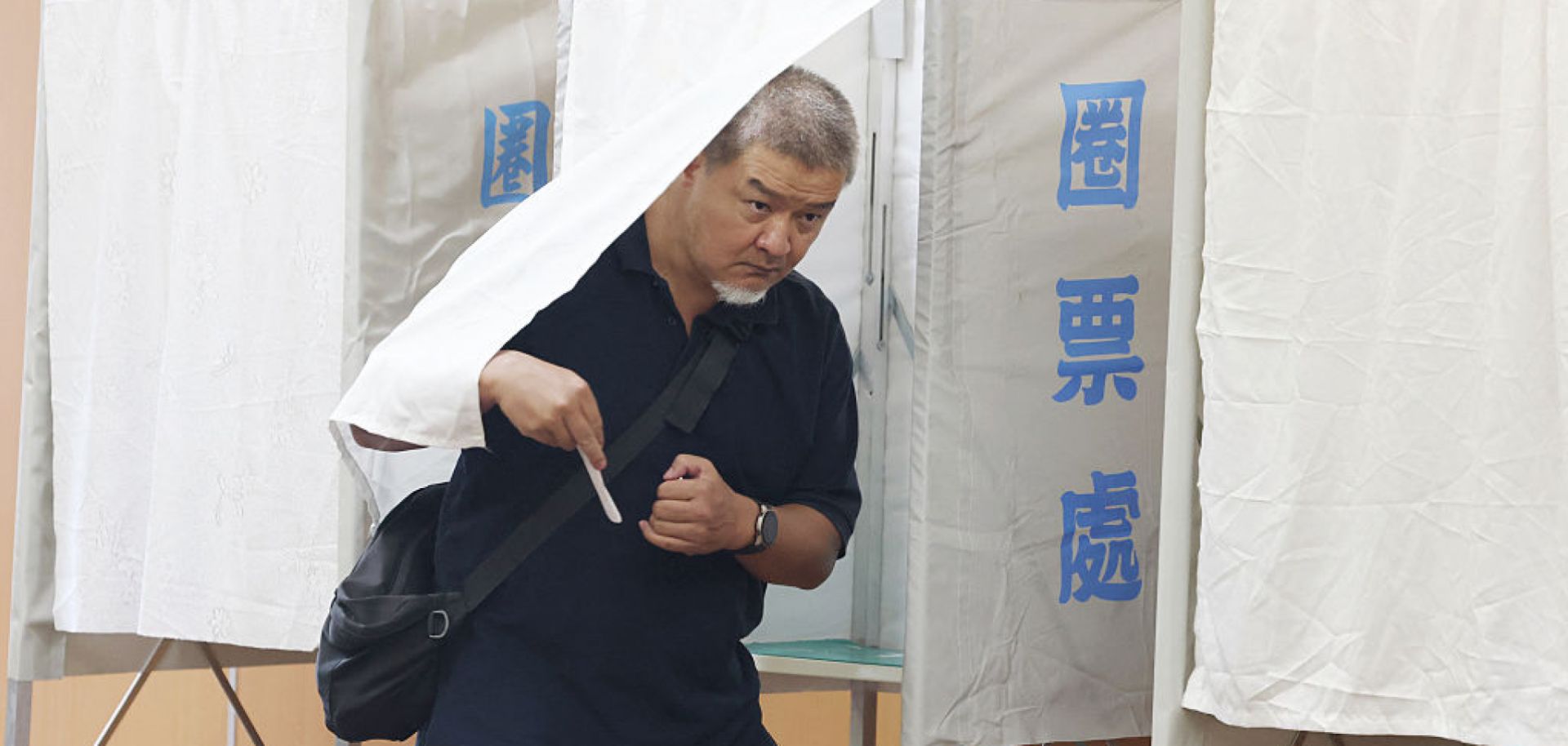
In Taiwan, a failed legislative recall effort will empower the opposition to press on with disruptive government reforms, risking unrest and stoking future tensions with the United States, though it will help prevent a near-term acceleration of (still slowly rising) tensions with China. On July 26, recall votes were held for 24 lawmakers from the opposition Kuomintang (KMT) in localities across Taiwan. Despite significant grassroots engagement and late-stage support by the party organs of the ruling Democratic Progressive Party (DPP), none of the recall votes passed. Taiwanese President William Lai of the DPP tried to spin his party's defeat as a win for democracy, calling the recall process an exercise of the Taiwanese people's legitimate constitutional rights. The legislature's minority leader, Ker Chien-ming — also a DPP member and the progenitor of the so-called ''Great Recall'' movement — said that the DPP must admit it failed. But Ker added that the party had no reason to be pessimistic and would continue to ''defend democratic values.'' Recall votes for seven more KMT lawmakers will be held on Aug. 23.
- Taiwan's January 2024 general elections ended eight years of the DPP holding both the presidency and the legislature. Though Lai kept the presidency under the DPP's control, the KMT and minor opposition partner Taiwan People's Party (TPP) won a combined 60 seats in the 113-seat unicameral legislature, giving them a majority over the DPP's 51 seats.
- In Taiwan, the process to recall a lawmaker involves three stages. The first two stages require gathering signatures from 1% and 10% of voters in the lawmaker's constituency, respectively. In the final stage, a recall vote is held. For the recall to succeed, at least 25% of voters must vote in favor, and the number of pro-recall votes must exceed the anti-recall votes. Should the recall pass, a by-election to fill the vacant legislative seat must then be held within three months.
- Since Ker first suggested the Great Recall, polls by the Taiwan Public Opinion Foundation have consistently shown that more Taiwanese citizens oppose the recall effort than support it, with the latest poll (conducted from July 7-9) showing 42% in support versus 48% against.
While the KMT remains unlikely to launch no-confidence votes against Lai's cabinet for fear of losing its legislative majority, the party's victory in the recall votes will embolden it to pursue disruptive government reforms that could generate more protests. The failure of the July 26 recall votes means the seven additional recall votes due on Aug. 23 are highly unlikely to upset the current balance of power in Taiwan's legislature. Against this backdrop, the KMT and its minor opposition partner, the TPP, could capitalize on their political momentum by tabling a no-confidence vote against Lai's premier, Cho Jung-tai, to force a cabinet reshuffle — something that KMT lawmaker Wang Hung-wei suggested the party was contemplating on July 27. But the opposition is unlikely to follow through with such a move, as Taiwan's constitution permits Lai to call early legislative elections in the event of a no-confidence vote. Though the KMT and the TPP are feeling confident after the recall, July polling still shows combined support for these parties is lower than support for the DPP. National elections also tend to focus more on national security issues that favor the DPP, versus the parochial and economic issues that favor the KMT in local votes. An early national ballot would thus risk resulting in the opposition losing seats. Nonetheless, the DPP's recall vote failure will embolden the KMT and the TPP to continue with their disruptive policymaking, particularly efforts to reform institutions so as to empower the legislature. Notably, the two parties will likely continue to refuse to fill vacancies on the Constitutional Court, which, in concert with their judicial reforms, effectively renders the court defunct. Still, given the wide-scale public backlash against the KMT and the TPP's legislative reform bills, which inspired the Blue Bird protest movement in May 2024, these new reform efforts will risk triggering large-scale social unrest — especially if they continue to undermine the Constitutional Court, which is the highest court on matters pertaining to the constitution and national law. In addition, the opposition could seek to abolish Taiwan's Control Yuan — the government's auditing, supervisory and investigative watchdog — or pursue another round of legislative reforms after its previous round ran into legal challenges at the Constitutional Court.
- In January, the KMT and TPP passed reforms that increased the minimum number of justices needed for the Constitutional Court to issue rulings. This was meant to pressure Lai to appoint opposition-friendly justices, as the court then had too many vacancies to meet the new requirement. The KMT has since continued to reject Lai's nominations to fill the vacancies, with the latest rejections occurring on July 25, thereby leaving the court unable to make rulings. This comes after the Constitutional Court overturned most of the content of the KMT's controversial legislative reforms, proposed in May 2024, which would have empowered the legislature relative to other branches of government. These reforms inspired the Blue Bird protest movement, which saw over 100,000 demonstrate outside Taiwan's legislature.
- National Chengchi University's Election Study Center released its mid-year survey of party identification in Taiwan in June 2025, showing that 31.6% of voters support the DPP, 18.9% support the KMT and 10.6% support the TPP. At 38.2%, the largest segment of voters selected ''independent or no-party identification,'' a notable increase from the 34.5% who did so in 2024. Conversely, support for all major parties has declined since 2024: the DPP by 0.7%, the KMT by 1.6%, and the TPP by 1.2%.
The failed recall effort will limit the DPP's ability to reverse recent defense spending cuts, likely straining Taiwan-U.S. relations. Of the opposition's legislative actions over the last year, its decision to decrease defense spending has had the greatest impact on Taiwan's foreign policy by impeding President Lai's long-term efforts to raise such expenditures to 3% of Taiwan's GDP. In February, the KMT and TPP voted to reduce President Lai's proposed military budget by 1.3%, and to freeze spending on 14% of budget items (including about half of the funding for Taiwan's indigenous submarine program). With KMT lawmakers here to stay, the DPP will have fewer options to expand this defense budget, increasing the likelihood that the United States becomes impatient with Taiwan's slow pace toward taking a greater role in its own defense. This could result in new delays to deliveries of U.S. platforms as a pressure tactic for Taipei to up its defense commitments. However, given the strategic importance of arming Taiwan to deter China, the United States is unlikely to change its long-term trend of increasing the pace and value of such arms sales.
The KMT's continued legislative control will help prevent a near-term escalation of Chinese coercive tactics, which would have otherwise accelerated the slow deterioration of cross-strait relations. Had the DPP regained legislative power, China could have justified ramping up its coercive tactics against Taiwan. The KMT's victory will thus help prevent an immediate escalation of Chinese military actions (e.g., live-fire drills and daily incursions) and Chinese economic coercion (e.g., removal of tariff exemptions for Taiwanese goods), which would have worsened already deteriorating cross-strait relations. However, China's coercive actions remain on a gradual upward trajectory, which means the failed recall will only temporarily prevent the acceleration of growing tensions between Taipei and Beijing, rather than reverse the overall trend. Furthermore, future actions by Lai and his DPP will provide ample opportunities for escalating tensions in the future, including efforts to limit Chinese citizens' access to Taiwan via national security laws, Lai's pro-sovereignty speeches, and efforts to expand Taiwan's military cooperation with the United States, Japan and other external actors.
- The DPP tried to make its recall effort a referendum on the KMT's ties to China. The KMT's victory will thus encourage it to continue its efforts to conduct informal (not sanctioned by Taipei) diplomatic missions to China in exchange for minor economic concessions (such as the end of long-standing customs restrictions), in a bid to show the Taiwanese people that the KMT is better at managing tense relations with China than the DPP.
