
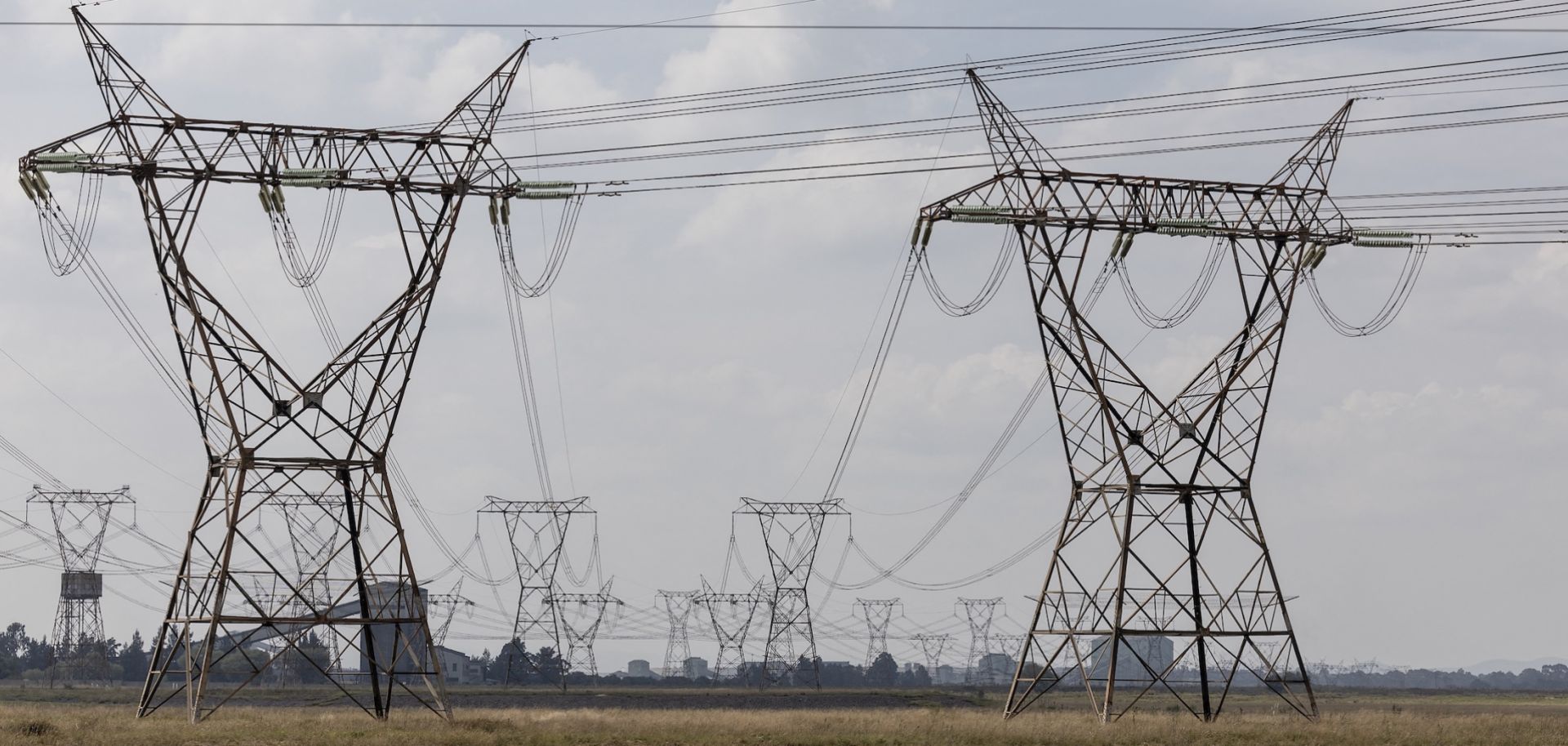
South Africa's power sector reforms will likely spur rising investment in electricity generation and transmission projects despite remaining years away from completion, but the country remains exposed to a high risk of resurging rolling blackouts from 2029 onward if it presses ahead with plans to decommission many of its coal-fired power plants. On Feb. 12, South African President Cyril Ramaphosa confirmed plans to break up state-owned electricity utility company Eskom and ensure that the ownership of South Africa's power transmission infrastructure would be transferred to an independent transmission entity, known as the Transmission System Operator, or TSO. Ramaphosa thereafter assigned a task team of the National Energy Crisis Committee to deliver a report within three months on Eskom's restructuring, including by providing clear implementation timelines. This marked a steep reversal from plans unveiled in December 2025 by Energy Minister Kgosientsho Ramokgopa with the backing of Eskom, which foresaw the state-owned company retaining indirect ownership of South Africa's power transmission assets through its power transmission subsidiary, the National Transmission Company of South Africa, or NTCSA. Prior to Ramaphosa's Feb. 12 announcement, Ramokgopa stressed that this decision was driven by concerns that removing the assets from Eskom's balance sheet would push the company into cross-default, but the December 2025 plan triggered significant backlash from investors, the center-right Democratic Alliance party and the National Treasury. Many investors rejected Ramokgopa's claim regarding the risk of Eskom facing cross-default and warned that his plans would prevent the emergence of a level playing field between the state-owned utility and private sector generators.
Eskom's unbundling is a key component of Ramaphosa's plans to create a more competitive electricity market, but its implementation has faced lengthy delays and is constrained by the company's financial challenges. Eskom has faced severe difficulties in meeting South Africa's electricity demand over the past two decades due to underinvestment in power generation, corruption and interference by organized criminal groups in its operations. Acknowledging these challenges, Ramaphosa announced soon after his ascent to the presidency in 2018 plans to set up a competitive electricity market — with the goal of encouraging investment in South Africa's electricity grid and, ultimately, improving the country's energy security. Eskom's unbundling has been a cornerstone of this push, as the company's vertically integrated structure across generation, transmission and distribution, as well as its ownership of the grid, grants it a decisive edge over independent power producers. In practice, the unbundling aims to make the power transmission, generation and distribution units entities in their own right, while retaining them under state ownership. However, the company's unbundling has faced major delays amid lengthy consultations with stakeholders, as well as legal and technical challenges regarding the transfer of Eskom's assets and liabilities to unbundled entities. Moreover, a steep spike in rolling blackouts in 2022 and 2023 shifted the government's focus away from the unbundling process. Nonetheless, South Africa's National Assembly passed legislation to unbundle Eskom in 2024, with the company's transmission unit being unbundled as the NTCSA that same year. Importantly, the legislation mandates the establishment of a TSO as well as nondiscriminatory access to South Africa's transmission and distribution networks. However, despite the formation of the NTCSA in 2024, further progress in unbundling Eskom's other units has yet to materialize. This is largely a product of the company's large debt and rising municipal arrears, which Eskom CEO Dan Marokane said in November 2025 would prevent the finalization of the company's unbundling if left unaddressed.
- South Africa's nationwide rolling blackouts, locally known as load shedding, have almost completely stopped since the start of 2024, with the latest incident dating back to May 2025. This has been driven by improvements in Eskom's management of coal-fired power plants, which generate around 70% of South Africa's electricity, as well as a rapid expansion of private sector investment in renewable energy, which has eased upper-income households' and larger companies' reliance on the state-owned company. These private sector investments in power generation accelerated after Ramaphosa adopted several reforms in January 2023 that fully removed caps on power generated by independent power producers.
- Eskom has long faced dire financial challenges, and the government guarantees an estimated 70% of the company's debt. However, the government's performance-linked financial support through the 2023 bailout has pushed Eskom to reduce its debt from 412 billion rand ($24 billion) in March 2024 to 372 billion rand in March 2025, and enabled it to return to profitability. Better management has also facilitated improvements in its energy availability factor, which has risen from around 52% in early 2024 to 65% as of February 2026.
South Africa's upcoming launch of a wholesale electricity market will gradually increase competition among power producers, and built-in regulatory safeguards mandating nondiscriminatory access to the electricity grid will mitigate lingering risks of market interference by Eskom. Amid controversy over its ownership of South Africa's power grid, the NTCSA has advanced plans to launch the South African Wholesale Electricity Market, or SAWEM. SAWEM is currently slated to begin trading in the third quarter of 2026 and, once fully operational, will create an open market for power generators, traders and consumers to directly buy and sell electricity, a stark departure from the previous Eskom-led, single-buyer system. While the launch of SAWEM may be further postponed due to regulatory delays, it remains likely to start trading in 2026. The transition toward market-determined pricing will mark a milestone in Ramaphosa's drive to encourage private sector investment in South Africa's power generation. However, SAWEM's debut will only mark the start of a multi-year process to liberalize South Africa's power sector. Electricity purchases through SAWEM will initially be limited to large electricity consumers, and most municipalities will prove unable to participate at first due to their large debt burden to Eskom and failure to meet technical criteria. Moreover, concerns about conflicts of interest in SAWEM's management are set to linger, as the NTCSA is due to operate as SAWEM's market operator in the next few years until the TSO becomes fully operational. Eskom is also likely to retain indirect ownership of South Africa's grid through the NTCSA in the short to medium term, despite Ramaphosa's announcement, due to financial and legal risks associated with the asset transfer. In practice, this could lead the NTCSA to unduly favor Eskom when allocating grid capacity to power generation projects. Nonetheless, the risk of monopolistic abuse by the state-owned company will be curtailed by built-in regulatory safeguards that mandate the NTCSA to ensure nondiscriminatory access to the grid. This means that while the NTCSA may seek to advantage Eskom, it would likely be legally compelled by South Africa's electricity regulator to back down on many of those decisions.
- South Africa faces major constraints on its power transmission capacity, which exacerbates competition among power generators for grid access. In practice, independent power producers' inability to secure sufficient access to the grid would prevent them from selling their electricity to customers. However, independent power producers will be able to appeal decisions by the NTCSA on grid access to South Africa's electricity regulator.
- The continuation of Eskom's vesting contracts, which are long-term power purchase agreements between the state-owned utility and large customers, will hinder South Africa's transition toward full market-based pricing of electricity for the foreseeable future. These contracts involve fixed electricity prices that enable Eskom to recoup costs for capital-intensive power generation projects, such as the infamous Medupi and Kusile power stations. In practice, the continuation of Eskom's vesting contracts will reduce the total amount of electricity traded within SAWEM, thereby weakening price signals and hindering the efficient allocation of affordable electricity, and, by extension, shielding Eskom from competition from independent power producers. However, work by South Africa's electricity regulator may reduce the distorting effects that vesting contracts will have on SAWEM's functioning.
Eskom's unbundling and the transfer of power transmission assets to the TSO will likely take years to finalize due to the state-owned utility's financial challenges and resistance to reform, which sustains the risk of a reversal or stalling of these reforms if they are not completed before the end of Ramaphosa's term in 2029. Key priorities for the National Energy Crisis Committee's upcoming report to Ramaphosa, which is due by May, will include detailing timelines and processes regarding Eskom's unbundling and the transfer of power transmission assets from the NTCSA to the TSO. In both cases, Eskom's financial challenges are set to complicate the process. South Africa's transmission lines and substations are valuable, cash-generating assets for Eskom, and removing them from its balance sheet will hurt the company's financial position. This suggests that the asset transfer will likely take several years to avoid destabilizing Eskom's finances. Moreover, the strategic and financial importance of power transmission assets means that vested interests within Eskom will likely resist the asset transfer to the TSO. This is most likely to materialize through elements within the company attempting to delay the process until after the end of Ramaphosa's term, slated for 2029, in the hope that his successor will adopt a less market-friendly stance. Meanwhile, Eskom's large debt is set to delay the unbundling process, as stakeholders will need to agree on how to split liabilities among the company's unbundled units. Negotiations to that effect are set to be lengthy, given that the debt will weigh heavily on the new — and smaller — entities, which could eventually prompt a controversial fiscal intervention by the South African government. Importantly, the growing challenges posed by municipalities' debt to Eskom's financial position mean the unbundling process will likely require a strengthening of guardrails to ensure payment discipline from municipalities to the company's distribution unit, which will prove challenging to implement given that a majority of municipalities are in financial distress, corrupt and/or badly mismanaged. In practice, this suggests a significant risk that Eskom will not be fully unbundled by 2029, which could result in further delays to the process — if not a policy reversal — should Ramaphosa's successor decide to oppose, pause or deprioritize recent power sector reforms.
- Debt owned by municipalities to Eskom amounted to 103.5 billion rand as of August 2025, a more than 27% increase compared with the previous financial year.
South Africa's power sector reforms will likely increase private sector investment in power generation and transmission projects, which will support the country's long-term energy security and decarbonization efforts. Ramaphosa's Feb. 12 announcement marked a clear pledge toward the independence of South Africa's grid, a key metric for investors to press ahead with new projects in the power sector. Although the completion of proposed reforms remains years away, this will support cautious market optimism and likely spur more private sector investment in power generation and transmission projects, which are critical to the country's long-term energy security, given fiscal constraints hindering large-scale public investment. Moreover, the TSO's ownership of power transmission assets will — once completed — enable it to leverage its balance sheet and raise debt to finance the construction of new projects, which it will likely be able to do at a lower cost than Eskom, given the state-owned company's high debt and poor track record at project management. Importantly, the TSO's independence means its grid expansion efforts will not be driven by Eskom's commercial interests but by the overarching objective of ensuring South Africa's energy security. This will be important for the rollout of renewable energy projects, as the country's power grid currently follows a broad north-south axis that underserves regions with high potential for wind and solar power in the east and west. In practice, Ramaphosa's reforms make it more likely that the insufficient power transmission capacity stifling South Africa's renewable energy projects will be meaningfully addressed in the medium to long term, which will likely encourage private sector investment in wind and solar power. This will support Pretoria's efforts to reduce its reliance on coal-fired power, in line with its decarbonization pledges made under its Nationally Determined Contributions to the U.N. Framework Convention on Climate Change and $12.8 billion Just Energy Transition Partnership, or JETP.
- South Africa long relied on coal-fired power plants for around 80% of its total electricity production, but the rapid rollout of solar energy in recent years has reduced this figure to around 68% as of December 2025.
Despite the likely rise in private sector investment spurred by power sector reforms, South Africa faces an elevated risk of resurging rolling blackouts from 2029 onward due to the planned phaseout of coal-fired power plants, which raises the prospect of further phaseout delays that would threaten JETP financing and tensions with the European Union. In line with South Africa's decarbonization efforts, Eskom is planning to phase out 5.26 GW in coal-fired electricity generation in 2029 and 3.48 GW in 2030, which together amount to close to 16% of installed power production capacity as of 2025. Although the government's reform agenda will stimulate investment in the power sector, matching the associated loss in power generation will still prove highly challenging given the scale of investment needed in both power generation and transmission, short timelines for project completion and continued growth in South Africa's domestic electricity demand. In practice, this means pressing ahead with the proposed coal phaseout will expose South Africa to a high risk of frequent rolling blackouts resurging as early as 2029. Although households and businesses' installation of their own power supply in recent years suggests that a return to frequent rolling blackouts would likely prove less disruptive than in 2022 and 2023, it would still hurt economic growth and investor sentiment. To avert these risks, Pretoria could further postpone the planned phaseout of coal-fired power plants by several years. Nonetheless, the risk of renewed blackouts would still gradually rise as the country's aging coal fleet becomes increasingly prone to breakdowns. Delaying the phaseout of coal-fired power plants would also risk leading to a partial or complete suspension of JETP financing, which would likely slow South Africa's grid expansion. Moreover, the associated watering-down of Pretoria's climate commitments could also undermine its relationship with the European Union at a time when relations with the United States are proving more challenging.
