
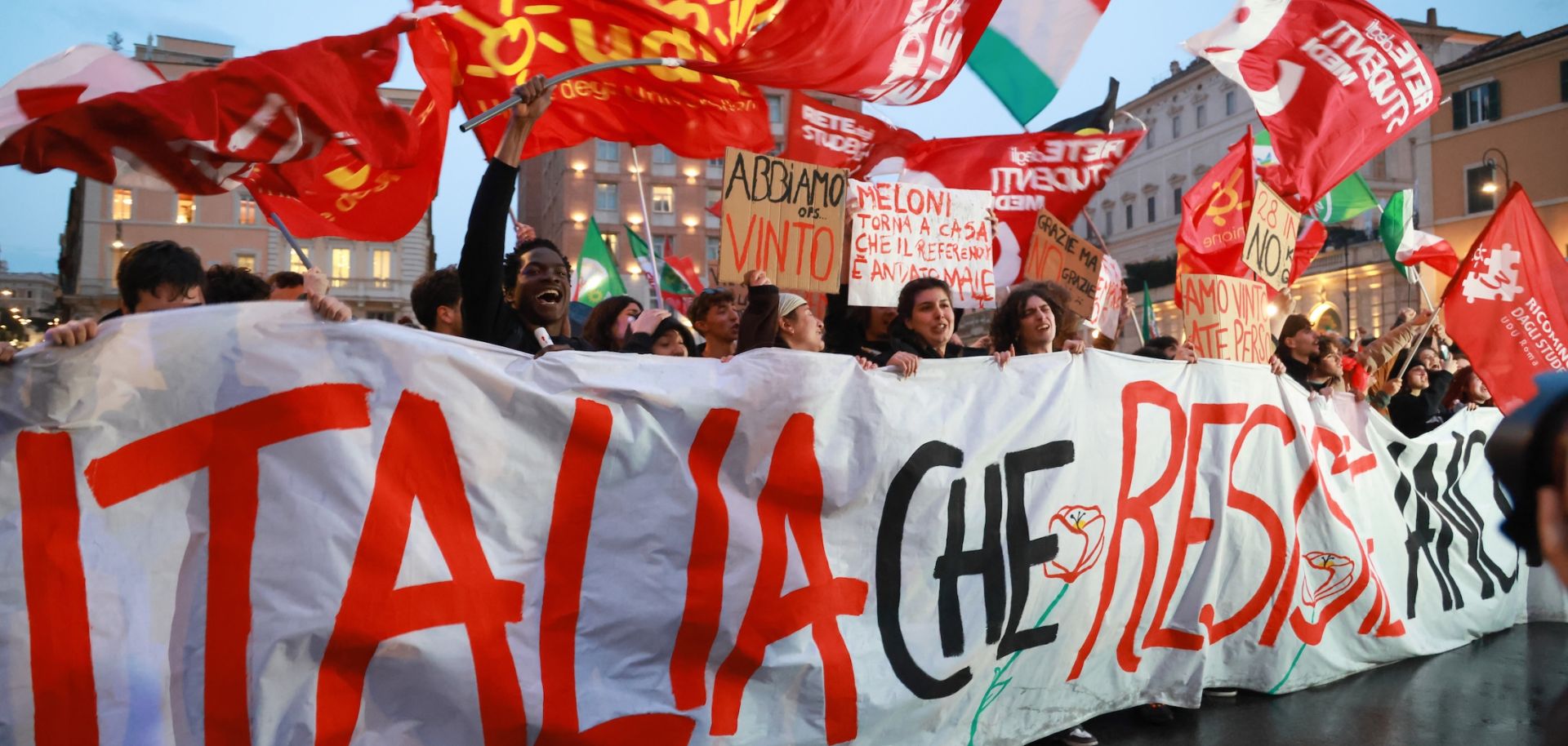
The defeat of a highly politicized judicial reform referendum exposes limits to the Italian government's dominance, and may embolden the fragmented opposition and strain coalition unity ahead of next year's elections. It also increases the government's incentives to complete the legislature and pursue electoral reform to strengthen its reelection prospects. Italian voters rejected a government-backed judicial reform in a March 22-23 referendum, with the "No" camp securing 53.7% of the vote, according to official results. The outcome blocks changes to the Italian Constitution proposed by Prime Minister Giorgia Meloni's government. The vote followed a highly politicized campaign, with turnout approaching 60%, nearly nine points higher than the last comparable referendum in 2020, and strong participation among younger voters. Meloni acknowledged the outcome on social media on March 23, calling it "a missed opportunity to modernize Italy," but ruled out her resignation or early elections, emphasizing that the government would continue its work as planned. Government allies, including Deputy Prime Ministers Antonio Tajani and Matteo Salvini, leaders of the co-ruling Forza Italia and Lega, added that the vote concerned the reform itself, not the future of the government, and affirmed that the coalition remains united and stable.
- The failed reform sought to separate the career paths of prosecutors and judges, introduce two Supreme Courts within the High Council of the Judiciary, and create a High Court to oversee magistrates. The restructuring of Italy's judicial hierarchy was, in part, presented as a way to address political bias in prosecutorial activity. The government argued the reform would have improved accountability and efficiency within the judiciary, while critics warned it could weaken prosecutorial independence and expand political influence, heightening concerns of rule-of-law backsliding amid already tense relations between the executive and the judiciary.
- Long-standing tensions between Italy's political right and the judiciary, broadly rooted in the 1990s Mani Pulite (Italian for "Clean Hands") investigations that uncovered widespread political corruption and dismantled much of the Cold-War era party system in Italy (including parties on the left side of the political spectrum), and later reinforced under former Prime Minister Silvio Berlusconi, provide the political foundation for Meloni's reform. Meloni framed her plan as a necessary corrective to the judiciary's ideological drift on issues such as migration, security and general political prosecution.
- YouGov data indicate that 61% of "No" voters were motivated by "defending the Constitution," while 31% voted as a protest against Meloni's government, reflecting a combination of some genuine concerns over executive power concentration and broader anti-government sentiment within the electorate.
Intended to consolidate Meloni's grip on power, the referendum wound up revealing a more complex political landscape, with implications for her authority within the coalition, her broader political standing and the perception of stability she had been able to project so far. After taking over in late 2022, Meloni's right-wing coalition emerged as an exceptionally stable government by Italian — and even recent European — standards. Meloni heads Italy's longest-serving Cabinet since Silvio Berlusconi's 2011 administration, and only the third postwar government to last three years. Backed by a comfortable parliamentary majority, broadly aligned coalition party policy priorities and solid approval ratings for the three ruling parties, Meloni cultivated an image of a steady, unassailable government. Then, the March 22-23 referendum quickly became highly politicized, turning into a vote on her leadership and backfiring on her efforts to strengthen her position ahead of the 2027 legislative elections. The "No" victory marks Meloni's first national-level setback and the first defeat for her Brothers of Italy party since taking office. While she has sought to delink the vote from her political fate, the outcome revealed limits on her government's ability to mobilize its supporters, signaling a more uncertain path toward reelection in 2027.
- Referendums in Italy often carry broader political consequences. In 2016, former Prime Minister Matteo Renzi's failed constitutional reform, intended to streamline the Senate and strengthen the executive, quickly became a referendum on his leadership, leading to his resignation the day after nearly 60% of voters rejected the proposal.
- Turnout for the March 22-23 referendum reached approximately 60%, significantly higher than recent Italian ballots, indicating strong mobilization and conferring even greater political weight to the result, elevating its significance beyond the technical scope of the judicial reform.
- Opposition leaders framed the outcome as evidence of an "alternative majority" to the ruling parties within the Italian electorate, with the center-left Democratic Party leader Elly Schlein calling for coordination among progressive forces and expressing readiness to participate in an opposition primary alongside the populist left-wing Five Star Movement to consolidate a challenge to Meloni's government.
The referendum might strengthen the opposition and raise the risk of internal coalition tensions, but Meloni will still likely seek to complete the legislature and prioritize electoral reform to secure her position ahead of the 2027 elections. Politically, the referendum result may give the opposition momentum ahead of next year's elections. That said, the outcome was driven largely by grassroots mobilization outside traditional party structures, and the still-divided opposition may struggle to translate this momentum into a coordinated campaign. The political fallout could meanwhile expose divisions within Meloni's coalition if her allies begin pursuing their own priorities to shore up their own bases and improve their popularity as legislative elections approach, potentially destabilizing the government and complicating policymaking. In this political environment, next year's budget — always a sensitive issue, especially ahead of an election year — could face delays or tensions, and even include fiscal giveaways, heightening the risk of fiscal slippage and renewed market concerns. In the immediate term, Meloni could press for early elections before opposition parties manage to reorganize around the referendum victory and economic conditions deteriorate further amid the fallout from the war in Iran and the winding down of key EU post-pandemic recovery funds, which will expire at the end of 2026. But this is unlikely given her weakened position after the referendum defeat and the fact that many lawmakers have a strong financial incentive to remain in office until at least February 2027, when they become eligible for full pension benefits. The more likely course of action is for Meloni to stay the course and remain in office, maintaining her government's record for longevity while prioritizing the completion of electoral reforms designed to increase her chance of reelection and potentially secure a larger majority in 2027.
- The "No" victory represents a rare win for Italy's left-wing opposition, which has struggled in recent years to mobilize voters. Another referendum on citizenship and labor reforms in June 2025, also backed by the opposition, failed to reach the 50% turnout threshold by a wide margin, underscoring enduring fragmentation and weakness and making the March 22-23 result even more meaningful.
- In February, the government submitted an electoral reform to Parliament that would introduce a proportional system with a majority bonus of 70 seats in the lower house and 35 in the Senate for coalitions exceeding 40% of the vote, with a runoff if a coalition reaches 35%-40%. Existing thresholds of 3% for standalone parties and 10% for coalitions are maintained. The reform, which does not require a constitutional reform or referendum, is designed to strengthen Meloni's coalition's prospects of retaining power in the 2027 general election by reshaping seat allocation rules in a way that reduces the risk of losing its Senate majority if opposition parties coordinate behind unified candidates. Under the current mixed system, roughly one-third of seats are decided in single-member districts, where a consolidated left-wing alliance could win key constituencies, particularly in southern Italy. By shifting to a proportional framework with a structured majority bonus, the proposed system would reduce the electoral leverage of tactical alliances in competitive districts and increase the likelihood that the leading coalition secures a workable parliamentary majority.
