
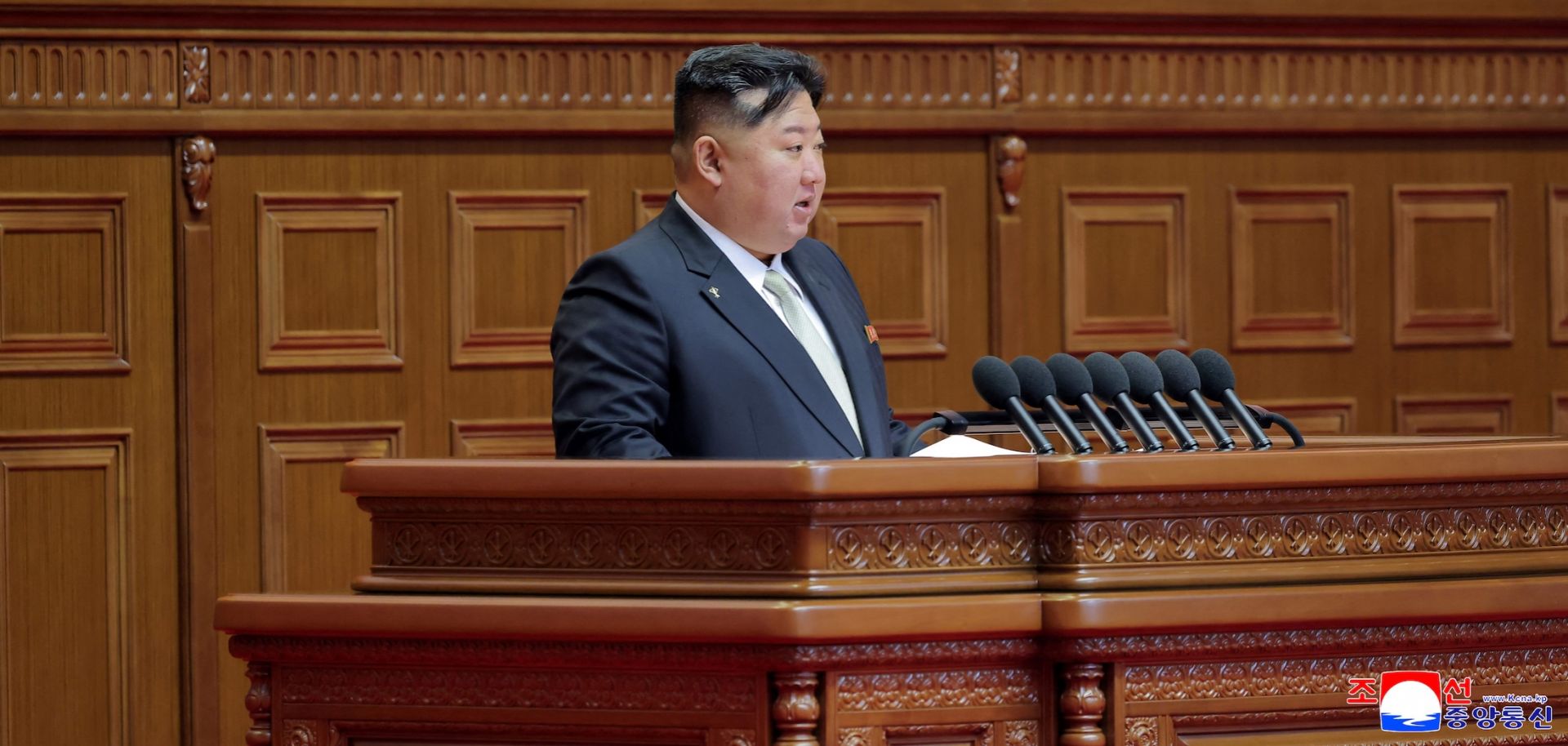
A key party meeting highlights a rare opportunity for North Korea to engage diplomatically with Russia and the United States, and to a lesser extent China and South Korea, to help overcome its economic isolation, though the low risk of military clashes on the peninsula will persist. On Feb. 26, North Korea's dominant Workers' Party of Korea (WPK) concluded its quinquennial Party Congress, which spanned seven days in Pyongyang. Supreme Leader Kim Jong Un was re-elected as general secretary of the WPK in an entirely predetermined voting process, ostensibly extending his already 14-year reign by another five years. Kim also replaced 52% of members of the WPK's Central Committee, the primary decision-making body for the party in the central government, along with 79% of alternate members, unusually high shares for a congress. Most of the replacements were technocrats and party members who rose up in the ranks of the WPK during Kim Jong Un's leadership. Most "second-generation" officials, who ascended politically under his father, Kim Jong Il, were replaced. Further representative of this turnover, 76-year-old First Vice President Choe Ryong Hae — largely seen as No. 2 below only Kim — was removed from Central Committee membership, signaling he will very likely be replaced in his senior role when North Korea's rubber-stamp parliament, the Supreme People's Assembly, next convenes, though there is no date confirmed for this yet. Kim's sister and deputy director of the Publicity and Information Department, Kim Yo Jong, was promoted to director, giving her a party oversight role over both domestic propaganda and foreign affairs. Kim's 13-year-old daughter, Kim Ju Ae, was present alongside her father at the Feb. 25 military parade, a pride of place that usually signifies high political prospects in North Korea.
North Korea remains focused on bolstering Kim's leadership and providing basic goods and services, conditions that will align with Pyongyang's interest in expanding foreign ties to secure economic benefits. Kim's Central Committee appointments show him insulating his already supreme political power with more loyalists, while Ju Ae's increasing presence alongside her father suggests she is the most likely successor to her relatively young but unhealthy father, a conclusion increasingly supported by South Korea's intelligence service, which is the most adept at monitoring North Korea. At the conclusion of the Party Congress, Kim delivered a final report in which he laid out domestic and foreign policy goals. His domestic plans focused on qualitative improvements in North Korea's economy and standard of living, with a particular focus on building "regional-industry factories, hospitals and leisure complexes" every year over the next five years in 20 cities and counties in order to raise rural living standards. He likewise pledged to advance hospital infrastructure more broadly in 100 cities. Though vague and aspirational, these pledges suggest the isolated North Korean government continues to struggle with the provision of basic health care and livelihood needs for its 26 million citizens, particularly the 23 million who live outside of Pyongyang. Kim's personnel decisions at the congress, aside from bolstering his power base, also served to empower technocrats who would best know how to remediate these economic concerns. These ongoing struggles to provide basic services to North Korea's population also suggest that, though North Korea will persist with military brinkmanship partly as a show of strength to its neighbors, foreign engagements that can help remediate the country's manifold economic struggles will be welcome in Pyongyang.
- The exact health conditions of the 42-year-old Kim Jong Un are a closely guarded state secret. Still, much can be gleaned from his public appearances and South Korea's intelligence service, which is known to have spies inside Pyongyang. Kim is morbidly obese, believed to suffer from high blood pressure and diabetes, has long been a heavy smoker and drinker, and has a family history of heart disease. This, when combined with the high stress of his work, suggests it is prudent to plan well in advance of his likely early demise — hence the speculation about the role of Kim's daughter and monitoring of his sister in North Korea's political hierarchy.
Despite Kim's reiteration of North Korea's ideological opposition to talks with South Korea, they remain possible, if unlikely, for practical ends like economic benefits. North Korea will nonetheless continue to militarily threaten South Korea, keeping the risk of peninsular clashes low but not zero. On foreign policy with South Korea, Kim was more explicit. He called President Lee Jae Myung's charm campaign toward North Korea "a clumsy, deceptive farce" to pursue Pyongyang's denuclearization and called for ceasing efforts at inter-Korean reconciliation and reunification. Nonetheless, Kim kept the door open to future talks, noting that "if there is anything" in North-South relations, "it is only a cool-headed calculation and strict response for our national interests." This language is driven by an ideological shift in the WPK from early 2024 that saw Pyongyang abandon the pursuit of unification with estranged southern compatriots in favor of treating South Korea as a persistent foreign rival. But it also shows Pyongyang is willing to be pragmatic about North-South relations in its pursuit of national interests, but only in the unlikely event that Seoul agrees to abandon its main demand — North Korea's denuclearization. This congressional stance further supports that a revival of North-South talks will be difficult, though not impossible, given that even the most pro-engagement actors in the current South Korean government ardently maintain their denuclearization stances. To wit, Kim underlined Pyongyang's opposition to denuclearization by shifting the object of his strategic nuclear threats from the United States to South Korea. In the report, he highlighted the utility of "strategic" multiple-launch rocket systems (MLRSs) to deter "targets in the territory of [South Korea]." Thus, there remains a latent risk of military confrontation on the peninsula, which could follow North Korean advancements on disputed territories or failed diplomatic efforts, though this risk is lower than under Lee's conservative predecessor. Any such clash would, however, most likely occur via conventional weapons exchanges between border forces in unpopulated areas.
The congress showed North Korea's willingness to revive talks with the United States that could yield sanctions relief and its efforts to deepen ties with Russia and to a lesser extent China, which could bolster North Korea's defense industry and potentially its energy exports. Regarding other powers, Kim was more optimistic. Despite the usual rhetoric denouncing U.S. imperialism and Washington's threats to North Korea's security, Kim expressed continued openness to meeting with the United States, but only if Washington abandons its "hostile policy" (meaning the demand to denuclearize) and related actions (for instance, joint military drills with South Korea). Under these parameters, Kim noted, "there is no reason why we cannot get on well with the [United States]." Thus, whenever U.S. President Donald Trump decides to focus on the matter — he is for now engrossed in trade negotiations with China and several other partners as well as in conflicts in Latin America and the Middle East and planning for midterm elections in November — there is a good chance Pyongyang would be open to another Kim-Trump meeting. Such a meeting would require Trump to convince his national security team to downplay language on denuclearization. Trump is likely to be able to do so, given that he views talks with Kim as unfinished business from his first term and that the U.S. national security establishment is gradually recognizing that denuclearization is effectively impossible. Though, as with the last round of talks in 2018-2019, trust would be low and discussions vulnerable to breakdown, they could yield limited sanctions relief for North Korea, for example, in return for Pyongyang slowing down its nuclear buildout. Lastly, Kim noted Pyongyang's plan to continue building relations with "anti-imperialist powers". This pertains to Russia primarily — as seen in the Russian flag in the Feb. 25 military parade — and to China secondarily. This likely portends a continued expansion of cooperation to build out North Korea's defense industry and to supply Russia with munitions and occasionally North Korean labor to support Moscow's wartime economy focused on defeating Ukraine. Finally, ties with Beijing remain somewhat cool despite Kim's attendance at China's military parade in Beijing in September 2025. Another summit between Kim and Chinese President Xi Jinping is possible, but their long-standing bad blood and Pyongyang's relatively advantaged position alongside Moscow suggest tangible benefits from China will likely be modest. For example, Beijing could increase purchases of sanctioned North Korean anthracite coal, primarily used in industry, as this would not exacerbate China's ongoing supply glut in thermal coal.
The congress highlights that most of North Korea's long-term economic difficulties and diplomatic isolation persist, but it also shows Pyongyang taking advantage of rare opportunities to shore up those weaknesses over the next five years. Overall, the Party Congress paints the picture of a North Korea that is still highly underdeveloped and structurally vulnerable to a sudden leadership crisis should Supreme Leader Kim Jong Un experience a health crisis. Succession plans that likely involve Kim's 13-year-old daughter in some capacity show how disruptive a sudden succession crisis could be for policy continuity, although Kim Yo Jong's elevation may suggest Kim's efforts toward a backup plan in the near term. That said, the Hermit Kingdom's rare variety of options for international connections could yield a moderate expansion of economic activity, albeit most likely in low-end coal extraction or the already expanding defense industry. Growth is less likely in goods and services that raise the standard of living for the average North Korean, a disparity that will perpetuate the country's underdeveloped economy. Though the congress suggests a looming expansion of diplomatic visits, talks with the United States or South Korea falling apart would portend an expansion of North Korean military brinkmanship. In the event that failed talks are followed by the return of a conservative government in South Korea, the North's brinkmanship could yield a fatal incident, like the 2010 sinking of the Cheonan, which could set back Pyongyang's efforts to secure long-term economic relief from Washington or Seoul for years, perhaps until after the next Party Congress or beyond.
