
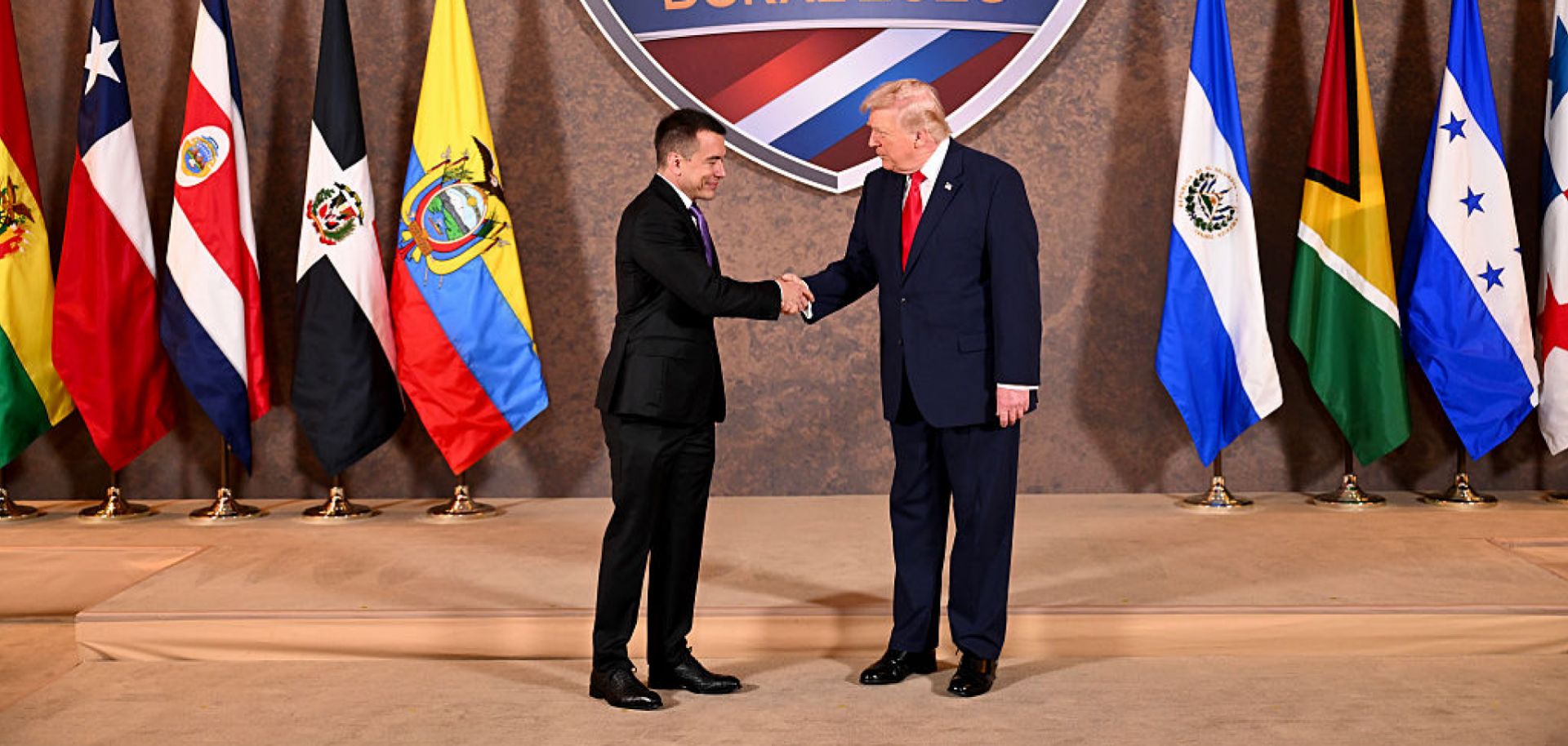
Joint U.S.-Ecuador military operations meet strategic goals for both governments, despite the risk of political backlash in Ecuador, and they further demonstrate the Trump administration's intent to expand U.S. security operations to other Latin American countries as Washington's regional interventionism grows. On March 6, Ecuador's defense ministry said its military used U.S. intelligence and support to identify and bomb an alleged narco-trafficking base near the Colombian border. The announcement was the first regarding a specific operation since U.S. Southern Command (SOUTHCOM) announced on March 3 in a social media post that U.S. military forces had begun assisting Ecuadorian military forces in "operations against Designated Terrorist Organizations in Ecuador." SOUTHCOM said the operations were to combat illicit drug trafficking. Ecuador's defense ministry also confirmed that the operations were underway, and Ecuadorian officials indicated that U.S. military forces were present at an Ecuadorian air force base in the port city of Manta, Manabi province. Subsequent reporting by The New York Times regarding the March 3 announcement cited an anonymous source who stated that U.S. forces were not participating in the actual raids against criminal groups and were instead providing logistical and planning support, as well as intelligence sharing. The announcement drew minimal criticism from opposition groups in Ecuador, though influential former President Rafael Correa (2007-17) of the left-wing Citizen Revolution Movement voiced his opposition to the U.S. involvement.
- SOUTHCOM's announcement came a day after U.S. Marine Gen. Francis L. Donovan, head of SOUTHCOM, met with Ecuadorian President Daniel Noboa in Quito on March 2 to discuss bilateral security cooperation. During his visit, Gen. Donovan said Ecuador was "one of the United States' strongest partners in disrupting and dismantling Designated Terrorist Organizations in the region."
- After the joint operations were announced, Ecuadorian Foreign Minister Gabriela Sommerfeld clarified that the U.S. military presence at the Manta air base was temporary and did not constitute a foreign military base. In a November 2025 referendum, Ecuadorians rejected a proposed constitutional change to allow foreign military bases in the country. The U.S. Air Force previously stationed personnel at the Eloy Alfaro International Airport in Manta from 1999 until 2008, with their presence ending after Ecuador outlawed foreign military installations in the country in 2008.
The joint operations could help Ecuador combat gang violence and improve relations with the United States, while enabling Washington to expand regional counter-crime operations. Since taking office in November 2023, President Noboa has struggled to curb extreme gang violence in Ecuador linked to regional drug trafficking. Despite repeated states of emergency and the deployment of armed forces across the country, violence has remained at record-high levels in the last year. Noboa has also sought to strengthen relations with the United States to attract foreign investment and reduce U.S. tariff threats. For Ecuador, the newly announced joint operations thus provide the dual benefit of more resources to fight gangs and closer U.S. ties. Meanwhile, over the last year, the Trump administration has repeatedly indicated its intent to prioritize security issues in the Western Hemisphere, as part of a broader policy to expand U.S. influence in the region under what the White House has called the "Trump Corollary to the Monroe Doctrine," or the "Donroe Doctrine." This has been visible in the ongoing maritime strikes on alleged drug trafficking vessels transiting the Caribbean and the eastern Pacific Ocean, the designations of major criminal groups as foreign terrorist organizations (FTOs) and the Jan. 3 operation to arrest then-Venezuelan President Nicolas Maduro. Given Ecuador's growing security challenges and President Noboa's requests for assistance, the country is thus an appealing location for the U.S. military to increase its presence, even if only in a supporting role for local forces. This is particularly true since Mexico (the Trump administration's preferred target for such operations) has rejected more direct U.S. assistance.
- Ecuador has seen a severe surge in violent crime in the last five years, as major prison gangs, including Los Lobos and Los Choneros (both of which received FTO designations), received new external support from Mexican and Colombian transnational drug trafficking groups, which wished to gain access to trafficking routes through the country, particularly through port cities such as Guayaquil and Manta. This led the homicide rate to rise from 6.7 per 100,000 people in 2019 to over 50 per 100,000 people in 2025, making Ecuador one of the most violent countries in the Western Hemisphere.
- Ecuador's economy is highly reliant on exports to the United States, which accounted for 20.4% of Ecuador's total exports in 2024, with an emphasis on food products and oil, according to the Central Bank of Ecuador and U.N. Comtrade. China is Ecuador's second-largest export market, receiving 14.8% of Ecuadorian exports in 2024.
- Noboa has taken other measures to strengthen ties with the United States, including expelling the entire staff of the Cuban Embassy in Quito on March 4 amid expanding U.S. pressure on Cuba. Noboa also attended the March 7 U.S.-hosted regional security summit in Florida with various Latin American leaders, signalling Ecuador's intent to participate in the "Shield of the Americas" counter-cartel coalition.
The operations could improve security conditions in Ecuador but will risk triggering eventual political backlash against Noboa's administration if public violence does not decrease. Given extreme insecurity in Ecuador, most of the population will likely embrace assistance from the United States, particularly in the near term. And although the opposition Citizen Revolution Movement will likely continue to criticize this cooperation over sovereignty concerns, Noboa and his allies control the National Assembly, so there will be little political limitation on operations in the near term. Moreover, U.S. security assistance could ultimately reduce violence and make Ecuador more attractive to investment and business operations, although only after at least a year of sustained pressure on gangs, which is not guaranteed to materialize. In the meantime, the operations will gradually raise the potential for backlash, particularly if reports emerge of U.S. operations leading to civilian deaths and/or if the operations do not achieve a substantial and sustainable reduction in violence. Popular opposition would be more likely if operations unsettle the criminal environment in a way that drives an increase in competition between rival criminal groups or retaliatory violence against authorities and civilians.
- If U.S. assistance substantially boosts Ecuador's security capabilities and funds, it would be more likely to pressure criminal groups to at least temporarily operate more carefully, with less public violence. However, the fundamental drivers for the uptick in Ecuador's violent crime and narcotrafficking would remain.
- Joint operations could disrupt Ecuador's agricultural sector, given that criminal groups commonly use food shipments from the country to hide cocaine shipments. Increased scrutiny of bananas, coffee or other food production could create supply chain delays; for bananas in particular, supply chain disruptions would be substantial, as Ecuador accounts for over 25% of global banana exports.
The United States will likely conduct further security operations against drug trafficking groups in other Latin American countries, as well as pressure regional states to reduce ties with China and expand U.S. companies' access to deposits of critical minerals. According to repeated statements by Trump and other top U.S. officials, further U.S. military and law enforcement operations are likely in other Latin American countries with high crime threats and where national governments are most likely to specifically request U.S. assistance. Trinidad and Tobago, Honduras and Haiti are likely candidates, and Peru and Colombia may become more so following presidential elections in April and May, respectively. However, the Trump administration has repeatedly shown a high risk tolerance and willingness to break international norms, meaning that the United States will likely also conduct unilateral operations against drug traffickers in countries that reject U.S. assistance, including Mexico and Colombia. This will be a likely source of regional diplomatic tensions over the next year and beyond, threatening to harm Washington's ties with governments that push back and creating operational uncertainty for companies as they navigate the legal complexities and physical safety risks associated with a more aggressive U.S. security posture in the region. In addition to counter-cartel efforts, the Trump administration's efforts to expand the United States' regional influence under the broader "Donroe Doctrine" will likely also pressure countries to reduce relations with China. While Latin American countries have thus far broadly attempted to balance improving ties with the Trump administration and maintaining economic ties with China, many governments (especially ones ideologically aligned with Washington, including Ecuador's) will likely adjust their foreign policy focus to prioritize relations with the United States by reducing Chinese involvement in strategic sectors, such as critical infrastructure and the mining and energy sector; however, as China is a top export market and major source of foreign investment for many regional countries, they will face a tricky balancing act that could draw rebukes from Washington and/or Beijing. The Trump administration will also seek to expand U.S. companies' access to critical minerals in the region (such as gold, lithium and copper), leading to new opportunities for U.S. mining companies and organizations seeking to purchase critical minerals. However, these developments will risk reducing access for companies from other parts of the world, and the United States will still face an uphill battle in challenging China's dominance over critical minerals supply chains, especially as Chinese companies continue to dominate the refining of many key resources.
- In early 2025, the Trump administration announced tariffs on Mexico, Canada and China over fentanyl trafficking into the United States, though the tariffs were ultimately invalidated by the February 2026 Supreme Court ruling against the Trump administration's use of the International Emergency Powers Act. In October 2025, the Trump administration announced sanctions on Colombian President Gustavo Petro and his allies over cocaine production in the country, and though Petro met with Trump in a positive meeting on Feb. 3, the sanctions remain in place.
