
European governments are financially capable of supporting Ukraine's war effort this year, but the country's long-term reconstruction — and its emergence as a viable, independent economic entity — will hinge on the sustained political will of European countries and a lasting peace settlement to attract necessary levels of investment. Foreign financial, military and humanitarian support has enabled Ukraine to remain in the fight against numerically superior Russian forces, backed by vastly greater economic resources, for nearly four years of conflict. Although the United States under President Donald Trump has largely ended its support for Ukraine, European countries have stepped in to fill the gap. In January 2026, the European Commission officially approved a 90 billion euro "Ukraine Support Loan," which includes approximately 60 billion euros for military support and 30 billion euros for general budgetary support. In late 2025, the European Union and G-7 partners also agreed on a 45 billion euro loan backed by the revenues from immobilized Russian assets.
- Ukraine has restructured various debts since the beginning of the war in 2022, as part of requirements set by the International Monetary Fund (IMF). Among other debt restructuring operations, the country restructured $20.5 billion in international bonds in 2024. In late 2025, it swapped $2.6 billion in GDP-linked warrants for bonds. Ukraine has also been restructuring commercial claims, some of which were guaranteed by the government and thus constitute contingent liabilities.
- According to the Kiel Institute for the World Economy, European countries collectively have become the top providers of total aid (military, financial and humanitarian) to Ukraine since the beginning of the war in February 2022. However, the United States remains the single largest individual donor in raw terms, with total U.S. aid reaching approximately 130 billion euros since 2022. Among individual European countries, Germany is Ukraine's top donor (28 billion euros, not accounting for contributions through EU institutions), closely followed by the United Kingdom (21 billion euros). The European Union, as an institution, has provided 86 billion euros worth of aid to Ukraine. As a share of GDP, Scandinavian and Baltic countries have provided the most financial support — upwards of 2% of GDP — whereas France, Italy and Spain have contributed a mere 0.1% of their annual GDP.
- The European Union and the United States are reportedly preparing a $800 billion "Prosperity Plan" for Ukraine's post-war reconstruction. The 10-year financing framework aims to transform Ukraine from a recipient of emergency aid into a self-sufficient, modernized economy, according to documents seen by Politico. Brussels, Washington and international financial institutions will seek to provide roughly $500 billion as a foundation to attract further private capital, which is in line with the World Bank's estimates of Ukraine's reconstruction needs and financing requirements.
The recent boost in EU aid to Ukraine comes after Kyiv secured another deal with the IMF to help address the country's precarious financial position, which had imperiled its war effort. Absent Western support, Ukraine would quickly collapse financially, economically and, in turn, militarily. Neither a maximally large fiscal adjustment nor a massive debt writedown would be enough to offset the drying up of external funds that help keep Ukrainian forces in the field. This reliance made securing foreign financing a crucial priority for Kyiv. After eight successful reviews, Ukraine reached a staff-level agreement with the IMF for a new four-year Extended Fund Facility in November 2025. The IMF deal aims at improving macroeconomic stability, debt sustainability and external viability, and provides Kyiv with a vital financial lifeline. But the IMF also demanded that donors take prompt action to backstop Ukraine's fiscal and external financing needs, which subsequently unlocked recent EU financial support.
- The IMF program is fully financed, with a four-year external financing envelope projected at $153 billion in the baseline scenario and $165 billion in the downside scenario — though both are highly uncertain given Ukraine's deeply uncertain economic outlook. However, IMF support will continue to hinge the timely and predictable disbursement of all official bilateral financial support, mainly from the European Union.
- As for official bilateral claims, the debt standstill, meaning an agreement by official creditors to pause the collection of debt payments, remains in effect and the Ukrainian government is engaged in consultations to restructure the claims. Moreover, financing assurances by Ukraine's creditors and donors remain in place in view of exceptionally high uncertainty surrounding the economic outlook.
- In its mid-2025 program review of Ukraine, the IMF forecast a current account deficit of 14% of GDP and a fiscal deficit of more than 22% of GDP, while public debt was projected to increase from 90% of GDP in 2024 to more than 130% of GDP by the end of 2026. This indicates just how challenging and unsustainable Ukraine's financial and economic position would be without official financial support.
- Projected EU financial support for Ukraine in 2026-27 is equivalent to just 0.3-0.4% of the bloc's projected cumulative GDP over the same period. While Ukraine is technically expected to repay these loans once it receives war reparations from Russia, this is highly unlikely. Even if EU member states had to cover the repayment from their national or the EU's long-term budgets, the financial burden would still be very manageable, even for highly indebted countries like France and Italy.
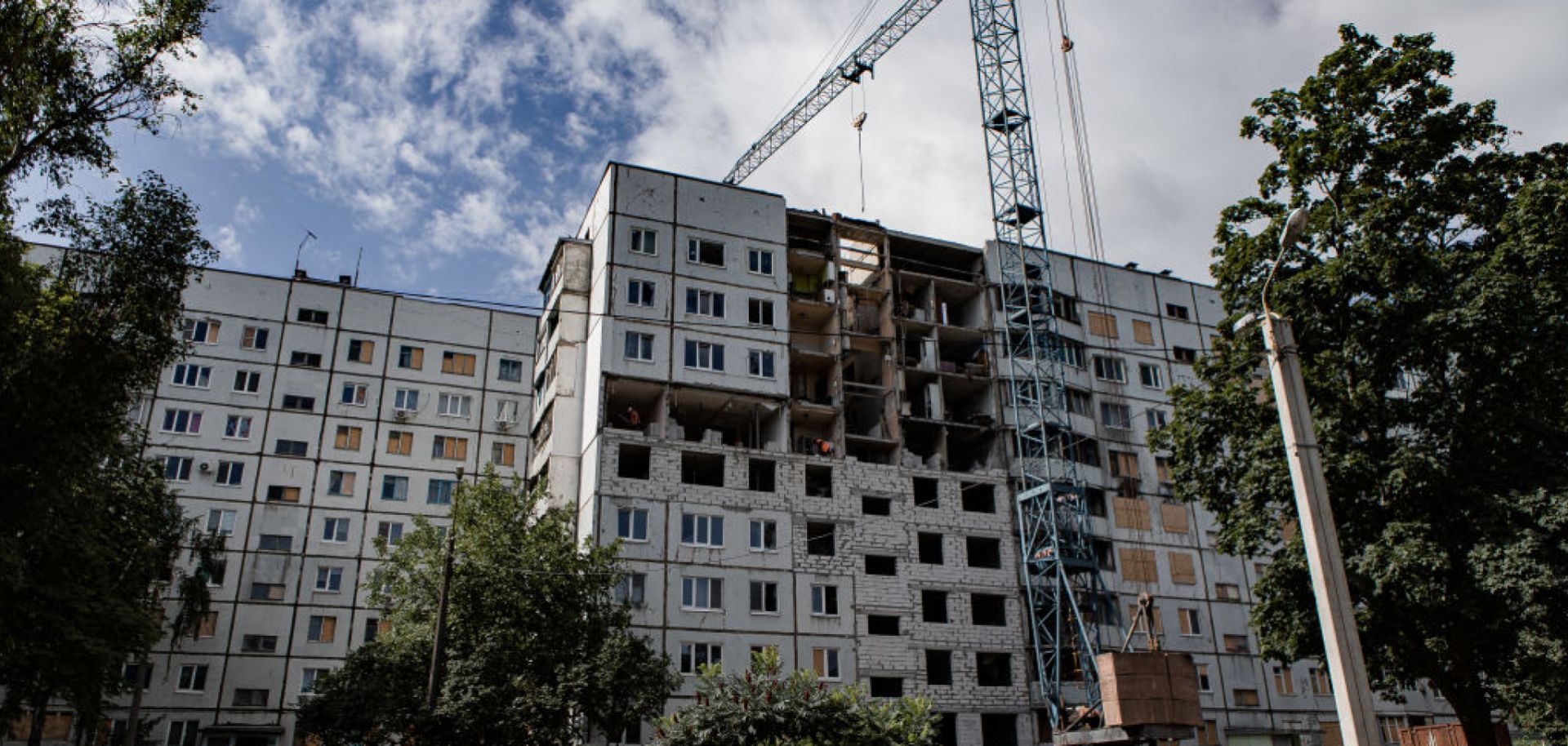
For the European Union, supporting Ukraine's post-conflict reconstruction will be financially manageable but politically divisive. Ukraine's long-term reconstruction needs currently exceed $500 billion, and this figure will continue to increase the longer the war lasts. EU governments will not provide the entire half trillion, as other official bilateral and multilateral supporters, as well as private-sector investment, will cover part of the requirements. Given Europe's substantial contribution, a large share of officially supported financing for rebuilding contracts will go to EU-based companies, though the Trump administration will seek to ensure U.S. companies secure a share of these benefits as well. Ukraine would also benefit from increased private-sector inflows, provided it can — supported by U.S. and European security guarantees — assure investors that political and geopolitical stability will prove long-lasting. However, even if the European Union were forced to provide the entire amount required for reconstruction as a grant, this would be doable financially, as it would only increase EU governments' liabilities by 3-4% of GDP, whether directly through increased borrowing or indirectly via the EU budget. Instead, the bigger challenge to continued European financial support may prove to be political, given strong opposition from both far-right and far-left parties in multiple countries to increasing public spending on Ukraine at a time of already significant and politically costly fiscal tightening. The growing likelihood that these parties will gain power (for example, in France) further complicates the issue.
- In February 2025, the World Bank estimated that Ukraine's reconstruction will require $524 billion over the next decade, a sum roughly three times the country's GDP. Rebuilding housing is projected to require the largest share of investment (33%), followed by transport (21%). Energy and extractives — specifically focusing on power generation, transmission and district heating systems — are expected to account for 12% of the needs, while commerce and industry are projected to comprise 10% to help restore productivity, particularly among small and medium enterprises.
Ukraine's long-term post-conflict economic outlook will strongly depend on lasting domestic and geopolitical stability in the face of challenging demographics, governance challenges and an uncertain trajectory toward EU integration. Western countries have a strong strategic interest in Ukraine's economic success, as a stable, aligned Ukraine serves as the first line of defense in Eastern Europe in conventional deterrence against Russia. However, successful reconstruction will be challenging due to significant economic constraints. For one, though Ukraine has a well-educated workforce, over 10 million people have left the country since 2022. Their return will depend in part on post-conflict stability, but highly educated workers who have fled (mainly to Europe) are far less likely to return due to the large wage gap between Ukraine and the European Union. Low private investment and structural weaknesses will also raise the burden on Ukraine's public finances. Ukraine has historically struggled to attract foreign direct investment due to poor economic governance and political instability, and post-conflict political uncertainty may deter private investment unless governments offer political risk insurance and incentives to companies. Continued economic reform could improve Ukraine's investment outlook, especially if the country also further integrates with the European Union — either through a phased EU accession process or by unilaterally adopting the bloc's laws and treaties. However, securing the level of official and private sector financing needed to rebuild damaged infrastructure will prove difficult if Ukraine's governance and corruption challenges persist. The overall reconstruction process will also remain deeply uncertain without a sustained end to hostilities and a long-term peace settlement backed by Western security guarantees that can shore up investor confidence.
- Ukraine's labor force has declined sharply, compounding the economic challenges related to demographic decline. In 1993, Ukraine's population stood at 52.2 million. By 2014, it had declined to 45.2 million due to a combination of high mortality and low fertility, as well as emigration. Since then, it has declined to 32.2 million.
- Other post-conflict experiences (e.g., former Yugoslavia) suggest that the longer a war lasts, the less likely refugees are to return.
- Ukraine's FDI-to-GDP ratio from 1995 to 2022 was less than 3% of GDP, compared to annual flows worth 4-8% of GDP in former Soviet republics like Georgia (8.1%), Kazakhstan (6.7%), Moldova (4.7%) and Armenia (4.65%).
