
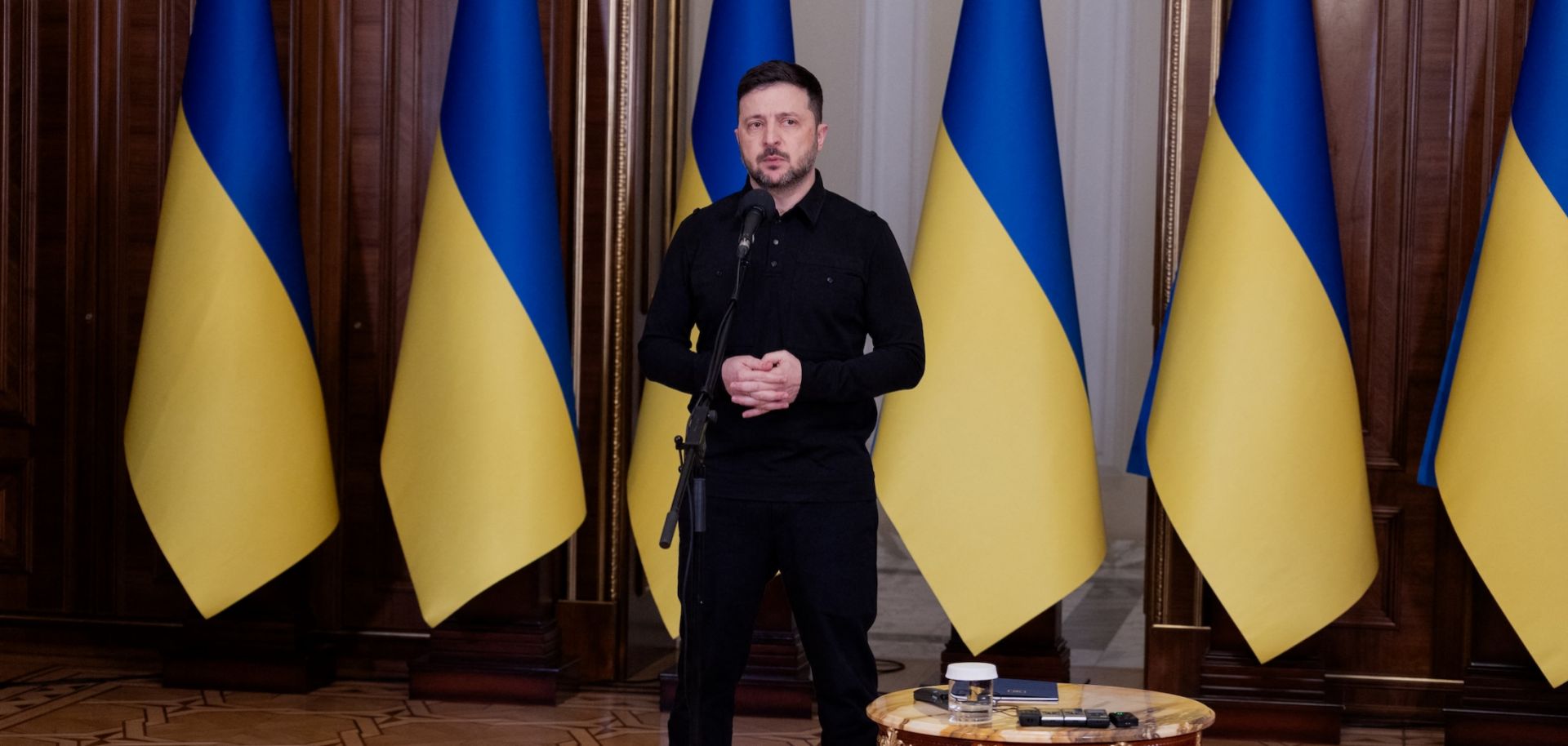
Ukrainian President Volodymyr Zelensky's government reshuffle will help strengthen his negotiating capacity and mitigate the political fallout from a likely unfavorable peace process, as Western support weakens and Russia seeks to translate battlefield gains into diplomatic leverage. On Jan. 14, Ukraine's parliament approved former defense minister Denys Shmyhal as first deputy prime minister and minister of energy, as the country rushes to stabilize its energy sector amid intensified Russian attacks. Lawmakers also confirmed former digital transformation minister Mykhailo Fedorov as deputy prime minister and minister of defense. These appointments were part of a wider government reshuffle, which also included President Zelensky's Jan. 2 decision to appoint the Main Directorate of Intelligence (HUR) chief, Kyrylo Budanov, as head of the Presidential Office, and to dismiss Security Service of Ukraine (SBU) head Vasyl Maliuk.
- Shmyhal served as Ukraine's prime minister from 2020 to 2025 and as minister of defense from July 2025 to January 2026.
- Fedorov, Zelensky's longtime loyalist, was appointed first deputy prime minister and minister of digital transformation in 2019, where he oversaw government digitalization initiatives and defense-related technology programs. In his new role as deputy prime minister and minister of defense, Fedorov has pledged to focus on digitization, institutional reform and scaling technology, particularly drones, to improve mobilization efforts and training.
- Lt. Gen. Budanov led Ukraine's HUR since 2020, where he oversaw intelligence operations and prisoner exchange contacts with Russia. Maj. Gen. Vasyl Maliuk has served as SBU head since 2022, overseeing counterintelligence, internal security and asymmetric operations during the war, including the famous Operation Spiderweb, which struck strategic bombers deep inside Russia.
Zelensky's government reshuffle occurred amid domestic governance challenges and intensified external pressure to negotiate a peace deal that would force Ukraine to cede territory. The first personnel change came on Nov. 19, with the firing of Zelensky's powerful chief of staff and lead negotiator, Andriy Yermak. At the time, Zelensky's administration was grappling with a major corruption scandal at Energoatom, a state-owned nuclear energy company, which weakened his domestic standing and threatened to damage Kyiv's credibility with Western partners. Zelensky was also facing mounting U.S. pressure to accept problematic territorial concessions in negotiations with Russia. Against this backdrop, Zelensky appointed the popular military leader Budanov to replace Yermak as his chief of staff. The appointment placed a senior security figure with strong military credentials, high public trust and established working channels to both Western partners and Russia at the center of wartime decision-making and ceasefire negotiations. The timing is critical as Ukraine prepares to enter the fifth year of the war, and as Kyiv and Washington advance what is currently the most significant and sustained diplomatic effort to end the conflict to date.
- In November 2025, Ukrainian anti-corruption agencies released information about ongoing investigations into alleged graft involving procurement and contracting practices at Energoatom, prompting the resignations of two ministers and the arrest of another. The scandal raised concerns among Western partners about governance and oversight in Ukraine's energy sector. In the following weeks, Russian missile and drone strikes over the winter severely degraded the country's remaining power generation and transmission capacity, forcing blackouts and widespread heating outages across multiple regions during sub-zero temperatures.
- In late 2025, Ukraine, the United States and European partners developed a 20-point draft peace framework that would establish a non-aggression pact and security guarantees for Ukraine, though key territorial issues remain unresolved, and Russia has not formally accepted it. The framework followed an earlier 28-point proposal put forward by U.S. and Russian officials, which envisaged extensive Ukrainian territorial and security concessions.
The trajectory of Western-backed peace negotiations will likely grow more precarious if the United States increases pressure on Ukraine and Europe struggles to compensate for a potential reduction in U.S. support. During a meeting in Paris on Jan. 6, Ukraine, its European allies and the United States outlined a series of security guarantees for Kyiv, including the prospective post-ceasefire deployment of the so-called "Coalition of the Willing" to deter renewed Russian aggression. Russia will almost certainly reject any framework that stipulates a robust Western military presence and credible security guarantees for Ukraine. However, Kyiv will likely seek to secure as much detail as possible on Western guarantees and the so-called "prosperity plan" without offering territorial concessions in the next round of talks, which may take place during the World Economic Forum in Davos on Jan. 22. The diplomatic momentum generated in Paris, however, is unlikely to hold. Trump appears to be pivoting again toward direct pressure on Kyiv to accept territorial compromises in exchange for guarantees, increasing the risk that negotiations shift from staged, security-first talks to ultimatum-style tradeoffs. Should Washington increase pressure on Kyiv, potentially by threatening to curtail the sale of air defense weapons, intelligence sharing or other support, Europe would likely attempt to compensate but would struggle to provide the scale, speed and credibility of support required to offset a U.S. pullback, let alone independently deliver enforceable security guarantees absent a U.S. military backstop. Growing transatlantic tensions — including over Trump's tariff threats and his bid to acquire the Danish territory of Greenland — could also further complicate matters by absorbing political capital and negotiating bandwidth among Ukraine's Western partners. In this context, the Trump administration might leverage support for Ukraine as a bargaining chip in parallel negotiations with the European Union. And European governments, already facing significant political, financial and industrial strain from sustaining Ukraine's war efforts largely on their own, would likely prioritize de-escalation with the United States, even as they seek to preserve aid for Kyiv.
- According to the Kiel Institute's Ukraine Support Tracker, new aid allocations to Ukraine in 2025 reached their lowest level since the war began in 2022. Europe only allocated about 4.2 billion euros in new military aid through October 2025, which is not enough to offset the halt in new U.S. support.
Russia will likely continue its battlefield advances, aiming to secure more territory before potentially accepting a ceasefire that it believes the West will struggle to enforce, thereby enabling Moscow to cement its gains and potentially secure sanctions relief. Despite grappling with economic contraction and a budget shortfall, Russia remains more equipped to endure a prolonged conflict than Ukraine. With time still on its side, the Kremlin thus likely assesses that it can still secure the remainder of the Donetsk region militarily, and will therefore have little incentive to agree to a ceasefire before attempting a renewed spring or summer offensive. At the same time, past Russian battlefield performance and Ukraine's layered defensive "fortress belt" around Sloviansk and Kramatorsk in the Donetsk region suggest that a rapid or decisive Russian breakthrough remains unlikely, particularly in the absence of a major collapse in Ukrainian defenses. That said, incremental Russian gains will still carry important strategic consequences. Should Russian forces succeed in grinding through Ukrainian defenses (a distinct possibility, given Ukraine's manpower and equipment shortages) to capture the rest of Donbas and make further advances in Zaporizhzhia, they would almost certainly entrench within seized urban centers, raising the cost and lowering the feasibility of any future Ukrainian counteroffensive. Under these conditions, Moscow could assess that it has entered a rare window of strategic opportunity to exploit Washington's emphasis on deal-making. As a result, the Kremlin may calculate that accepting a ceasefire following territorial gains, possibly even ahead of the U.S. midterm elections, would carry limited downside since Trump's security commitments for Ukraine, although rhetorically robust, are likely to prove conditional, reversible or operationally hollow. Meanwhile, the Kremlin would likely judge that European guarantees, which would in many countries require parliamentary approval, will likely lack the political will, cohesion and military capacity required for rapid post-ceasefire deployment. Agreeing to a deal in this context would thus shift enforcement risk onto the West while securing Russia's territorial gains and opening the door to the eventual lifting of some sanctions on Moscow. In this scenario, a ceasefire would also open space for a Ukrainian referendum on both the peace proposal and presidential elections, which Moscow would certainly exploit via hybrid warfare and influence campaigns.
- According to the Institute for the Study of War, Russian forces seized approximately 4,831 square kilometers of Ukrainian territory in 2025, compared with 3,604 square kilometers captured in 2024. These gains represent about 0.8% of Ukraine's total territory, with the average daily rate of Russian advances also increasing throughout 2025. However, this progress came at a high cost: Ukraine's General Staff data indicates that Russian forces suffered roughly 416,570 casualties in connection with these advances in 2025, averaging 78 casualties for every square kilometer seized.
- Ukraine entered 2026 with a severe manpower shortage amid ongoing structural difficulties in mobilization, training and retention, constraining the military's force regeneration against a sustained Russian offensive. On Jan. 14, Defense Minister Fedorov reported that roughly 2 million Ukrainians are evading conscription and about 200,000 troops are absent without leave (AWOL).
The reshuffle better positions Zelensky to manage the political risks of negotiations while preserving multiple pathways to legitimize a potentially unpopular deal. By elevating Budanov into the presidential inner circle, Zelensky will neutralize a credible potential contender in the case of a presidential election. The move also binds Budanov to the negotiation process, ensuring that responsibility and blame for any difficult trade-offs will be shared and not borne by Zelensky alone. This could reduce the political cost of compromise and strengthen Zelensky's ability to argue that decisions on war and peace reflect a collective leadership judgment. If negotiations produce terms that prove politically risky and toxic for Ukraine (a likely outcome given current dynamics), Zelensky will likely seek to hold a referendum on the proposed peace deal, potentially combining it with presidential elections, to broaden the base of legitimacy and dilute individual accountability. A combined "referendum-election" arrangement would likely favor Zelensky as the incumbent, as voters facing high-stakes security choices tend to prioritize continuity and risk avoidance. At the same time, holding a referendum and a presidential election simultaneously could itself threaten to derail the peace agreement, as voters could reject the deal outright or rally behind a candidate campaigning on a pledge to continue fighting, effectively collapsing the negotiated settlement. In an alternative scenario, if negotiations fail and fighting continues, Ukraine will likely find itself in a weaker position, as battlefield attrition and Western fatigue erode Kyiv's leverage. In this scenario, even the prospect of security guarantees for Ukraine, however imperfect, would likely dissipate. Regardless, Ukraine still faces profound structural challenges, including demobilization, adverse demographic trends and the challenge of funding postwar reconstruction. And if EU membership does not materialize, Kyiv may ultimately be forced to adopt neutrality to deter renewed Kremlin aggression and stabilize its long-term security environment.
- A recent poll, conducted by the Kyiv International Institute of Sociology and published on Jan. 16, found that about 55% of Ukrainians support holding a referendum on a potential peace agreement, while roughly 32% oppose such a referendum. However, polls continue to show that a majority of Ukrainians oppose territorial concessions to Russia, including formal recognition of occupied territories as part of Russia.
- The terms of Ukraine's parliament and presidency expired in 2023 and 2024, respectively, but elections have been repeatedly delayed due to the ongoing war. Zelensky has stated that he is prepared to hold elections if international partners can ensure adequate security. He has also instructed parliament to draft proposals allowing for changes to election rules under martial law.
- Recent opinion polling suggests that if a presidential election were held today, Zelensky would narrowly lead in the first round but likely lose in a runoff to former Armed Forces Commander-in-Chief Valerie Zaluzhnyi. An alternative projection suggests that Budanov could also outperform Zelensky.
