
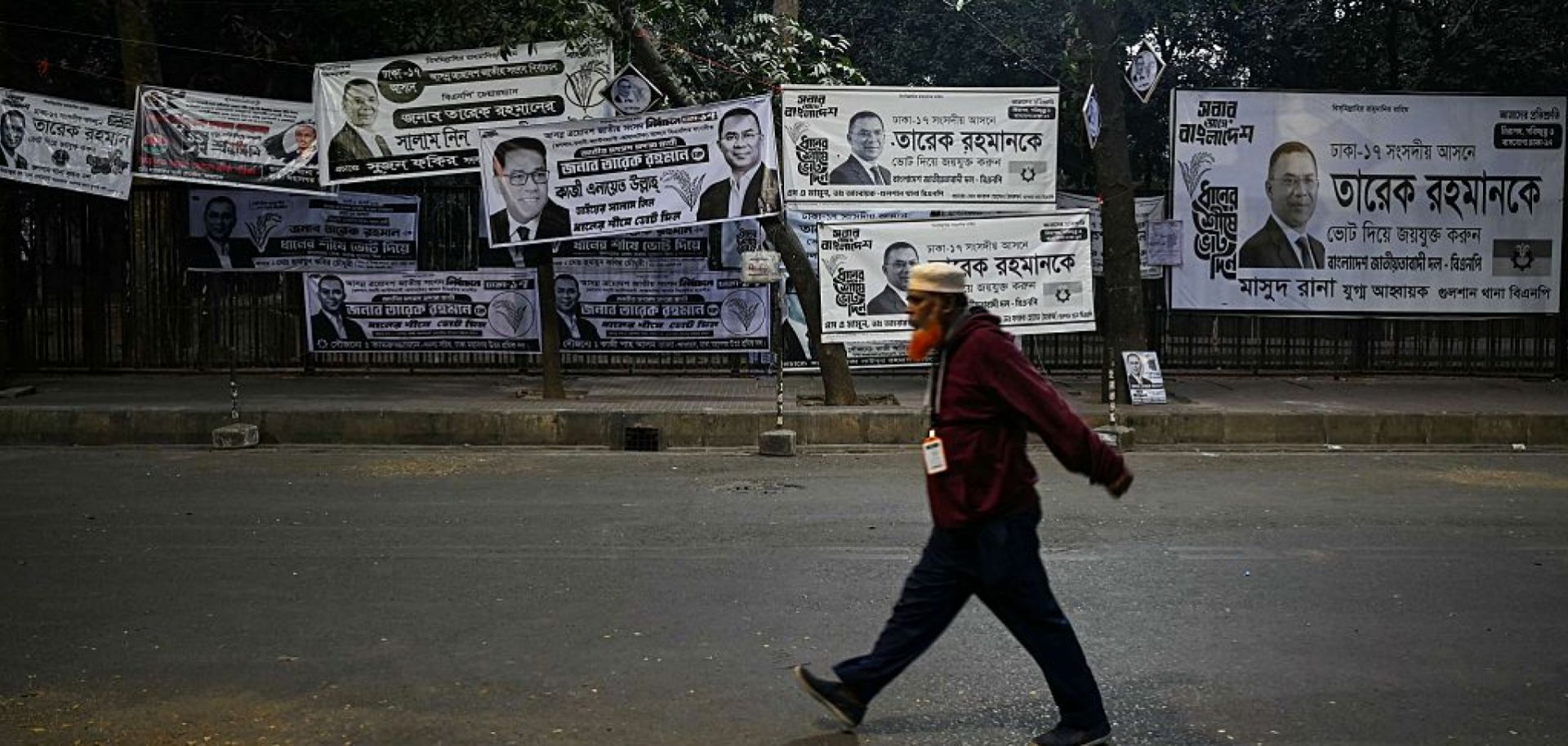
The Bangladesh Nationalist Party's election victory will strengthen political stability, while its legislative supermajority will enable the party to advance constitutional and economic reforms and pursue a foreign policy that balances ties with India and China; however, social and fiscal pressures will constrain its efforts to reform the country in the wake of the 2024 revolution. On Feb. 13, the center-right Bangladesh Nationalist Party (BNP) announced that it won Bangladesh's Feb. 12 parliamentary elections, positioning its leader, Tarique Rahman, the son of the late former Prime Minister Khaleda Zia, to assume the premiership. As of Feb. 13, the Election Commission had not yet published the official results, but several local media outlets report that the party surpassed the 151-seat threshold needed for a simple majority in the 350-member parliament, winning an estimated 209 general seats that, when combined with seats allocated after results are confirmed, give the BNP a two-thirds supermajority. The other main contender was an Islamist party, Jamaat-e-Islami, which participated as part of an 11-party alliance that cumulatively only won an estimated 74 seats. Once the Election Commission publishes the official gazette, newly elected members of parliament are required to take their oaths within three days, formally transferring power from an interim government that has led the country for the past year and a half and enabling the formation of the new government. Alongside the parliamentary vote, Bangladeshis also approved a referendum on the interim government's proposed constitutional reforms. While this carries significant political weight and will pressure lawmakers to enact the reforms, the outcome is legally non-binding and still requires parliamentary approval to take effect.
- Bangladesh's unicameral legislature has 350 seats, with 300 seats elected via first-past-the-post voting and 50 seats reserved for women, allocated proportionally after the election. This means a two-thirds majority requires at least 234 seats, and once the BNP is allocated its share of the 50 reserved women's seats, its total meets this threshold. The election occurred in 299 of 300 constituencies; voting in the remaining constituency was postponed following a candidate's death, with no new date set.
- In the referendum, voters were asked whether to implement the interim government's political charter, which provides a roadmap for constitutional reforms. Unveiled in July 2025, the reforms aim to strengthen governance, accountability and democratic oversight, while preventing a return to concentrated executive power. Key proposals include creating a bicameral legislature, imposing a 10-year term limit for prime ministers and establishing an independent body for judicial appointments to reduce political influence.
The election was the first held since mass unrest ousted then-Prime Minister Sheikh Hasina in 2024, and the outcome marks a major political comeback for the BNP. In the summer of 2024, protests initially erupted over a job quota system that reserved government positions for descendants of Bangladesh's 1971 freedom fighters, who were seen as a political elite. But the demonstrations quickly morphed into a mass anti-government movement, prompting then-Prime Minister Hasina to order a large-scale crackdown that left nearly 1,400 dead and over 20,000 injured. This escalation ultimately forced Hasina to flee to India, paving the way for an interim government, headed by Nobel laureate Muhammad Yunus, to manage the transition and organize new elections. Dissolved parliamentary roles and senior officials tied to Hasina's Awami League party were subsequently replaced with technocrats and civil society figures. The interim administration also drafted a political charter outlining reforms to bolster transparency and democratize institutions, and sought to secure broad party support for it. During this period, the BNP, which had long been repressed during Hasina's time in power, took advantage of popular frustration with Awami League rule and freer space for political activism to mobilize its supporters, positioning itself as the top contender to lead the new government, especially since the interim administration had outlawed the once-dominant Awami League. On the campaign trail, BNP leader Tarique Rahman, long dogged by corruption allegations, presented his party as a pragmatic, centrist force. He sought to project an image of stability to both domestic stakeholders and foreign partners, contrasting the BNP with opponents' perceived hard-line positions.
- The last election took place in January 2024, returning Hasina to office for a fifth term. The main opposition at the time, the BNP, boycotted the vote amid a crackdown on its officials and alleged mass vote-rigging, while international observers and rights groups widely condemned the election as neither free nor fair.
- The BNP was founded in 1978 by Rahman's father, Ziaur Rahman, who rose from the military to serve as president until his assassination in 1981. His mother, Khaleda Zia, later served two terms as prime minister beginning in 1991. The BNP's rivalry with the Awami League and Hasina has defined much of the country's political dynamics.
The BNP's supermajority will enable it to pass constitutional and economic reforms and implement IMF-backed austerity measures, but social and fiscal pressures will still pose constraints, particularly as Bangladesh faces the possibility of losing some duty-free export access and concessional financing. The transition from an unelected interim administration to an elected government will likely restore political stability in Bangladesh, with the BNP's supermajority likely facilitating the passage of promised constitutional amendments. However, even with firm control of the legislature, the BNP will still face bureaucratic resistance, legal and procedural hurdles, and fiscal constraints. The party could also choose to prioritize other pressing issues, such as economic challenges, over full implementation of the charter. But a failure to fully execute the reforms could generate public frustration, spur civil society protests, and draw criticism from opposition groups that view the measures as selective or inadequate. Meanwhile, the BNP's approach to the banned Awami League and other opposition parties will be an indicator of whether it strengthens democratic governance or drifts toward authoritarian practices, like those seen under Hasina. If the BNP suppresses the Awami League or undermines checks and balances, it could erode democratic accountability, heighten political polarization and trigger domestic unrest. Additionally, the BNP is set to inherit economic challenges that will limit its fiscal space, including a fiscal deficit near 5% of GDP, inflation around 10%, GDP growth slowing to 3.8% and public debt at roughly 38.5% of GDP. These substantial hurdles, and the need to restore investor confidence, will likely compel the BNP to adhere to Bangladesh's current IMF program, which mandates austerity measures like subsidy cuts, spending constraints and tighter monetary policy. Even if the BNP enjoys a brief honeymoon period following the election, implementing such unpopular economic measures, especially if paired with slow or incomplete constitutional reform, could reignite protests. The BNP also aims to lobby the United Nations to delay Bangladesh's 2026 graduation from Least Developed Country (LDC) status to retain preferential trade benefits, concessional financing and policy flexibility supporting industrial growth and social programs. A deferment would protect duty-free exports, favorable loans and technical assistance, but failure to secure a delay could tighten fiscal space, raise borrowing costs, and slow growth, especially in key sectors like ready-made garments and agriculture.
- To reduce Bangladesh's economic reliance on the ready-made garments sector, the incoming BNP government plans to expand agriculture, logistics, information and communication technology (ICT) services and renewable energy manufacturing. While full diversification remains constrained by fiscal and infrastructure limits, incremental gains in these sectors could support broader economic resilience and competitiveness.
- The BNP will likely work to implement a "Family Card" program designed to provide targeted social security support, including direct financial assistance, women's empowerment initiatives and a phased rollout to rural and low-income populations. This initiative could help reduce poverty, improve household resilience and expand access to essential services for vulnerable communities. However, constraints such as limited fiscal resources, administrative capacity and potential delays in distribution could slow implementation and reduce the program's short-term impact.
- The LDC status, designated by the United Nations Committee for Development Policy, provides Bangladesh with preferential treatment from key international partners, including the European Union and the United States, helping make Bangladeshi exports more competitive. However, Bangladesh no longer meets all the criteria for LDC status due to sustained improvements in income levels, human assets and economic resilience, and is therefore set to graduate from this classification in 2026.
On foreign policy, the BNP will cautiously work to ease tensions with India to maintain vital trade, transit and security links, as it simultaneously seeks to strengthen ties with China and maintain pragmatic relations with Pakistan. The BNP will likely pursue what it describes as a "Bangladesh First" foreign policy, emphasizing pragmatic, balanced engagement with major powers while moving away from the Awami League's India-centric approach. In practice, this will mean cautiously improving relations with India, which borders Bangladesh on three sides and is crucial for trade, transit and security. Specifically, the BNP may reinstate the transshipment facility for Bangladeshi exports suspended in 2025 and/or entry visas for Indian citizens that were ended in 2025, while simultaneously managing political sensitivities, such as the two countries' ongoing water dispute. However, tensions over New Delhi's hosting of Hasina (whose return the BNP will likely push for) will probably limit full normalization of ties until the issue is resolved. At the same time, the BNP will likely strengthen ties with China, focusing on economic and infrastructure cooperation in energy, transport and technology. Beijing is an attractive partner due to its substantial investment incentives and relative detachment from Bangladesh's domestic controversies — unlike India, which has criticized Bangladesh over the treatment of its Hindu minority population, particularly since the 2024 revolution. The BNP may also modestly enhance relations with Pakistan, as it seeks to broaden Bangladesh's regional partnerships. This could involve new trade and investment deals, as well as limited security dialogue. However, deeper military and strategic cooperation with Islamabad will likely remain limited by domestic sensitivities stemming from the 1971 Bangladeshi war of independence from Pakistan, keeping defense ties largely confined to pragmatic, low-profile engagement.
- China has been Bangladesh's largest trading partner for over a decade; annual bilateral trade is around $18 billion, with Chinese imports comprising nearly 95% of that total. However, India also remains a crucial economic partner. Despite the two countries' recent political tensions, bilateral trade has remained steady at approximately $13.5 billion, with Indian companies supporting Bangladesh's electricity infrastructure and supplying key goods, including cotton yarn, rice and other agricultural products.
- Tensions between India and Bangladesh, especially under the interim government, stem from both political and historical grievances. Bangladesh has accused India of allegedly intervening in past elections to favor Hasina's Awami League, fueling lingering distrust. Rising attacks and communal violence against Hindu communities in Bangladesh have also drawn criticism from Indian leaders and human rights groups.
