
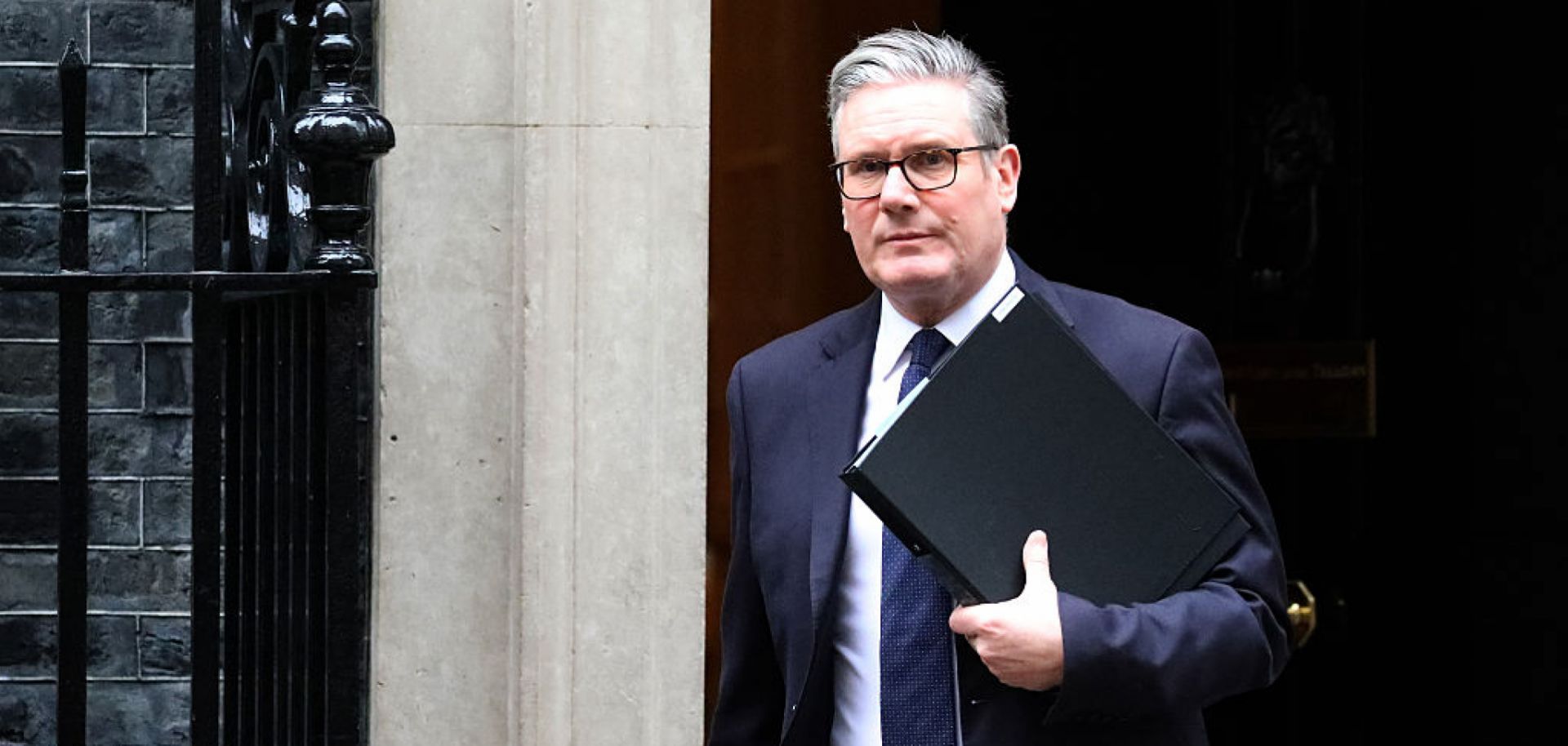
A deepening internal crisis within Labour is weakening Prime Minister Keir Starmer's authority and raising the likelihood of a leadership challenge, but structural constraints and broad party consensus make sharp policy shifts or a break with the United Kingdom's current fiscal trajectory unlikely, limiting the risk to only limited, short-term market volatility. Starmer's leadership came under acute pressure after renewed controversy over his appointment of Peter Mandelson as ambassador to the United States triggered senior resignations in Downing Street and open calls for him to step aside. Chief of staff Morgan McSweeney resigned on Feb. 8, taking responsibility for advising Starmer on the appointment despite Mandelson's past association with convicted sex offender Jeffrey Epstein. Tim Allan, Starmer's director of communications, followed suit shortly thereafter. Officials cited by British media said cabinet ministers were also preparing to privately urge Starmer to resign or threaten their own departures. On Feb. 9, Scottish Labour leader Anas Sarwar publicly called for Starmer's resignation, becoming the most senior Labour figure to do so. At least for now, however, Starmer maintains the public support of senior government members, including those U.K. media have identified as potential contenders for Labour Party leadership, such as Former Deputy Prime Minister Angela Rayner, Health Secretary Wes Streeting, Home Secretary Shabana Mahmood and Energy Secretary Ed Miliband.
- The crisis follows renewed criticism from Labour lawmakers and senior party figures over Mandelson's appointment. Tensions peaked on Feb. 4 when the government narrowly avoided defeat in the House of Commons by agreeing to submit documents related to the controversial appointment to the parliament's Intelligence and Security Committee, following a parliamentary motion demanding their release. Mandelson resigned as ambassador in September after further details emerged about his continued contact with Epstein post-conviction, and is now under police investigation for alleged misconduct in public office. Starmer has admitted that he knew of Mandelson's friendship with Epstein before he appointed him ambassador, but only from publicly available information at the time.
The Mandelson scandal adds to months of mounting internal pressure on Starmer stemming from weak polling and growing criticism within Labour over his authority, policy direction and electoral appeal, significantly increasing the risk that he either resigns or faces a formal leadership challenge in the coming weeks or months. Starmer had hoped to deflect blame over Mandelson's appointment by forcing out McSweeney. He may still attempt to shore up his position through a cabinet reshuffle or symbolic concessions to the party's left, including by elevating figures like Rayner. However, these damage-control measures are unlikely to halt the erosion of confidence within his party, particularly as potential challengers may be reluctant to tie themselves to a weakened leader in subordinate roles. The crisis is unfolding as Labour is losing support to Reform UK on the right and to the Greens and Liberal Democrats on the left. Upcoming electoral tests could thus act as catalysts for a leadership change. A Feb. 26 by-election in Gorton and Denton, traditionally a Labour stronghold, now sees the Greens and Reform UK seriously competing for the seat, while a broader round of local elections in May is widely expected to deliver significant losses for Labour. Labour's internal party rules allow a leadership challenge if just 20% of its members of parliament (or 81 of 405) back an alternative candidate. This threshold appears increasingly attainable as more party members question whether replacing Starmer could improve Labour's prospects ahead of the May local elections and the 2029 general election. Even if Starmer survives the immediate fallout from the Mandelson affair, his party's expected electoral setbacks will deepen internal Labour divisions and intensify calls for a new leader — if not ahead of the May elections then shortly afterwards, following what will likely be a painful Labour defeat.
- Once the 20% nomination threshold is met, a leadership contest is formally triggered and administered by Labour's National Executive Committee (NEC), with lawmakers, affiliated trade unions and party members voting under a one-member-one-vote, preferential system. After nominations close, the NEC sets the timetable, with membership ballots in past contests typically remaining open for several weeks before results are announced. Unlike the Conservative Party, the Labour Party's rules impose no moratorium on repeat challenges, meaning that even if Starmer survives a leadership challenge, he will remain exposed to renewed contests.
- Reform UK was polling at 27% nationally in a Feb. 9 YouGov survey, while Labour and the Conservatives were tied at 18%, just four points ahead of the Liberal Democrats and the Greens at 14%.
- Scottish Labour leader Anas Sarwar's public call for Starmer's resignation may indicate growing anxiety ahead of the May local elections, with British media reporting that senior figures within Scottish Labour increasingly believe their prospects would improve if Starmer stepped aside.
While markets are unsettled by renewed political instability and the prospect of a leadership change, any successor to Starmer would likely preserve broad policy continuity and budget discipline amid significant fiscal constraints. Market reaction has so far been limited but noticeable, with small moves in gilts and sterling in recent days reflecting investor sensitivity to renewed leadership uncertainty following years of political volatility in the United Kingdom. The key question for investors revolves around who might replace Starmer and how much they would prioritize fiscal restraint over other economic policies and political priorities. Figures from Labour's centrist or center-right factions (e.g., Streeting, Mahmood, Cooper and Healey) would likely emphasize fiscal discipline, debt control and policy predictability, broadly preserving Starmer's supply-side approach and constrained social reforms. They would also seek to support economic growth within existing fiscal limits, maintain current defense spending trajectories and pursue cautious, pragmatic re-engagement with the European Union. Alternatively, a more left-leaning leader (e.g., Rayner or Miliband) would focus more on social spending, green investment and wealth redistribution policies more strongly aligned with Labour's traditional socioeconomic agenda. However, they would still keep overall spending increases relatively contained through offsets, such as slowing the growth of defense expenditure or implementing targeted wealth or windfall taxes, under the constraints imposed by bond-market discipline and internal party consensus. Across either camp, broad policy continuity would prevail on defense, NATO alignment and EU relations. The main differences would center on the degree of fiscal restraint and ways to achieve it, rather than its underlying principle. A more ambitious EU rapprochement would also be more likely under a left-leaning leader, as they would be less constrained by concerns over perceptions of reversing Brexit. Overall, sharp policy reversals remain unlikely under any new leadership. Though short-term volatility may persist as the contest unfolds, the risk of sustained market pressure is limited given strong cross-party aversion to fiscal instability and the absence of credible alternatives advocating radical departures from the current macro framework.
- Despite the leadership turmoil, Labour's large parliamentary majority and weak nationwide polling make a snap general election highly improbable, given the party would be unlikely to retain power, let alone with such a commanding majority, if a new vote were held.
- The Labour government operates under tight fiscal constraints shaped by weak growth and heightened market sensitivity. GDP growth has largely stagnated since 2022, while public debt rose to nearly 96% of GDP by December 2025, up from 94.6% a year earlier, after several years of elevated public spending. Debt levels are projected to continue climbing toward around 97% by 2029 under current trajectories. The 2021-23 inflation shock, compounded by the fallout from then-Prime Minister Liz Truss's 2022 "mini-Budget," drove gilt yields sharply higher and pushed annual debt-interest costs to about 106 billion euros ($126 billion), roughly 3.6% of GDP. With borrowing costs elevated, defense demands increasing and markets highly alert to fiscal slippage, Chancellor Rachel Reeves has committed to strict self-imposed fiscal rules, funding day-to-day spending from revenues and putting debt on a declining path within five years to avoid renewed market instability. This has significantly constrained the government's room for maneuver on fiscal policies, with spending increases largely offset by successive tax rises.
- On Feb. 9, 10-year government bond yields rose by up to four basis points to about 4.55%, while sterling recorded only marginal losses against both the U.S. dollar and the euro. The limited sell-off in U.K. government bonds and the pound following renewed tensions within Labour suggests that while investors are nervous about political uncertainty, they remain broadly confident that any new prime minister would largely maintain a commitment to fiscal discipline.
