
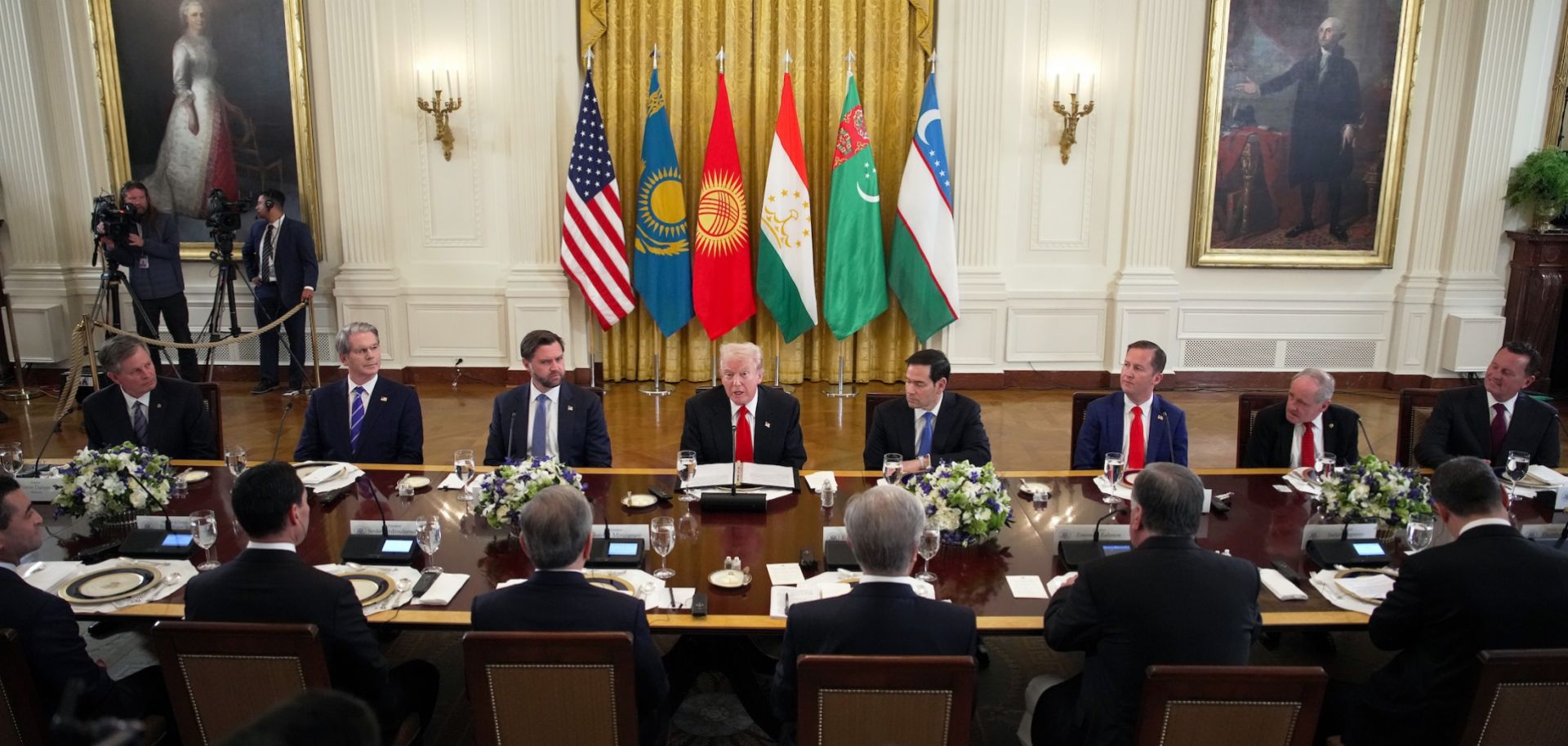
The White House's recent summit with Central Asian leaders signals a renewed U.S. effort to compete with Russia and China through trade and critical minerals, but Central Asia's geography, governance and structural dependence on Beijing and Moscow will ultimately limit the impact of heightened U.S. engagement in the region. On Nov. 6, U.S. President Donald Trump hosted the leaders of Kazakhstan, Kyrgyzstan, Tajikistan, Turkmenistan and Uzbekistan at the White House for a C5+1 summit — the format launched by the Obama Administration in 2015 after Russia's annexation of Crimea the prior year. This was only the second leaders-level C5+1 meeting, and the first ever held at the White House, reflecting Washington's renewed attention on Central Asia since Russia's 2022 full-scale invasion of Ukraine. The summit occurred just after the C5+1 Business Forum, where U.S. Secretary of Commerce Howard Lutnick unveiled a record package of trade and investment agreements across energy, infrastructure and technology, framing the adopted Joint Statement of Intent on Economic Cooperation as a blueprint for deeper commercial ties between the United States and Central Asia. Those multi-billion-dollar contracts included Uzbekistan's pledge to invest over $100 billion in the United States over the next decade, Kazakhstan's signing of commercial agreements worth more than $17 billion, and purchases by regional airlines for dozens of Boeing jets. In addition, the United States and Kazakhstan signed a memorandum of understanding on cooperation in critical minerals. In a diplomatic goodwill gesture toward Washington, Astana also announced it would join the Abraham Accords, despite already having diplomatic relations with Israel.
- Opening the C5+1 summit, President Trump called Central Asia "an extremely wealthy region" and stated that its "location in the heart of Eurasia gives [it] incredible importance and unbelievable potential."
- The five countries in Central Asia collectively account for nearly half of global uranium output, with Kazakhstan producing about 40% alone. The region also contains large deposits of tungsten, antimony, rare earth elements, copper, lithium and gold, along with substantial oil and gas reserves in Kazakhstan and Turkmenistan.
- A U.S. private company, Cove Capital LLC, struck a deal for a 70% stake in Kazakhstan's largest undeveloped tungsten deposits, a metal for which China is a key source and is important for weapons manufacturing, Meanwhile, Uzbekistan announced it would invest over $100 billion in key U.S. sectors over the next decade, a substantial sum for a country whose 2024 GDP was just under $115 billion. U.S. aircraft maker Boeing secured deals for the cumulative sale of up to 40 jets to airlines in Kazakhstan, Uzbekistan and Tajikistan.
The timing and tone of the summit reflected both opportunity and necessity as the United States seeks to diversify supply chains and reassert influence, while Central Asian governments look for ways to balance against Russia and China. The summit took place as the United States seeks to reduce reliance on China for rare earths and other critical minerals, and as Central Asian states, whose mineral wealth underpins their growing strategic importance, look to diversify their economic and security ties. This shared set of interests and President Trump's transactional foreign policy provided fertile ground for a wave of high-value economic deals and an opportunity to advance U.S. strategic interests, namely expanding the United States' economic influence and reasserting its presence in a region long dominated by Russia and China. U.S. Special Envoy for South and Central Asia Sergio Gor, an Uzbek-born political operative and former Director of the White House Presidential Personnel Office, played a key role in organizing the meeting, highlighting how his access in Washington created new openings for Central Asian leaders and shaped the Trump administration's approach to regional diplomacy. For the Central Asian states, the summit came amid deepening uncertainty over the outcome of the war in Ukraine, which has disrupted trade and transport routes and exposed their dependence on Russia for energy, remittances and security. However, the conflict has also created opportunities for Central Asian countries to profit from sanctions-busting and redirected financial flows, fueling their short-term GDP growth. Growing anti-immigrant sentiment in Russia has unsettled Kyrgyzstan, Tajikistan and Uzbekistan, while persistent Kremlin-linked claims questioning Kazakhstan's sovereignty have reinforced Astana's desire to balance more visibly toward the West. At the same time, China's expanding economic role, through its Belt and Road infrastructure, financing and control of regional mineral offtake, has created a new form of dependence that Central Asian governments are eager to hedge. Against this backdrop, engagement with the United States offered an opportunity to attract investment, diversify partnerships and gain political recognition without the human rights, governance and other conditionalities attached to financing in previous U.S. administrations. Reflecting Washington's effort to turn symbolic engagement into sustained strategy, U.S. Secretary of State Marco Rubio has pledged to visit all five Central Asian capitals in 2026 to carry the summit's momentum forward.
- Central Asia's dependence on Russia remains deep across trade, energy and labor. Kazakhstan exports about 80% of its crude through Russian territory and its electricity grid remains physically synchronized with Russia's. Uzbekistan has deepened its reliance on gas imports from Russia's Gazprom to meet domestic demand, with import volumes from Russia surging by 340% in 2024; Kyrgyzstan also depends on Russian gas and fuel supplies. In 2024, remittances from Russia made up about 30% of Tajikistan's GDP, 20% of Kyrgyzstan's GDP and 15% of Uzbekistan's GDP, underscoring Moscow's leverage through labor migration and finance.
- Central Asian countries' economic dependence on China has also grown in the past decade through trade, infrastructure projects and investment, and control of mineral offtake. China now accounts for roughly one-quarter of Central Asia's total trade, with country shares ranging from around 20-25% in Kazakhstan, Uzbekistan and Tajikistan to 35% in Kyrgyzstan and 65% in Turkmenistan. Beijing has financed infrastructure and industrial projects across the region under its Belt and Road initiative and has invested in at least 25 critical minerals ventures, importing an estimated 70% of Central Asia's critical mineral exports in 2024.
The C5+1 summit will modestly expand U.S. commercial and diplomatic reach in Central Asia over the next few years, but the region's myriad internal challenges and structural dependence on Russia and China will continue to constrain both Washington's influence and the region's strategic autonomy. In the near term, the United States will likely follow up with targeted financing for mineral exploration, midstream processing and transport infrastructure, alongside new business missions and Rubio's planned 2026 regional tour. Yet translating high-profile commercial pledges into durable business partnerships will prove difficult. U.S. firms face logistical and financial barriers in a region where Russia-controlled pipelines, Chinese-dominated rail corridors and state-heavy economies define trade routes and investment terms. This means that while Central Asian leaders will welcome U.S. engagement as a counterbalance, they will also avoid steps that would risk retaliation from Moscow or Beijing. Moreover, many of the newly announced mining projects will take years to reach production, and their success will depend on sustained foreign financing, reliable power supply, and functional transport routes — all areas that will likely progress slowly, given chronic underinvestment, endemic corruption and weak governance. Geography and water scarcity will further limit expansion: the shrinking Caspian Sea and receding glacier-fed rivers, fragmented customs systems and aging infrastructure will continue to raise transit costs and limit export capacity. Mining and processing are highly energy-intensive, and chronic electricity shortages, particularly in southern Central Asia, where hydropower dominates, will worsen as river flows decline. At the same time, climate-driven water loss in the Caspian will reduce port capacity and expose new shoreline, forcing costly redevelopment of docks and transport infrastructure. Compounding these constraints is the region's deepening autocracy. The lack of clear mechanisms for leadership succession, along with the suppression of democratic institutions, media and civil society, will expose regional countries to a future economic crisis or external shock that could easily ignite unrest and threaten regime stability. Finally, when the fighting in Ukraine eventually ends or subsides, Russia will likely move to reassert control over Central Asia's transport, energy and security architecture.
- Recent history suggests that political transitions and reform cycles in Central Asia frequently trigger unrest and power struggles. Since gaining independence, Kyrgyzstan has experienced three revolutions (in 2005, 2010 and 2020) and faces parliamentary elections later this month that could again test public patience with corruption and declining living standards amid a state-led crackdown on the media and civil society. In Kazakhstan, the government is pushing for another constitutional reform less than three years after the January 2022 unrest, the country's most violent episode since independence. In Tajikistan, a seemingly orderly succession from President Emomali Rahmon to his son Rustam Emomali — which is expected to coincide with the next presidential election in 2027 — is likely to mask significant tension beneath the surface. The consolidation of family rule amid Tajikistan's weak institutions, growing socioeconomic inequality and the exclusion of alternative elites could produce factional rivalries and localized instability once the transfer of power begins.
- In March 2025, Uzbekistan, Kyrgyzstan and Tajikistan signed a landmark agreement resolving all remaining border disputes, ending decades of tension and intermittent clashes in the Ferghana Valley, a key region rich in resources and history, and where the borders of these countries converge. The accord delineated contested enclaves, opened new crossings, and established mechanisms for joint management of water and infrastructure. For the first time since gaining independence from the Soviet Union, the three countries achieved such a settlement entirely through their own diplomacy, without external (namely, Russian) mediation, marking a rare moment of genuine regional consensus and self-determination.
- In a comparatively less likely scenario, if Russia continues to face prolonged economic challenges after the war in Ukraine winds down — even as China deepens its regional economic reach — there would then be a larger opportunity for the United States or other Western states to balance against Chinese influence in Central Asia. This is because regional states would be more keen to reduce dependence on China and promote Central Asia's value as an alternative transit corridor and source of critical minerals.
The strategic consequences of the summit will depend on whether Washington and Central Asian governments pursue a genuine long-term partnership or remain confined to transactional deal-making. If Washington maintains a purely transactional approach, the region will see short-lived economic wins but little structural diversification. Such a deal-driven policy will likely fuel intra-regional competition, particularly between economically dominant Kazakhstan and the dynamic and most populous Uzbekistan, as both vie for U.S. attention and investment rather than coordinating strategies. The rivalry will weaken Central Asia's collective leverage and slow the emergence of a coherent regional economic bloc. However, there are opportunities for the United States and its Central Asian partners to help shape two complementary corridors, which could redefine the region's connectivity. On the one hand, the westward route through the South Caucasus — supported by Armenia-Azerbaijan normalization, Georgia's growing transit role, Ukraine's eventual postwar reintegration into the East-West trade networks and supply chains (provided the Port of Odessa remains open), and the long-envisioned Trans-Caspian Gas Pipeline project linking Turkmen gas to European markets — will gradually provide an alternative to Russian and Chinese infrastructure. On the other hand, a southward route through Afghanistan and Pakistan could reopen prospects for Central Asia's access to the Indian Ocean, with Afghanistan being both a security risk and a vital transit corridor. Recognizing this dual reality, Central Asian governments will continue to advance and invest in projects crossing Afghan territory, most notably the Trans-Afghan Railway, the CASA-1000 power line and the Turkmenistan-Afghanistan-Pakistan-India (TAPI) gas pipeline — all currently progressing slowly but visibly notwithstanding ongoing challenges. Despite persistent tensions between Islamabad and Kabul, these infrastructure projects are likely to remain on course, driven by mutual economic incentives and the region's shared interest in securing new outlets to the Indian Ocean. These corridors would not supplant great power influence. But any progress made toward building them, despite financial, geographic, security and other challenges, would create parallel pathways for trade, energy and resources — giving Central Asian countries more options and reducing their reliance on Russian and Chinese infrastructure, while marking a tangible step toward a more balanced and interconnected Eurasian order.
- The Joint Statement of Intent on Economic Cooperation, adopted after the C5+1 summit, reaffirmed the broader connectivity agenda, pledging to "fully develop the potential of the Trans-Caspian Trade Route" and link it with the proposed Trump Route for International Peace and Prosperity (TRIPP) via Armenia to secure the flow of cargo, information and energy across Eurasia. The document also committed participants to harmonize customs procedures, expand aviation links, and promote workforce training and educational exchanges to strengthen commercial and technological connectivity among the C5+1 states.
- Central Asian governments have intensified practical engagement with the Taliban regime in Afghanistan through major infrastructure initiatives. These include the CASA-1000 power line, which will carry 1,000 megawatts of electricity from Kyrgyzstan and Tajikistan to Pakistan via Afghanistan and is expected to be completed in 2027, and the $10 billion TAPI gas pipeline, with 14 kilometers of the 774-kilometer Afghan section so far completed. Meanwhile, Uzbekistan and Afghanistan are advancing plans for the $4.8 billion Trans-Afghan Railway, a build-operate-transfer project that could link Central Asia to Pakistani ports.
- The appointment of Sergio Gor as U.S. Ambassador to India, while retaining his role as Special Envoy for South and Central Asia, represents the latest iteration of Washington's long-standing ambition to link its South Asia and Central Asia strategies. Speaking at the C5+1 welcome reception, Gor highlighted President Trump's "personal commitment" to sustained regional engagement, pledging that "Central Asian leaders will have a direct line to the White House and will receive the attention this region has long deserved."
- In a less likely but plausible scenario, if regional leaders capitalize on the current geopolitical window by leveraging Western attention, stronger coordination and record investment pledges, Central Asia could begin to turn its strategic location and mineral wealth into real economic diversification. Uzbekistan would likely emerge as the region's informal leader, as President Shavkat Mirziyoyev's forward-looking, region-centric remarks at the summit signaled a commitment to frame Central Asia's future as collective rather than country-specific. In such a scenario, a follow-up C5+1 summit in Samarkand before the end of Trump's term would be plausible.
