
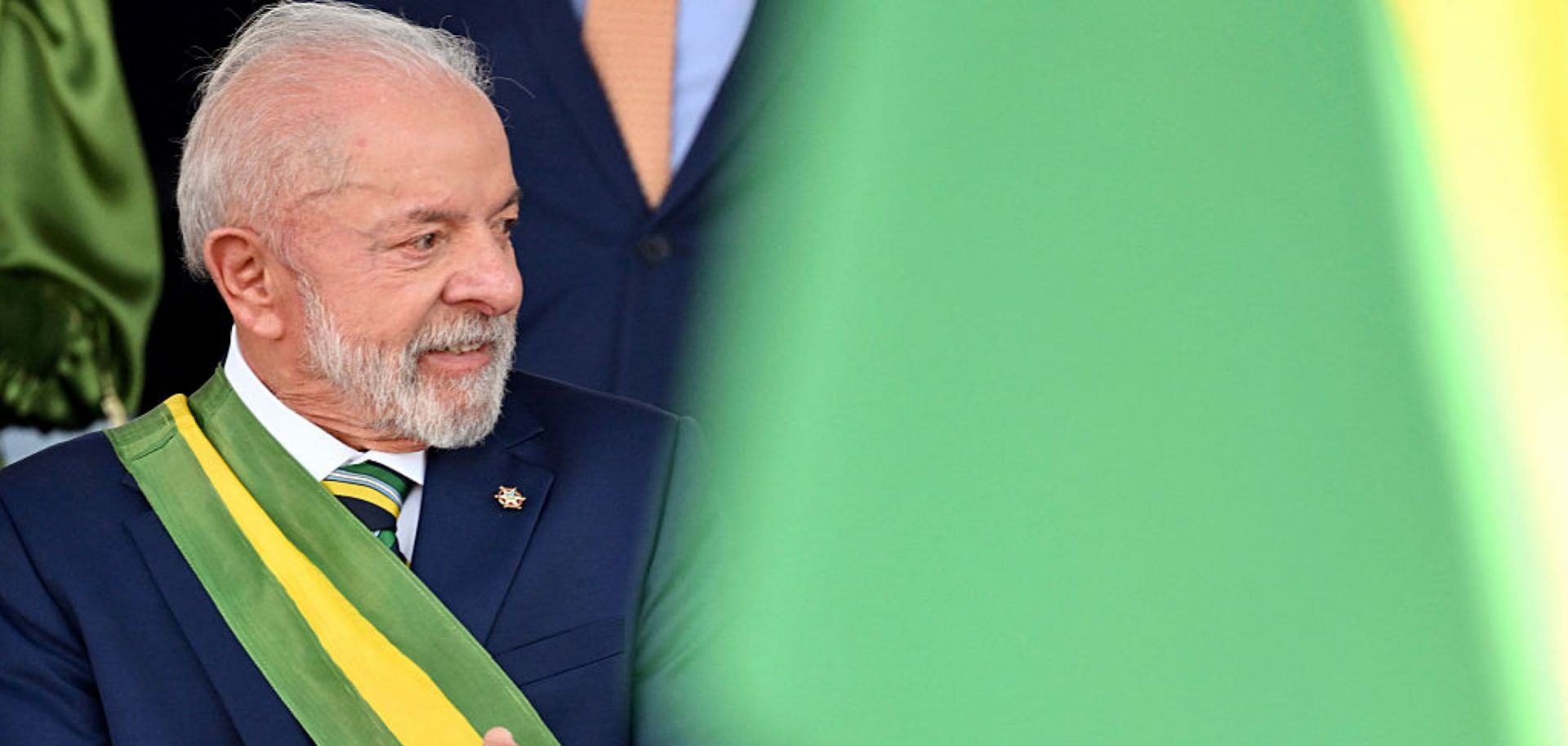
President Luiz Inacio Lula da Silva's failure to acknowledge structural changes in Brazil's society and power dynamics, reliance on policies from his previous time in office, and prioritization of international affairs over domestic issues have translated into a presidency that struggles to resonate with voters and will become a challenge for his 2026 reelection bid. While da Silva could win reelection or designate an heir-apparent who in fact succeeds him amid a strong economy, his shortcomings and a highly polarized political environment create the conditions for a right-wing contender to become the president. Given former President Jair Bolsonaro's continued strong influence over many Brazilians despite his conviction for plotting a coup, center-right candidates will likely adhere to his tough on crime and culture wars agenda to boost their electoral prospects and reverse his left-wing policies.

Da Silva's 2023 return to the presidency after 12 years out of office and 19 months in prison on corruption charges marks one of the most impressive comebacks in Brazilian politics. During the campaign, he promised to expand welfare programs, fight polarization and reclaim Brazil's role in the international arena he pursued when he was first president, from 2003 to 2010. Once back in office, however, the former union leader sought to take the same approach to governing as he did in his first two terms. During that period, more power was concentrated in the presidency, party leaders had more control over their members and Brazil also benefited from an economic windfall on the back of China's economic boom that allowed for sustained economic growth and comprehensive welfare programs. This plus fiscal discipline and political stability helped Brazil attract foreign investment and take a higher profile role internationally. The same approach, however, is not yielding the same results. Now, the legislative branch is vying with the executive for power over budget allocation, fewer but more heterogeneous parties make it harder to secure support in Congress and large portions of Brazilians have grown more enthusiastic about the free market. Moreover, diminished support for the left plus heightened polarization will further limit his popularity potential, which will likely remain in the 40%-50% seen over the past 12 months and significantly below the 83% level of when he finished his second term.
Old Approaches vs. New Political Reality
The way Brasilia operates has changed significantly during da Silva's 12 years out of office, and his unwillingness to adapt has made relations with Congress more challenging. In his first terms, da Silva offered Cabinet positions, political appointments in state-owned enterprises and regulatory agencies, and funds for legislators' projects in exchange for political parties' support in Congress. Since then, legislators have approved a series of constitutional changes that increased their power over budget allocation. Congress now controls nearly one-quarter of the government's discretionary spending — a significant chunk, given that only 7% of Brazil's total budget is discretionary. That means presidents can offer far fewer perks than before, so members of the legislature are less interested in forming solid alliances with the executive branch. Moreover, as ideologically loose political parties have concentrated more legislators with diverging political interests, party leaders are less able to close deals with the executive branch and control the votes of all, or even most, of their benches. That means that even parties with members holding Cabinet positions can have members who strongly oppose the government. Thus, da Silva's efforts to form a broad coalition by including Cabinet politicians from center-right parties, like he did in the 2000s, have not prevented several members of these parties from voting against the government.
Moreover, trying to use the old model to deal with a more complex and challenging dynamic in Congress has often resulted in tougher and lengthier negotiations that have occasionally backfired, paralyzing policymaking and, in a recent case, leading to a parliamentary commission under opposition control charged with investigating a pension corruption scandal. Strained executive-legislative relations have also undermined the progress of the government's economic agenda, which includes addressing the country's persistent fiscal imbalances that have fueled investor concern and financial volatility in recent years. Da Silva's diminished clout will almost certainly see him lose support from some right-wing parties ahead of the October 2026 general election. Such parties will have an even stronger reason to defect to the opposition given the favorable prospects for a right-wing presidential candidate to win. As some Cabinet ministers step down and legislators no longer side with the administration, the chances that major bills or structural reforms will not be approved before 2027 will rise.
Policy Priority Retreads and a Lack of Interest in Political Horse Trading
In addition to the political and institutional changes since his first two governments, da Silva's policy choices for his third term are in many ways a rerun of old ideas. His key campaign proposals included relaunching popular housing, health care and welfare programs Minha Casa Minha Vida; Mais Medicos; and Bolsa Familia, respectively. The federal government's slogan for the first two and a half years was Union and Reconstruction, a reference to the metaphorical destruction left by Bolsonaro and the physical destruction of government buildings his rioting supporters perpetrated in Brasilia in da Silva's first week in office. But the administration has so far failed to convince voters it has delivered on those promises. Polls have shown the government's disapproval rating fluctuating between 40% and 55%. A lack of coordination among Cabinet members, who often seem to work in silos, combined with some having competing political interests contributes to the lack of a clear identity or action plan for the administration.
Da Silva has demonstrated less interest in directly engaging in domestic politics, leaving most political bargaining to key ministers, especially Chief of Staff Rui Costa and Finance Minister Fernando Haddad. Most ministers' limited political capital, charisma and social media skills have meant the far-right opposition has frequently dominated the online debate. That has helped the opposition to keep its base mobilized amid recurring large street demonstrations in recent years. In contrast, the government's core supporters have been limited to those strictly on the left, with demonstrations relying on unions' participation, making it harder for da Silva's campaign to resonate with a broader audience next year.
Societal Changes Make Voters View the Free Market More Favorably
Meanwhile, da Silva's focus on welfare and strengthening formal workers' rights no longer resonates with parts of the labor force. Many have come to prefer the flexibility of gig economy jobs and to prioritize success obtained through entrepreneurship rather than state support. Part of this is due to the growing evangelical movement in Brazil over the past decades, which has promoted a message of hard work and entrepreneurship as paths to success, reshaping attitudes of a growing demographic toward welfare and undermining popular support for da Silva's policies and ideology.
But da Silva has stayed true to his unionist background, defending strengthening trade unions and workers rights, including for ride-hailing or delivery app workers. Many gig economy workers have opposed proposals to expand their welfare protections and establish parameters for how they should engage with hiring platforms. In a country where companies' labor costs are high and wages are low, low-skilled workers have opted to become independent, benefiting from flexible working hours, no commutes and higher earnings. Millions have picked this option, with 38% of Brazil's 101 million-strong workforce currently lacking stable working contracts, social security guarantees or other labor rights.
Lula Looks Abroad, and Brazil After Lula
While his domestic challenges have mounted, da Silva has prioritized international affairs over domestic politics. But his ambitious goals for Brazil have not landed as planned, generating only a few concrete wins apart from leveraging polarization domestically ahead of the upcoming elections. Since taking office, da Silva has sought to gain prominence in the international arena, perhaps partly in hopes of garnering a high-profile award or position in a multilateral organization to end his political career on a high note. Upon taking office, he sought to mediate between Russia and Ukraine. Claiming that both Moscow and Kyiv were equally responsible for the conflict backfired, as Ukrainian President Volodymyr Zelensky has repeatedly criticized da Silva's position and refused to accept his offers as a mediator. The Brazilian leader was also among the first to condemn Israel's initial reaction to Hamas' October 2023 attack, comparing Tel Aviv's response in Gaza to terrorism and genocide, angering the Israeli government. Da Silva has met more success asserting Brazil's leadership ahead of the G20 in 2024 and of the BRICS+ and COP 30 in 2025 to push for his foreign policy triad: the defense of multilateralism and global governance reform, championing environmental protection and the energy transition, and fighting social inequality and hunger globally. But discussions have resulted mainly in aspirational commitments from developed economies to fund a global alliance against hunger and a series of green initiatives.
In contrast, Brazil's prominent role in BRICS+ and da Silva's calls for dedollarization have meanwhile contributed to U.S. President Donald Trump's decision to impose 50% tariffs on Brazil in July. Since then, da Silva has held several calls with foreign leaders, hosted some presidents in Brasilia and chaired a BRICS+ virtual meeting Sept. 8. His efforts aim to secure new markets for Brazilian goods and a coordinated response to U.S. protectionism. Trump's pressure in support of Bolsonaro has helped da Silva rally many around the defense of Brazil's sovereignty, which has boosted his popularity amid increased political polarization in recent weeks. While additional U.S. tariffs and sanctions against Brazilian authorities would keep the issue fresh, the positive impacts on da Silva's image will likely dwindle as the tariffs' economic impacts intensify closer to the October 2026 election while polarization will limit his ability to reach out to the right. Right-wing politicians' skillful use of social media platforms, in which users are increasingly exposed to messages that align with their political views, will intensify this trend. Da Silva's outdated political strategy and disconnect with some of Brazilians' priorities will be obstacles for his likely 2026 reelection bid.
Brazil's economy is performing well, with unemployment at record-low levels, inflation under control, and stable albeit declining growth rates. But da Silva's shortcomings and heightened political polarization will curb his electoral prospects – or those of an appointed left-wing successor. The Workers' Party will likely retain at least the 30% of votes it has historically obtained in first-round elections over the past three decades. But the October 2026 race will once again be decided by moderate voters who will be heavily influenced by whether they are angrier with da Silva or Bolsonaro. Even though the latter will not be on the ballot, a right-wing candidate will make significant concessions to the far-right camp to secure support from the 20%-30% of the electorate that strongly supports the former president. The persisting polarization will once again prevent centrist politicians from becoming competitive as voters veer more right or the left. As a result, even center-right politicians, such as Sao Paulo state Gov. Tarcisio de Freitas, will highly likely make concessions to Bolsonaro and his allies — including promises to pardon the president, secure political positions for his key allies and family members, and commit to their agenda of cultural conservatism and a heavy-handed approach to crime.
The electoral cycle will likely see increased financial volatility as polls and other drivers influence investors' decisions. The good chances that a right-wing candidate could win and implement a business-friendly agenda that includes less taxes for companies and the wealthy, privatizations, significant spending cuts, and improved relations with the United States under Trump will likely strengthen Brazil's stock markets and currency over the coming year. Meanwhile, the left has no other political leader with the same charisma or popularity as da Silva. So despite his flaws, without him, it would face significant challenges to coordinate a strong opposition in Congress and secure a spot in future run-off presidential votes as it has done in every election since 1989, after Brazil returned to democracy. This means his eventual departure from the political scene will significantly reshape the country's political landscape for years to come.