
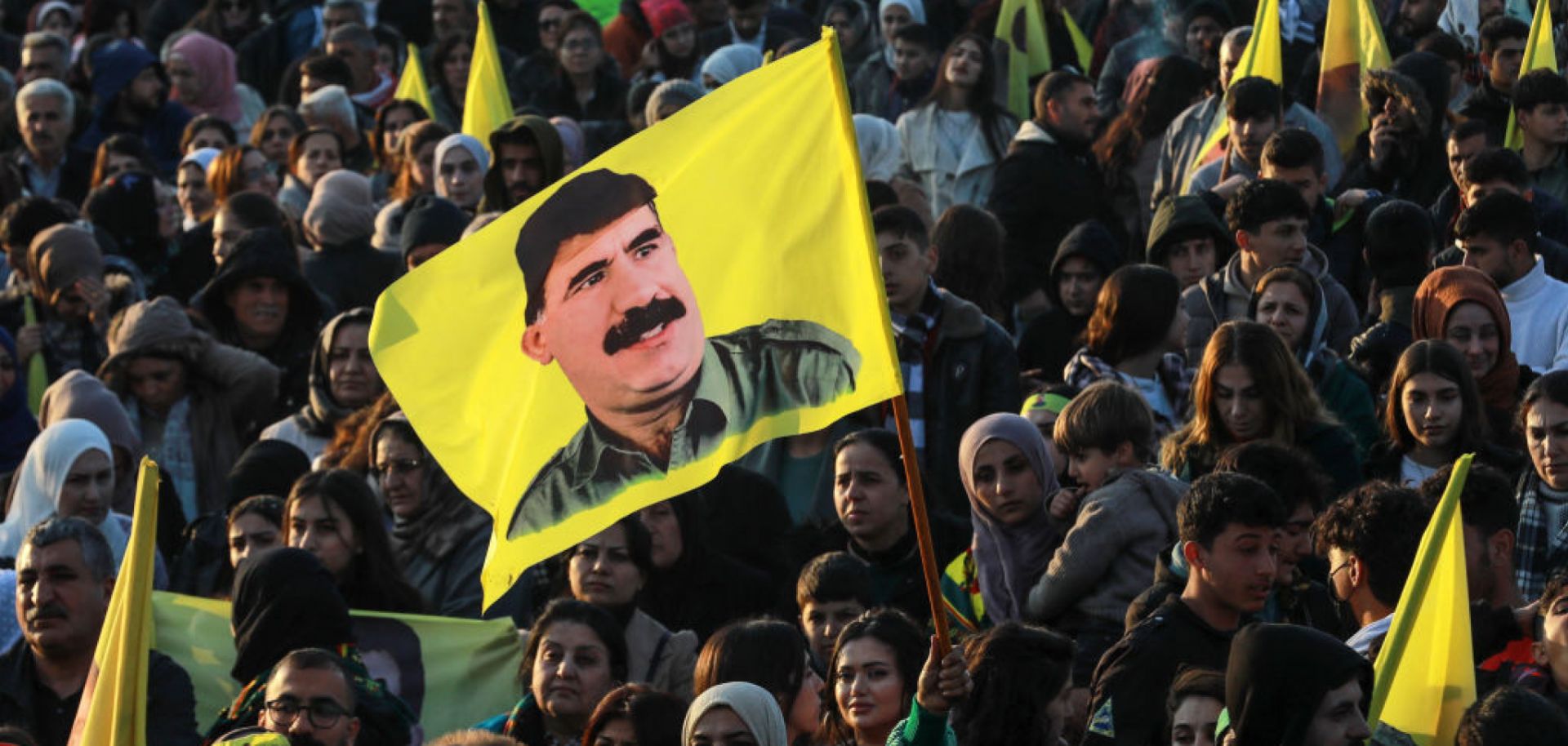
The disbandment of the Kurdistan Workers' Party, or PKK, will reduce the group's immediate security threat to Turkey, but the peace process will remain fragile amid the potential for internal PKK fragmentation, isolated terrorist attacks and disputes over pro-Kurdish concessions, which could rob the ruling coalition of the political support it needs to secure President Recep Tayyip Erdogan's 2028 reelection bid. On May 12, the PKK announced it would dissolve and end its decades-long armed conflict with Turkey. The group said its imprisoned founder and leader, Abdullah Ocalan, will lead the "practical process" of disbandment but did not stipulate specific demands, concessions or a timeline for the process in the statement. In response to the PKK's announced disbandment, a spokesperson for the ruling Justice and Development Party, or AKP, said it was "an important step toward a terror-free Turkey." The PKK's announcement comes after Ocalan called for the group's disarmament and disbandment in February, which saw the PKK unilaterally call for a ceasefire with Turkey shortly thereafter, conditioned on a "legal framework" for peace negotiations.
- The PKK held a conference from May 5-7 in northern Iraq discussing the group's future, which increased speculation that the PKK would announce its disbandment.
- Ocalan established the PKK in 1978 with the intent to establish an independent Kurdish state, though the group has since tempered its political goals to obtain more Kurdish autonomy within Turkey. In 1984, the PKK launched an armed conflict against the Turkish state, at times conducting terrorist attacks, which have reportedly killed more than 40,000 people over the decades. Turkey, the United States and the European Union all recognize the PKK as a terrorist organization.
- There have been several previous Turkish-PKK peace processes, most recently from 2013-15, though that ceasefire collapsed following PKK attacks in Turkey and Turkish airstrikes against PKK militants in northern Iraq. Since then, the government has cracked down on PKK targets both within Turkey and in northern Syria and Iraq. The PKK, meanwhile, has intermittently conducted high-profile terrorist attacks in Turkey, such as the deadly October 2024 attack on Turkish Aerospace Industries near Ankara. The group has also launched cross-border attacks from positions in Syria and Iraq.
The PKK's announcement comes amid the government's ongoing rapprochement with the pro-Kurdish Peoples' Equality and Democracy Party (DEM Party), as it seeks to gain support for electoral changes that would allow Erdogan to run for another term in 2028. Turkey will hold its next presidential election in 2028. Without a clear successor, the AKP and its far-right, nationalist coalition partner, the National Movement Party (MHP), have increased calls for Erdogan to run for another term, which Turkey's constitution currently does not allow. This has, in turn, prompted the government to consider holding either a referendum for constitutional reform or early elections before the end of Erdogan's current term. But either of these actions would require opposition support in Turkey's 600-seat National Assembly, where the DEM Party controls a sizable 57 seats. The DEM Party, however, is unlikely to back the government's efforts to extend Erdogan's presidency without securing pro-Kurdish concessions (such as releasing political prisoners in Turkey and a constitutional amendment that provides a legal framework for laws that protect Kurdish rights). The DEM Party has also promoted a renewed Turkish-PKK peace process as part of its broader goals for Kurdish integration, which has subsequently pushed Ankara to relaunch efforts to end its decades-long conflict with the Kurdish militant group, as it seeks to gain the DEM Party's support for the electoral changes needed to extend Erdogan's presidency.
- In Turkey's 600-seat National Assembly, the ruling coalition's 324-seat majority falls short of the 360-vote threshold needed to make constitutional changes or call for an early election. The DEM Party's 57 seats would thus push the government over that threshold.
- The first sign of a potential rapprochement between Turkey's ruling coalition and the DEM Party came in October 2024, when the leaders of the MHP and DEM Party shook hands, which marked a significant development given that the MHP has previously accused the DEM Party of having ties to the PKK.
- There is some ideological overlap between the DEM Party and the PKK, with some Turkish Kurds likely supporting both. But while both groups support expanding the rights of Kurds, the PKK advocates for Kurdish autonomy and frequently uses violence, whereas the DEM Party defends Kurdish rights and representation within the Turkish state through non-violent means.
But while the Turkish government is politically incentivized to advance the peace process, its hesitation to grant significant concessions, particularly on Kurdish autonomy, could ultimately stall progress and alienate the DEM Party. By remaining engaged in peace talks, the Turkish government is hoping to secure the DEM Party's support for electoral reforms, while the PKK is hoping to extract pro-Kurdish concessions. Ankara will likely agree to some of these concessions as confidence-building measures, such as providing imprisoned PKK leader Ocalan with additional freedoms and releasing imprisoned non-violent DEM Party members. However, the government will be wary of acquiescing to PKK demands that call for greater Kurdish autonomy within Turkey, which would challenge the ruling coalition's nationalistic platform. The DEM Party, for its part, may be willing to accept less maximalist concessions in exchange for supporting the AKP's electoral reform efforts, though it will likely leverage any attempt to alter Turkey's constitution to also push an amendment that enshrines Kurdish legal protections. In particular, the DEM Party will likely demand some domestic cultural and linguistic concessions, such as allowing Kurdish language in Turkish schools, government institutions and expanded Kurdish media. Furthermore, the party will likely pressure the central government to release imprisoned non-violent party members and to stop removing DEM Party mayors from elected offices, which Turkey has frequently done as part of its domestic crackdowns on Kurds. However, there is a chance the DEM Party will align more closely with the full extent of the PKK's more maximalist demands, given the party's coordination with Ocalan to enter a new peace process. In this scenario, the likely impasse over disputes on Kurdish autonomy would risk not only alienating the DEM party but also collapsing the entire peace process. This would, in turn, significantly reduce the likelihood of Erdogan being eligible to seek reelection in 2028, since other opposition parties are very unlikely to back the needed electoral changes.
From a security standpoint, the PKK's disbandment will reduce the risk of terrorist attacks in the short term, though isolated incidents may still occur as more militant PKK elements try to derail the peace process. The PKK's May 12 statement appears to show cohesion within the group to support Ocalan's earlier call for disbandment. This indicates that most PKK members will likely abide by the peace process, which will decrease the risk of terrorist attacks on Turkish soil, at least over the next several months. However, some elements of the PKK — including hard-line fighters and leaders, as well as members who profit off of the group's illicit economic activities — will probably oppose disbandment and conduct militant attacks to derail the peace process. Without the backing of the broader group, these small cells would likely only be able to launch attacks with limited sophistication. However, the call for disbandment could gradually deepen internal divides within the PKK, especially as some senior officials have recently expressed doubt about the Turkish government's commitment to the peace process. If factions within the PKK deem this process to be slow-moving, are dissatisfied with the Turkish government's offered concessions to Kurds, or lose confidence in Ocalan's leadership, they may split off and form a new group that resumes the armed conflict for greater Kurdish autonomy or independence.
- The PKK's disarmament will be the final step in the peace process, though there is no timeline attached. Furthermore, unless Turkey stops its ongoing, sporadic attacks on the PKK in northern Syria and Iraq, PKK officials will likely resist disarmament.
While Turkey will likely tolerate some isolated terrorist attacks, if the threat of Kurdish militancy persists, the government may resume more expansive military action against the Kurds, which would also collapse the peace process. So as not to upend the tenuous peace process, the Turkish government will likely have some tolerance for some isolated terrorist attacks, especially those that cause minimal damage and/or fatalities. While unlikely due to the group's diminished capabilities, a prolonged PKK campaign of terrorist attacks or cross-border attacks cannot be ruled out, which would heighten domestic pressure on Turkey to resume more extensive airstrikes against the PKK, thereby collapsing the peace process. Although Turkey is still conducting some sporadic airstrikes against the PKK, if the peace process stalls over time amid Ankara's unwillingness to accept the PKK's maximalist demands, Turkey may conduct additional airstrikes (though likely not in a sustained campaign) against PKK targets in northern Iraq and Syria to pressure the group to move forward with disbandment, which would also risk collapsing peace talks altogether. If the peace process collapses, Turkey would likely resume more extensive military operations in northern Iraq and Syria to combat Kurdish militancy through increased airstrikes and potentially limited ground operations.
- The PKK's disbandment announcement will increase pressure on the Kurdish-led Syrian Democratic Forces (SDF) to integrate into the central Syrian government, which they have already agreed to do, since the PKK's wing in Syria, which is the armed wing of the SDF — People's Defense Units (YPG) — will lose support from the broader group. Kurdish media reports speculate that some PKK senior officials would be allowed to relocate to northern Iraq. As such, the Turkish government may be wary that these individuals could reorganize and pose a threat of future Kurdish militancy from Iraq.
