
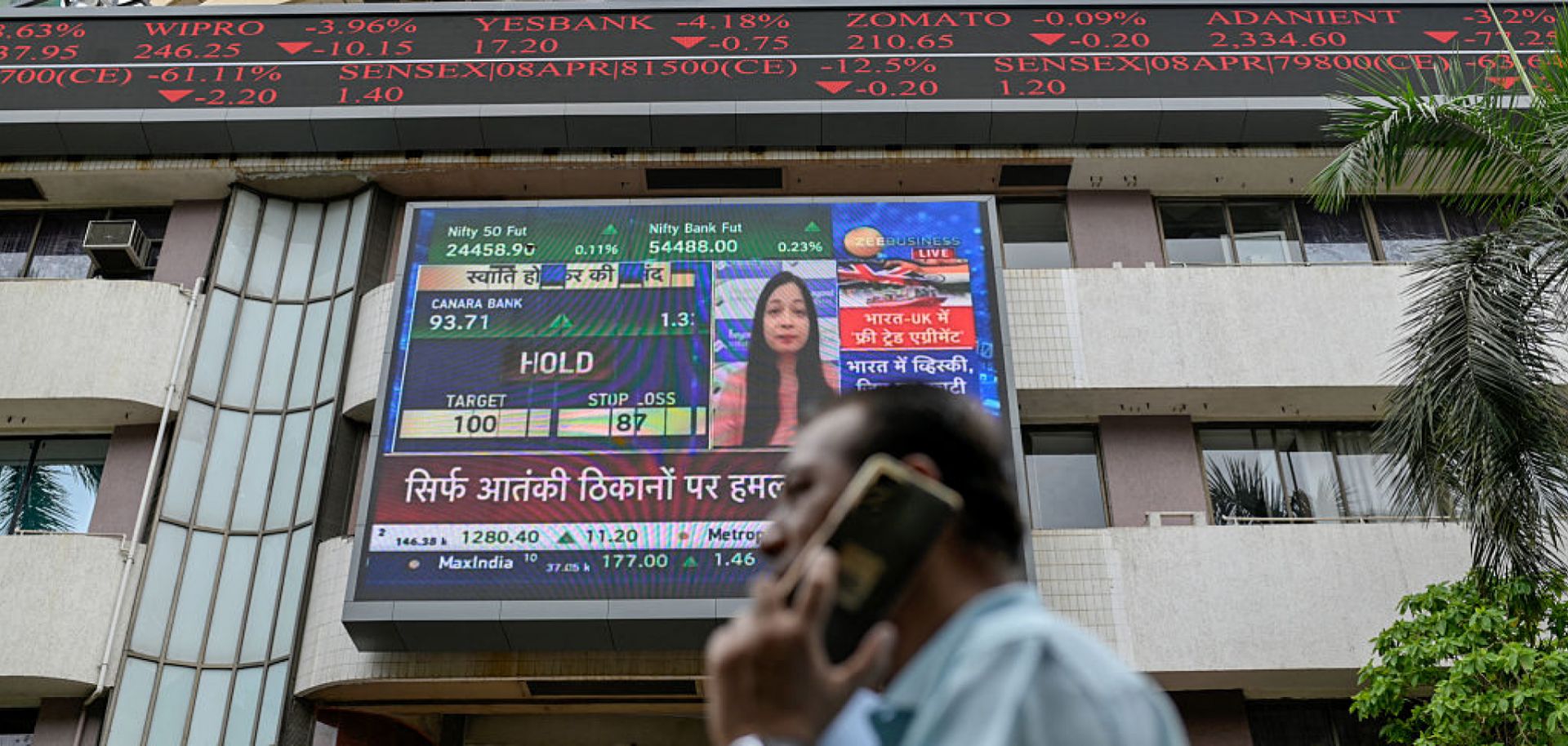
The Bombay Stock Exchange building May 7 in Mumbai, India.
While both New Delhi and Islamabad have no interest in further hostilities, should the conflict resume — and especially if it becomes protracted — economic conditions in both countries will be a significant factor in determining how they proceed. Pakistan would find conflict significantly more difficult to sustain from an economic and financial perspective given India's far greater economic size and financing flexibility and stronger economic fundamentals. Between May 7 and May 10, India and Pakistan engaged in tit-for-tat attacks that risked erupting into a prolonged conflict. On May 12, representatives from India and Pakistan spoke on the phone to discuss ways to de-escalate their conflict following a ceasefire agreement on May 10.
- India is one of the fastest-growing emerging economies in the world, with real GDP projected to average 6-7% in 2025-6, compared to International Monetary Funds projections for Pakistan of 3-4%. Pakistan's economic outlook is much more fragile, given its more fragile financial position in terms of large fiscal deficits and large external financing requirements.
- India's gross domestic product is set to reach $17.6 trillion in 2025, compared to Pakistan's $1.7 trillion (U.S. GDP at PPP exchange rates is projected to reach $40 trillion.)
Although both Pakistan and India have high levels of government debt, India is much better positioned to raise additional revenue or increase debt issuance than Pakistan would be should the military conflict resume and last for several months. India's economy is about 10 times larger than Pakistan if GDP is converted at purchasing-power exchange rates, and its structural economic growth rate is about twice as high. This gives India a far larger economic base and resources to support a prolonged armed conflict. India's much larger size means that 1 percentage point increase in fiscal deficits allows India to finance 10 times as much expenditure as Pakistan. Moreover, Pakistan has a narrower revenue and tax base, and its fiscal deficit is tangibly larger than India's. India also benefits from higher structural economic growth, providing greater spending and revenue flexibility. Finally, most India's government debt is held by residents and is denominated in local currency, which significantly limits financial risks.
- India's government debt exceeds 80% of GDP, very high by emerging market standards. The country's fiscal deficit is projected at a little less than 5% of GDP, which is also relatively high. This is not a problem for India, however, because of India's high economic growth and its reliance on domestic investors to finance the deficit. Although Pakistan's government debt ratio is lower, amounting to only 70% of GDP, the financial risks attached to it are greater because of Pakistan's lower economic growth and greater dependence on foreign financing, including in foreign currency. Pakistan's deficit is projected at 6-7% of GDP, and its tax base is also smaller than India's. India collects more than 20% of GDP in revenue, out of which more than 18% of GDP consists of taxes. Pakistan collects 15% of GDP, of which 12-13% of GDP is tax revenues.
- Pakistan's public sector is also far more dependent on external financing than India's is, with Islamabad's external amortization accounting for 50% of the country's external financial needs in 2025 or 2% of GDP. By comparison, India's government foreign-currency financing needs amount to a mere 0.3% of GDP. India also has more ready access to international private capital markets.
Pakistan's greater dependence on official financing makes it more sensitive to foreign financial pressure — including pressure from its external creditors — compared to India, whose external financial position is significantly stronger. This may make Islamabad more susceptible to diplomatic pressure from its bilateral lenders, who are not too keen to provide financial support that could be diverted to costly armed conflict. To the extent that a prolonged conflict further weakens Pakistan's financial position and capacity to repay its loans, bilateral lenders will be interested in at least limiting the adverse financial consequences of a prolonged military conflict. In a protracted conflict, Pakistan's economic and financial outlook would deteriorate to a point where Pakistan's IMF program moves off track. This would lead to a sharp decline in multilateral — and likely in official bilateral — lending, on which Pakistan is highly dependent. India faces far fewer external financial pressure points thanks to its far more manageable external financing needs and its ability to tap private sector financing as needed.
- India's international financial position is manageable, while Pakistan's is very fragile. This is unsurprising given that Pakistan is under IMF supervision due to its significant financial needs. Pakistan's external financial position is highly dependent on multilateral and official bilateral financing and continued compliance with the IMF program. It was only the new government's willingness to sign up to a new IMF program following last year's election that helped Pakistan avoid a broader financial crisis. Pakistan's foreign-exchange reserves are also much lower than India's in terms of import cover (and external financing requirements). Pakistani foreign exchange reserves cover only two months' worth of imports, compared to India eight months.
- India's external debt is less than 20% of GDP, compared to 30% of GDP in Pakistan. More significantly, about 40% of Pakistan's balance-of-payments financing needs are covered by official borrowing, underscoring its dependence on the continued goodwill of official lenders. Unlike India, the Pakistani government has no access to international capital markets due to heightened sovereign credit risk. Pakistan's credit rating is in the CCC range, while India is in the BBB range. Unlike Pakistan's subinvestment grade, India's investment-grade rating would allow it to access international capital markets, making India's external financing flexibility far greater than that of Pakistan
While the ceasefire will likely hold, in a prolonged conflict — particularly one involving costly, large-scale deployments of ground troops — Pakistan would face severe economic and financial strains. Islamabad and New Delhi will probably seek to avoid a resumption of the conflict, especially in the short to medium term, because of economic disruption, international diplomatic pressure and the threat of nuclear escalation. But if the conflict restarts, and especially if it lasts for several months, the economic imbalance between the two counties would give India a major strategic advantage. It would allow New Delhi to sustain hostilities longer and pressure on Pakistan via its economic vulnerabilities, which could trigger political instability and worsen its socioeconomic conditions. A prolonged conflict without visible gains could fuel protests or even trigger calls for government change in Pakistan, which has a long history of civil-military power struggles. By contrast, if hostilities do not resume, the May 7-10 conflict will have a minimal economic impact in terms of economic growth, financial stability and, in the case of Pakistan, continued compliance with IMF-supervised economic reform.
