
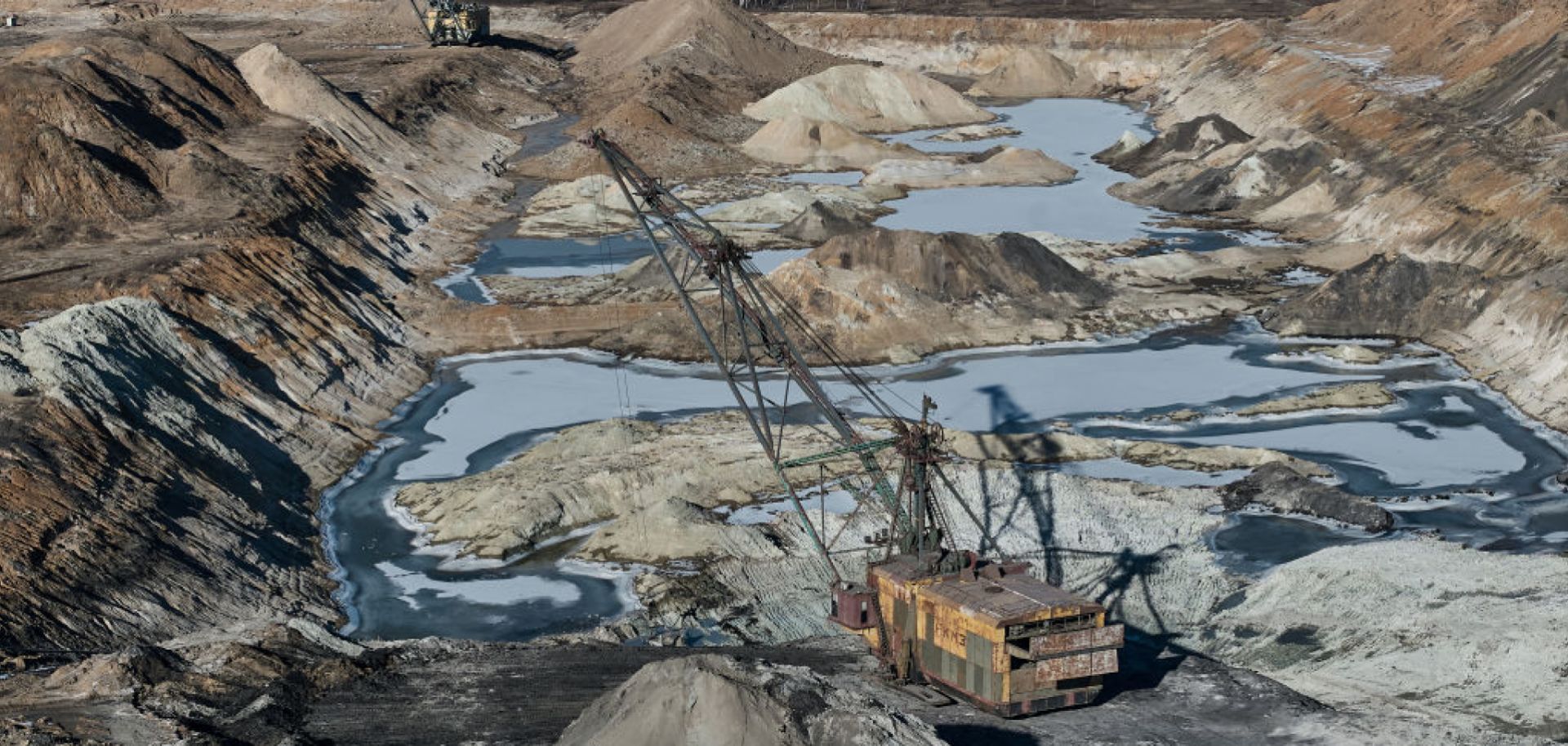
Drag-line excavator mines rare earth materials on Ukrainian soil on Feb. 25, 2025, in the Zhytomyr region of Ukraine.
(Photo by Kostiantyn Liberov/Libkos/Getty Images)
Drag-line excavator mines rare earth materials on Ukrainian soil on Feb. 25, 2025, in the Zhytomyr region of Ukraine.

The revised U.S.-Ukraine economic deal will likely face large constraints in its near-term ability to help the United States diversify its critical minerals supplies, but it indicates a long-term U.S. interest in the security of Ukraine that could help support the White House's push for a ceasefire. On April 30, U.S. and Ukrainian representatives signed a deal to give the United States a large stake in the future development of Ukraine's natural resources, including critical minerals, and associated infrastructure projects. The deal is based on one provisionally reached in late February and centers on the creation of a joint investment fund into which each country would contribute half of the financing. Ukraine would make contributions from revenue accrued from royalties from future licences for minerals and oil and gas projects, while future U.S. military assistance would count towards its contributions. The fund would be jointly governed, with each country installing three board members, according to Axios. However, media reports differ on how the profits will be distributed. Bloomberg reports that the United States would receive first claim on profits, whereas most others, including statements from Ukrainian officials, say the two countries would split the profits evenly and that, for the first decade, they would be reinvested in Ukrainian reconstruction projects. The deal does not provide any explicit U.S. security guarantees, but promises "long-term strategic alignment" and U.S. "support for Ukraine's security, prosperity, reconstruction and integration into global economic frameworks." Ukraine's parliament must still ratify the deal, but it is expected to do so in the next two weeks.

  • U.S. President Donald Trump and Ukrainian President Volodomyr Zelensky were expected to sign a previous version of the deal in Washington on Feb. 28, but a contentious Oval Office meeting that descended into shouting scuttled the plan. Since then, however, the two sides have made strides to revive the deal, leading them to sign a broad memorandum of intent on April 17.
  • Trump has repeatedly said that Kyiv needs to pay back Washington for its support since the Russian invasion of Ukraine in February 2022. Trump initially demanded $500 billion worth of critical minerals, equivalent to what he said had been the value of U.S. aid — a figure he later lowered to $350 billion but which is still more than the approximately $100 billion estimated by Ukraine. However, the final deal removes any explicit demand that Ukraine pay back the United States or that past U.S. assistance should count towards its contributions to the joint investment fund.

Compared to prior versions, the final agreement is less advantageous for the United States, but it still gives Washington significant influence over Ukraine's future economic development. Prior versions of the deal and media leaks about terms under discussion were heavily slanted in favor of the United States, particularly the now-removed provisions that past U.S. assistance would count towards its contribution to the fund and that Kyiv owed debts to Washington. The final deal also explicitly says that its terms should not conflict with Ukraine's aspirations to join or at least more deeply integrate with the European Union — a key demand from Kyiv that previously had been in question. Moreover, compared to previous media leaks indicating that the United States would effectively control the fund's governance by nominating three of five board members, the reportedly even split reduces U.S. leverage. But even so, and while it remains to be seen precisely how the deal will work in practice, the United States will receive a significant stake in Ukraine's economic future. More specifically, according to some reports, the United States receives preferential access to investments in any projects to extract rare earth elements, although Ukraine is believed to have comparatively few major deposits of these, and the right of first refusal for these opportunities; if it also becomes evident that the United States has the first claim on profits from the fund, this would further enhance U.S. influence. Over time — and this may not be for a decade if reports are accurate — these terms would provide revenue for both the United States and business opportunities for private U.S. companies. To this end, even though the deal should not harm Kyiv's aspirations to join the European Union, it will also likely create some friction with European countries that have supported Ukraine and are eyeing future investment deals given that the United States would have some level of influence to obstruct European firms' proposals for investments in Ukraine.

  • On Feb. 25, a joint effort by the Ukrainian government, World Bank, European Commission and United Nations estimated that, as of the end of 2024, the total cost of Ukraine's reconstruction would be $524 billion over the next decade. Even if U.S. firms received only a fraction of the infrastructure contracts that are eventually offered, they would still be worth tens of billions of dollars.
  • In 2023, Forbes Ukraine estimated that the value of Ukraine's mineral and other natural resources could be as much as $15 trillion. While this approximation should be treated with caution, other independent estimates indicate Ukraine is endowed with a large amount of mineral wealth.

The deal aligns with Washington's efforts to reduce dependence on Chinese control of critical minerals supply chains, but many constraints likely will limit its near-term impact. In recent years, the United States has broadened efforts to reduce China's influence over the exploration, development and processing of critical minerals, which are used in a wide variety of strategic goods, including those critical for military applications, the energy transition and other high-tech industries. Since taking office, the Trump administration has accelerated these efforts, including by signing a series of recent executive orders that, among other things, expedite plans to mine the seabed for critical minerals, open the door to implementing tariffs on imports of critical materials and aim to boost investment for U.S. critical minerals projects. The deal with Ukraine aligns with this trend by providing the United States with influence over Ukraine's resources as an alternative to supplies controlled by China. However, major obstacles will likely limit its near-term viability to supplant U.S. reliance on China-linked critical minerals supply chains. For one, it is unclear precisely where and in what quantity critical minerals are in Ukraine, given that most estimates date back to the days of the Soviet Union. Moreover, even if these dated assessments are correct, some critical minerals are in Russian-controlled territory, close to the frontline and/or in areas covered by landmines, thereby forestalling, or at least limiting, the near-term ability to exploit them. Further, as the deal will require long-term private sector commitments and large upfront costs, mining firms will likely be hesitant to make major investments, at least in the eastern portion of the country, until the security situation becomes more stable. Finally, even if these constraints are overcome, China still has by far the most capacity to process critical minerals into a usable form and any efforts to break this stranglehold will take significant time and energy supplies, limiting Ukraine's ability to easily and quickly fill this void given the severe damage to Ukraine's electricity grid.

  • Ukraine is believed to have significant reserves of many critical minerals, including 22 of 50 identified by the U.S. Geological Survey in 2022 as essential to the U.S. economy and national security, according to London-based Benchmark Mineral Intelligence. These include lithium, titanium, zirconium, graphite, nickel, cobalt, zine and manganese. However, these estimates rely on dated Soviet-era maps and it is unclear to what degree the deposits are commercially viable.
  • Since 2023, China has responded to U.S. high-tech export controls by tightening, and in some cases forbidding, the export of critical minerals. On April 4, China responded to Trump's initial imposition of so-called 'reciprocal tariffs' — which have since ballooned in a series of tit-for-tat moves between Washington and Beijing — by restricting the export of seven rare earths. While Beijing's move was not a complete ban, it gives Chinese authorities greater control over exports and signals that they can go further in the future, as trade tensions persist.

The deal gives the United States a long-term interest in Ukraine's security and, as such, could help support Washington's push for a ceasefire by helping to ease Kyiv's security concerns and demonstrate to Moscow that it is not abandoning Ukraine. In recent weeks, the United States has ramped up pressure on both Russia and Ukraine to wind down their war. While it will still be an uphill battle to achieve even a limited ceasefire, the U.S.-Ukraine deal indicates that the United States will have a long-term interest in Ukraine's security in order to realize gains envisioned in the deal; after all, the war's persistence or resumption after a pause would damage the deal's financial prospects. Thus, it could help the United States push for a ceasefire by demonstrating that it will not simply abandon Ukraine. This is particularly important for Kyiv as the deal, even though it does not include explicit U.S. security guarantees, should ease some of Ukraine's security concerns — especially as it should preserve crucially important U.S. intelligence sharing — and incentivize Kyiv to show some flexibility in talks to deescalate the war to avoid drawing a rebuke from the White House accusing Ukraine of asking for too much despite just inking a long-term economic deal with the United States. The key question, therefore, is how Russia will react. Moscow has refused to agree to a ceasefire as it believes it has the upper hand on the battlefield in Ukraine and has not yet felt significant coercion from Washington. However, the deal will dash the Kremlin's hope of fully removing U.S. influence from Ukraine as it signals that the United States will retain long-term interests there that will presumably motivate the White House to sustain a baseline level of support for Kyiv. If the White House follows through on its threat to increase pressure on Russia for refusing to agree to a ceasefire, Moscow may become even more motivated to return to the negotiating table, though the Kremlin may continue to stall in order to enter talks on even more favorable terms.

  • Trump has repeatedly criticized Ukraine for allegedly starting the war, but in recent weeks, he has expressed frustration with Russia for its ongoing attacks that are preventing him from achieving a ceasefire. Most recently, after meeting with Zelensky on the sidelines of Pope Francis's funeral on April 26, Trump issued a social media post saying Putin may be stringing him along and threatening to expand sanctions on Russia. Media reports indicate that bipartisan legislation is moving through both houses of the U.S. Congress that, if passed and signed into law by Trump, would scale up sanctions.
  • Although the United States has repeatedly ruled out sending troops to Ukraine and pushed back against European requests to provide various forms of U.S. support for a deployment of forces from a coalition of the willing, top U.S. officials have said on multiple occasions, including when signing the deal, that it would incentivize ongoing U.S. support for the country in order to facilitate the physical reconstruction and resource development from which Washington and U.S. companies stand to benefit.
     
RANE
SUBSCRIBERS ONLY

Expert analysis when it matters most.

Get access to RANE's decision-grade geopolitical intelligence.