
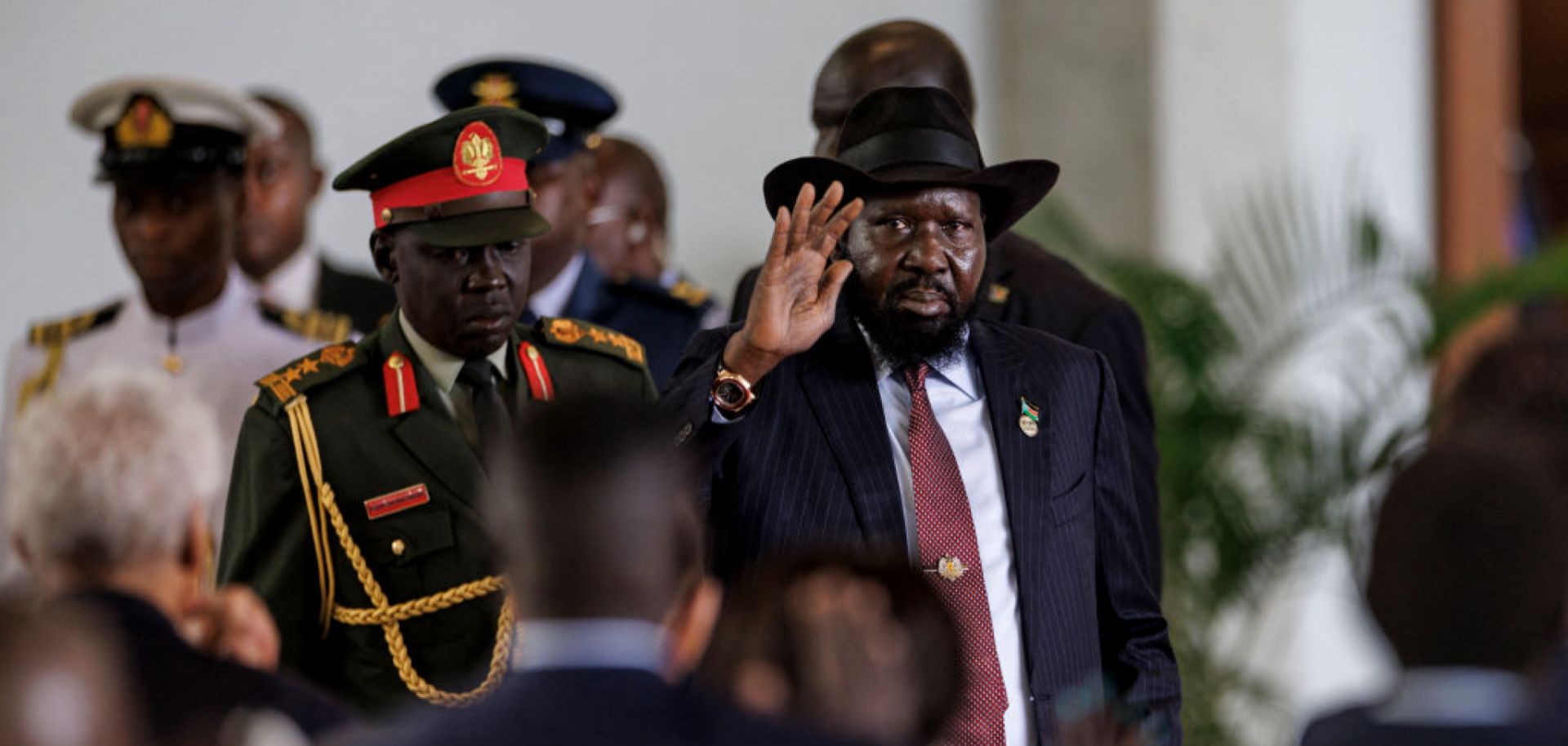
Rising political tensions in South Sudan threaten to drag the country into a new civil war, but even if rival factions can safeguard a 2018 peace deal, more fighting is set to occur in the northeastern Upper Nile state, which will likely draw in growing involvement from Sudan's warring parties. On March 18, the party of South Sudan's First Vice President Riek Machar, SPLM-IO, announced it was halting its participation in key provisions of a 2018 peace deal, including joint security and ceasefire monitoring committees, until authorities released allies of Machar who are currently being detained. The announcement comes amid rapidly surging tensions between Machar and South Sudanese President Salva Kiir, who in early March ordered the arrest of pro-Machar figures after the White Army, a militia drawing support from Machar's Nuer ethnic group, captured the town of Nasir in Upper Nile state on March 4. Amid growing concerns about South Sudan's destabilization, Uganda's military chief Muhoozi Kainerugaba announced on March 11 that the country had deployed troops to South Sudan's capital of Juba on March 9. After initially denying the deployment, Kiir's government later acknowledged the presence of ''technical and support units'' from Uganda in South Sudan on March 17. The same day, forces loyal to Kiir conducted airstrikes in Upper Nile's Longechuk and Nassir counties, killing at least 23 people. Clashes now appear to be spilling outside of Upper Nile, with airstrikes reported on the road connecting the towns of Walgak and Akobo in neighboring Jonglei state, fueling fears that South Sudan may be headed for another all-out civil war.
- The deployment of Ugandan forces to South Sudan came after the White Army allegedly shot down a U.N. helicopter on March 7 that was attempting to evacuate South Sudanese soldiers from Nasir, killing 27 people.
- Since deploying to South Sudan, the Ugandan military has been accused of conducting airstrikes in support of the Kiir government, but these claims have yet to be independently verified.
Tensions between Kiir and Machar have steadily grown in recent years due to the slow implementation of the 2018 peace deal, but the recent escalation in Upper Nile state appears linked to Kiir's growing ties to Sudan's Rapid Support Forces (RSF) paramilitary group, as his government has leaned on the RSF's foreign backer, the United Arab Emirates, to secure financial support. After securing independence from Sudan in 2011, South Sudan was plunged into a five-year civil war in 2013 that pitted Kiir and Machar against one another, causing the deaths of around 400,000 people. Although the two sides struck a peace deal in 2018 and formed a power-sharing government in 2020, the implementation of key provisions of the agreement has since faced repeated delays due to distrust between Kiir and Machar, as well as financial shortfalls. This has prompted Kiir to repeatedly delay plans to hold a general election, which is now scheduled for December 2026. Compounding South Sudan's challenges has been the eruption of civil war in neighboring Sudan in April 2023. The nearly two-year war has resulted in over one million refugees fleeing to South Sudan, most of whom are South Sudanese returnees. The fighting also damaged one of the two pipelines connecting South Sudan's oil fields to international markets, which shut off over half of the country's oil exports for most of 2024, curbing state revenue — of which over 95% is based on crude oil exports — and resulting in monthslong delays in the payment of South Sudanese soldiers and public sector workers. To keep his cash-strapped government afloat, Kiir struck a $13 billion, 20-year oil-backed loan with an Emirati company linked to the United Arab Emirates' royal family in April 2024. Since then, Kiir has leaned closer to the wealthy Gulf Arab nation, which backs the paramilitary Rapid Support Forces, or RSF, in Sudan's civil war. In February, the Sudan People's Liberation Movement-North (SPLM-North), a Sudanese militia with ties to Kiir, struck a partnership with the RSF against Sudan's Sudanese Armed Forces (SAF). The partnership between the RSF and the SPLM-North was likely a driver behind the recent escalation in Upper Nile state, as anonymous diplomatic sources quoted in a March 7 International Crisis Group report said they suspected that the SAF provided military support to the White Army's takeover of the town of Nasir. Reports of Kiir's ties to the Sudanese paramilitary group are further corroborated by clashes between the RSF and SPLM-IO members near the locality of Renk in Upper Nile state on March 15-16.
- In March 2024, Sudan's SAF-led government declared force majeure on South Sudan's oil exports after clashes with the RSF near the capital Khartoum ruptured the Petrodar pipeline. This pipeline connects oil fields in South Sudan's Upper Nile state to the city of Port-Sudan, from where South Sudan's oil is then exported to international markets. According to the oil magazine Argus, the rupture decreased South Sudan's crude oil output by around 100,000 barrels per day, or two-thirds of its total output, but other estimates suggest that production dropped by around half. Sudan's SAF-led government lifted its force majeure in January and oil production reportedly resumed in February, but South Sudan's crucial oil exports remain vulnerable amid the ongoing escalation in Upper Nile state.
- On Feb. 8, Kiir met with UAE President Sheikh Mohammed bin Zayed Al Nahyan in Abu Dhabi. Less than two weeks later, the SPLM-N signed a charter agreement to form a Sudanese government with the RSF to rival that led by the SAF.
Escalating tensions between Kiir and Machar threaten to collapse the 2018 peace deal and plunge South Sudan into a new civil war within weeks, but even if this can be averted, further clashes are set to take place in Upper Nile state, which will likely draw in further military involvement from Sudan's SAF and RSF. The SPLM-IO's exit from key provisions of the 2018 peace deal reflects the agreement's growing fragility. Should Kiir refuse to release pro-Machar figures who were recently arrested, or if factions allied with either Kiir or Machar engage in further provocations, it would significantly increase the likelihood of the agreement collapsing in the coming weeks. This could manifest through escalating clashes between Machar's Nuer ethnic group and Kiir's Dinka ethnic group, or with pro-Machar elements within South Sudan's military rallying behind the Nuer fighters in the White Army — either of which would portend a rapid geographical expansion of fighting across the country. In response to neighboring South Sudan's return to civil war, Sudan's SAF and RSF would likely expand their involvement in the country, with presently available information suggesting that the SAF would likely side with Machar while the RSF would back Kiir. Moreover, Uganda would likely expand its support to Kiir, potentially setting the stage for a new proxy conflict that draws in other actors from across Northeast Africa and potentially Central Africa, including militants from the northeastern Democratic Republic of the Congo. However, as seen in previous crises between Kiir and Machar, mediation remains possible, which could, for example, see Kiir release Machar's allies in exchange for Machar siding against the White Army. But even if a collapse of the 2018 peace deal can be avoided, the White Army appears unlikely to peacefully lay down its weapons, and recent airstrikes show that Kiir's government is intent on forcefully retaking Nasir and other localities captured by the Nuer militia if need be. In response, the White Army could launch fresh offensives against pro-government positions elsewhere in Upper Nile state in order to link up with friendly forces in Sudan and/or capture Nuer-inhabited areas in the central states of Jonglei and Unity, thus portending further clashes in northeastern South Sudan in the weeks ahead. In turn, the RSF and SAF and their allied militias are likely to expand their military involvement in Upper Nile state in the coming weeks, with the goal of outflanking each other. This would threaten to bring Sudan's civil war into South Sudan's Upper Nile state, which would also increase the risk of violent spillovers into Ethiopia's southwestern Gambella region if the White Army uses the area as a rear base. Moreover, an intensifying insurgency in Upper Nile state would heighten the risk of South Sudan falling into a new civil war for the foreseeable future — even if tensions between Kiir and Machar can temporarily be kept in check.
