
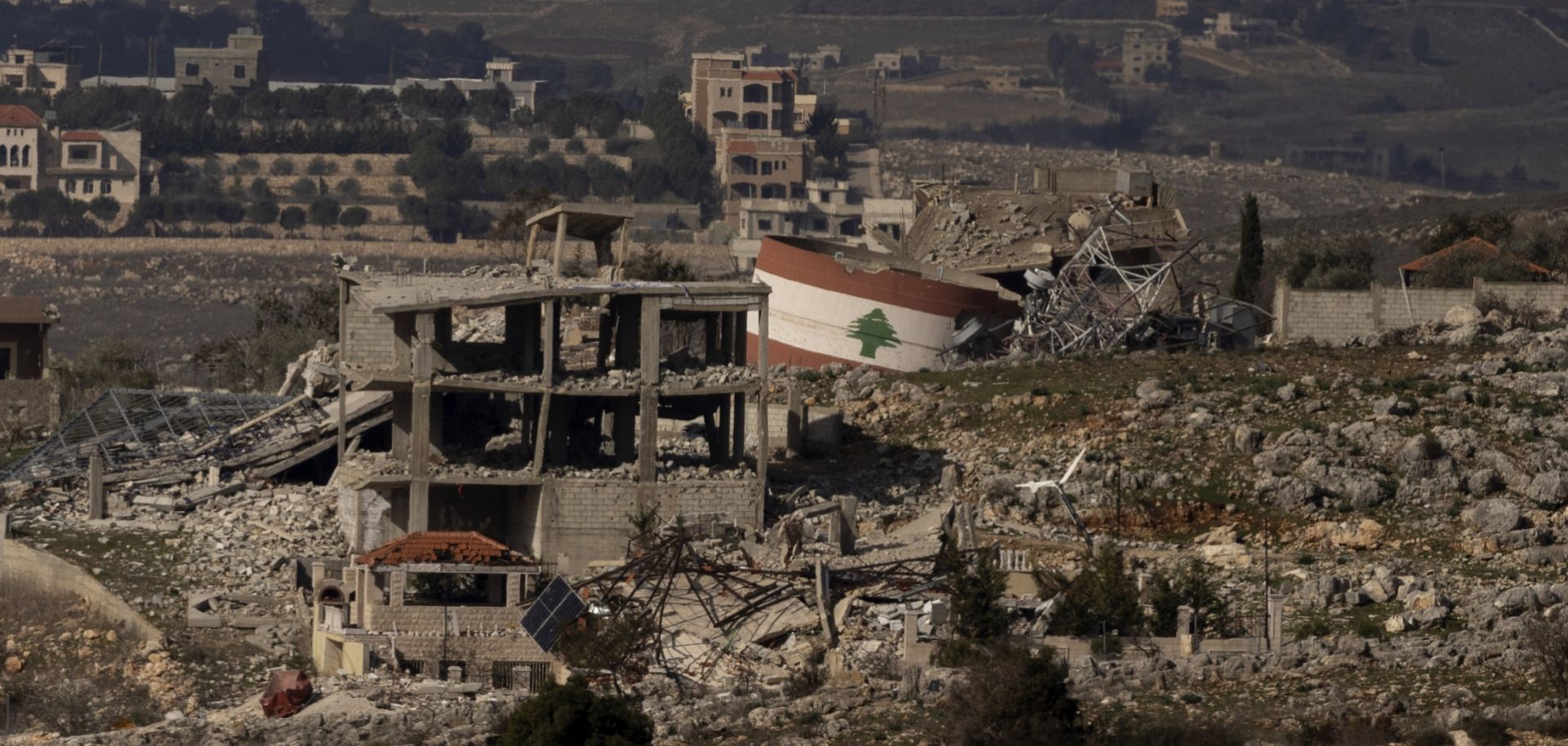
Political and security imperatives will deter Israel from fully withdrawing from southern Lebanon by the Jan. 26 deadline outlined in its ceasefire with Hezbollah, which will risk impeding U.S. strategy in Lebanon and provoking renewed Hezbollah attacks. But an alternative scenario in which significant diplomatic pressure compels Israel to withdraw at the last minute cannot be ruled out. On Jan. 23, The Times of Israel reported that Israel had reportedly asked the United States for an additional 30 days to withdraw from southern Lebanon, ahead of the Jan. 26 deadline stipulated in the Nov. 27 ceasefire agreement with Hezbollah. Israel's Army Radio reported the same day that U.S. President Donald Trump is not inclined to extend Israel's withdrawal date and wants the Israel Defense Forces (IDF) to withdraw by Jan. 26. On Jan. 22, Bloomberg, citing sources familiar with the subject, reported that the Hezbollah-Israel truce will likely be extended for another 30 days. Meanwhile, on Jan. 16, Trump reportedly conveyed a message to Israel that the United States did not want the ceasefire in Lebanon to collapse amid reports the IDF and senior Israeli officials had indicated their intent to remain in southern Lebanon.
- The Nov. 27 truce agreement between Israel and Hezbollah stipulates that the IDF must cede all of its positions in southern Lebanon to the Lebanese Armed Forces by Jan. 26. Israel claims that the Lebanese army has been slow to deploy across the region and is subsequently forcing the IDF to delay its withdrawal.
- On Dec. 25, Israeli media outlet Haaretz reported that sources in the Israeli army had indicated that the IDF would need to stay in southern Lebanon beyond the agreed-upon 60-day period, claiming that it would need to stay there until the Lebanese army can fulfill its commitments.
Israel is mulling extending its stay in southern Lebanon just days ahead of the looming deadline, with the IDF wanting more time to clear Hezbollah infrastructure in areas near the border. In the past few weeks, the United States and Israel have held several rounds of backchannel talks on extending the truce before it expires on Jan. 26, with reports suggesting that the Biden administration was considering granting Israel an additional 30 days to withdraw from southern Lebanon. Since the ceasefire took effect on Nov. 27, Israel has operated in hundreds of towns and villages in southern Lebanon, seizing weapons and rockets while demolishing houses it suspected Hezbollah was using, along with Hezbollah infrastructure like tunnels and underground command centers. According to Israel, the Lebanese army's deployment to the south and their implementation of the agreement has been slow, and Israel claims that some officers have been tipping off Hezbollah before searches to seize weapons. For its part, Hezbollah has recurrently issued warnings in the face of Israel's ceasefire violations and the potential for the IDF to remain in southern Lebanon longer than the agreed-upon deadline. Indeed, the Trump administration's alleged reluctance to formally extend the truce is likely due to worries that a delayed IDF withdrawal would reignite fighting in Lebanon, which would threaten recent momentum toward the U.S. goal of reducing Hezbollah's influence in the country following Israel's degradation of the Iran-backed group over the past year and Lebanon's election of a pro-U.S. president and prime minister on Jan. 9.
- Israel has so far withdrawn troops from only two villages in southern Lebanon. In the at least 60 other villages where it maintains a presence, the IDF has forbidden Lebanese residents from returning home. Israeli Prime Minister Benjamin Netanyahu also asked Trump to endorse the IDF's continued occupation of five strategic military outposts in southern Lebanon.
- Hezbollah's leader Naim Qassem said on Jan. 5 that the group had so far shown restraint amid Israel's ceasefire violations, including its continued attacks on Hezbollah targets and ongoing presence in southern Lebanon. But Qassem warned that the group may resume attacking Israel if its troops do not withdraw from southern Lebanon before the 60-day period ends.
- Lebanese authorities have reported over 460 Israeli violations of the ceasefire since the deal was signed on Nov. 27, including attacks that killed at least 32 people in Lebanon and injured 39 others.
- On Jan. 23, the IDF said its troops found Russian-made anti-tank missiles, grenades and assault rifles in southern Lebanon. Additionally, in a joint operation with the elite Yahalom combat engineering unit, the IDF said troops discovered several tunnels belonging to Hezbollah, seized weapons there and demolished the remaining infrastructure.
Israel is unlikely to completely withdraw from southern Lebanon by the Jan. 26 deadline due to concerns over Hezbollah's continued presence and domestic political pressure, which will raise the risk of resumed Hezbollah attacks on Israeli troops that would impede the U.S. strategy in Lebanon. The IDF is unlikely to remove all its troops from southern Lebanon in the coming days and weeks, likely citing the Lebanese Armed Forces' slow deployment to the region and Hezbollah's still-robust presence in the south, where IDF troops continue to find weapons stockpiles and Hezbollah infrastructure that threaten Israel's north. Additionally, despite the ceasefire, the Israeli government has not been able to convince northern Israelis that they can safely return home due to fears of Hezbollah's continued presence near the border; leaving southern Lebanon without completely clearing out the militant group's infrastructure would thus only exacerbate these fears and, in turn, increase domestic political pressure on Netanyahu's government. The IDF remaining in southern Lebanon would likely rhetorically strain Israel's relations with the Trump administration. More importantly, however, it would impede the U.S. strategy in Lebanon, with Washington adamant to capitalize on the momentum the West has gained in weakening Hezbollah's influence both in Lebanon and across the region. This is because Hezbollah — which has been pressuring the Lebanese government to enforce the ceasefire and warning of Israeli violations — would likely resume guerilla tactics against the remaining Israeli troops in southern Lebanon, aiming to exact a cost on the IDF for its continued presence and gain domestic political support among the displaced residents in the region who are eager to return home. Such a scenario would make it harder for newly elected Lebanese President Joseph Aoun to uphold his pledge of keeping weapons solely in the hands of the state by lending credence to Hezbollah's arguments that the group needs to remain armed for resistance purposes.
- The IDF may try to withdraw a large portion of troops from southern Lebanon, while keeping some in areas believed to still have Hezbollah infrastructure, though this too would likely prompt Hezbollah to attack the remaining IDF troops to force them out.
- Numerous residents of southern Lebanon have informed the Lebanese army intelligence that they plan to re-enter their towns on the Jan. 26 deadline, regardless of whether Israeli troops withdraw. This would create another problem for not only Israel but the Lebanese military, which has repeatedly urged returning citizens to comply with orders and not to approach areas where Israeli forces were still stationed.
However, there is a chance, albeit slim, that a combination of U.S. pressure and Hezbollah threats compels the IDF to withdraw from Lebanon by Jan. 26, which would avert the return to a full-scale conflict. In an unlikely scenario, Israel could fulfill its withdrawal commitment at the last minute, concluding that keeping troops in southern Lebanon would expose them to potentially costly Hezbollah attacks that would have domestic political ramifications for Netanayahu's government. Such a decision would also be aimed at appeasing the Trump administration, whose backing Israel needs to pursue more pressing issues, such as annexing territory in the West Bank, upholding the new ceasefire with Hamas in Gaza, weakening Iran and its regional allies (like the Houthis), and deterring Iran's nuclear development. Israel's withdrawal would force the newly elected Lebanese government to implement the ceasefire agreement with more urgency and dismantle Hezbollah's infrastructure south of the Litani River. It would also pressure Hezbollah to abide by a Lebanese national defense strategy where decisions are made solely by the government, as an IDF exit from southern Lebanon would make it easier for the Lebanese government to negotiate with the militant group by eroding the need for a resistance movement. Israel, however, would still maintain its informal understanding with the United States that it can use force on Lebanon whenever it chooses to. After withdrawing from southern Lebanon, the IDF would thus likely capitalize on this freedom of action clause more often by continuing to conduct airstrikes on Hezbollah infrastructure and raids into Lebanese border towns and areas south of the Litani to clear out any specific threat. Moreover, an Israeli withdrawal from Lebanon by Jan. 26 would enable the United States to maintain its current strategy of stabilizing Lebanon by promoting political reforms and decreasing Hezbollah's influence in the country. This is because Washington would be able to continue pressuring the Lebanese government to implement the ceasefire and enact policy changes that strengthen Lebanon's institutions and facilitate eventual negotiations for Hezbollah's disarmament — all while allowing Israel to continue striking Hezbollah targets in response to any suspicious activity and/or attempts by the group to rearm.
- Israel and Hezbollah are war-weary and are unlikely to want to resume full-scale hostilities, but both sides have domestic incentives for continuing low-scale fighting and pressuring one another to fully implement their ceasefire.
- While the war with Israel degraded its capabilities, Hezbollah's military power still exceeds that of the Lebanese Armed Forces. Additionally, Hezbollah maintains political influence via its presence in the Lebanese cabinet and parliament. As a result, the Lebanese Armed Forces, which includes some Hezbollah loyalists, is limited by the potential for internal conflict and is therefore unable or unwilling to disarm Hezbollah completely as things stand. Hezbollah's disarmament is thus more likely to occur as part of a negotiated ''national defense strategy'' with the Lebanese government.
