
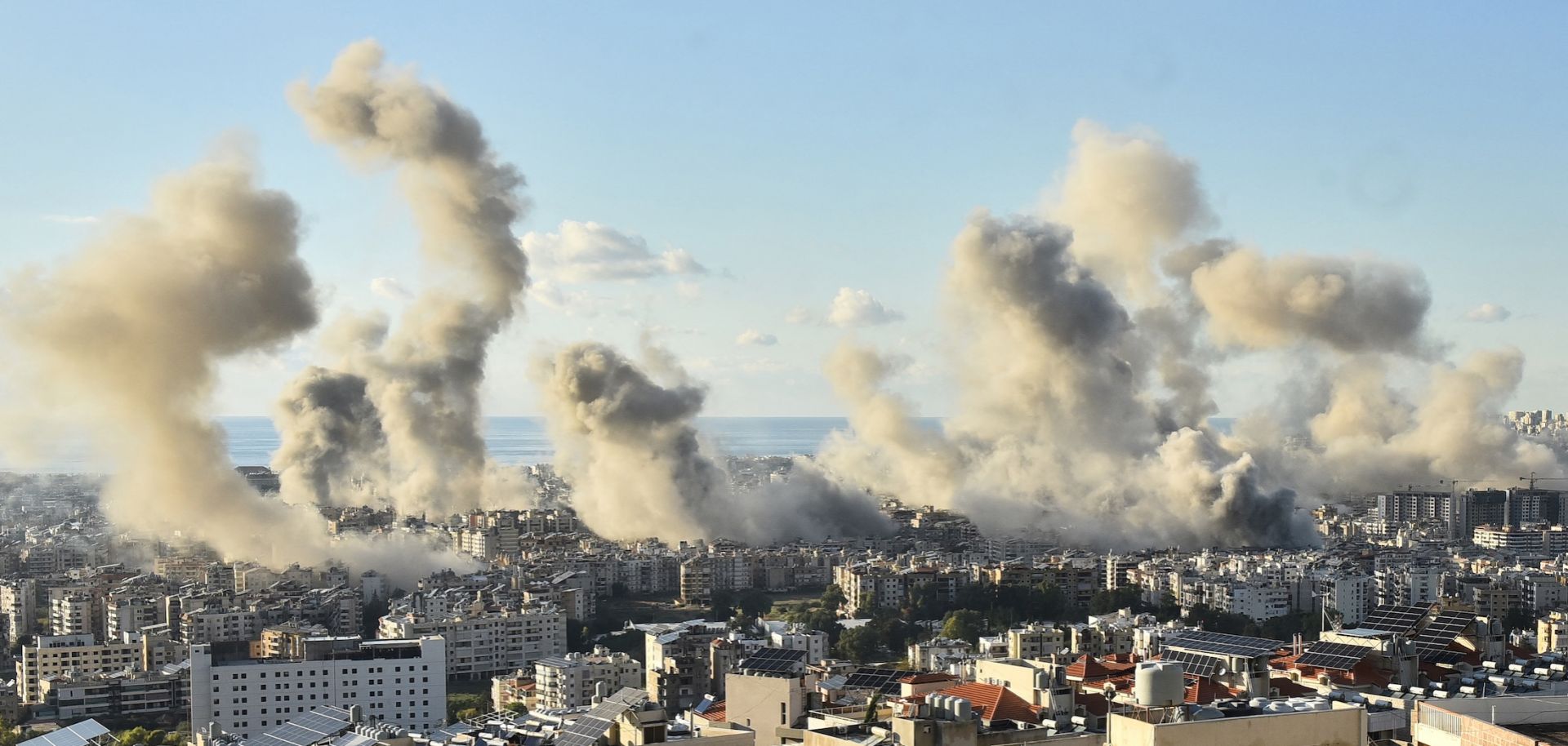
War-weariness has largely compelled Israel and Hezbollah to accept a 60-day cease-fire agreement that will decrease hostilities on both sides of the Israeli-Lebanese border, though periodic tit-for-tat attacks during the truce period could undermine the deal, reignite fighting and impede progress toward a permanent cease-fire. In the coming hours, Israel and the Lebanese militant group Hezbollah are reportedly set to approve a 60-day truce that paves the way for an eventual permanent cease-fire between the two sides, which have been in conflict since September. Israeli Prime Minister Benjamin Netanyahu convened with his security Cabinet on Nov. 26 to approve the agreement, while Lebanon's caretaker government will likely approve the deal on Nov. 27. U.S. President Joe Biden will probably announce the cease-fire after the Israeli security Cabinet approves it. Meanwhile, on Nov. 25-26, fighting remained ongoing on both sides of the border, with Israeli forces continuing to issue evacuation orders in the Beirut suburbs ahead of airstrikes, while Hezbollah continued rocket fire toward northern Israel, including a barrage of rockets on the city of Nahariya. In Israel, news of the impending truce was met with staunch criticism from far-right ministers Itamar Ben-Gvir and Bezalel Smotrich, though unlike during Israel's talks with Hamas to end fighting in Gaza, Ben-Givir and Smotrich did not threaten to topple Netanyahu's government if a cease-fire deal was reached. The United States has in the past few days pressured both Israel and Hezbollah to accept the agreement, threatening to end mediation efforts if they did not.
- The proposed cease-fire agreement includes a 60-day transition period for Israel to withdraw its forces from southern Lebanon, contingent on Hezbollah's moving its heavy weaponry, infrastructure and fighters north of the Litani River. The Lebanese Army, supported by the U.N. Interim Force in Lebanon (UNIFIL), will assume control of the area, with ongoing aerial surveillance by Israel to monitor security threats. The agreement also facilitates the return of displaced residents to northern Israel and southern Lebanon.
- According to Axios, the draft agreement was ready on Nov. 21, though it was postponed with the announcement of the International Criminal Court's arrest warrants against Netanyahu and former Israeli Defense Minister Yoav Gallant.
- According to a Nov. 23 Axios report, U.S. envoy Amos Hochstein reportedly threatened to step down as the mediator of Israel-Lebanon talks if Israel failed to make progress toward an agreement with Hezbollah in the coming days, which would have ended negotiations under the Biden administration until the end of its term in January.
- The agreement establishes a U.S.-led oversight committee to monitor the implementation of the 60-day transition period and address any violations. It also includes a commitment by the United States, outlined in a letter of assurances, to back Israeli military actions against immediate threats originating from Hezbollah, as well as Israeli efforts to prevent activities such as Hezbollah reestablishing a presence near the border or smuggling heavy weapons. According to U.S. and Israeli officials, these actions would follow consultations with the United States and only occur if the Lebanese military fails to address the threats.
The success of negotiations is largely due to war-weariness from both sides, as well as U.S. pressure to end hostilities. Several factors have driven Israel to consider accepting a cease-fire agreement with Lebanon, with the Israelis generally believing they have degraded Hezbollah enough to mitigate the most immediate threats while avoiding an unsustainable escalation. For one, recent reports have indicated that Israeli reservists, fatigued by war, are not fully responding to military call-ups, complicating the Israel Defense Forces' ability to sustain ground operations. Meanwhile, on the battlefield, Israel has faced significant resistance along two main axes of advance in southern Lebanon, particularly in al-Bayada and al-Khiyam, resulting in heavy material losses and a high casualty toll. With that in mind, Israel has likely assessed that Hezbollah's capabilities have been sufficiently degraded, particularly with the feasibility of large-scale bombardments involving thousands of rockets per day against Israel. However, Hezbollah retains the ability to strike deep into Israel, targeting cities like Tel Aviv and Haifa, signaling that the long-range threat remains mostly intact. Politically, the United States has been increasing pressure on Israel to end the conflict with Hezbollah, reportedly tying the release of U.S. arms shipments to a cease-fire and signaling potential support for a U.N. Security Council resolution to end the war. Israel's leadership appears to have accepted that the cease-fire conditions it negotiated — such as enforcement mechanisms and a preserved agreement with the United States on freedom of action in Lebanon if violations are not addressed — represent the most advantageous outcome that Israel could get from this conflict. The Israeli government and the IDF have likely assessed that a prolonged war of attrition would be unfavorable, as it would risk enabling Hezbollah to extract additional concessions. For Hezbollah, the agreement allows it to replenish and regroup after the tactical losses it has incurred from Israel's strikes and assassination campaign, which have degraded most of its military capabilities, and have also killed most of its senior leadership and command structure. Additionally, Hezbollah likely assessed that accepting the agreement was the only way it could claim victory, having withstood an Israeli ground operation and negated Israel's maximalist objectives.
- Since launching its ground incursion in southern Lebanon on Oct. 1, Israel has reportedly lost dozens of Merakava tanks that Hezbollah claims to have destroyed, while the IDF has announced that at least 40 soldiers have been killed in the fighting and more than 1000 injured. Meanwhile, the IDF assesses that at least 2,500 Hezbollah fighters have been killed during these operations, including through close-quarter combat and airstrikes.
- The IDF has assessed that its widescale aerial bombing campaign in Lebanon has degraded Hezbollah's rockets, missiles and drone capabilities by 70-80%, significantly reducing the threat posed by the group. Even so, Hezbollah has maintained the ability to launch hundreds of rockets, missiles and drones a day toward Israel, including on Nov. 24, when the group launched over 340 projectiles toward northern and central Israel, including at least three barrages toward Tel Aviv.
The breakthrough will likely see Israel and Hezbollah apply an initial de-escalation mechanism, but eventual sporadic clashes risk undermining the prospects of a permanent cease-fire. During the 60-day de-escalation period outlined in the deal, which likely will start on Nov. 27, Hezbollah will begin retreating north of the Litani River as U.N. peacekeepers and the Lebanese military deploy south of the river. Meanwhile, Israeli troops will start to gradually retreat from southern Lebanon, refraining from occupying any areas they advanced to in the country. Throughout this period, Hezbollah and Lebanon will likely continue to participate in negotiations on an eventual permanent cease-fire based on UNSC resolution 1701, which ended their 2006 war. The intensity of their cross-border clashes will also largely decrease as the need to recuperate and end the fighting, at least temporarily, will drive Israel and especially Hezbollah to uphold their sides of the agreement. However, Israel will likely still conduct opportunistic and sporadic strikes, such as in response to Hezbollah receiving suspected weapons shipments from Syria. Receiving such shipments would violate the agreement by enabling Hezbollah to restore its capabilities, thus allowing the Israelis to address it through force to persuade Hezbollah to refrain from breaching the de-escalation mechanism. In response, Hezbollah would likely conduct a long-range missile attack and drone strikes against Israel. While they would not be as intense as during the war, such periodic tit-for-tat strikes could undermine negotiations for a more permanent cease-fire.
- UNSC 1701 ended the 2006 Israel-Hezbollah war. It called for a cease-fire, the withdrawal of Israeli forces from southern Lebanon, and the deployment of the Lebanese army alongside an expanded U.N. peacekeeping force to monitor the cessation of hostilities and Hezbollah's retreat north of the Litani River.
