
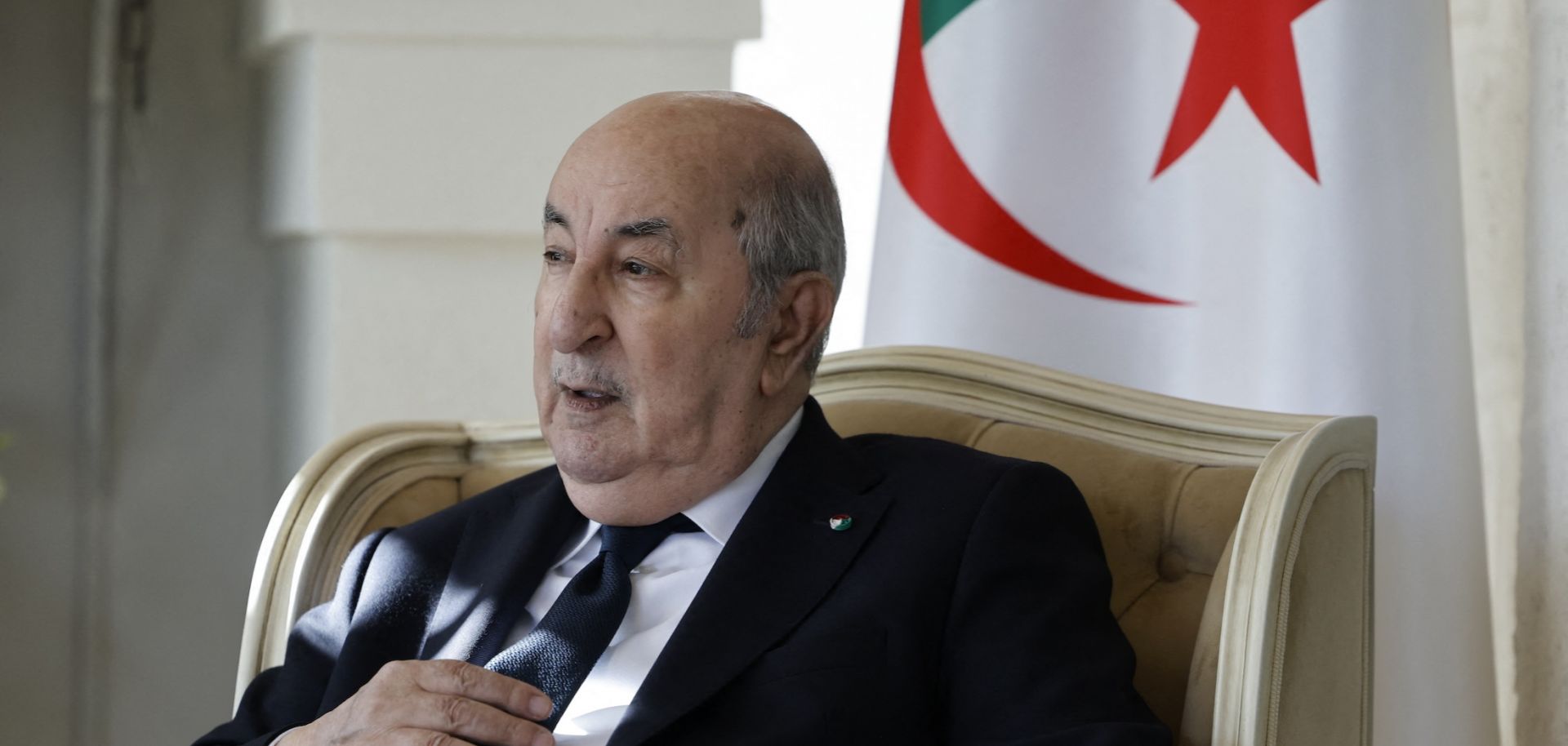
During his expected second term, Algerian President Abdelmadjid Tebboune will likely take a populist approach to foreign policy in the short term and reduce barriers to foreign investment, although he will likely remain averse to borrowing externally. The first round of the Algerian presidential election is scheduled for Sept. 7, with three candidates in the race: Tebboune (who is running as an independent candidate while holding membership in the center-left nationalist National Liberation Front, or FLN), Youcef Aouchiche of the center-left Socialist Forces Front, and Adelali Hassani Cherif of the Islamist Movement for Society and Peace. The Algerian constitutional court approved all three candidacies, though opposition candidates cited an "authoritarian climate," including alleged voter intimidation. Tebboune is widely expected to win a second five-year term due to backing from the Algerian military and several political parties, including the FLN, the National Democratic Rally, the El Bina Movement and El Moustakbal. He has campaigned primarily on achievements from his first term, such as recovery from COVID-19, social support services for vulnerable Algerians and economic reforms, and he has indicated the next legislature would prioritize the economy if he is reelected.
- On July 23, 11 prominent Algerian opposition figures published an open letter denouncing the election environment, citing crackdowns on freedom of expression through the intimidation of journalists and political opponents. There are also growing concerns that the state will cut advertising funding for media outlets critical of the Tebboune administration. Workers' Party leader Louisa Hanoune withdrew her candidacy in mid-July, citing "unjust," slow administrative processes that obstructed signature and endorsement collection.
- Under Algerian electoral law, if no candidate receives a majority of votes in the first round of the election, a second round of voting would be held 15 days after the constitutional court announces the first round's results.
- Algerian youth face a high unemployment rate of just under 31% in 2024, and since more than 44% of the population is under 25 years old, young Algerians' disenchantment with the political system could result in low voter turnout.
In Tebboune's first term, Algeria passed legislation reducing barriers to foreign investment and liberalizing the economy, but high global gas and oil prices reduced pressure on the Algerian government to implement more significant economic reforms. Tebboune was first elected president months after the ousting of former President Abdelaziz Bouteflika amid the Hirak movement protests from 2019 to 2021, which called for substantial social, political and economic reforms, including to democratic procedures and rule of law. Under Tebboune, Algeria has made some efforts to answer these demands by liberalizing the country's economy and removing barriers to foreign investment. With momentum from the 2019 hydrocarbons law revisions that passed a few months before Tebboune assumed office, Algeria passed the July 2022 foreign investment law, which aimed to increase investment flows, increase development into Algeria's natural resources and diversify Algeria's economy. Furthermore, in 2020, Algeria removed the requirement for new businesses to have 51% Algerian majority ownership; however, the rule remains for "strategic sectors," which include energy, mining and defense. Amid these reforms, Algeria's economy benefited from high global natural gas and oil prices following the 2022 Russian invasion of Ukraine, which decreased pressure for additional economic diversification efforts due to increased government revenue. However, global gas and oil prices have since declined, decreasing government revenue even as the government has increased spending on public wages and low-cost housing. This dynamic has increased Algeria's internal debt.
- In December 2019, Tebboune won the presidential election in the first round with over 58% of the votes in an election with a 39.9% voter turnout rate.
- According to the World Bank, Algeria's oil and gas production accounted for 19% of gross domestic product and 38% of government income between 2016 and 2021.
- Algeria's external debt-to-GDP ratio has remained relatively stable since the start of Tebboune's term, largely due to Algeria's aversion to external borrowing. In 2019, this ratio was 2.8%, and it increased to 3.2% by 2022.
The weeks leading up to the election will likely inflame nationalism and populist sentiment toward Western Sahara and the Palestinian Territories, but Algeria will restore its relations with France in the medium term. Ahead of the election and shortly afterward, Tebboune will likely appeal to Algeria's nationalistic voters and invoke the FLN's history as a champion of Algeria's independence movement and decolonization following France's July 30 recognition of Morocco's sovereignty claims over Western Sahara. As part of this appeal, Algeria will continue to obstruct deportations from France and possibly divert French flights over Algerian airspace. But in the medium term, Algeria will likely reinstate its ambassador to France and restore pragmatic, if strained, diplomatic ties due to robust trade relations, mutual interest in stabilizing the Sahel and historical precedence. In fact, Algeria's relations with France will likely follow a similar pattern as Algeria's gradual reconciliation with Spain after Spanish recognition of Morocco's Western Sahara sovereignty claims in 2022. Ahead of the election, Algeria will also contrast its foreign policies regarding the Israel-Hamas war with those of Morocco; Algeria will portray itself as a champion of the Palestinian cause through humanitarian aid efforts for Palestinians in Gaza and portray Morocco as "pro-Israel" since Morocco has normalized relations with Israel as part of the Abraham Accords. To push this point further, Algeria will likely use its impermanent position on the U.N. Security Council to support resolutions aiming to curtail Israel's military actions in the Gaza Strip and advocate for increased humanitarian aid and civilian protections for Palestinians through June 2025, when its two-year term ends.
- Algeria recalled its ambassador to France following Paris' decision to recognize Morocco's sovereignty claims, and during the week of Aug. 12, Algeria began to block deportations of Algerian citizens from France.
- During a campaign stop in Constantine, Tebboune pledged to build three field hospitals for Palestinians in Gaza within 20 days of the Egypt-Gaza Rafah border crossing reopening.
During Tebboune's probable second term, Algeria will very likely support some additional economic reforms to liberalize the economy and remove barriers to foreign investment, but the country remains unlikely to borrow externally. Tebboune's second-term administration will likely adopt additional legislation to incentivize foreign investment to drive economic growth. However, his administration is unlikely to remove the 51% ownership rule for strategic sectors due to national security concerns and to ensure Algeria maintains majority ownership of the sectors that bolster its economy, such as energy and mining. Meanwhile, Algeria's internal debt will likely rise, as the government will likely increase public spending on salaries and additional low-income assistance initiatives even though government revenue is unlikely to increase proportionally amid lower global oil and gas prices. As a result, Algeria will likely face pressure to implement additional economic reforms and will consider three options to cover an extended period of budget deficits. The most likely option would be for Algeria to increasingly rely on debt monetization, as it did in 2017. This strategy would enable Algiers to maintain economic and foreign policy autonomy without the requirements attached to external borrowing, but it would risk worsening Algeria's inflation rate and drawing down its foreign exchange reserves to pay for imports. Already, Algeria's foreign exchange reserves have decreased from a high of $192 billion in 2013 to $67 billion in 2024. The drawdown on exchange reserves would likely pressure Algiers to cut imports, leading to some product shortages, and in the long term would likely prove unsustainable. As a result, this strategy would eventually put additional pressure on Algiers to borrow externally or cut public spending, such as by scaling back subsidies, which would worsen the quality of life for Algerians. Alternatively, Algeria could enter negotiations with the International Monetary Fund for a loan. However, the country's previous experience with the IMF and disagreements over loan conditions, such as external borrowing, would likely make this option politically unpalatable and therefore unlikely. In a final scenario, Algiers could reach a bilateral agreement with a Gulf country, like Saudi Arabia or the United Arab Emirates, but such an agreement would constrain Algeria on matters relating to Morocco and Tunisia since Saudi Arabia and the United Arab Emirates have closer ties with both countries. Pressure on Algiers to borrow externally would likely increase if debt monetization significantly raised inflation rates and worsened the quality of life for Algerians, a scenario that could spark widespread unrest.
- Algeria's aversion to foreign borrowing and financing stems largely from the "Black Decade" of the 1990s, when a deal with the IMF required Algiers to restructure its external debt through measures including the devaluation of the dinar, privatization of state-owned enterprises and job cuts. These measures improved Algeria's economy but worsened the standard of living for many Algerians.
- The IMF forecast that Algeria's gross debt-to-GDP ratio will continue to increase from 46.4% to 59.5% between 2024 and 2029.
- According to World Bank data, inflation in Algeria has increased throughout Tebboune's first term; in 2019, annual inflation was at 2% and rose to 9.3% in 2023. The inflation rate will likely worsen if Algiers relies on debt monetization to finance its budget deficits.
Social, political and economic grievances will likely persist throughout Tebboune's expected second term, especially among young generations, but suppression and small concessions will likely quell localized protests. Young Algerians are particularly likely to continue to experience high levels of unemployment in the absence of substantial economic growth and diversification efforts that would create more employment opportunities. Frustrations over a lack of economic opportunities compounded with recurring allegations of corrupt political elites and a lack of transparency from the influential military could result in localized protests. However, these protests would be unlikely to spread nationwide like the 2019-21 Hirak movement due to government suppression. Additionally, small concessions to address grievances — such as measures to improve transparency and increased public spending for vulnerable Algerians — will likely further quell localized protests. Even so, significantly deteriorating economic conditions and unified goals could lead to a resurgence of a broader movement.
- The Hirak movement largely dissolved during the COVID-19 pandemic due to protesters' inability to mobilize and organize safely amid public health concerns. Since then, crackdowns on journalists and government critics have impeded and disincentivized activists to reorganize the movement.
