
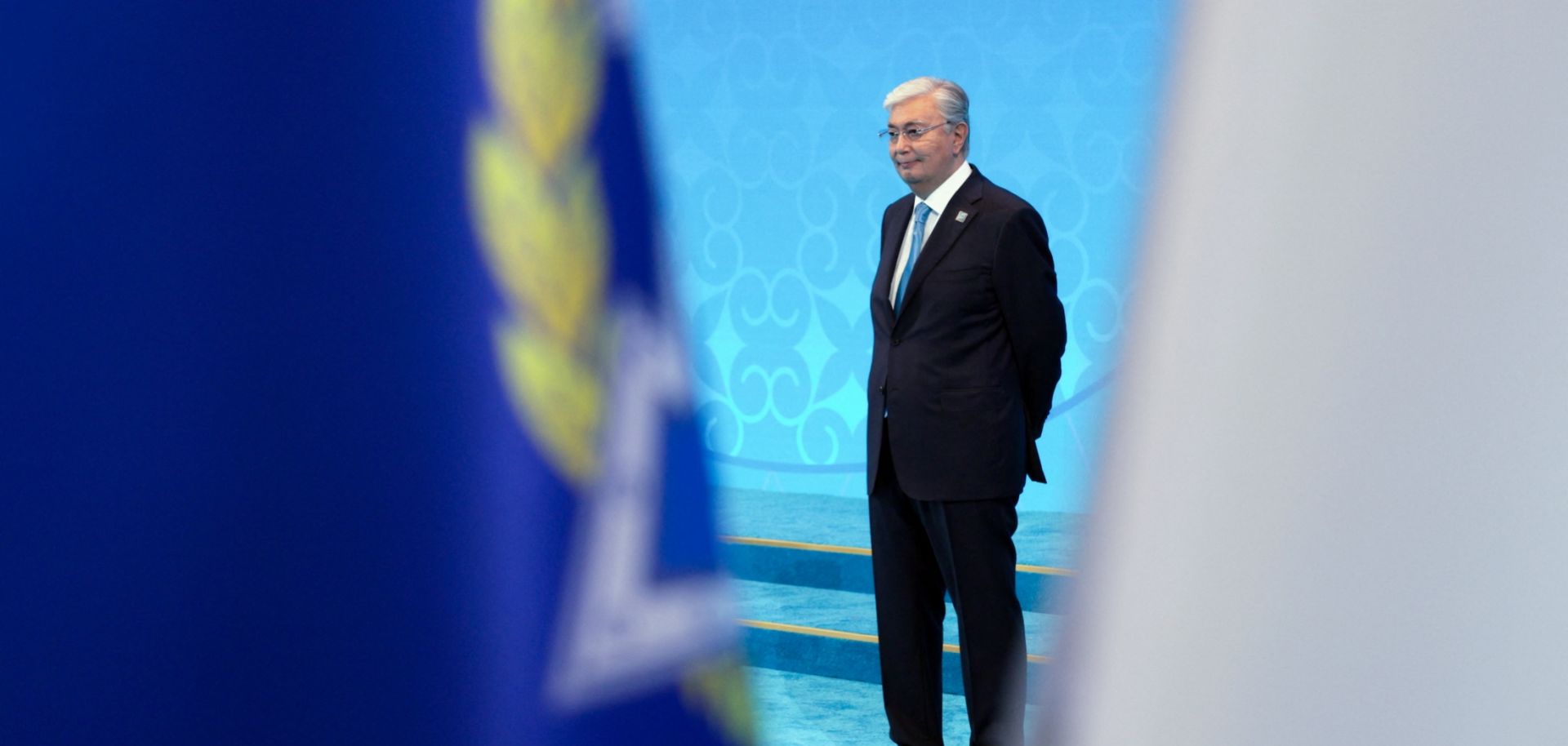
Kazakhstan will likely take further steps toward economic liberalization in the years ahead to attract foreign investment, but the country's close economic and political ties with Russia and China (even while preserving its geopolitical balancing strategy) will likely limit foreign investment. On Aug. 7, Kazakh President Kassym-Jomart Tokayev signed a decree approving Kazakhstan's national economic development plan from 2024 to 2029. The plan's stated goal is to overcome the "middle-income trap" and form a solid institutional and socio-economic foundation to secure Kazakhstan in the cohort of high-income countries. The plan emphasizes increasing investments in fixed capital and boosting the production of high- and medium-value-added goods, thereby moving Kazakhstan away from reliance on raw material exports, which in 2023 constituted more than 15% of Kazakhstan's gross domestic product and around 70% of exports. The plan proposes reforming the economy in adherence to five broad pillars, namely economic liberalization to stimulate competition and enhance Kazakhstan's global competitiveness, developing a culture of entrepreneurship with predictable and attractive policies for investors, improving Kazakhs' education to create a more skilled and productive workforce, prioritizing the modernization and digitalization of key industries, and preventing large gaps in economic development conditions between regions to ensure each has a degree of economic self-sufficiency. However, the plan is also deliberately vague, declining to provide a comprehensive list of measures the government will take in the coming years. This lack of detail intimates the document's likely primary purpose — to stimulate domestic investment, slow capital flight and attract foreign investors by somewhat exaggerating the government's expected pace of economic liberalization in the years ahead.
- The plan notes that Kazakhstan's previous strategy for economic growth based on raw material exports is no longer proving as effective as in previous decades, as the country's average annual GDP growth rate has slowed to just 5% in 2023 after years of much higher growth rates. The European Bank for Reconstruction and Development forecast that Kazakhstan's GDP growth rate will slow to 4.5% in 2024.
- Moreover, the plan notes that Kazakhstan is among the top 20 countries in terms of greenhouse gas emissions, and its resource extraction economy has dealt significant damage to the environment and contributed to climate change, which poses disproportionate risks to Kazakhstan. The plan therefore devotes significant attention to "green" development in line with the United Nations' 17 Sustainable Development Goals.
- The plan includes some concrete measures intended to demonstrate fiscal responsibility to potential foreign investors. The government committed to gradually reduce the non-oil deficit relative to GDP from over 8% to 5.5% by 2029, while the share of budget expenses for servicing government debt should be at most 10% of the total national budget expenditure until 2029.
Kazakhstan will likely allow some privatizations over the next five years, though a desire to preserve political and economic stability will slow reform and prevent a large increase in the country's attractiveness to most foreign investors. Ever since his reelection to another seven-year term in November 2022, Tokayev has insisted that he is focused on implementing reforms to establish a fairer economic system in Kazakhstan. However, there were no major economic reforms in 2023, which Tokayev attributed to the government still being in crisis management mode amid the need to adapt to changes in global and regional trade flows following Russia's 2022 invasion of Ukraine. The government reaffirmed its commitment to reform this February when Tokayev named the former head of Kazakhstan's anti-corruption agency as the country's youngest-ever prime minister and partially privatized Kazakhstan's national airline, Air Astana, by listing a portion of its shares on the London Stock Exchange. The government has since made additional concrete steps toward reducing the state's outsized role in the economy, phasing out state subsidies for gas, utilities and some food products. While further steps are likely, most notably through privatizing the country's many state-owned enterprises (SOEs), the pace of reforms will likely be slow, as the government fears a fast pace of reform could destabilize the economy. Destabilization would anger elites and common citizens alike and fuel demands for political liberalization to accompany lifting economic restrictions, which the government believes could risk contributing to a repeat of the sudden unrest that swept the country in January 2022.
- Since Kazakhstan gained independence from the Soviet Union in 1991, the government has played an oversized role in the Kazakh economy, leaving little space for foreign businesses to gain a foothold in key sectors. According to Kazakhstan's National Statistical Bureau, the government in 2022 owned over 25,000 SOEs, which benefit from greater access to subsidies and other government support. According to the Organization for Economic Cooperation and Development, SOEs constitute between 30% and 40% of Kazakhstan's GDP, with some estimates putting the number closer to 50% considering fluctuations in commodity prices. These SOEs have a checkered popular reputation of existing not to benefit the Kazakh people, but to provide job security and large compensation to elites, who then support Kazakhstan's ruling authoritarian regime.
One of the most important factors in determining Kazakhstan's attractiveness to investors will be the trajectory of its foreign policy, as overreliance on Russia and China would make Western businesses less likely to invest in Kazakhstan. While a slow but steady pace of reforms intended to ease doing business in the country could attract some foreign investment, the more important factor affecting the interest of major foreign investors will be the evolution of Kazakhstan's foreign relations with Russia and, to a lesser extent, China. Overreliance on trade and political ties to either country would threaten Kazakhstan's reform agenda, as Russia and China would likely oppose reforms forcing their firms to face greater competition from Western companies and increasing the reputational and compliance risks related to business in Kazakhstan, particularly amid U.S. sanctions on Russia and worsening U.S. relations with Moscow and Beijing. As Kazakhstan's 2029 economic development plan is likely unachievable without continued access to outside investment and Western capital markets, the Kazakh government will likely preserve its current geopolitical balancing strategy and avoid overreliance on Russia and China, diluting their influence through trade and strategic partnership agreements with outside powers. For instance, Kazakh officials discussed enhancing their strategic partnership with the United States in May.
- Against this backdrop, potential investors will closely watch a national referendum on allowing nuclear power in Kazakhstan that Tokayev said will take place this fall, though the exact date has not been announced. The referendum will likely pass amid power shortages in the country but will turn attention to which nation's nuclear power company Kazakhstan will award the tender to construct the country's first nuclear power plant. While Russia's Rosatom is heavily favored to win, France's Electricite de France and South Korea's Korea Hydro and Nuclear Power both made the final shortlist to receive the construction contract, as did China's China National Nuclear Corp. The selection of the Russian or Chinese bidders would be a sign of the government's intention to preserve long-term relations with Russia and China, increasing investment risks, while the selection of the French or South Korean companies, while unlikely, would be seen as evidence of the Tokayev government's resolve to liberalize the country's economy further and open it to influence from outside powers.
